|
(This was a Road Scholar trip from
Nice to Paris with an emphasis on art. Pre-COVID we had taken one
from Paris to Normandy and enjoyed it - when we finally were able to
travel again, we wanted to do the second half! This
section of the trip log
includes our arrival, our initial days in Nice and the surrounding
area, a day in Aix-en-Provence and meeting our riverboat in
Martigues.
You can enlarge any picture in this narrative by
clicking on it - it
will open in a separate window and in many cases, show detail you can't
see in the smaller version. Many more pictures are here.)
Sunday May 1 - Tuesday May 3 We drove up to Minneapolis Sunday afternoon, got the car settled into its parking space at Dave's (who kindly lent us a spot in his driveway for 2 weeks), then had supper with Katie and George at their condo. Katie took us to the airport around noon on Monday. The COVID rules of masks on all planes and in airports were still in effect; each country has its own rules about what you need for entry. We were going to Schiphol on an overnight flight then connect to Nice Tuesday afternoon. We got there in plenty of time because we weren't sure what forms we might need to fill out. It turns out that all they needed was to see our vaccine cards so we had time for lunch! We weren't happy with the timing of the flight - it was too early in the afternoon to really give us a chance to sleep. But we did splurge for Priority Select seating, giving us a little more legroom and recline. The flight was totally full, including a group of 57 college choir students setting off on a European tour but it went well. The served supper was pretty good, there were lots of snacks and drinks offered and we had a pre-arrival breakfast in the morning.  The
authorities in Netherlands didn't want anything from us except to
stamp our passports. Even though we were continuing on to a
different country, it was still in the EU, so they didn't make us pick
up our luggage and recheck it like we are used to doing in the USA if
we have a connecting flight. The one odd thing we learned about
Schiphol (we had not noticed before because we never connected there)
is that it is divided in two halves: the EU side and the "everywhere
else" side. To get between the two you have to go through
Passport control, which isn't very threatening but there are
lines. So, we came in on the "everywhere else" side and were
connecting to an EU country so had to change sides. Not a big
deal. The Nice flight was delayed so we had several hours to kill
and decided to go visit the airport site of the Rijksmuseum.
What a great idea - except that we were now on the EU side and the
museum was on the "other" side and we couldn't get from one place to
the other without waiting in line for Passport Control! We could go back and forth as often as
we wanted to, collecting passport stamps, but it meant going through
the line each time. The
authorities in Netherlands didn't want anything from us except to
stamp our passports. Even though we were continuing on to a
different country, it was still in the EU, so they didn't make us pick
up our luggage and recheck it like we are used to doing in the USA if
we have a connecting flight. The one odd thing we learned about
Schiphol (we had not noticed before because we never connected there)
is that it is divided in two halves: the EU side and the "everywhere
else" side. To get between the two you have to go through
Passport control, which isn't very threatening but there are
lines. So, we came in on the "everywhere else" side and were
connecting to an EU country so had to change sides. Not a big
deal. The Nice flight was delayed so we had several hours to kill
and decided to go visit the airport site of the Rijksmuseum.
What a great idea - except that we were now on the EU side and the
museum was on the "other" side and we couldn't get from one place to
the other without waiting in line for Passport Control! We could go back and forth as often as
we wanted to, collecting passport stamps, but it meant going through
the line each time. So, we got some Euros at an ATM, found a nice lounge area with couches, had a good lunch and dozed a little bit until it was time to go track down the gate. After 2 gate changes and one "what happened to the exit row seats I paid for to get the extra space?" we did finally get to the right gate, they accepted the receipt for the seats I had on my phone and reinstated us in the exit row. The 2 hour flight was fine and they gave us sandwiches which turned out very helpful since we were too tired to go out to eat once we got there. Since it was all EU we didn't have any additional immigration issues. They did ask us to fill out a France "declaration of vaccination" but then nobody wanted it. Cabbed to the hotel (40€ - if we hadn't been totally exhausted we could have taken the tram and then walked a few blocks for only 3€) Best Western Plus Hotel Masséna, got checked in and slept for 12 hours! We purposely arrived a day before the tour started so we had some jet-lag recovery time! Wednesday May 4  The hotel room was very small -
there was a small closet for hanging
things up and a mini-fridge but no drawers or shelves. John was
happy that there was a bathtub so he could enjoy a soak later in the
week. The WiFi didn't reach to our room, but we did have good
reception in the stairwell and the lobby. The breakfast at the
hotel was very nice: eggs, fruit, crepes, yogurt, many croissants and
pastries along with cheeses and meat. The hotel room was very small -
there was a small closet for hanging
things up and a mini-fridge but no drawers or shelves. John was
happy that there was a bathtub so he could enjoy a soak later in the
week. The WiFi didn't reach to our room, but we did have good
reception in the stairwell and the lobby. The breakfast at the
hotel was very nice: eggs, fruit, crepes, yogurt, many croissants and
pastries along with cheeses and meat. After breakfast we just meandered down to the Promenade des Anglais that runs for miles along the Mediterranean. It was begun in 1822 as a place for the wealthy (mostly British, hence its name) to enjoy seeing and being seen. It is lined with benches and chairs, assorted sculptures and murals. On the left is the Apollo statue at the Fontaine du Soleil that we passed on the way to the beach. Below, left, is part of the Promenade - the street view is much like Mexico or Florida or any other semi-tropical area. The beaches are rock, not sand, so they are pleasant to view but looked like a twisted ankle to me so we just walked on the Promenade and enjoyed the views!    We came back along Rue de France and Place Masséna, browsing the different shops and sites. We enjoyed the unique sculpture of the Holy Family in front of Église Saint Pierre d'Arène (left below), the typical city streets (center) and the produce shops (tomatoes on the right)! We stopped for lunch at O'Palermo on rue de Masséna - John had Salad Niçoise (seemed appropriate for a first meal in Nice!) and I had a very cheesy penne and eggplant casserole.    In the late afternoon we had our Road Scholar orientation, met Jamil who will be our group leader and introduced ourselves to everyone. We have 2 groups of 20-something each, and one of the leaders got ill at the last minute; Jamil is a very experienced, very fun, semi-retired guide and was recruited to fill in, but he doesn't have much art background so we will have "local guides" for many of the places we visit. We went to dinner at Lou Balico, walking distance from the hotel. We were only about a block from the hotel when one of our group fell in the street! Fortunately, it looked worse than it was - she was unconscious and lots of blood. Ambulance was called - leader and her roommate went with her, the rest of us went on to the restaurant. She was stitched up, declared concussed but released later that night. She rested for a couple of days but was back up and participating when we left Nice. What a way to start out! We were introduced to a new dessert - tourte aux blettes, a Provencial specialty. I had to look that up - turns out it is a swiss chard/ apple (or pear) tart and it was very good!! Definitely will have to try it out at home since we grow swiss chard! Thursday May 5 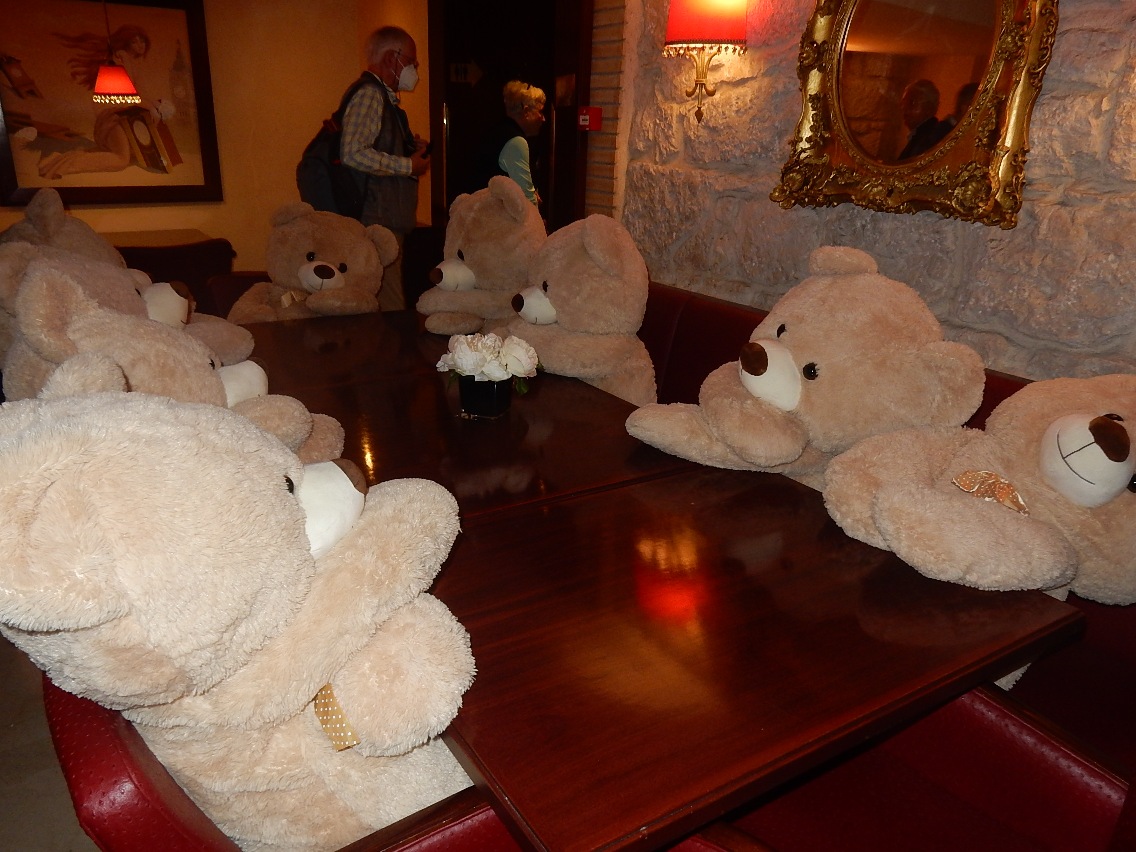  Today we first met at the Hotel Aston la Scala
(at left is a picture of the Teddy Bear room we passed through and
found amusing) to have our introduction to French art by Christine, who
was our local guide for the first few days. We were her first
group since Covid and she was excited to work and speak English
again - she was very good! We had a bus tour of the Nice area,
passing this new library administration building (on the right), known
as the "Square Head" designed by Sasha Sosno, and visited a number of
tourist sites. Today we first met at the Hotel Aston la Scala
(at left is a picture of the Teddy Bear room we passed through and
found amusing) to have our introduction to French art by Christine, who
was our local guide for the first few days. We were her first
group since Covid and she was excited to work and speak English
again - she was very good! We had a bus tour of the Nice area,
passing this new library administration building (on the right), known
as the "Square Head" designed by Sasha Sosno, and visited a number of
tourist sites. In the vicinity of the Matisse Museum, we saw the Cimiez Monastery (left below) and cemetery, walked through the old Roman Ruins of Cemenelum (center below) and saw the Calder Mobile (right) in front of the museum. We seem to run into that a lot - a Calder outside of many museums and galleries. Wonder if there is a list of them somewhere!    The museum was quite interesting as we saw the many different types of artwork Matisse produced over the years. I hadn't realized he was a sculptor as well as a painter. Below is the sculpture "Le Serf" - he originally completed this with full arms, then decided, to emphasize his slave status, to remove the arms. In the center and the right are two quite different styles of painting: "The Courtyard of the Old Mill" (1898) that is a typical Impressionist painting and then "Figure à L'Ombrelle" which is very pointilist (1905).      At
the left is an example of the sort of work he did in his later
years. He got into "cut outs" for many different purposes.
This particular work is a stained glass template for use in his chapel
which we will visit on Friday. On the right side is the only
group picture we have - taken on the patio outside the Matisse Museum
(we were wearing covid-19 masks indoors most of the time but not
outside). I think we were missing a few people, but most of us
were there! At
the left is an example of the sort of work he did in his later
years. He got into "cut outs" for many different purposes.
This particular work is a stained glass template for use in his chapel
which we will visit on Friday. On the right side is the only
group picture we have - taken on the patio outside the Matisse Museum
(we were wearing covid-19 masks indoors most of the time but not
outside). I think we were missing a few people, but most of us
were there! 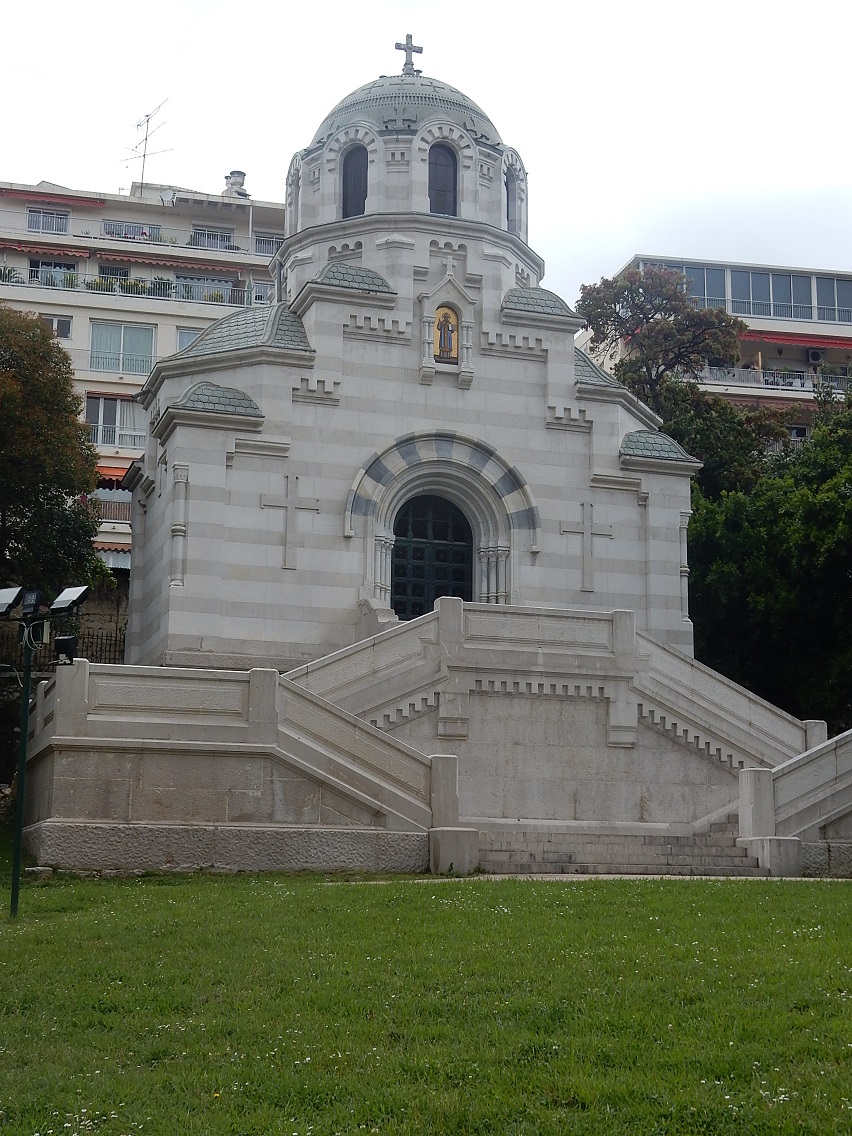 We had lunch at La Vigna
which is at the marina, so we also got to see that section of the
town. While the food was fine (especially the wonderful
strawberries) they apparently were not used to having large groups and
they did a very poor job of getting us all served in a timely
way. After lunch we stopped at the Cathédral Saint-Nicolas de
Nice, a very elaborate Russian Orthodox Church (left) and we also saw
the Chapelle du Tsarevich (right) at the same location - in memory of
Nicolas who was the son of Tsar Alexander II and died at age 21 in
Nice. We had lunch at La Vigna
which is at the marina, so we also got to see that section of the
town. While the food was fine (especially the wonderful
strawberries) they apparently were not used to having large groups and
they did a very poor job of getting us all served in a timely
way. After lunch we stopped at the Cathédral Saint-Nicolas de
Nice, a very elaborate Russian Orthodox Church (left) and we also saw
the Chapelle du Tsarevich (right) at the same location - in memory of
Nicolas who was the son of Tsar Alexander II and died at age 21 in
Nice. Finally, we went to the Musée Nationale Marc Chagall that holds the series of paintings that make up his "Biblical Message." (I have those in the "photos only" section on this site.) Christine was very informative here, showing us some of the symbolism in each and how they were related. Just as an example, at the left below is the one showing Adam and Eve being banished from Paradise. You can readily see how some help identifying all of the details would be useful!   We
were pretty exhausted by the time we got back to the hotel - that was
clearly a very long day! They gave us vouchers for 20€ each so
that we could have supper wherever we wanted to. John and I went
to Pizza
Cresci
(on Place Masséna, close to the hotel) - just in time, because they got
quite crowded not long after we arrived (right around 7 PM).
Great food, large servings, reasonable cost. They even gave us change
from our vouchers (which they really aren't supposed to do) that then
paid for our desserts at Gelateria Pinocchio down the street! We
were pretty exhausted by the time we got back to the hotel - that was
clearly a very long day! They gave us vouchers for 20€ each so
that we could have supper wherever we wanted to. John and I went
to Pizza
Cresci
(on Place Masséna, close to the hotel) - just in time, because they got
quite crowded not long after we arrived (right around 7 PM).
Great food, large servings, reasonable cost. They even gave us change
from our vouchers (which they really aren't supposed to do) that then
paid for our desserts at Gelateria Pinocchio down the street! Friday May 6  This morning we started out
walking to Old Town. John had ordered a pair of souvenir
cranberry slacks a few days ago and had to go pick them up as we left,
but he caught up with us before we did anything significant! One
of the interesting landmarks we passed was a hotel with a "fake" side
(on the right above). This morning we started out
walking to Old Town. John had ordered a pair of souvenir
cranberry slacks a few days ago and had to go pick them up as we left,
but he caught up with us before we did anything significant! One
of the interesting landmarks we passed was a hotel with a "fake" side
(on the right above).  That is all painted on - no
windows, no balconies, no shadows... just a flat side of the
building skillfully painted! We noticed that, while the chairs
along the promenade
were typically light blue, today there were also red and black
ones. That was in honor of the French football (soccer) finals
being played this weekend between Nice and Nantz (Nice lost).
There was also an enormous screen set up in the park so everybody could
come watch the televised match. That is all painted on - no
windows, no balconies, no shadows... just a flat side of the
building skillfully painted! We noticed that, while the chairs
along the promenade
were typically light blue, today there were also red and black
ones. That was in honor of the French football (soccer) finals
being played this weekend between Nice and Nantz (Nice lost).
There was also an enormous screen set up in the park so everybody could
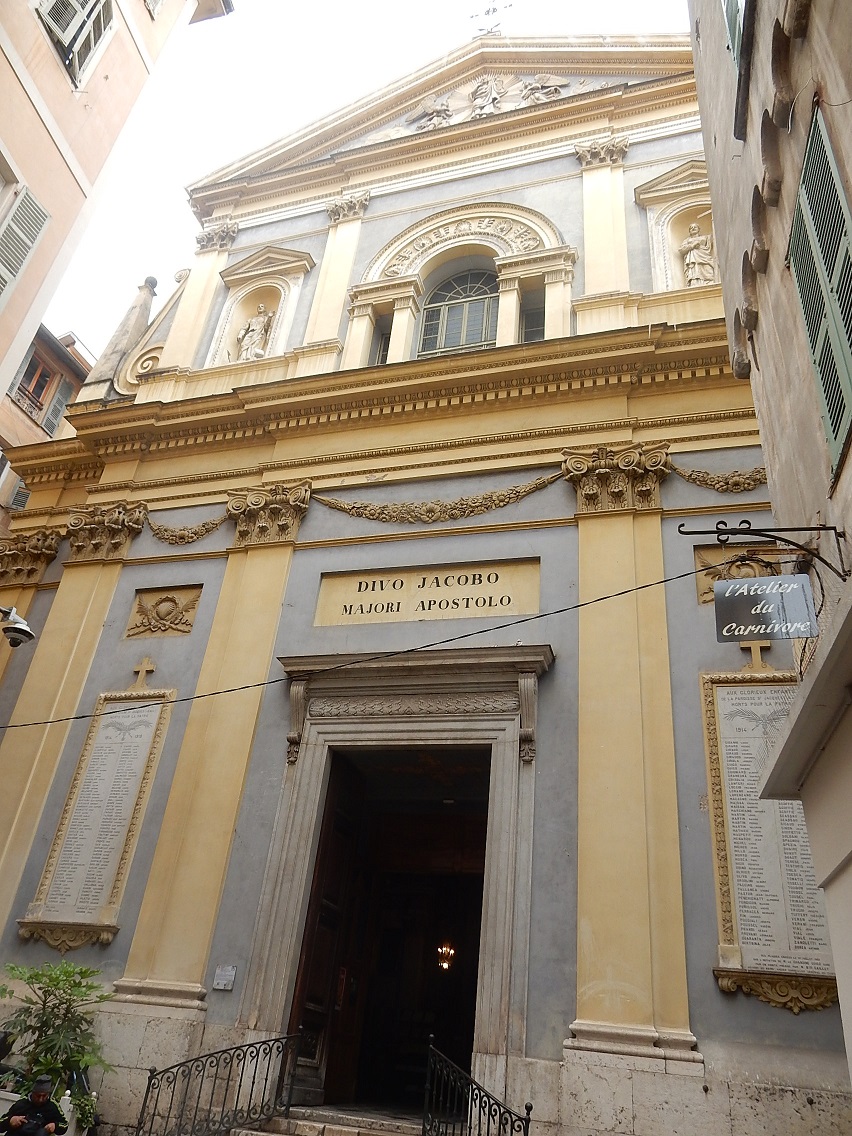
come watch the televised match.We passed the mini statue of liberty in the back of the Opera House (a gift from the USA to Nice in 2014) on the way to Èglise St Jacques-le-Majeur de Nice aka Church of the Gesù, a baroque church from the 17th century that was inaugurated as a Roman Catholic parish in 1802. John, along with Mark and Vivian Fischer, sang for us for a few minutes, taking advantage of the wonderful acoustics. Christine also pointed out the pulpit with a "third arm" which was apparently not uncommon at that time, but was new to me! At the right, below, see the picture with the arm sticking out, holding a crucifix!
Next we had free time to wander the Old Town Market for a while - we bought some Herbes de Provence, some local honey and a couple other bags of dried herbs, but mostly just gawked at all of the lovely produce. This market used to be known particularly for the flowers - it was called Marché aux Fleurs Cours Saleya, but there are very few flower merchants left as many of the local growers have sold off their fields of flowers to developers who want to use the land for construction projects and a higher return on investment. Kind of sad. There was also art and other souvenirs available but the food was the big attention getter for me!      After our market time, we met our bus and went off to Saint-Paul-de-Vence,
a small, walled town that bills itself "a village of art and
history." To the left, you can see it from the road as we
approach it. There is a nice restaurant - Cafe de la Place - just outside the wall (portion
of the wall at right) and that's where we had lunch. We watched a
group of men playing boules for a bit then had free time to explore the
town. It was an interesting mix of the old and the new.
There is an observation point at the "top" and an old cemetery where
Chagall is buried, but it is still in use: there were graves as recent
as 2021. Many shops were scattered throughout, mostly leaning
towards arts of various kinds - but we managed to find a gelateria,
too! At the left below is one of the picturesque little side
streets; in the center is a picture of a portion of the cemetery and
you can see the Mediterranean Sea in the upper left corner; on the
right is a contrast of the old and the new! After our market time, we met our bus and went off to Saint-Paul-de-Vence,
a small, walled town that bills itself "a village of art and
history." To the left, you can see it from the road as we
approach it. There is a nice restaurant - Cafe de la Place - just outside the wall (portion
of the wall at right) and that's where we had lunch. We watched a
group of men playing boules for a bit then had free time to explore the
town. It was an interesting mix of the old and the new.
There is an observation point at the "top" and an old cemetery where
Chagall is buried, but it is still in use: there were graves as recent
as 2021. Many shops were scattered throughout, mostly leaning
towards arts of various kinds - but we managed to find a gelateria,
too! At the left below is one of the picturesque little side
streets; in the center is a picture of a portion of the cemetery and
you can see the Mediterranean Sea in the upper left corner; on the
right is a contrast of the old and the new!
  Our next stop was at the Chapelle du
Rosaire (Rosary Chapel) that Matisse
created (1947-51) as a tribute to the Dominican nun (Monique Bourgeois,
later Sister Jacques Marie) who had been a
companion to him and nursed him after his cancer surgery and before she
entered the convent. No photographs were permitted in the chapel
itself but the hallways that lead to the gift shop serve as a sort of
museum showing many of his studies in preparation for a final piece and
photos of him working on the
chapel. The size of the murals meant that he did much of the
drawing and painting using a long pole (at left). To the right is
the garden behind the chapel, adjacent to the convent. Our next stop was at the Chapelle du
Rosaire (Rosary Chapel) that Matisse
created (1947-51) as a tribute to the Dominican nun (Monique Bourgeois,
later Sister Jacques Marie) who had been a
companion to him and nursed him after his cancer surgery and before she
entered the convent. No photographs were permitted in the chapel
itself but the hallways that lead to the gift shop serve as a sort of
museum showing many of his studies in preparation for a final piece and
photos of him working on the
chapel. The size of the murals meant that he did much of the
drawing and painting using a long pole (at left). To the right is
the garden behind the chapel, adjacent to the convent.The final visit of the day was at the Fondation Maeght, also in the Vence area. This private collection, founded by Marguerite and Aimé Maeght, contains examples of contemporary art of all types. Also on the property is a small chapel dedicated to Saint Bernard in memory of their son, Bernard, who died at age 12 of leukemia. At left is "The White Bird," a stained glass window in the chapel by Georges Braque.   On the right is a portion of the
sculpture
garden showing "La Montagne" by Germaine Richier and "Les Renforts" by
Alexander Calder (in the back). Another Calder "Les Trois
Soleils Jaunes" (3 yellow suns) is shown below as seen from an open
balcony, with a painting
"L'été" (Summer) by Pierre Bonnard. On the right is a portion of the
sculpture
garden showing "La Montagne" by Germaine Richier and "Les Renforts" by
Alexander Calder (in the back). Another Calder "Les Trois
Soleils Jaunes" (3 yellow suns) is shown below as seen from an open
balcony, with a painting
"L'été" (Summer) by Pierre Bonnard.  The largest and most
interesting outdoor installation at the Fondation is "Labyrinth" by
Joan Miro. It is a collection of sculptures and ceramics designed
especially for this location. Here are just a few of the parts of
this "walk through" work of art - there are 250 individual works in
total!
We sadly said goodbye to Christine
since this was our last day with her. We had dinner tonight at Marcel Bistro
Chic which was in Old Town, walking distance from the hotel.
I
particularly enjoyed the créme de flambé for dessert! Saturday, May 7
Moving
on, here are a few of the fountains scattered through town. The
Fontaine des Augustins (left) was originally built in 1620. The
Fontaine de la Rotonde in the center, built in 1860, is topped by three
figures representing Justice, Agriculture and Fine Arts. The
Fontaine des Quatre Dolphins, the first free-standing fountain in the
city, dates from 1667.
Finally the bus took us to Martigues where our riverboat was waiting in the marina (left below). Road Scholar booked the whole boat for our two groups so it was delightful to have plenty of room! We boarded the MS Camargue (right below), got oriented, met the crew and staff, had a great supper, learned how to set the thermostat to a good sleeping temperature (roughly 15ºC) and slept well! The trip continues in Part 2. 
 Click here to
continue with Part 2 of the France Trip |