|
Sunday May 8 -
  After our first night's sleep on the
CroisiEurope river boat MS
Camargue, we had a nice buffet breakfast and set off on the bus for our
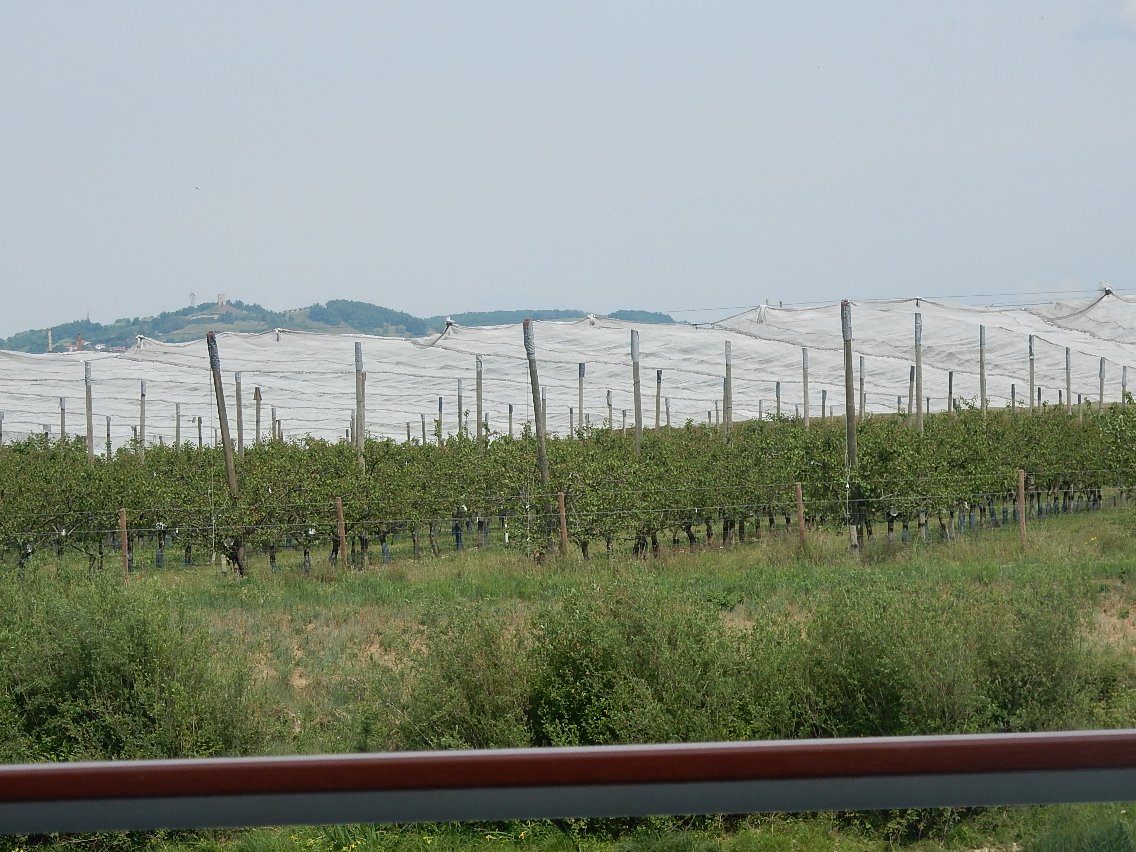
morning tour. The first picture on the left was taken out of the
bus so not very clear but it was a vineyard with poppies planted
between the rows - really striking! Our first stop was at "Les
Antiques" where the Roman road Via Domitia (the first one that went
through Gaul, commissioned about 120 BC) passed over the Alpilles to
what was then Glanum (a large and wealthy city) and is now close to
Saint-Remy-de-Provence. The archway here (John and Kerry shown
admiring it on the lower left) was the welcome into Glanum and has been
estimated to have been constructed about 20 AD. After our first night's sleep on the
CroisiEurope river boat MS
Camargue, we had a nice buffet breakfast and set off on the bus for our
morning tour. The first picture on the left was taken out of the
bus so not very clear but it was a vineyard with poppies planted
between the rows - really striking! Our first stop was at "Les
Antiques" where the Roman road Via Domitia (the first one that went
through Gaul, commissioned about 120 BC) passed over the Alpilles to
what was then Glanum (a large and wealthy city) and is now close to
Saint-Remy-de-Provence. The archway here (John and Kerry shown
admiring it on the lower left) was the welcome into Glanum and has been
estimated to have been constructed about 20 AD.  Amazingly,
except for the "roof" of the arch that was restored in the 18th
century, the rest of the structures are as they were found. The
monument (at the right) dates to circa 40 BC and appears to be in honor
of the forebears of three Julii brothers (inscriptions are actually
still legible). Our guide said it was not a sarcophagus - no
bodies were buried here, it was just a mausoleum. However, others
insist that the parents are indeed entombed here. In any case,
there are effigies of 2 people at the very top and friezes all around
the lowest of the three stages of the structure, showing scenes from
the Trojan War, other battles and hunts, for example. Pretty
impressive when you realize these are 2000 years old! Amazingly,
except for the "roof" of the arch that was restored in the 18th
century, the rest of the structures are as they were found. The
monument (at the right) dates to circa 40 BC and appears to be in honor
of the forebears of three Julii brothers (inscriptions are actually
still legible). Our guide said it was not a sarcophagus - no
bodies were buried here, it was just a mausoleum. However, others
insist that the parents are indeed entombed here. In any case,
there are effigies of 2 people at the very top and friezes all around
the lowest of the three stages of the structure, showing scenes from
the Trojan War, other battles and hunts, for example. Pretty
impressive when you realize these are 2000 years old! From
here, we walked a short way to the Maison de Santé Saint-Paul de
Mausole (front door at left; cloister at right), the From
here, we walked a short way to the Maison de Santé Saint-Paul de
Mausole (front door at left; cloister at right), the  mental
hospital where Vincent Van Gogh lived from 1889-90 and where he
completed 143 paintings, many drawn from the scenery in the area.
Some of the rooms have been restored to the condition when Van Gogh
lived there so we could "feel" what he seeing; the gardens include many
of the plants that he painted - chestnut trees, roses, irises.
Below are a view of the field he saw from his upstairs window
(reminiscent of some of his painting); a bronze sculpture of Van Gogh
by the Dutch sculptor Gabriel Sterk, in front of a very aromatic
flowering chestnut tree; and a stand of irises like those that appear
in a number of Van Gogh paintings. mental
hospital where Vincent Van Gogh lived from 1889-90 and where he
completed 143 paintings, many drawn from the scenery in the area.
Some of the rooms have been restored to the condition when Van Gogh
lived there so we could "feel" what he seeing; the gardens include many
of the plants that he painted - chestnut trees, roses, irises.
Below are a view of the field he saw from his upstairs window
(reminiscent of some of his painting); a bronze sculpture of Van Gogh
by the Dutch sculptor Gabriel Sterk, in front of a very aromatic
flowering chestnut tree; and a stand of irises like those that appear
in a number of Van Gogh paintings.    We had lunch back on the ship and then a lecture about
Van Gogh which,
I confess, I skipped to have a short nap and watch out our big "patio
doors" as we travelled on the Rhône to Arles. Our beds were
facing the floor-to-ceiling doors so it was very pleasant to lie there
and watch the world go by! I have lots of river pictures later on
so I won't post many of them now but we were watching a gray heron
following alongside the boat for a while. He appeared as
interested in us as we were in him! We had lunch back on the ship and then a lecture about
Van Gogh which,
I confess, I skipped to have a short nap and watch out our big "patio
doors" as we travelled on the Rhône to Arles. Our beds were
facing the floor-to-ceiling doors so it was very pleasant to lie there
and watch the world go by! I have lots of river pictures later on
so I won't post many of them now but we were watching a gray heron
following alongside the boat for a while. He appeared as
interested in us as we were in him!This evening we learned that someone on board had some mild symptoms and tested positive for covid. So we all tested and fortunately, everyone else was negative so far. But we are asked to keep our masks on as much as possible and to eat (when obviously masks have to be off) with the same people we ate with tonight to try to reduce exposure. (Spoiler: nobody else got sick the whole trip so I think we did a good job of being careful!) As we were getting ready for bed, I noticed a wet spot on my bed and examination showed a leak in the ceiling. Oh goody. I sought out our "social director" (the person who spoke the most English and basically took care of us) and he called the maintenance folks. Apparently some of the water lines run across the ceiling and one was leaking over our room! Fortunately they were able to wrap it up - literally - in only half an hour. They were very efficient and didn't get anything wet. Whew! Monday May 9   Overnight
we docked in Arles so set out to walk into town in the morning.
Van Gogh spent time here so there are signs at various places pointing
out paintings he made using the city as a backdrop, or, in some cases,
he focussed on specific things like the amphitheatre ("Les Arenes
d'Arles") or an old house ("La Maison Jaune"). On the left
is the view of the Rhône as we walked to the town and then through one
of the gates in the old town wall (right). Overnight
we docked in Arles so set out to walk into town in the morning.
Van Gogh spent time here so there are signs at various places pointing
out paintings he made using the city as a backdrop, or, in some cases,
he focussed on specific things like the amphitheatre ("Les Arenes
d'Arles") or an old house ("La Maison Jaune"). On the left
is the view of the Rhône as we walked to the town and then through one
of the gates in the old town wall (right).  While
typically the scene comes first and then is painted, in Arles there is
an example of the reverse: life imitating art. Van Gogh painted
the "Café Terrace at
Night" in 1888 (at left) and then in 1990 a café was remodelled and
renamed "Le Café La Nuit" (at the right) to approximately match the
painting! As we walked through the town, we stopped in many
small courtyards where we could see evidence of the time periods in
which they were constructed. It is always amazing to me to
consider people are still living in these places that were built many
centuries ago! See an example of one of the courtyards at the
left below. Then we came to the amphitheatre - built based on a
Roman colliseum about 90 AD. They are raising funds to continue
the process of restoring and maintaining the ancient structure.
At one point (maybe more than one?) it was used as a citadel and held
over 200 homes under its protection. The final picture on the
right is of the interior. While it is mostly the original
construction, things like handrails and seat labels have been added and
it is actually still in use for large concerts, e.g. While
typically the scene comes first and then is painted, in Arles there is
an example of the reverse: life imitating art. Van Gogh painted
the "Café Terrace at
Night" in 1888 (at left) and then in 1990 a café was remodelled and
renamed "Le Café La Nuit" (at the right) to approximately match the
painting! As we walked through the town, we stopped in many
small courtyards where we could see evidence of the time periods in
which they were constructed. It is always amazing to me to
consider people are still living in these places that were built many
centuries ago! See an example of one of the courtyards at the
left below. Then we came to the amphitheatre - built based on a
Roman colliseum about 90 AD. They are raising funds to continue
the process of restoring and maintaining the ancient structure.
At one point (maybe more than one?) it was used as a citadel and held
over 200 homes under its protection. The final picture on the
right is of the interior. While it is mostly the original
construction, things like handrails and seat labels have been added and
it is actually still in use for large concerts, e.g.      We went by an old Roman theater - that one
had too much construction
going on and we couldn't go in, though we could look through the gates
and get an idea of what it was like. The site was originally a quarry
that provided the rocks for the city walls. Then in the first
century it was converted to a theater that sat 8000 people. Yes,
this was a very large city in its Roman days! (As always, more
pictures are found in the photos only section here.) We went by an old Roman theater - that one
had too much construction
going on and we couldn't go in, though we could look through the gates
and get an idea of what it was like. The site was originally a quarry
that provided the rocks for the city walls. Then in the first
century it was converted to a theater that sat 8000 people. Yes,
this was a very large city in its Roman days! (As always, more
pictures are found in the photos only section here.)At the left is the Obelisque d'Arles in the Place de la République - the square where the town hall (Hotel de Ville - pictured at right above) resides. Completed in 1676, it is still the seat of government today.  One of its
claims to fame is that the ceiling was the first one at the time that
was able to hold itself up without additional columns or supports,
making the large lobby very famous at the time! At the side of
the building is a "jury box" (pictured at the right) where the jurors
could sit during public trials. One of its
claims to fame is that the ceiling was the first one at the time that
was able to hold itself up without additional columns or supports,
making the large lobby very famous at the time! At the side of
the building is a "jury box" (pictured at the right) where the jurors
could sit during public trials. Also opening onto the Place de la République is the Cathédrale and Cloister de Saint-Trophime d'Arles. The Church was in the Romanesque style and built between the 12th and 15th centuries on the site of a basilica from the 5th century AD. The cloister was built in the 12-13th centuries and is where the Canons (priests serving the local bishop) lived and worked. As the various galleries were added, styles changed and so the cloister represents both Gothic and Roman traditions. Around 1350 the headquarters of the church moved to Avignon and the Cathédrale and Cloister of Saint Trophime began to decline. Below are the front doors of the church - the sculptures all around the portal follow many events in Christ's life and are some of the best known examples of Romanesque eclesiastical sculptures. To the right below is an elaborate set of scuptures from the 16th century representing the entombment of Jesus Christ. It is located above the altar in the Holy Sepulcher side chapel of the church. Below the altar (not visible in my photo) is the sarcophagus of Paulus Geminus made of Cararra marble, dating back to the 5th century. Just a couple examples of the marvelous pieces of art found in this UNESCO World Heritage site. 

During this leg of our trip, we also went through a lock. We went through lots of them but some were overnight and after the first couple, they aren't very exciting anymore! Anyway, this is the Lock Beaucaire. The left picture is going into it - a pretty tight fit, but we made it. Then a picture of the captain keeping an eye on the progress. And finally, when it is all the way full, the green light goes on and the gate lifts and we are back out on the river!
As we disembarked and headed
through the walls, we made note of the gate we were using so we could
find our way back to the boat! We entered at Poterne de
l'Oratoire. As we walked towards the main town square we paused
at the Palais de Roure which was completed around 1469. I can't
imagine what it must be like to live amongst all of these places that
are
700 years old - or more! In the town square we saw the Hotel de
Ville (seeing a pattern here?) and a carousel, which was common in many
communities. We were warned that there are lots of steps in the Palais des
Papes and so some of the group just wandered the town,
shopped or sat at a cafe to
Below, left, is a very helpful
model of the whole palace. The part on the left is known as the
Palais Vieux (Old Palace) of Benedict XII; to the right is the Palais
Neuf (New Palace) of Clement VI. In addition to the famed
architecture and lavish ornamentation, the library was the largest in
Europe at that time and the Great Chapel attracted many musicians. In
spite of all of the expense, the seat of the church moved back to Rome
permanently in 1377. The center picture is of the
frescoes on the ceiling of the Salle de Jesus and on the right is the
view the Pope had when he addressed the people in the courtyard.
Obviously there is maintenance/reconstruction going on in the courtyard
now!
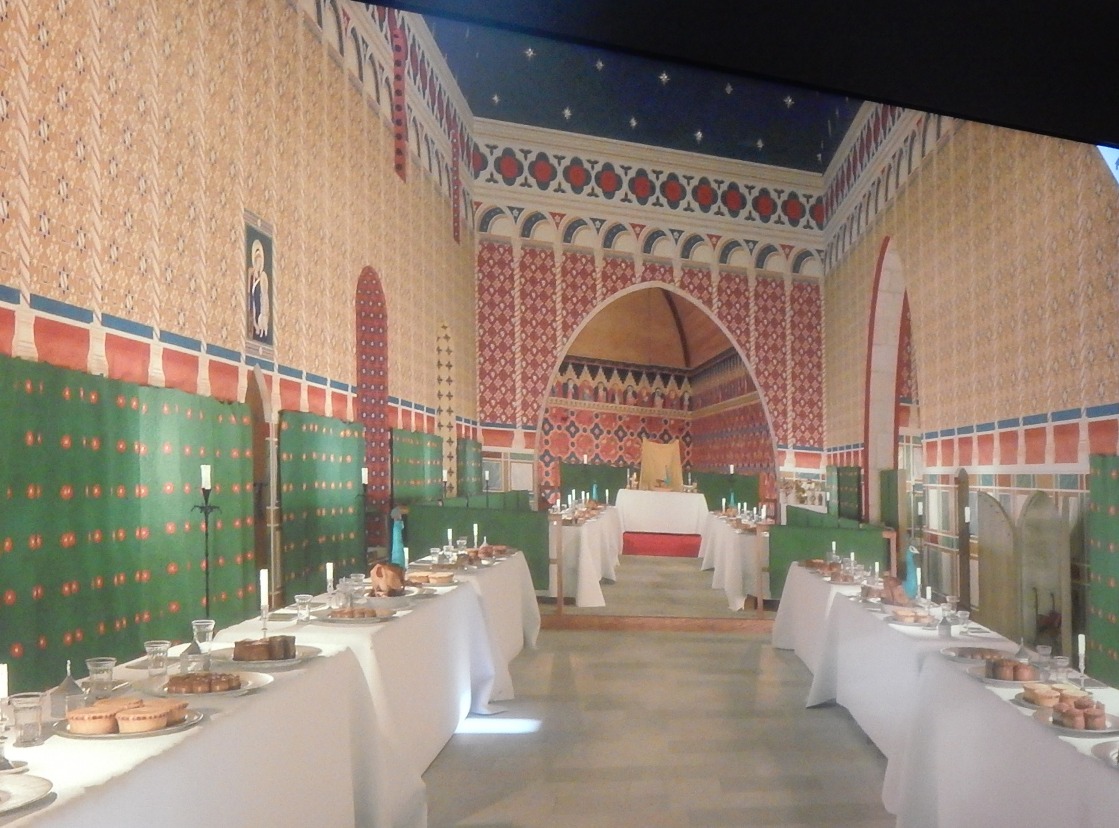
Below we have the great dining
hall (Grand Tinel) as it is now - the ceiling has been replaced after a
fire - and a rendering of what it likely looked like all set up for a
celebration during the time it was the home of the Pope. Notice
in the picture at left the arch at the end of the room that has been
blocked up - earlier that could be opened into a little annex for the
"head table" (as we can see in the center image). On the right is
the north
sacristy of the New Palace - the figures here are plaster replicas of
the tomb of Gregory XI and some of the prominent people of the time.
Tuesday, May 10
In hindsight, I would have much preferred an extra day in Nice or in Lyon - there were loads of things we didn't see in each of those towns that I think would have been more worthwhile than the time dedicated to the cave visit.
Wednesday May 11 This morning we spent in Lyon - wish we had had more time here! We started on a bus that took us by ruins of the old Roman Odeon Amphitheater (looked much like the ruins we had seen in Arles) and then dropped us at the Basilica of Notre Dame de Fourvière that overlooks the city. Below left to right are the best view of the front I could get; the sanctuary and statue of Pope John Paul II in the front of the Basilica.
Behind the Basilica was an observation point overlooking the town. On the left below is one of the many views from that point - you get a better view if you click the image to enlarge it; the large cylindrical building just to the left of center is the Opera House, originally built in 1831 but completely modernized and changed architecturally in 1993. In the center is the mini-Eiffel Tower just north ofthe Basilica. Known as the Tour Métallique, it is a model of the third tier of the Parisian tower. And on the right is a scale model of Lyon, labelled in Braille, financed by the Rotary Clubs of Greater Lyon. It was created by sculptor Dan Ohlmann, beginning as a wax and resin model and then cast in bronze. If you enlarge the image, you can easily see the Basilica and the Tour Metallique just below the center, and the two rivers - the Rhône (top) and Sôane (bottom) are also easy to locate. 
 
Then, after we shared a scrumtious brioche from La Maison Pralus we explored the traboules. A traboule is a long passageway that connects numerous buildings and streets. In the traboules are many very old courtyards that are sort of like lobbies to apartment complexes. The owners of each building have agreed to keep the passages open to the public during the day and the city, in turn, maintains them. In each courtyard area one usually sees terraces (the individual apartments), a spiral staircase to reach the upper levels and some previous source of water - an old well, e.g. Below at the left is the entryway to one of these passages; in the center is an example of the terraces along with the water source at the lower right; the right picture is of an old spiral staircase. (Remember, there are more pictures of these and many other sites in the photos section.)
We learned about the origins (and continuation of) the silk trade in Lyons. It was interesting to me that many of the merchants still maintain their own gardens and raise their silkworms locally. Finally, we walked through the Place de Terreaux where we saw the fountain sculpted by Frédéric Bartholdi that was created for the Paris World's Fair in 1889 and then installed in Lyon in 1892. The woman on the chariot represents France while the 4 horses are the four major rivers that she is having a hard time controlling! At one end of the Place is the Hotel de Ville for Lyon and there is a sort of "splash pad" down the middle where we enjoyed watching some children illustrate "joy!"
We left for Macon this afternoon, rounding the confluence and heading up the Sôane. Leaving Lyon and then the rest of the trip is in Part 3! Click here to
continue with Part 3 of the France Trip |