|
[You can enlarge any picture in
this narrative by
clicking on it - it
will open in a separate window and in many cases, show detail you can't
see in the smaller version. (Click on the back arrow to return to
the text.) Many more pictures can be found here.]
Friday August 8  We had breakfast at the hotel and then departed by bus
to the ferry at Tswwassen Terminal taking us to the Swartz Bay terminal
on Vancouver Island. We had lunch on the ferry - they have a full
service cafeteria as well as "grab and go" items. I spent some
time on the observation deck - my favorite picture is this one that I'm
told is Mt. Baker, in the Washington Cascades in the US. We had breakfast at the hotel and then departed by bus
to the ferry at Tswwassen Terminal taking us to the Swartz Bay terminal
on Vancouver Island. We had lunch on the ferry - they have a full
service cafeteria as well as "grab and go" items. I spent some
time on the observation deck - my favorite picture is this one that I'm
told is Mt. Baker, in the Washington Cascades in the US.The garden of the day was Butchart Gardens. John Adams was our local guide while we were in Victoria – he and his son, Chris, have a sightseeing business and they specialize in gardens. We were on our own in Butchart but had a good map and enough time to see almost all of it. They also gave us a plant identification guide that was very helpful. We took a break for gelato by the Star Pond when we got too hot and tired! 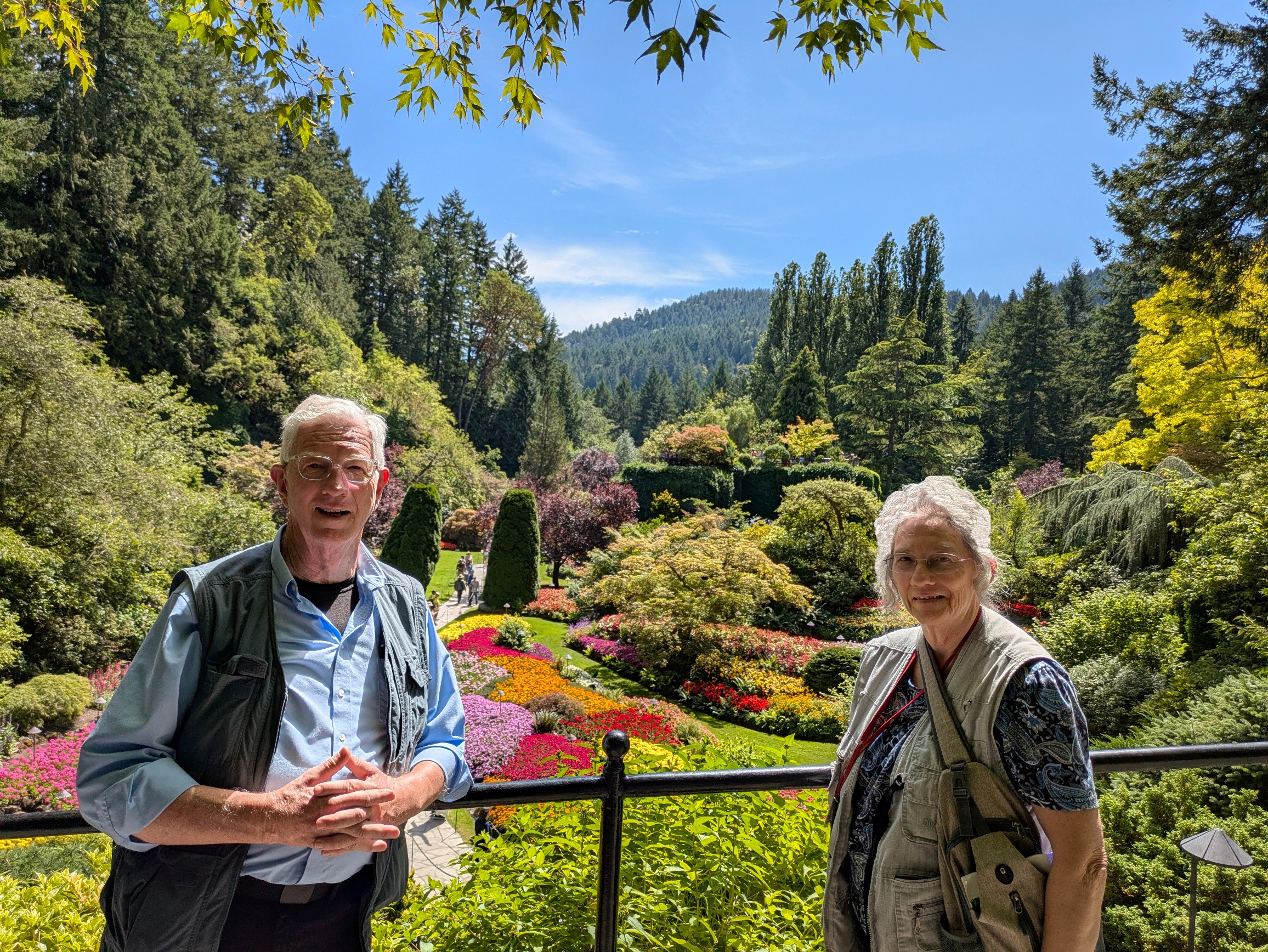 Butchart is the best known garden we visited
and, I think, the
largest. At least that's where I took the most pictures! Of
course there are many, many more in the photo collection.
We did get one picture of us standing above the sunken garden (the hat
head makes me laugh) but the rest are the various features and floral
displays we saw. The first row below includes a view of the
sunken garden (from where we are standing), a close up of one section
in the sunken garden and a striking display combining pink geraniums
and purple fan flowers. Butchart is the best known garden we visited
and, I think, the
largest. At least that's where I took the most pictures! Of
course there are many, many more in the photo collection.
We did get one picture of us standing above the sunken garden (the hat
head makes me laugh) but the rest are the various features and floral
displays we saw. The first row below includes a view of the
sunken garden (from where we are standing), a close up of one section
in the sunken garden and a striking display combining pink geraniums
and purple fan flowers. Below that, the second row includes the Ross Fountain (it has "dancing waters" that are lovely to watch as it changes form), a clematis vine and a martagon lily plant.    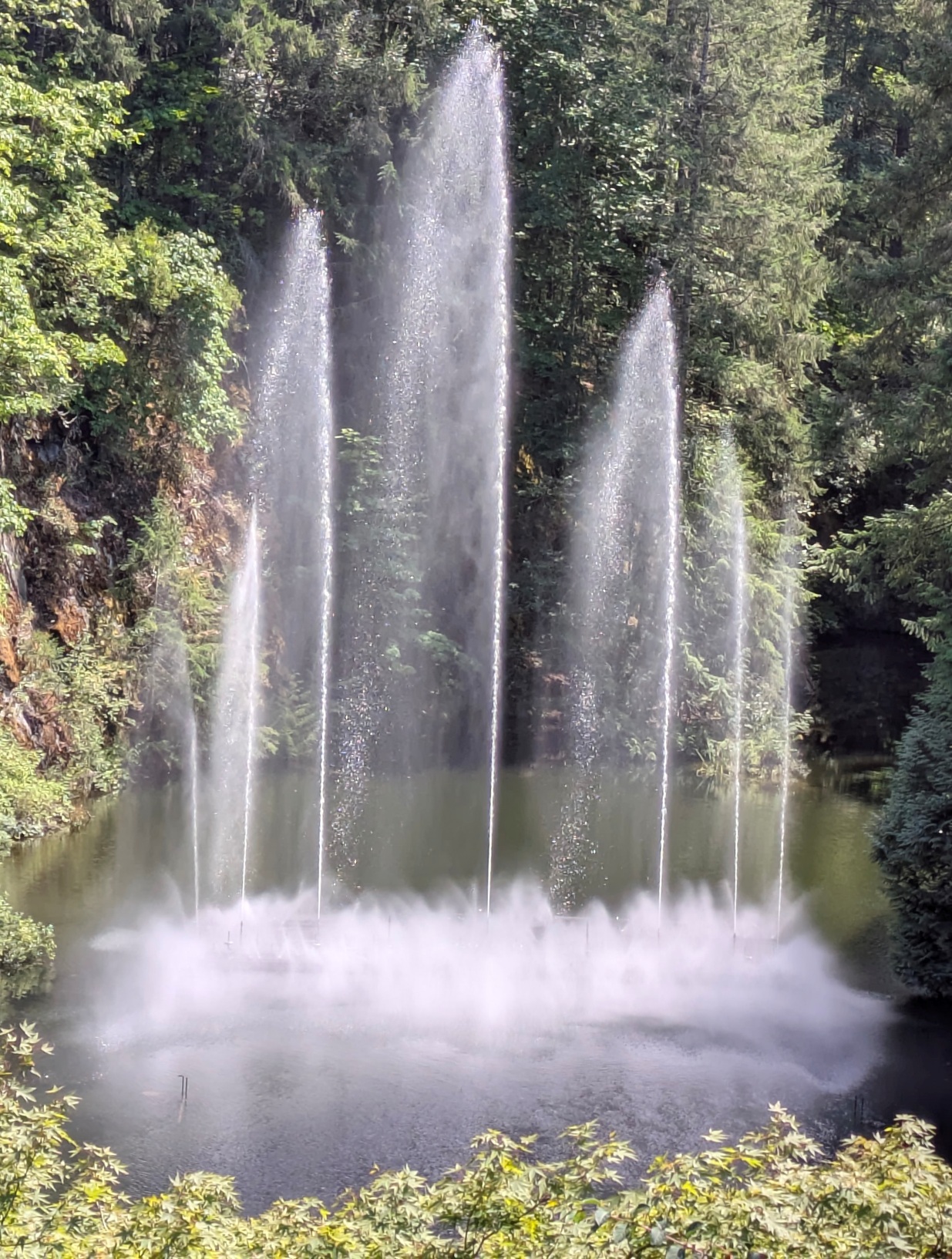   The
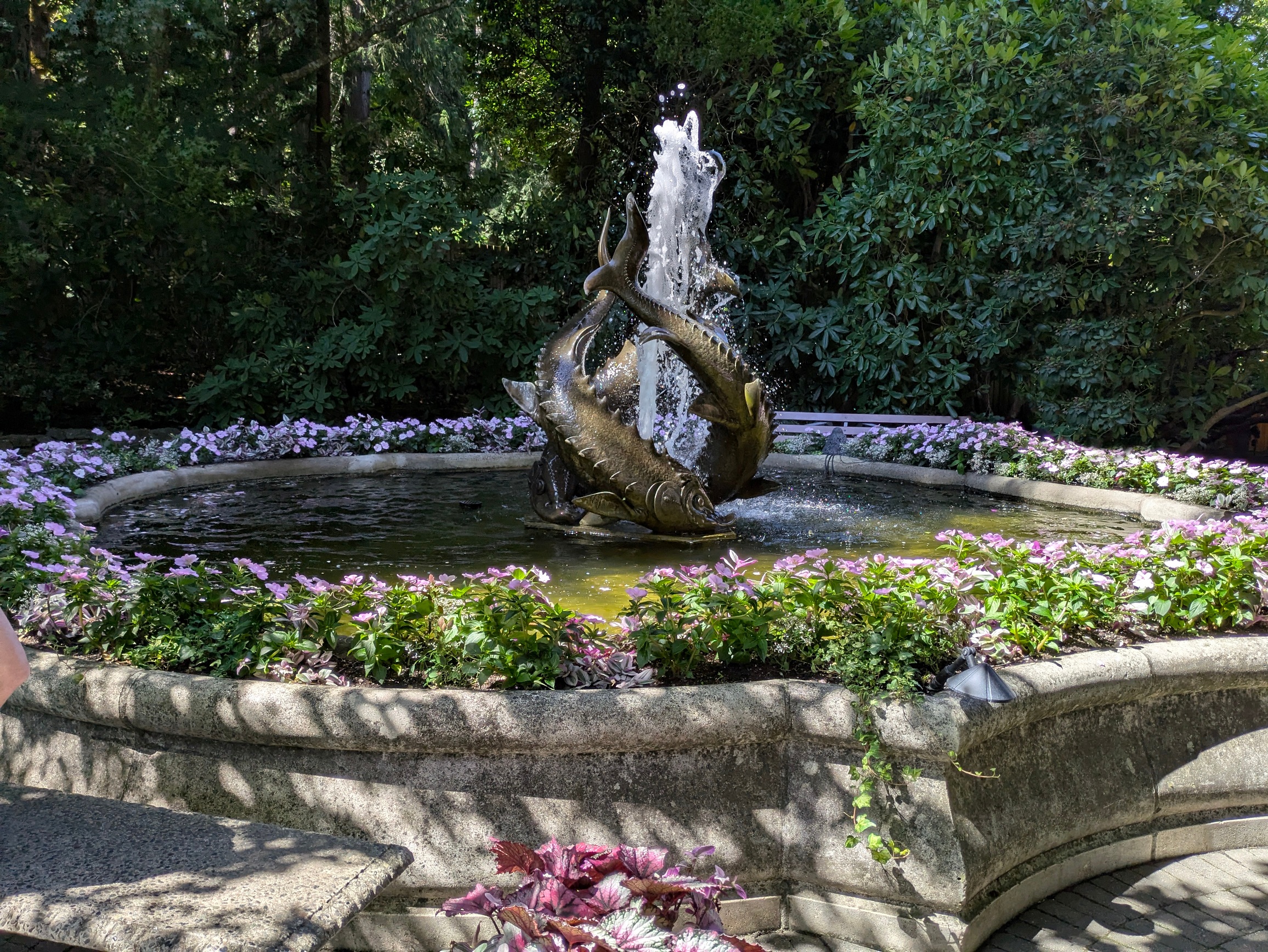
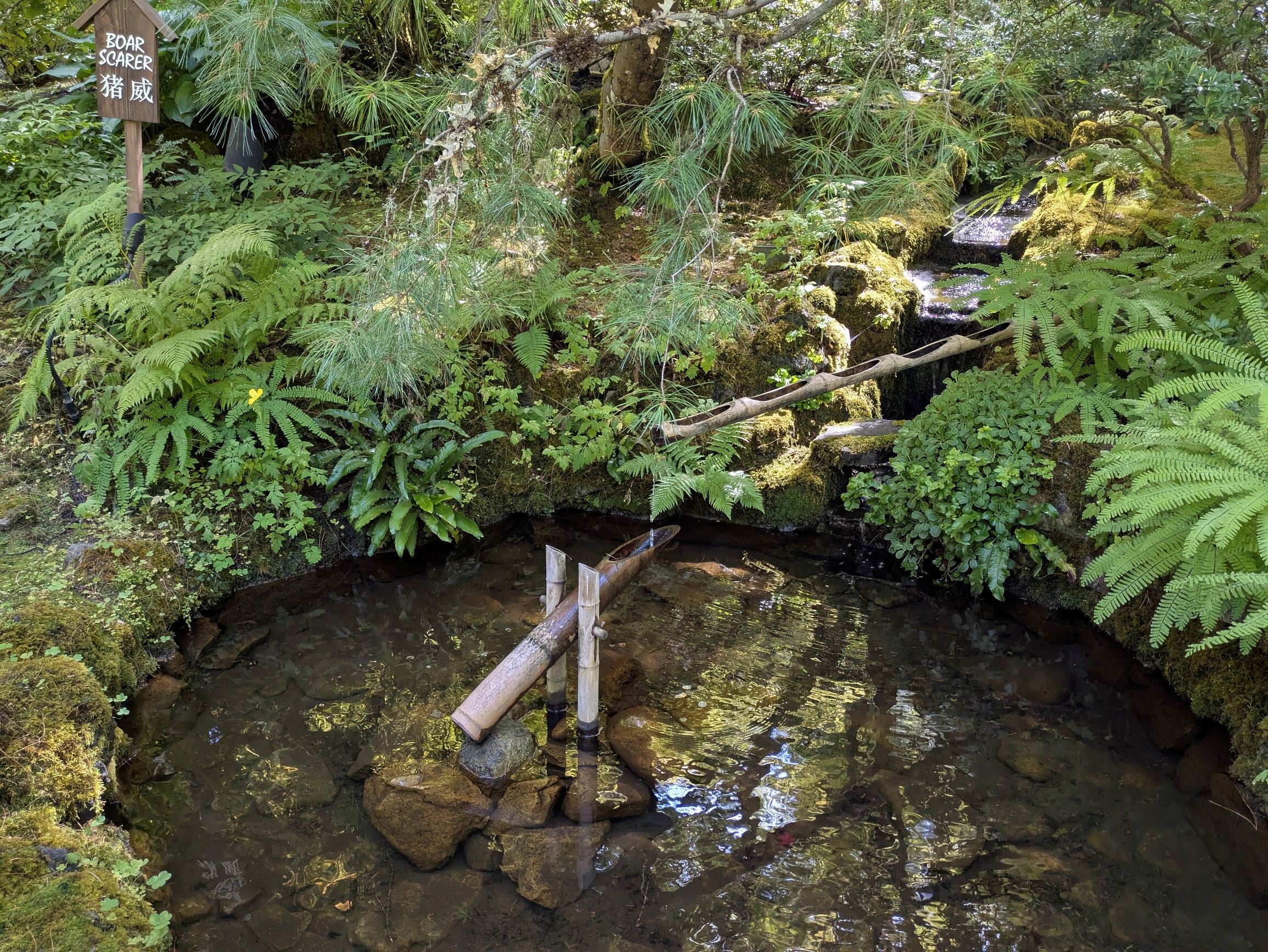
next row from Butchart, below, shows the Three Sturgeon Fountain, the
rose garden and, in the Japanese garden, a Boar Scarer. It's a
bit hard to see, but water is caught, runs down the bamboo tube and
drips into the second tube below it. That one is hinged, so as it
fills up, it tips over and makes a great noise when it clonks back down
onto the rock, allegedly scaring away boar, deer or anything else
around!
   In
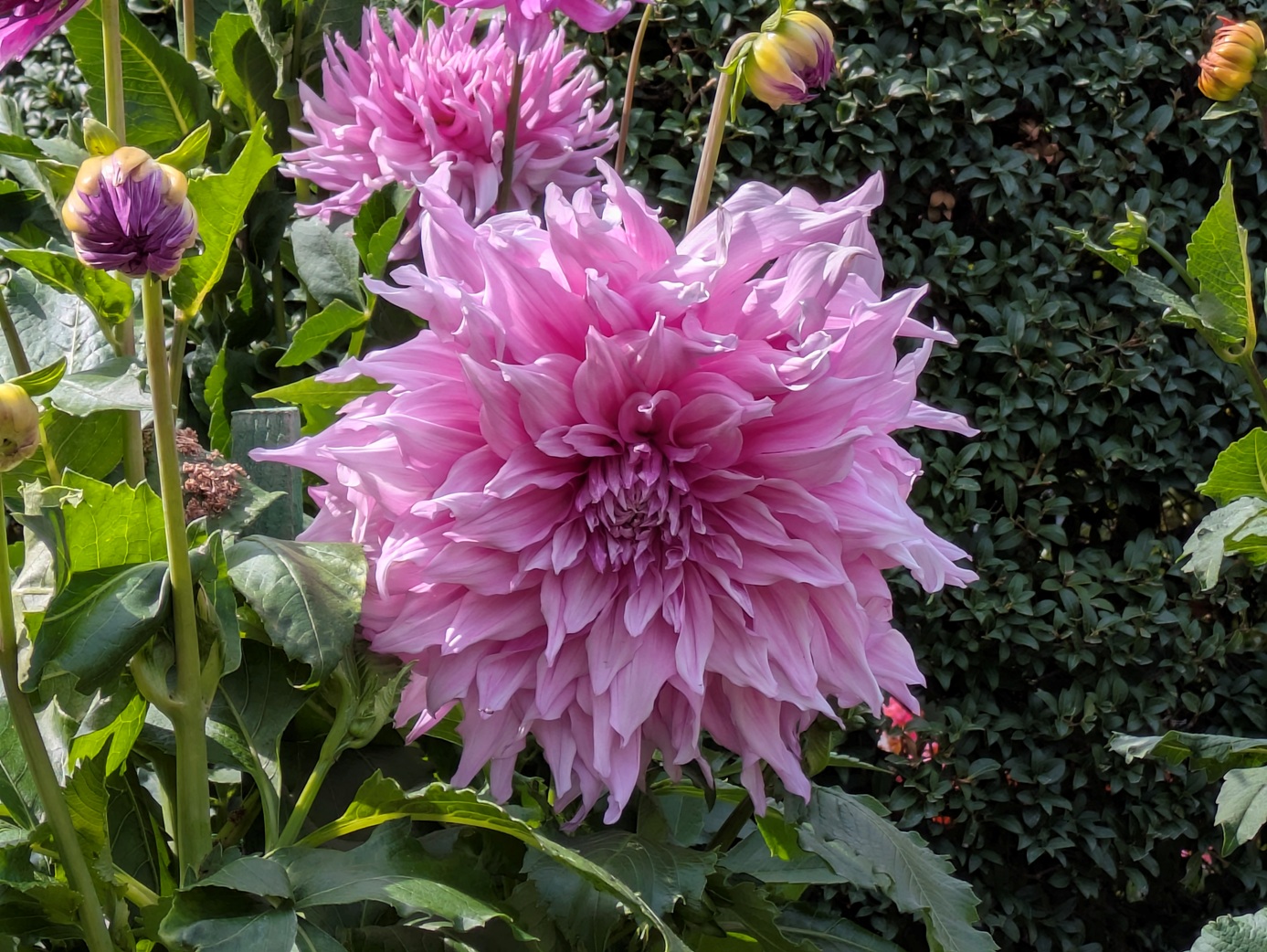
the final row of Butchart pictures you'll see the Dragon Fountain,
African Daisies and some striking dahlias. The plants are not
labelled in the garden but their plant identification booklet helped a
lot, as did Google Lens!
    Late in the afternoon we checked
into the Hotel
Grand Pacific,
enjoyed a buffet dinner (I mostly had pork ribs and some sides) and
then crashed in our room, unpacking a little bit and getting ready for
more adventures in the morning!
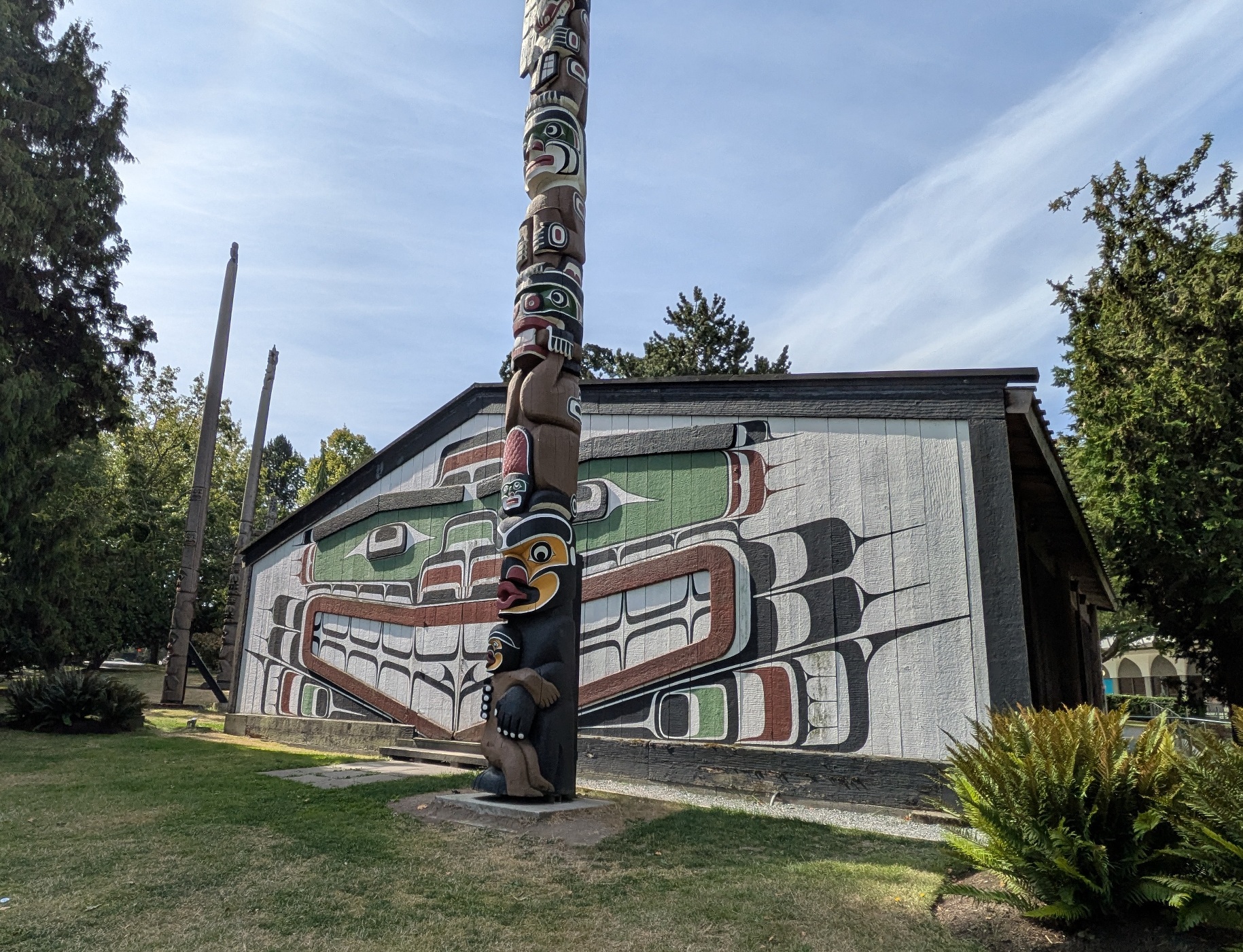
Saturday, August 9 This morning Phil Foster gave us an introduction to Victoria then took us on a walking tour where we saw many highlights of the area, some of which are shown below! On the left is the Confederation Garden Park created in 1967 to commemorate the Canadian Confederation. The display includes Coats of Arms from the 13 provinces and territories. (That is our hotel behind it.) In the middle is the British Columbia Parliament building where, since 1898, the legislative work of the province is accomplished. On the right is the Mungo Martin House in Thunderbird Park. This was built to celebrate the history and culture of the Kwakwaka’wakw people. Mungo Martin is considered the premier totem carver of his time (he also carved the World's Tallest Totem Pole in Beacon Hill Park). The building is still used for First Nation celebrations and events. 
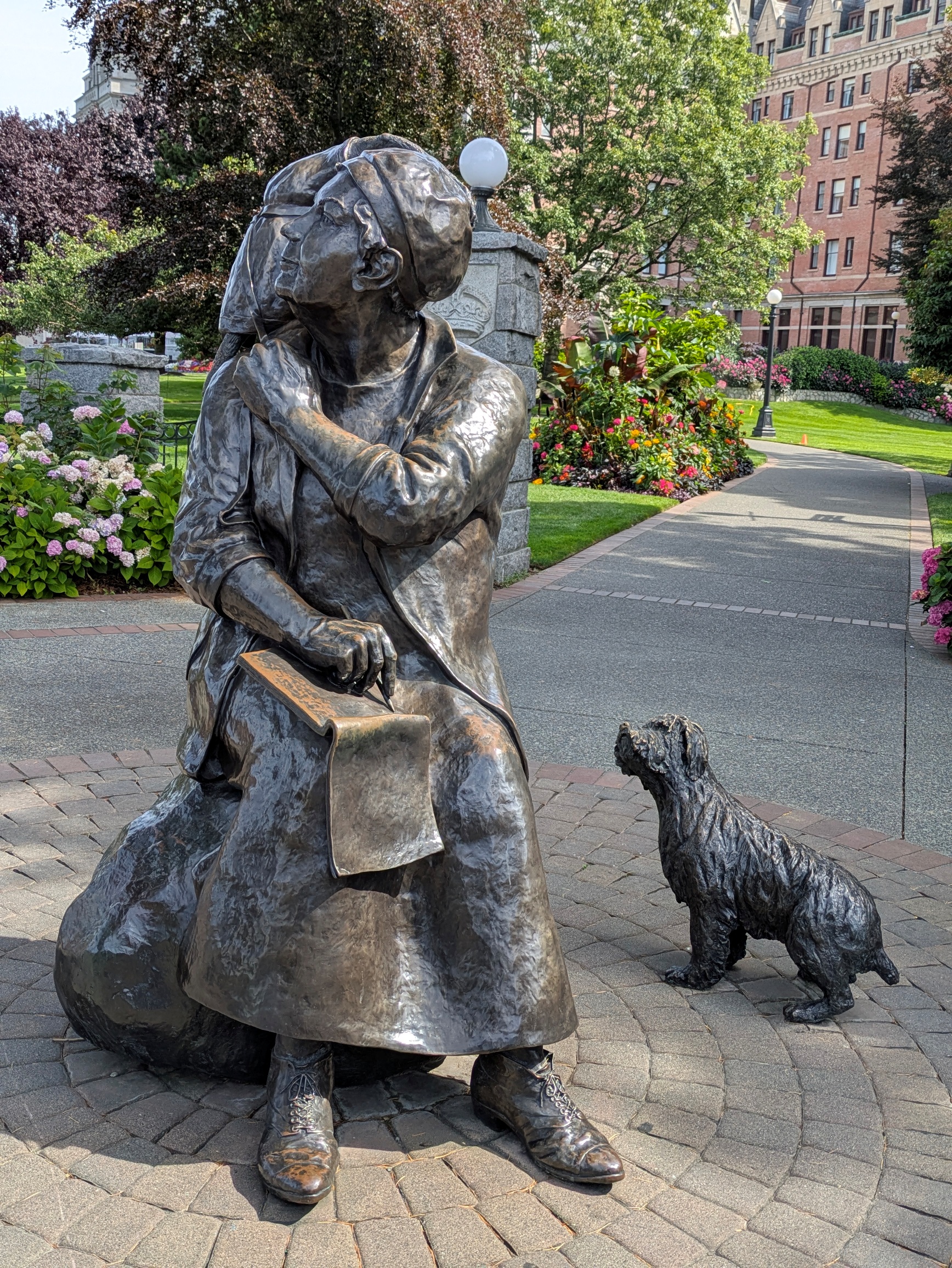
  Below I feature the Queen Victoria
statue in front of Parliament by artist Albert Bruce-Joy, completed in
1914; the center picture is the Knowledge Totem, carved for the 1994
Commonwealth Games by artist Cicero August and sons Darrel and Doug
August. Finally, on the right is a statue of the gifted Canadian
artist Emily Carr by the sculptor Barbara Paterson. It's hard to
tell from this angle, but she has her pet monkey "Woo" sitting on her
shoulder, as well as her dog "Billie" next to her.
   Finally, a few more harbor
area pictures include rowing races in the harbor on the left. The
tugboats also performed a "dance" of sorts for the gawking
tourists! A sculpture by Crystal Przybille in the center is part
of a Hands of Time series that includes 12 installations around the
city. At the right is one entry (Wharf St.) to Bastion Square, a
pedestrian shopping area that was just across the street from where we
had lunch at Finn's
Restaurant.
  
 After lunch
we had the rest of the day on our own.
We first walked through Bastion Square (pictured above) to Murchies -
one of John's favorite mail-order tea companies. They had some
tastings we enjoyed and we watched a tiny, terrified little mouse try
to get out of the building. (I don't After lunch
we had the rest of the day on our own.
We first walked through Bastion Square (pictured above) to Murchies -
one of John's favorite mail-order tea companies. They had some
tastings we enjoyed and we watched a tiny, terrified little mouse try
to get out of the building. (I don't think anyone except us
noticed it.) Then we stopped at a fudge store (stock up on
snacks). On the way to the Royal British
Columbia Museum we passed a
busking bagpiper (on the left). At the museum we saw John
Lennon's old Rolls Royce (right), a temporary exhibit of "Beyond the
Beat" - music of resistance and change that included both audio and
visual exhibits, and Old Town,
a recreation of a 1900’s hotel, theater, railway station and
saloon. A new addition is the Hayashi Photography Studio where
there was a very moving
video presentation about the importance of photography - as the central
example they examined the effects of old, "found" photos on Japanese
families who had been separated and lost everything during internment
during WWII. think anyone except us
noticed it.) Then we stopped at a fudge store (stock up on
snacks). On the way to the Royal British
Columbia Museum we passed a
busking bagpiper (on the left). At the museum we saw John
Lennon's old Rolls Royce (right), a temporary exhibit of "Beyond the
Beat" - music of resistance and change that included both audio and
visual exhibits, and Old Town,
a recreation of a 1900’s hotel, theater, railway station and
saloon. A new addition is the Hayashi Photography Studio where
there was a very moving
video presentation about the importance of photography - as the central
example they examined the effects of old, "found" photos on Japanese
families who had been separated and lost everything during internment
during WWII. Finally, we headed down to Fisherman's Wharf for supper where we were disappointed at the lack of variety of reataurants. It was fun to see the "floating houses" along the boardwalk but the only eateries were assorted fast foods. We did have some baskets at Barb's Fish and Chips (I had shrimp, John fish) that were fine, but we had expected more variety. Sunday August 10 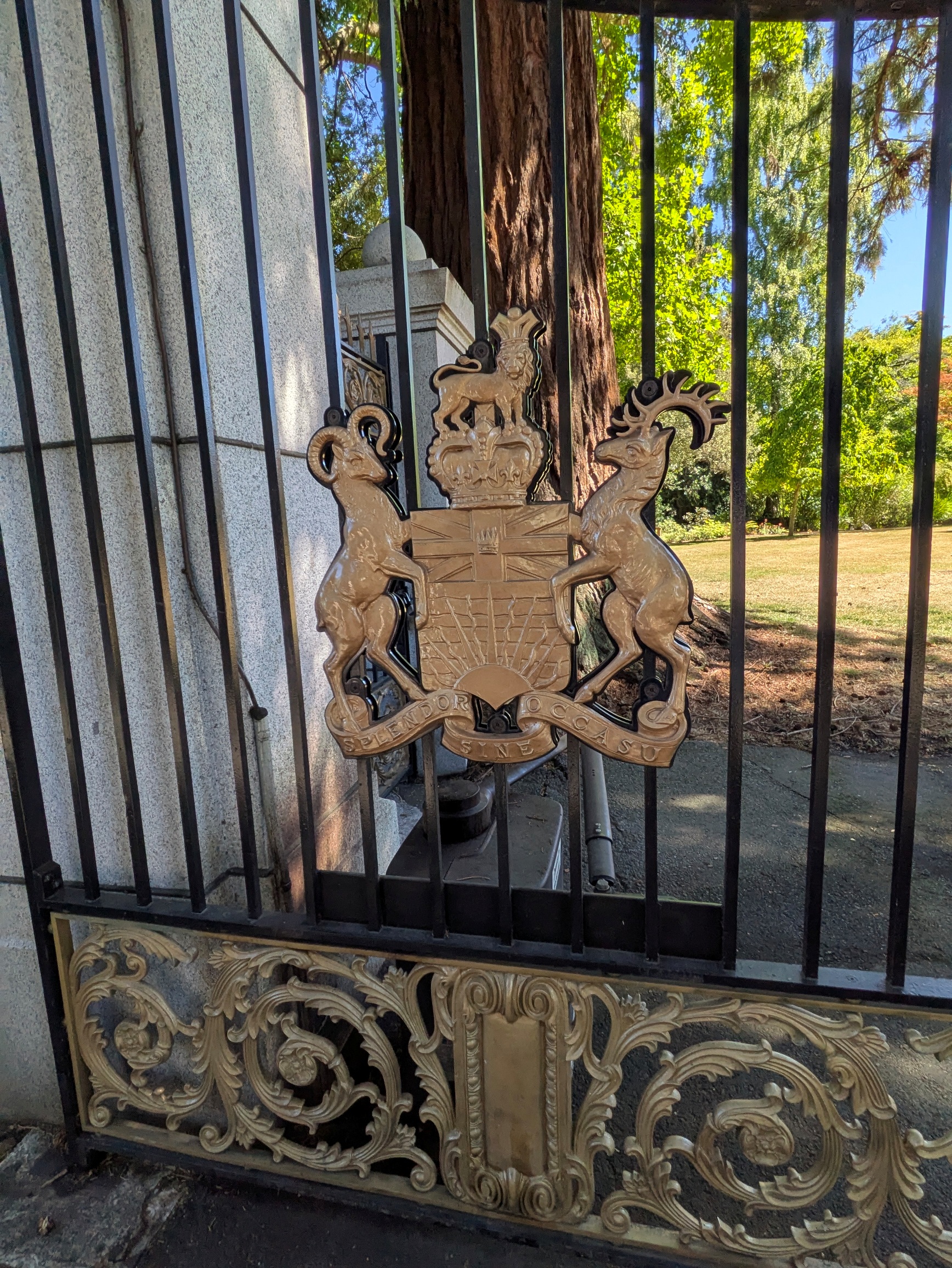  We started today at Government House.
This is the home of the Lieutenant Governor of British Columbia, the
person appointed to basically serve as the host/hostess of the
province. Celebrity guests are invited to stay here when visiting
and the beautifully maintained gardens are open to the public all
year. At the left is the gate to the estate, on the right, a view
of the house itself that is open to public tours on Saturdays by
reservation. We started today at Government House.
This is the home of the Lieutenant Governor of British Columbia, the
person appointed to basically serve as the host/hostess of the
province. Celebrity guests are invited to stay here when visiting
and the beautifully maintained gardens are open to the public all
year. At the left is the gate to the estate, on the right, a view
of the house itself that is open to public tours on Saturdays by
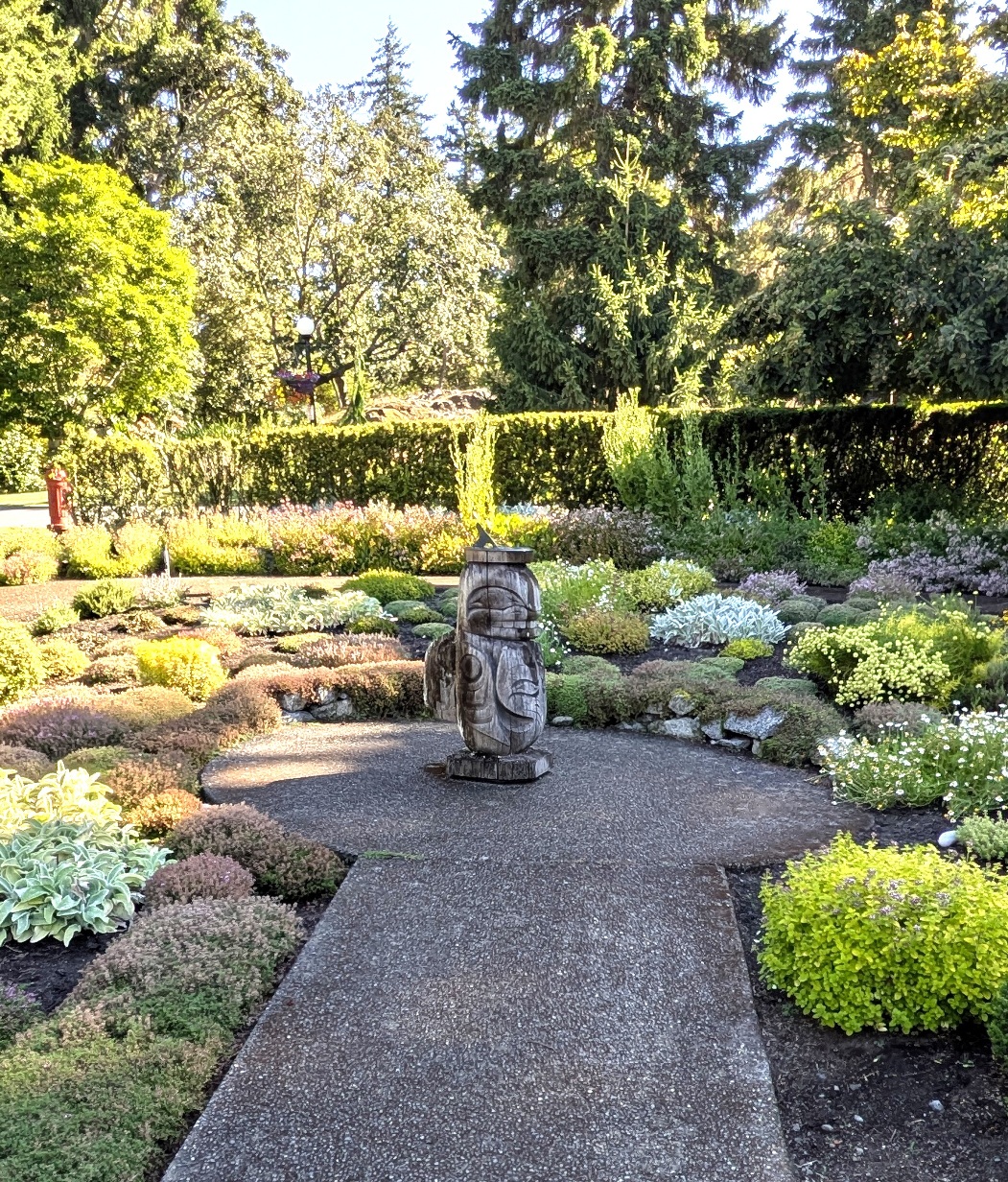
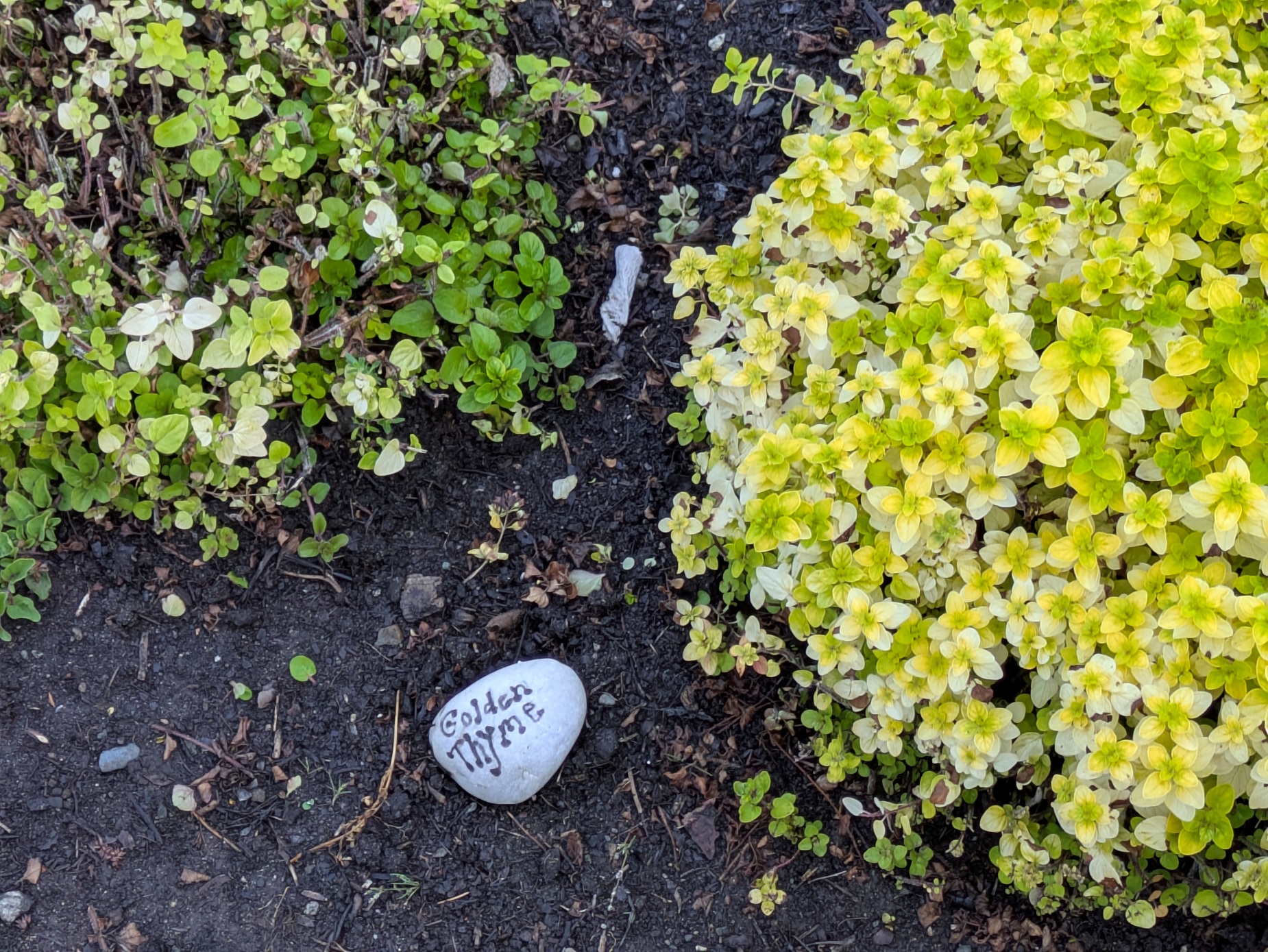
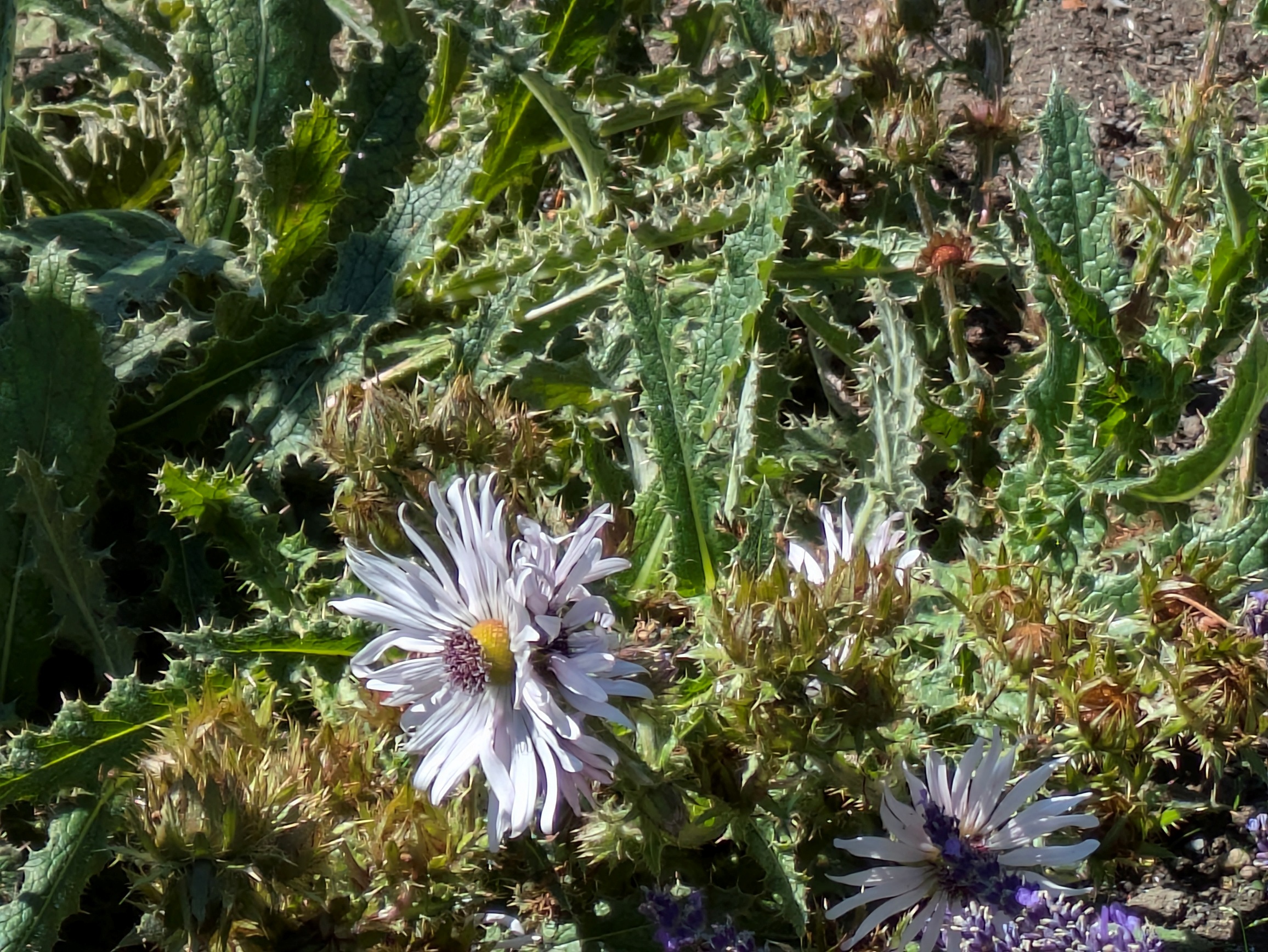
reservation. Some other highlights of the garden tour (we had a docent who took us around and gave us information about the various sculptures and plants) are below. On the top row from left to right a Lavender Dream rosebush, the orca sundial totem created by Aubrey LaFortune, and Golden Thyme plants showing some of the creative labels they used! The second row includes an African Thistle, another example of a Lacecap Hydrangea and a view across the Strait of Juan de Fulca to the Cascade Mountains in the USA. 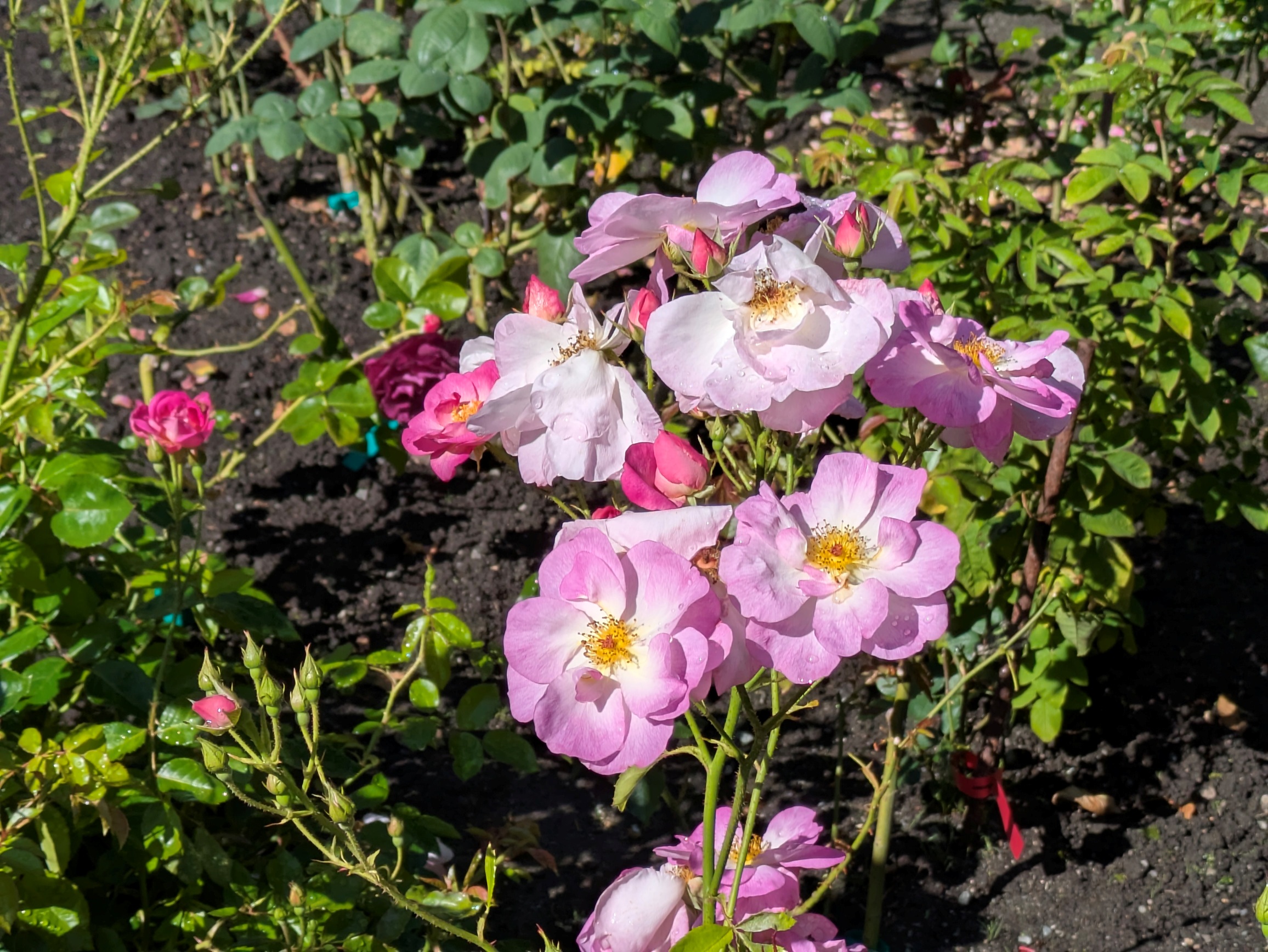
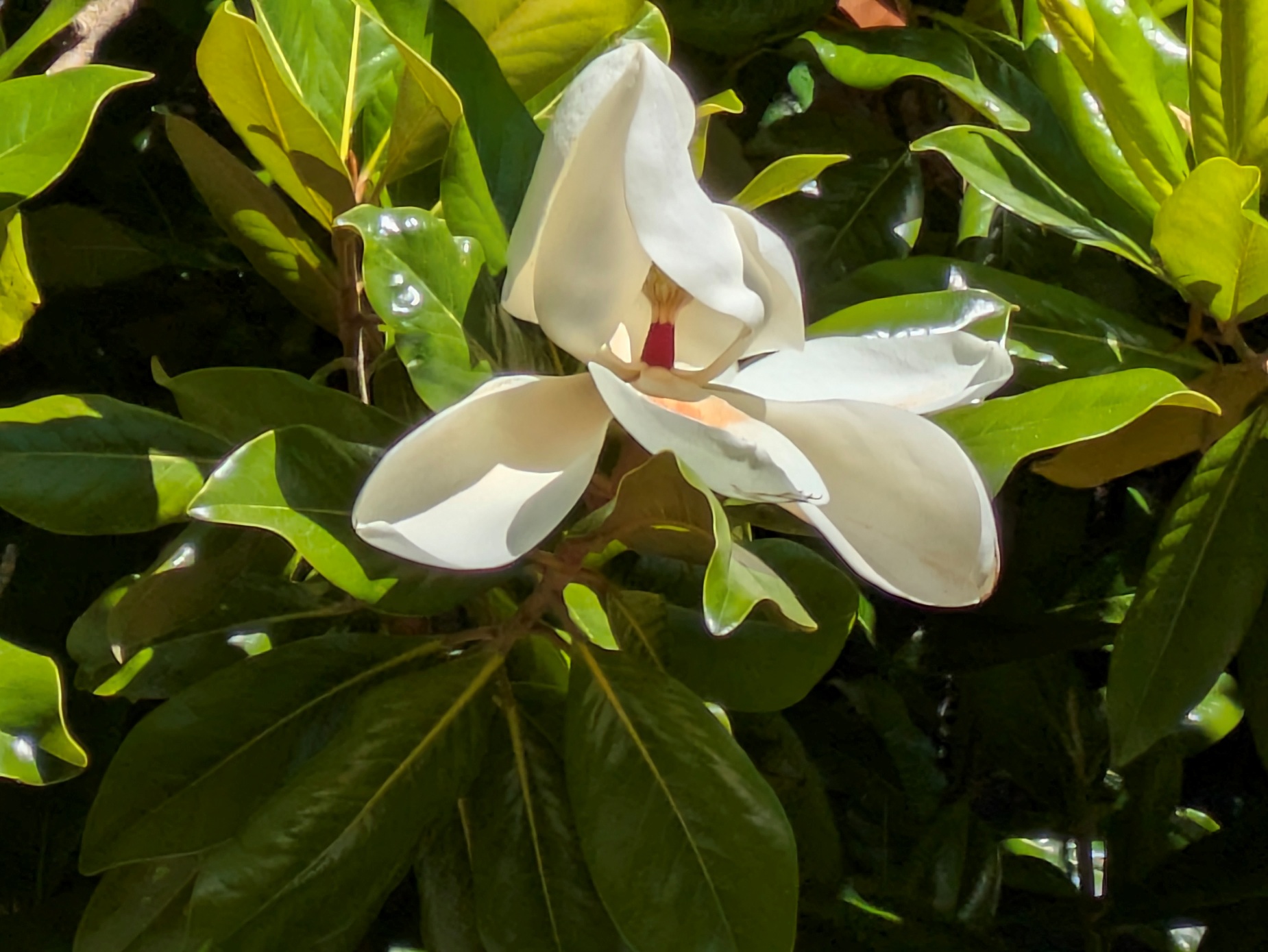
     Before lunch, Chris Adams took us
to one of his favorite "unknown" gardens from when he was a student at
the University of Victoria - the Multifaith Centre Finnerty
Gardens. One of its charms is that it's quiet since it receives
so few visitors. A few highlights include magnolia blossoms,
another variation of hydrangea and a nurse stump: the stump remaining after
a tree has died or been taken down that provides resources and
nutrients to support new growth.
 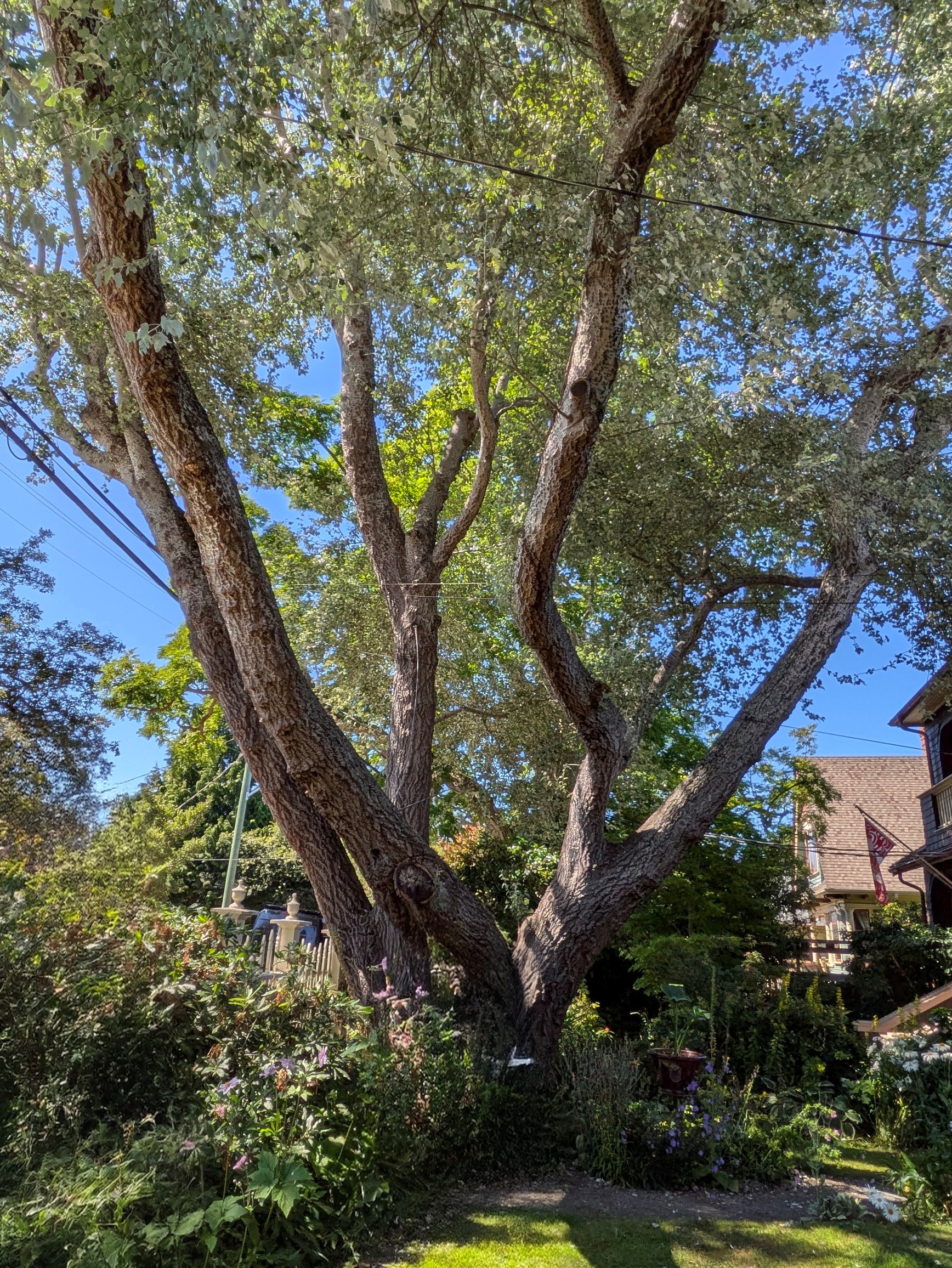  We enjoyed a
lunch at the Sticky Wicket Pub (chicken pot pie) then were
treated to a tour of three private gardens in the James Bay area -
Chris' home garden, his father's (John) garden and a neighbor who is
trying to recreate the 1930's appearance of her yard. At the left
is an old, original tree from her front yard that is now held up by a
system of cables. That's not going to last too much longer but
she's working with arborists to figure out if it's possible to salvage
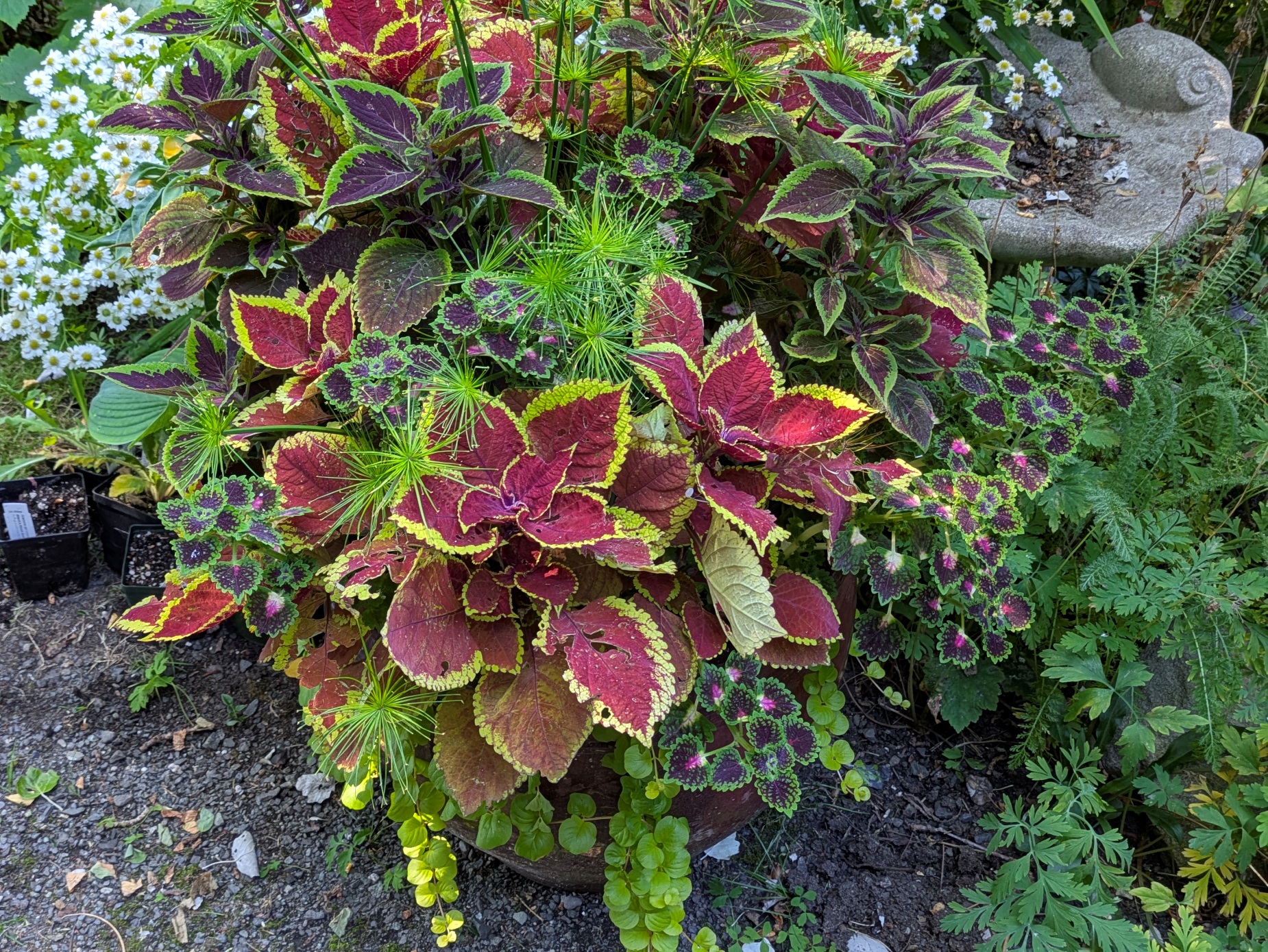
a portion of the tree. On the right is a portion of the border of
her yard incorporating coleus - not particularly profound but the
first coleus I've seen here! Chris' home garden was quite
interesting - he's trying to practice sustainability as much as
possible. He has a tiny flock of chickens and uses their
droppings to fertilize his plants, he uses companion planting and is involving his teenage children in experiments.
We had dinner at the 10
Acres Bistro very close to the hotel. We enjoyed a
lunch at the Sticky Wicket Pub (chicken pot pie) then were
treated to a tour of three private gardens in the James Bay area -
Chris' home garden, his father's (John) garden and a neighbor who is
trying to recreate the 1930's appearance of her yard. At the left
is an old, original tree from her front yard that is now held up by a
system of cables. That's not going to last too much longer but
she's working with arborists to figure out if it's possible to salvage
a portion of the tree. On the right is a portion of the border of
her yard incorporating coleus - not particularly profound but the
first coleus I've seen here! Chris' home garden was quite
interesting - he's trying to practice sustainability as much as
possible. He has a tiny flock of chickens and uses their
droppings to fertilize his plants, he uses companion planting and is involving his teenage children in experiments.
We had dinner at the 10
Acres Bistro very close to the hotel. Monday August 11  This morning we started at the 9 acre Horticulture Centre of the
Pacific
with a guided tour. Similar to other large gardens
we've visited, this has numerous sections within it: a Zen Garden,
Japanese Garden, Winter Garden and so on. But its emphasis is in
education and research - we saw some of each going on. Because we
have seen so many types of displays and individuals specimens, at this
garden we were looking more at ideas for display and how to create a
"feel" for the garden. I tried not to duplicate (e.g., I didn't
repeat the iconic bridge in the Japanese garden) so there's not a lot
new to share but it was a great experience. At the left is an
unidentified sculpture to draw interest to an otherwise ordinary
collection of low greens. Below are a Bonsai Colorado spruce, a
collection of individual containers near a walkway with an interesting
border and finally, another container display that uses several
different shapes to make it interesting. This is also the display
where we learned "thrills, spills and fills." That is, include
something startling or different (the thrill), something spilling over,
or plants that will draw the eye from top to bottom and then add the
fill-ins to complete the arrangement. After this we moved on to Abkahazi
Garden and Tea Room for both lunch and a garden tour This morning we started at the 9 acre Horticulture Centre of the
Pacific
with a guided tour. Similar to other large gardens
we've visited, this has numerous sections within it: a Zen Garden,
Japanese Garden, Winter Garden and so on. But its emphasis is in
education and research - we saw some of each going on. Because we
have seen so many types of displays and individuals specimens, at this
garden we were looking more at ideas for display and how to create a
"feel" for the garden. I tried not to duplicate (e.g., I didn't
repeat the iconic bridge in the Japanese garden) so there's not a lot
new to share but it was a great experience. At the left is an
unidentified sculpture to draw interest to an otherwise ordinary
collection of low greens. Below are a Bonsai Colorado spruce, a
collection of individual containers near a walkway with an interesting
border and finally, another container display that uses several
different shapes to make it interesting. This is also the display
where we learned "thrills, spills and fills." That is, include
something startling or different (the thrill), something spilling over,
or plants that will draw the eye from top to bottom and then add the
fill-ins to complete the arrangement. After this we moved on to Abkahazi
Garden and Tea Room for both lunch and a garden tour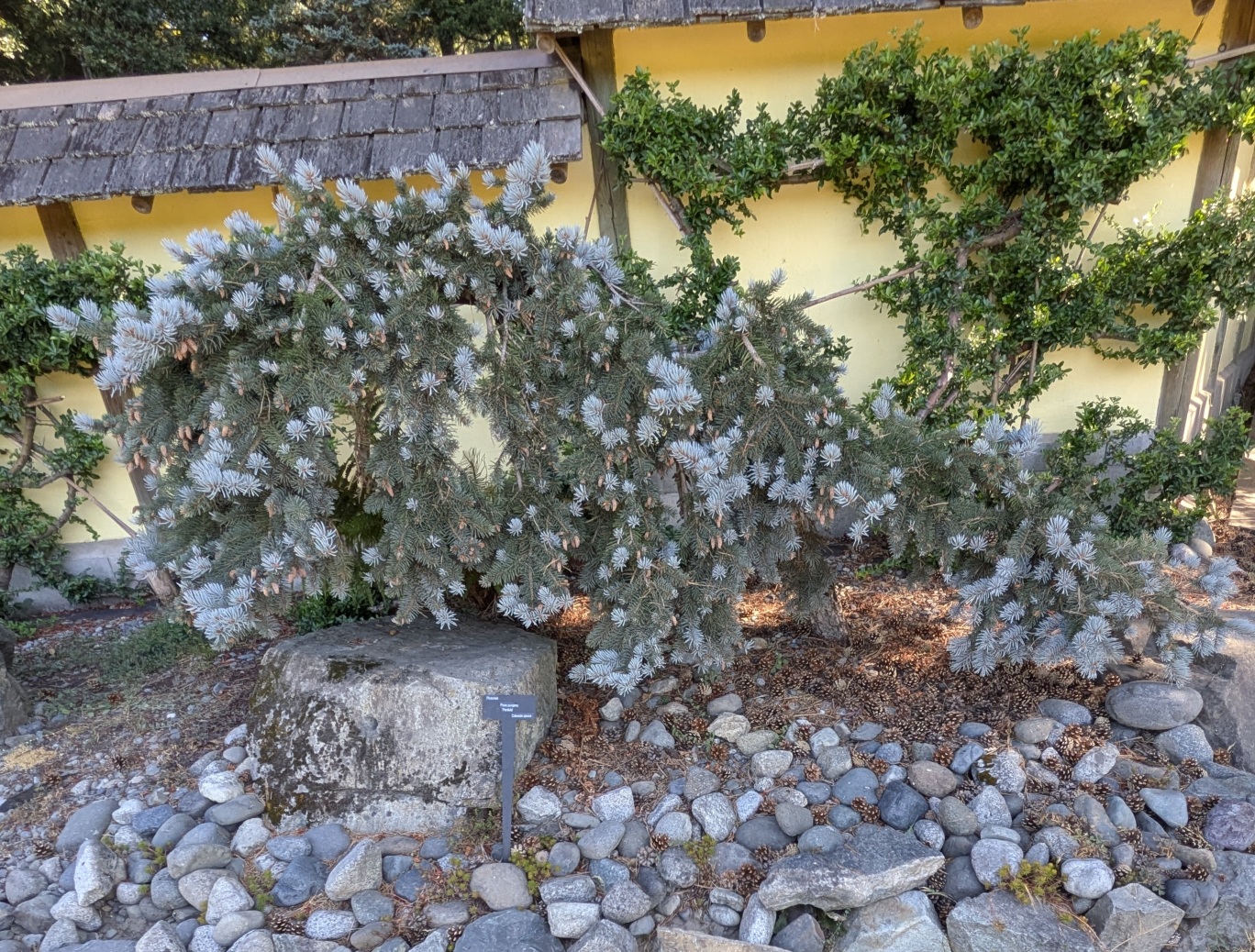 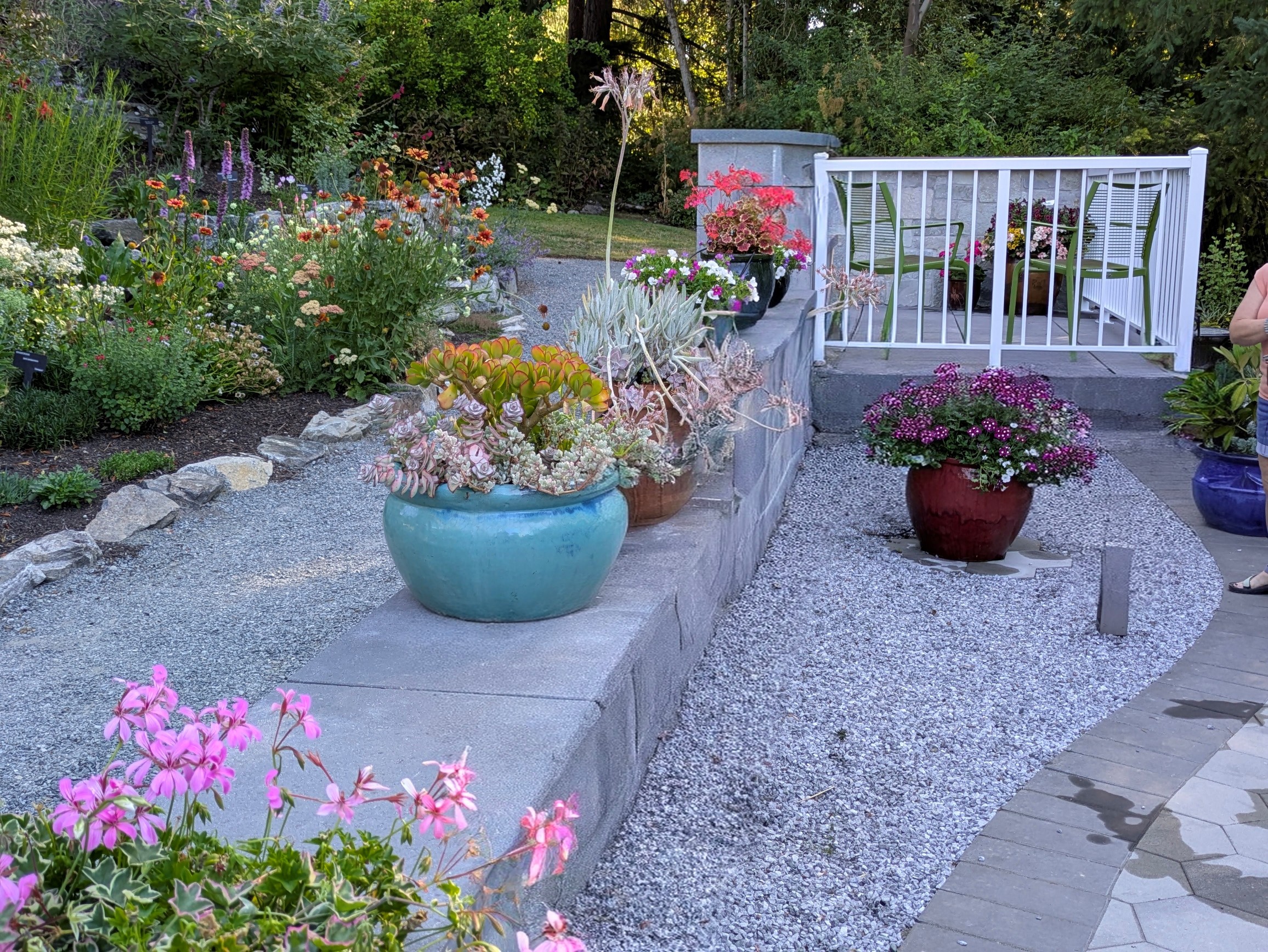 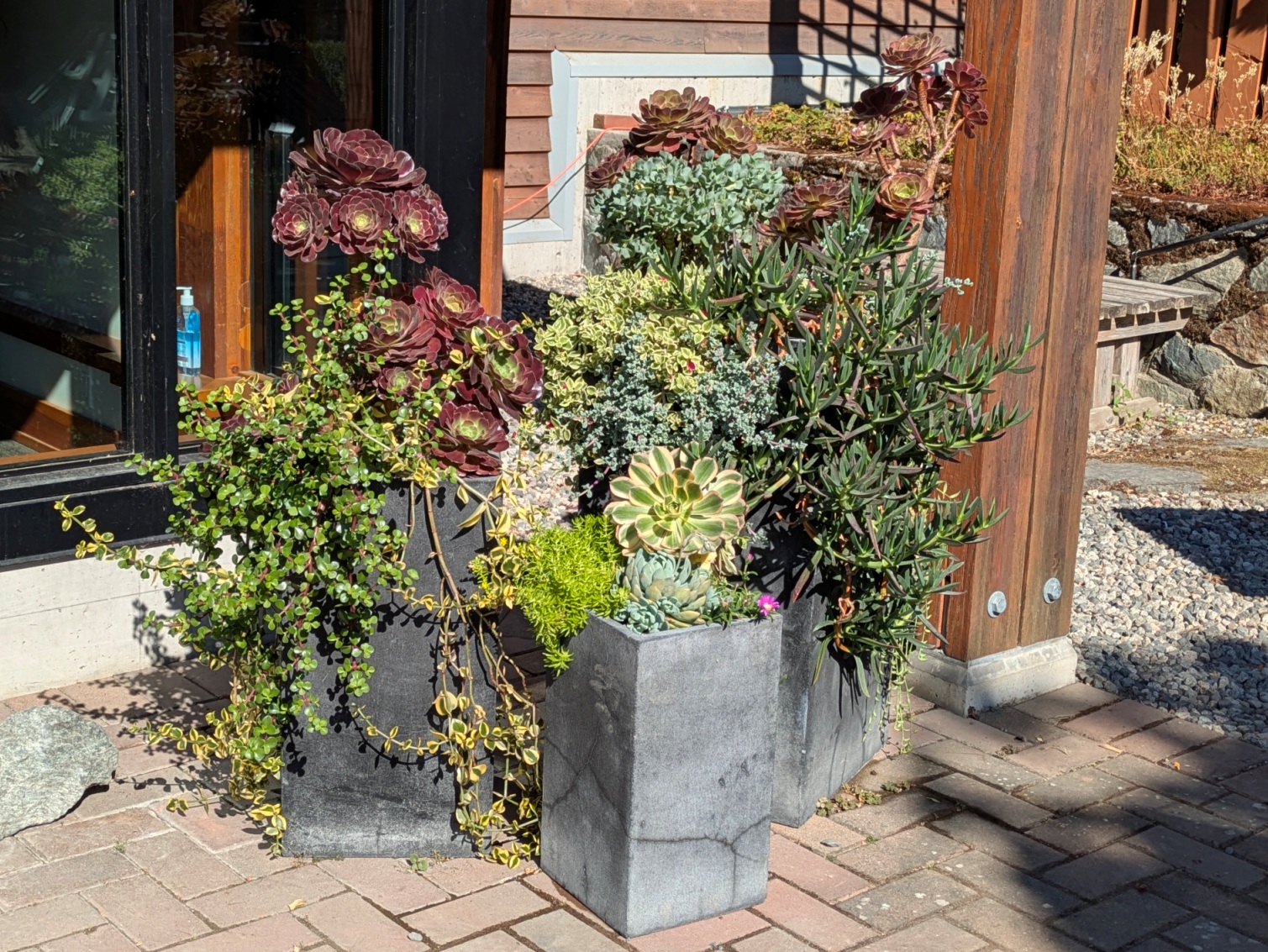 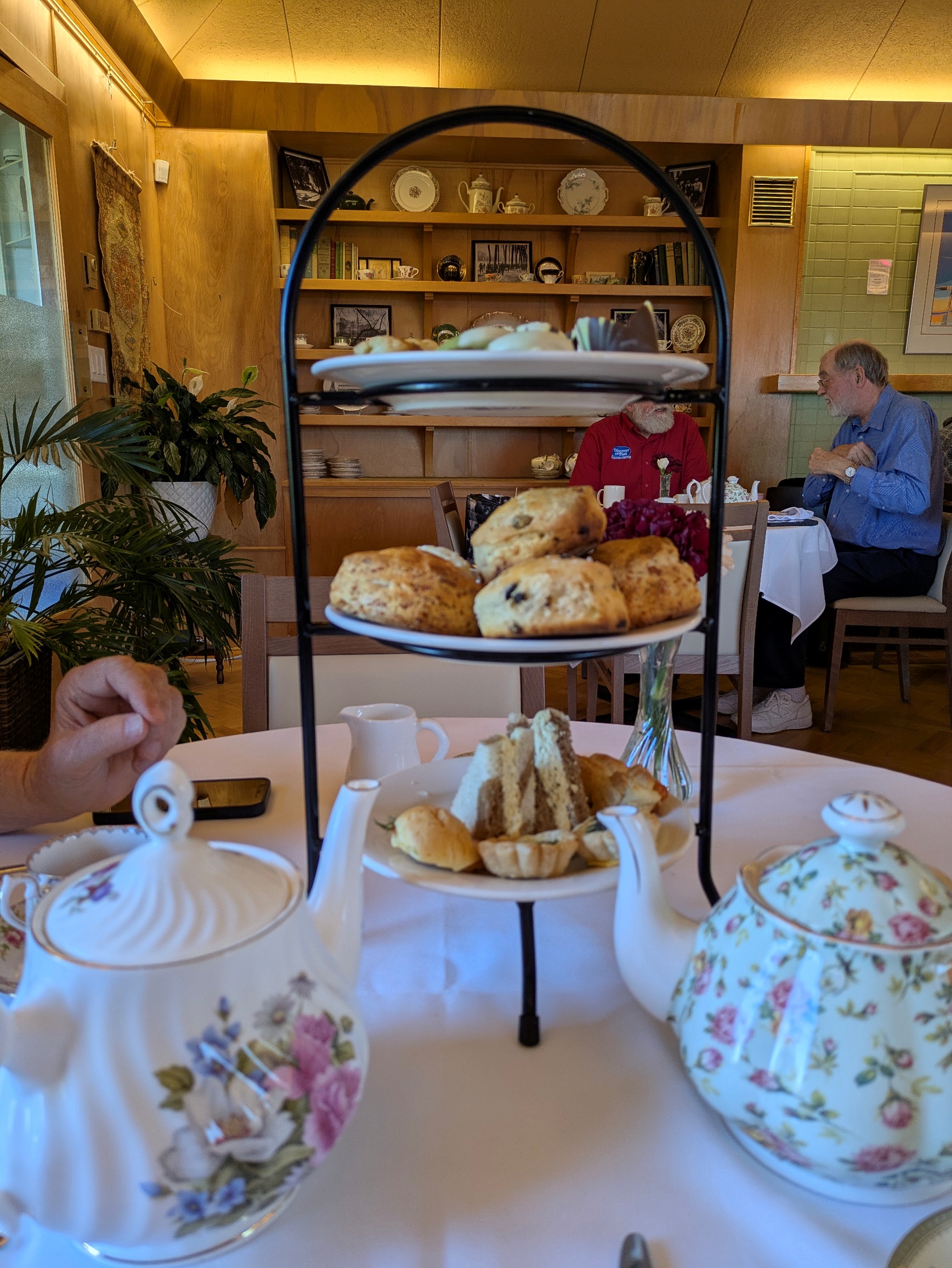 At the left is lunch! The Tea House at Abkahazi serves a formal "high tea" that was absolutely delicious as well as beautifully presented! It probably wasn't so nutritious but the courses were all different and we enjoyed it tremendously! Then we were guided through the garden and learned about its history as well as the current maintenance and administration. Its origins began in the 1920's when Peggy Pemberton-Carter met exiled Georgian Prince Nicholas Abkhazi. They met up again after WWII when Peggy had begun building her home and creating her garden in Victoria, and then they were married in 1946. After their deaths, the Land Conservancy of British Columbia was able to purchase the estate and save it from condo development! There is a commemorative rock in the garden, in recognition of a donation from the Georgian ambassador to Canada that reads "The Garden that Love Built." Lots more pictures, of course, in the Photo Section. Below are some highlights: the lily pond just outside the tea room, a typical path through the garden and a Weeping Blue Atlas Cedar.   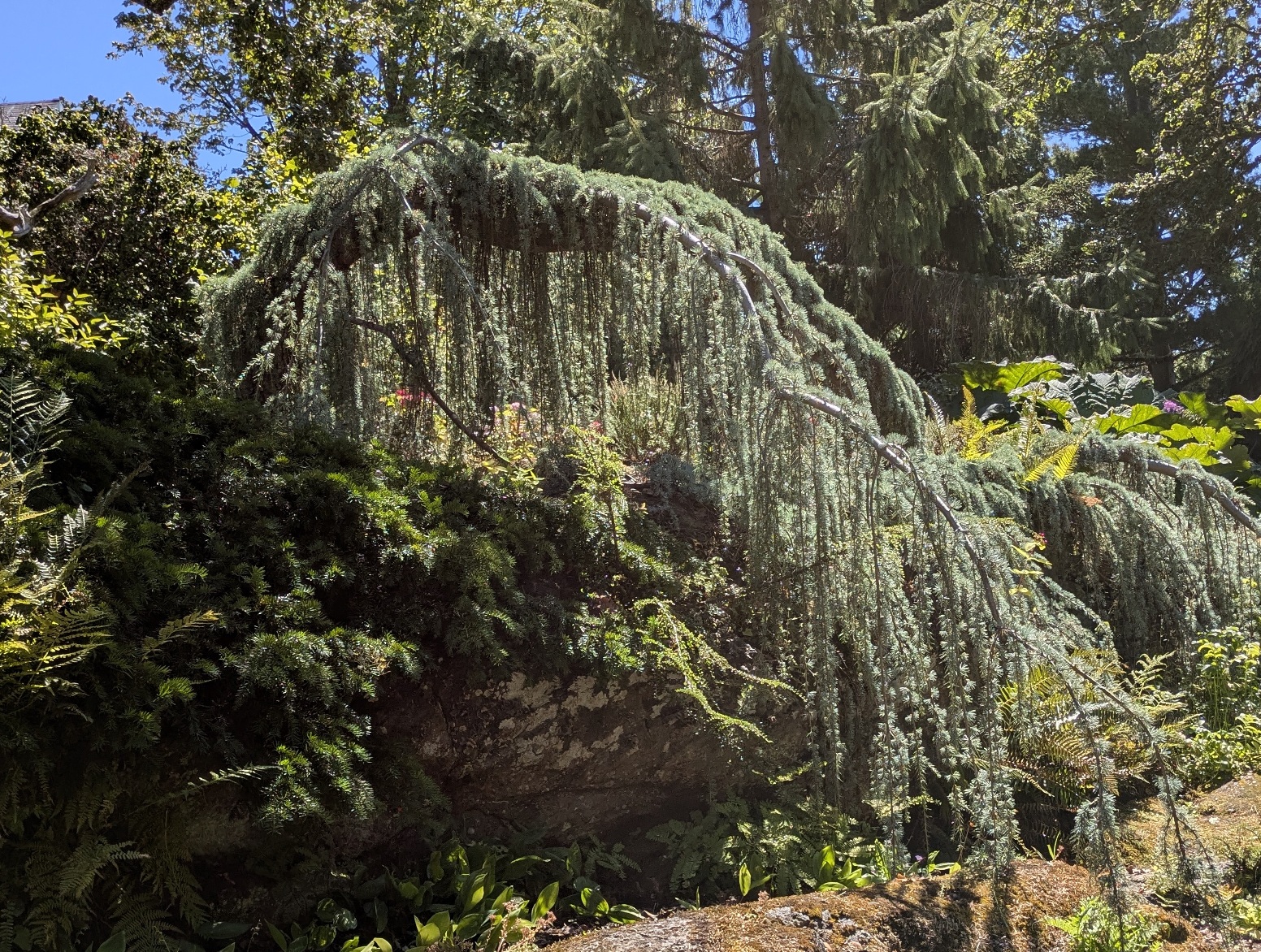 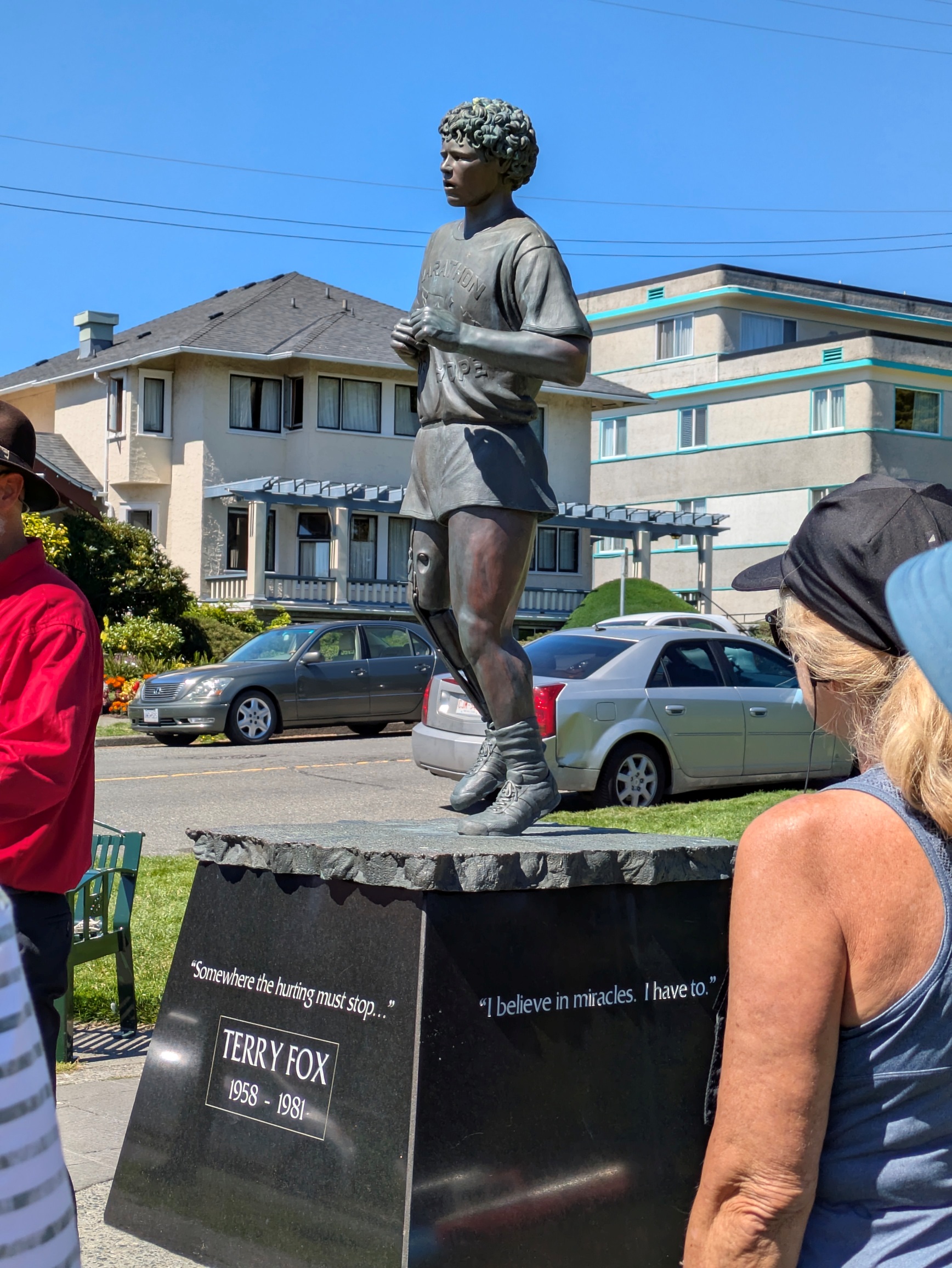  After that garden tour, those who wanted to
rest were shuttled back to the hotel and the rest of us were taken on a
tour of Beacon
Hill Park by John Adams. We stopped near Mile Zero of the
trans-Canadian highway at the memorial to Terry Fox - a teen who,
having lost one leg to bone cancer, set out on a "Marathon of Hope"
walking across Canada in support of cancer research. He did not
complete his journey but Marathons still are held regularly and lots of
research has been done in his name. On the right is a bronze and
stone statue of Robert Burns created by an unknown sculptor and
dedicated in 1900. Apparently there was some miscommunication
about the size of the work, so the pedestal that was created for it is
much larger than the actual piece. After that garden tour, those who wanted to
rest were shuttled back to the hotel and the rest of us were taken on a
tour of Beacon
Hill Park by John Adams. We stopped near Mile Zero of the
trans-Canadian highway at the memorial to Terry Fox - a teen who,
having lost one leg to bone cancer, set out on a "Marathon of Hope"
walking across Canada in support of cancer research. He did not
complete his journey but Marathons still are held regularly and lots of
research has been done in his name. On the right is a bronze and
stone statue of Robert Burns created by an unknown sculptor and
dedicated in 1900. Apparently there was some miscommunication
about the size of the work, so the pedestal that was created for it is
much larger than the actual piece.Beacon Hill is a huge park and has loads of special areas including a children's petting zoo, an amphitheater, an alpine section, Goodacre Lake, the world's largest totem pole, friendly peacocks, and several unique sculptures. While we were walking around, we could hear an Irish Band playing; though we did not go watch the performance, the music was a great backdrop to our visit. Below are some highlights of our walk. First a couple of examples of the lovely flower plantings and the one on the right was taken in the alpine garden.   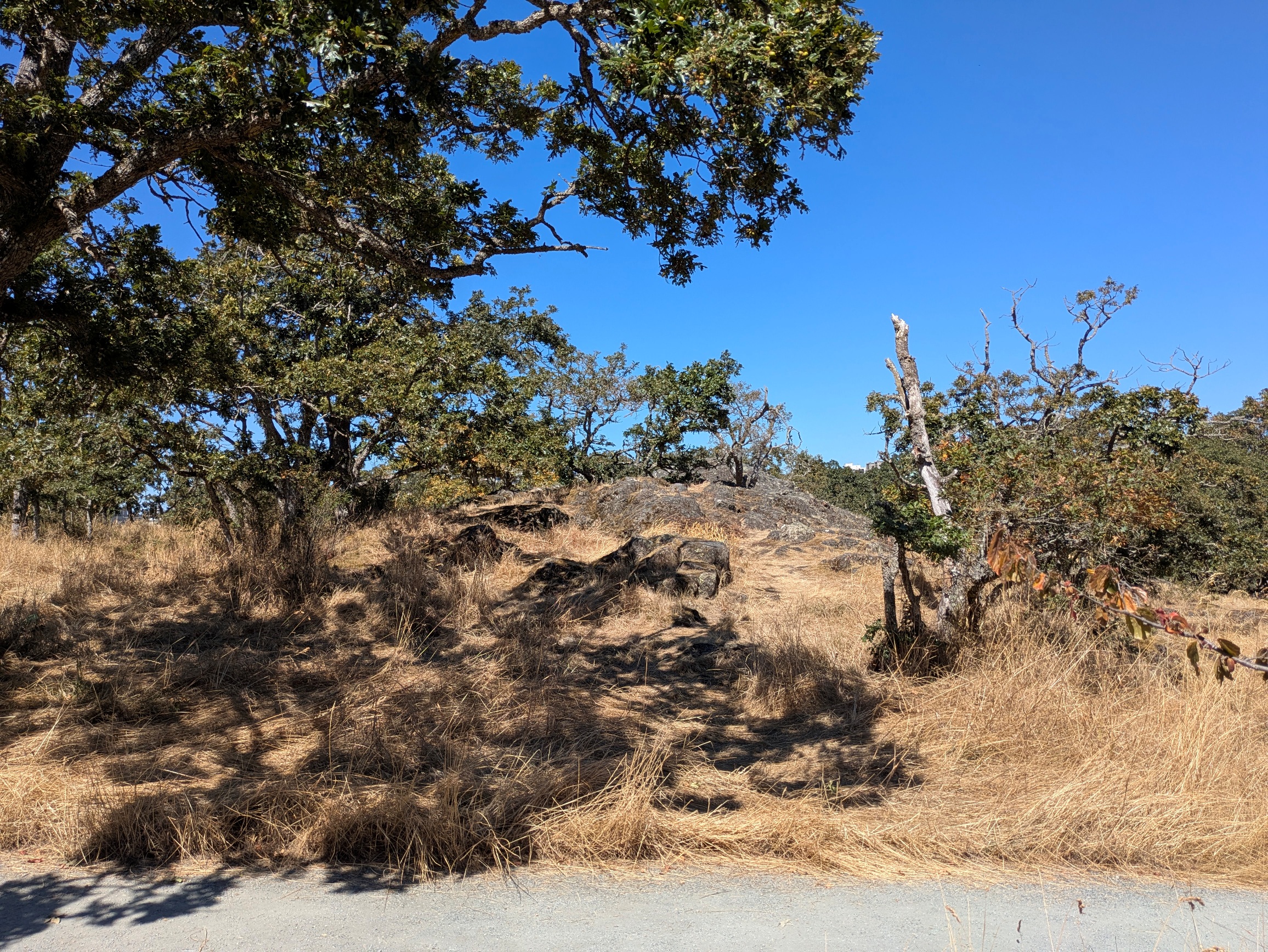 The next row includes a small
waterfall and water fowl at
Goodacre Lake, the bridge over the lake (a medieval stone bridge
constructed in 1889 as part of John Blair's original design for the
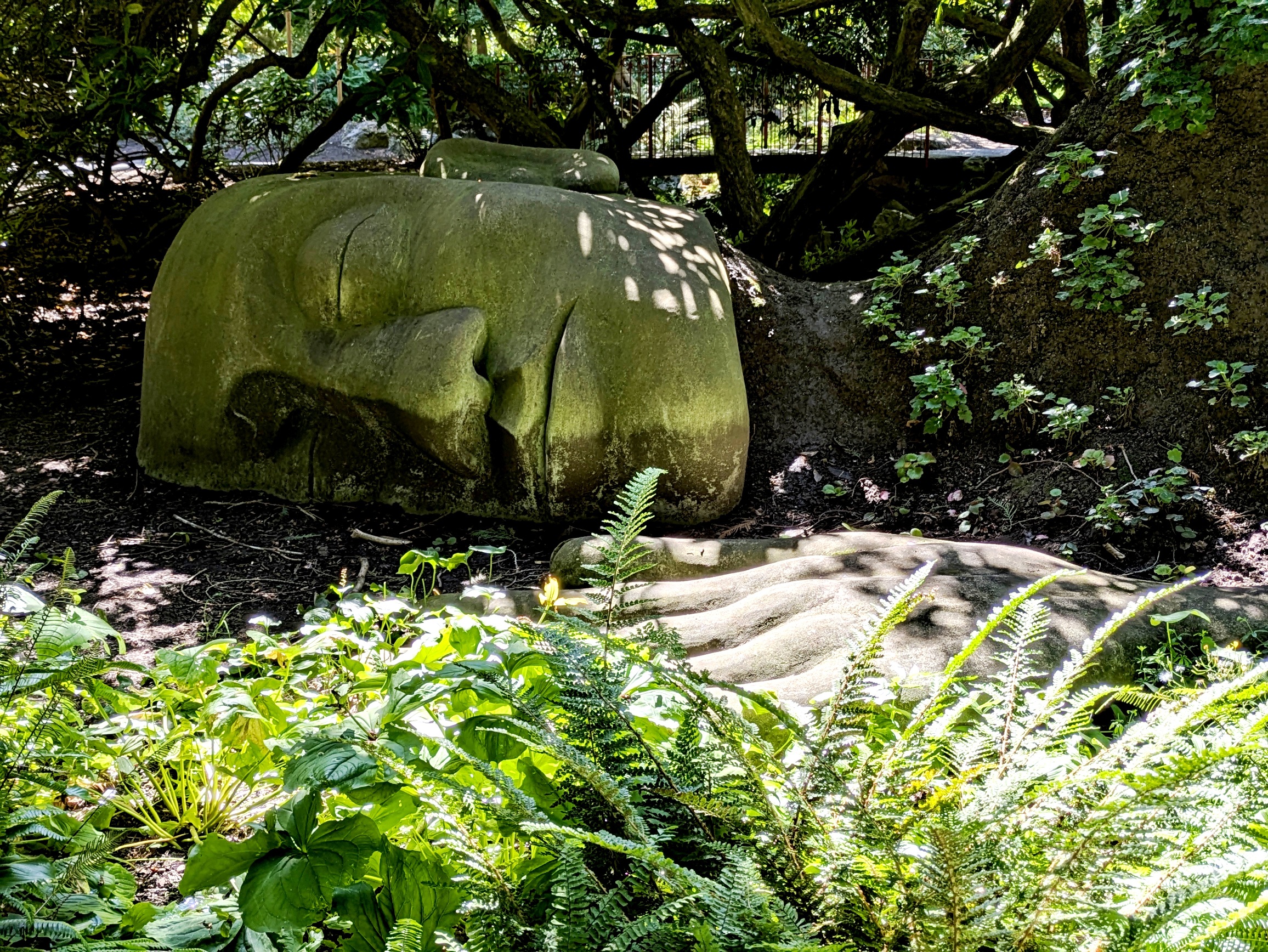
park) and the Moss Lady sculpture by Dale Doebert (2015) using cement,
boulders, metal pipe, vinyl-coated chicken wire and a clay-based soil
suitable for growing moss that covers most of the reclining figure. That evening we had dinner at Milestones then spent time packing and getting ready to leave in the morning!
   Tuesday August 12  We
had decided that our best itinerary included flying from Vancouver (not
Victoria), so Tuesday morning we walked up to the central Bus Depot a
few blocks from the hotel. Although the flowers along the bank at
the harbor were meant as a "welcome" they served as a "farewell" for
us! We took the BC Connections 9:45 AM bus to the Swartz Bay
terminal - the bus loads right into the ferry. We
had decided that our best itinerary included flying from Vancouver (not
Victoria), so Tuesday morning we walked up to the central Bus Depot a
few blocks from the hotel. Although the flowers along the bank at
the harbor were meant as a "welcome" they served as a "farewell" for
us! We took the BC Connections 9:45 AM bus to the Swartz Bay
terminal - the bus loads right into the ferry. 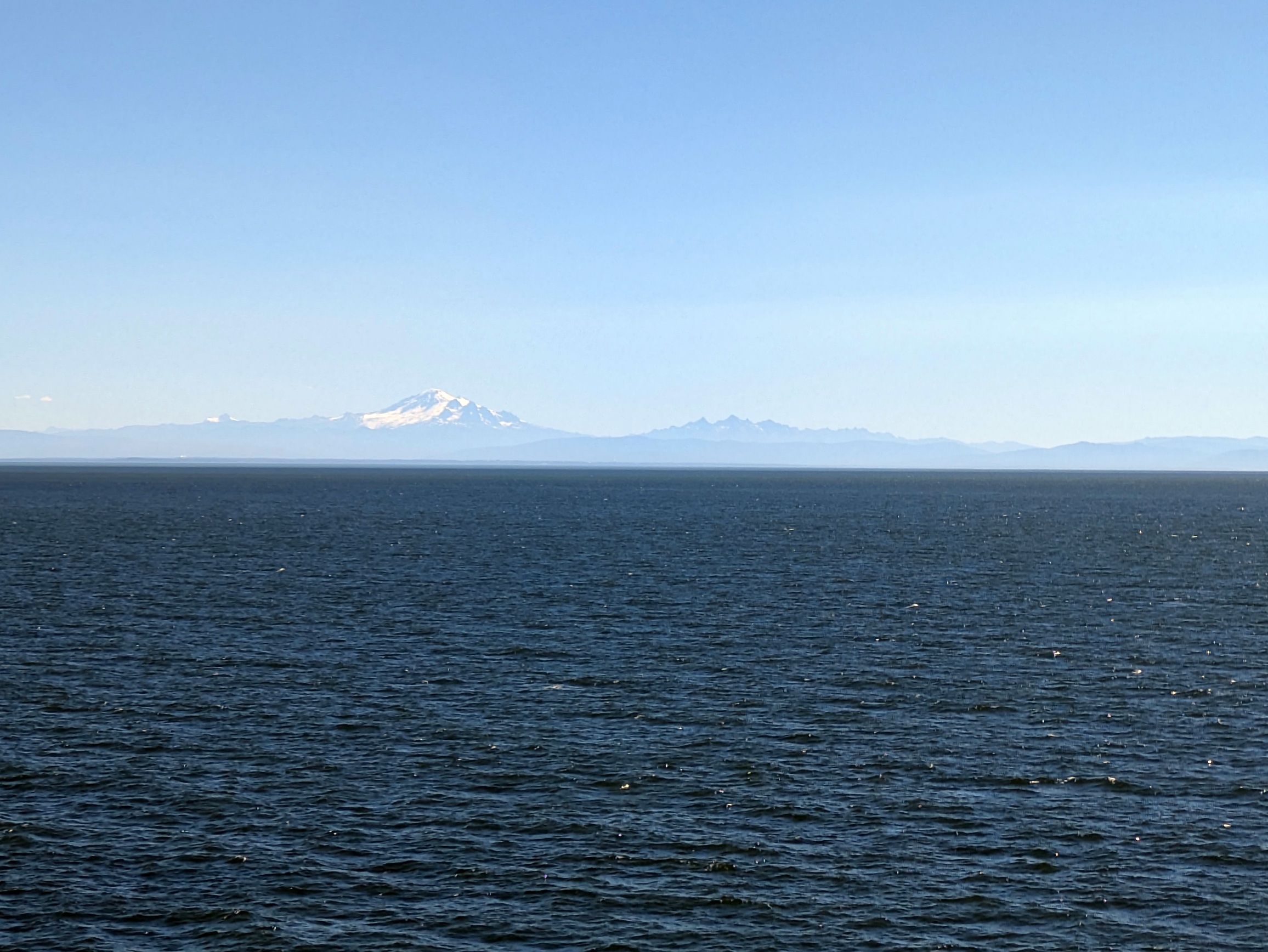 We
had lunch on the ferry and enjoyed the last views of the Cascade
Mountains as we crossed the Strait. After we docked at the
Tsawwassen terminal we switched buses and were delivered to the
airport. We spent the night at the Holiday Inn Express
at Riverport. (That was really an accident - I was aiming for the
one right next to the airport, not realizing there were two in
Richmond! But they shuttled us to the hotel then back the next
morning so it was fine.) That hotel is not close to very much but
we were able to walk to the nearby Old Spaghetti Factory
for a great supper, then get a good night's rest before returning to
Minneapolis the next day. We went through US Customs at the
Vancouver airport (there is even a big sign there that says "Welcome to
the USA") so the return at MSP was easy. Katie fed us yummy pesto
for supper and we got a leisurely start in the morning back to
Iowa. Such a fun trip and so
many ideas for plants and gardens! We
had lunch on the ferry and enjoyed the last views of the Cascade
Mountains as we crossed the Strait. After we docked at the
Tsawwassen terminal we switched buses and were delivered to the
airport. We spent the night at the Holiday Inn Express
at Riverport. (That was really an accident - I was aiming for the
one right next to the airport, not realizing there were two in
Richmond! But they shuttled us to the hotel then back the next
morning so it was fine.) That hotel is not close to very much but
we were able to walk to the nearby Old Spaghetti Factory
for a great supper, then get a good night's rest before returning to
Minneapolis the next day. We went through US Customs at the
Vancouver airport (there is even a big sign there that says "Welcome to
the USA") so the return at MSP was easy. Katie fed us yummy pesto
for supper and we got a leisurely start in the morning back to
Iowa. Such a fun trip and so
many ideas for plants and gardens!
Click
here to
return to the first part of the trip: Vancouver |