|
[You can enlarge any picture in
this narrative by
clicking on it - it
will open in a separate window and in many cases, show detail you can't
see in the smaller version. (Click on the back arrow to return to
the text.) Many more pictures can be found here.] Tuesday August 5  We
drove up to Minneapolis on Monday and stayed with Katie and George
using their new (guest) condo! It is still a work in progress and
there is no HVAC yet but the bed was comfortable, company was good and
she took us to the airport the next morning. Security and the plane trip
were smooth. We
had already
filled out the ArriveCAN form on line so when we got to Canada we just
scanned our passports and
they passed us right through. We took a taxi to the Coast Coal
Harbor hotel where we got checked in, met with our Road Scholar
Group
and leader (Joan), had a buffet supper and then off to bed for a busy
day to
come. We
drove up to Minneapolis on Monday and stayed with Katie and George
using their new (guest) condo! It is still a work in progress and
there is no HVAC yet but the bed was comfortable, company was good and
she took us to the airport the next morning. Security and the plane trip
were smooth. We
had already
filled out the ArriveCAN form on line so when we got to Canada we just
scanned our passports and
they passed us right through. We took a taxi to the Coast Coal
Harbor hotel where we got checked in, met with our Road Scholar
Group
and leader (Joan), had a buffet supper and then off to bed for a busy
day to
come.Wednesday August 6 It was a rainy day, which was not a surprise. What WAS a surprise was that it was really the only rainy day we had! After our buffet breakfast we met Alasdair Butcher, an urban planning specialist, who talked about the development of Vancouver and the trials of its expanding population, as well as the issues of the First Nations (what we would call "Native Canadians").  [My
bad news of the day was that my trusty Nikon super zoom camera stopped
working correctly. I had a hard time getting it to focus - as you
will see in the pictures! After a couple of days I started using
my phone camera and had much better luck.] [My
bad news of the day was that my trusty Nikon super zoom camera stopped
working correctly. I had a hard time getting it to focus - as you
will see in the pictures! After a couple of days I started using
my phone camera and had much better luck.] We had a
charter bus to Van
Dusen Botanical Garden – our driver pointed out some sights
on the way. We were given garden maps and sent
off to see it on our own. (They
have policy of no guided tours which was too bad from my point of view
as we had lots of questions and would have appreciated some guidance
about where to go, what to see!) There were numerous sculptures
and loads of trees and flowers - see lots more at the photos file - but
here are a few. We had a
charter bus to Van
Dusen Botanical Garden – our driver pointed out some sights
on the way. We were given garden maps and sent
off to see it on our own. (They
have policy of no guided tours which was too bad from my point of view
as we had lots of questions and would have appreciated some guidance
about where to go, what to see!) There were numerous sculptures
and loads of trees and flowers - see lots more at the photos file - but
here are a few.   On
the left, a monkey puzzle tree (above) and a fountain in Livingstone
Lake; at
the right, 2 (of hundreds) examples of floral borders. We didn’t have time to see it
all, then met back at
the Shaughnessy
Restaurant for a lunch we had pre-ordered. That made
the meal go smoothly and quickly! On
the left, a monkey puzzle tree (above) and a fountain in Livingstone
Lake; at
the right, 2 (of hundreds) examples of floral borders. We didn’t have time to see it
all, then met back at
the Shaughnessy
Restaurant for a lunch we had pre-ordered. That made
the meal go smoothly and quickly! After lunch we bussed to Queen Elizabeth Park. Again, we were on our own to explore - but without a map this time. In front of the  Bloedel
Conservatory is the Lions Clock (left) donated by Bloedel
Conservatory is the Lions Clock (left) donated by the Vancouver
Mandarin Lions Club in 1995 (an inscription says "We Serve") to
commemorate their relationship with a Hong Kong Lions Club. Nearby there is an observation point where we could
see most of
Vancouver,
though not
very clearly due to the clouds.
At the right see a zoomed view of BC Place (a sport stadium) and Harbor
Centre (includes a rotating restaurant on the top). We walked
down to the
sunken
gardens, then to the duck pond, smiled at small children playing and
drawing
on the path
in chalk. By the time we climbed back up
the hill we didn’t have time to visit the conservatory but would like
to another time. Below
are a
view of the Canadian mapleleaf flower bed in the sunken garden (with a
mimosa at the front left), a lacecap hydrangea and part of a sculpture
group with a story. Joan is telling us the backstory: across from
these 3 people is a photographer taking their picture. The story
is that the photographer is married to the woman at the left, who is
having an affair with the man next to her. I'm not sure who they
are or why we should care but that's the story that is told! the Vancouver
Mandarin Lions Club in 1995 (an inscription says "We Serve") to
commemorate their relationship with a Hong Kong Lions Club. Nearby there is an observation point where we could
see most of
Vancouver,
though not
very clearly due to the clouds.
At the right see a zoomed view of BC Place (a sport stadium) and Harbor
Centre (includes a rotating restaurant on the top). We walked
down to the
sunken
gardens, then to the duck pond, smiled at small children playing and
drawing
on the path
in chalk. By the time we climbed back up
the hill we didn’t have time to visit the conservatory but would like
to another time. Below
are a
view of the Canadian mapleleaf flower bed in the sunken garden (with a
mimosa at the front left), a lacecap hydrangea and part of a sculpture
group with a story. Joan is telling us the backstory: across from
these 3 people is a photographer taking their picture. The story
is that the photographer is married to the woman at the left, who is
having an affair with the man next to her. I'm not sure who they
are or why we should care but that's the story that is told!
  It was clear from our
surroundings when we entered Chinatown - for instance,
the lightpoles in the area have dragon motifs (left). Our last garden of the day was the
Sun
Yet-Sen Classical Chinese
Garden, created and opened in 1986 as part of the World Exposition held
in Vancouver. Our leader
for that center, Thomas, gave us a good
history of
the kind of garden we were going into – from the Ming Dynasty
mid-1300’s to
mid-1600’s. We gathered in the China Maple
Hall (plaque on the right) which is an example of Ming Dynasty building
techniques that include specific requirements like no nails, screws or
glue! It was clear from our
surroundings when we entered Chinatown - for instance,
the lightpoles in the area have dragon motifs (left). Our last garden of the day was the
Sun
Yet-Sen Classical Chinese
Garden, created and opened in 1986 as part of the World Exposition held
in Vancouver. Our leader
for that center, Thomas, gave us a good
history of
the kind of garden we were going into – from the Ming Dynasty
mid-1300’s to
mid-1600’s. We gathered in the China Maple
Hall (plaque on the right) which is an example of Ming Dynasty building
techniques that include specific requirements like no nails, screws or
glue!   As a replica of a Ming Dynasty creation, the garden
incorporates some basic Chinese design ideas:
Feng Shui, Taoism, Yin and Yang. It also tries to balance the
four main
elements: rock, water, plants, and architecture, and is designed so
that, as you walk through it, each view of the area is different.
To the left is one view of a water feature and pagoda - you can see all
four elements here. The top of
the pagoda features a heron - a symbol of purity, strength and
longevity. Its position at the top is said to assist souls on
their journey to heaven. The Chinese word for heron is lù which
also means "good fortune!" On the right is an example of Chinese
Bonsai (Jasmine plant). As a replica of a Ming Dynasty creation, the garden
incorporates some basic Chinese design ideas:
Feng Shui, Taoism, Yin and Yang. It also tries to balance the
four main
elements: rock, water, plants, and architecture, and is designed so
that, as you walk through it, each view of the area is different.
To the left is one view of a water feature and pagoda - you can see all
four elements here. The top of
the pagoda features a heron - a symbol of purity, strength and
longevity. Its position at the top is said to assist souls on
their journey to heaven. The Chinese word for heron is lù which
also means "good fortune!" On the right is an example of Chinese
Bonsai (Jasmine plant).  On
way back to hotel we had a
little
bus tour through Chinatown and Gastown. The gas clock on the left
plays "O Canada" every 15
minutes and
“toots” the hours with a steam whistle. On the right is a view of
the terrace surrounding the Civic Center - the Olympic Cauldron (from
the XXI Winter Games in 2010) and the Digital Orca sculpture by Douglas
Coupland. We had an hour or so before supper then went to
Earl’s Kitchen. We had also
pre-ordered here (I love this system) - the service and food were fine
but it was way too loud for conversation so we left and walked back to
the hotel as
soon as we
had finished dinner. On
way back to hotel we had a
little
bus tour through Chinatown and Gastown. The gas clock on the left
plays "O Canada" every 15
minutes and
“toots” the hours with a steam whistle. On the right is a view of
the terrace surrounding the Civic Center - the Olympic Cauldron (from
the XXI Winter Games in 2010) and the Digital Orca sculpture by Douglas
Coupland. We had an hour or so before supper then went to
Earl’s Kitchen. We had also
pre-ordered here (I love this system) - the service and food were fine
but it was way too loud for conversation so we left and walked back to
the hotel as
soon as we
had finished dinner. Thursday August 7   After
breakfast this morning we had a presentation by Tracy Kolb,
representing the Vancouver Botanical Gardens Association. One of
the things she told us about was "Community Gardens." The city of
Vancouver is very dense, with many people living in apartments and
condos, so one way they can help provide more green/garden space is
through Community Gardens. Some of them are relatively permanent,
in parks, others are temporary. As she described this, I realized
we had one just across the street that we could see from the window in
our hotel room! Pictured at the left, looking down from our
window, each little garden is contained in a box. When the
construction here is finished and the owners want to reclaim the area,
they will use forklifts to just move all of the boxes to a new location. After
breakfast this morning we had a presentation by Tracy Kolb,
representing the Vancouver Botanical Gardens Association. One of
the things she told us about was "Community Gardens." The city of
Vancouver is very dense, with many people living in apartments and
condos, so one way they can help provide more green/garden space is
through Community Gardens. Some of them are relatively permanent,
in parks, others are temporary. As she described this, I realized
we had one just across the street that we could see from the window in
our hotel room! Pictured at the left, looking down from our
window, each little garden is contained in a box. When the
construction here is finished and the owners want to reclaim the area,
they will use forklifts to just move all of the boxes to a new location.  The
first field trip this morning was to the Japanese Dr. Inazo Nitobe
Memorial Garden. This was a lovely place - Dr. Nitobe's goal was
to create an understanding of Japanese culture in the west.
We had a guide here and were not allowed to wander around ourselves -
that's too bad because I think we might have felt the "zen" better
given a chance to just sit and appreciate it! On the left is a
picture of the small pond and bridge - an iconic scene found in many
gardens. The photo on the right is from the yard next to the tea
house and shows a stone lantern behind
a water collector - it's hard to see among the foliage but water runs
out of a clay tube and into a collection bowl.
Below are two more photos from that garden: one is a waterfall whose
lovely sound added to the serene feeling of this garden; the other
another iconic stone lantern (in the photos
collection there are numerous pictures of other lanterns). The
first field trip this morning was to the Japanese Dr. Inazo Nitobe
Memorial Garden. This was a lovely place - Dr. Nitobe's goal was
to create an understanding of Japanese culture in the west.
We had a guide here and were not allowed to wander around ourselves -
that's too bad because I think we might have felt the "zen" better
given a chance to just sit and appreciate it! On the left is a
picture of the small pond and bridge - an iconic scene found in many
gardens. The photo on the right is from the yard next to the tea
house and shows a stone lantern behind
a water collector - it's hard to see among the foliage but water runs
out of a clay tube and into a collection bowl.
Below are two more photos from that garden: one is a waterfall whose
lovely sound added to the serene feeling of this garden; the other
another iconic stone lantern (in the photos
collection there are numerous pictures of other lanterns).     Just
down the street was the University of British Columbia Botanical
Garden. Again, we had volunteer guides to take us through the
various plantings here but in this case, they were helpful and shared
lots of knowledge! We saw several hummingbirds at the various
gardens but they are quick and hard to photograph! John caught a
black chinned hummingbird here but it's hard to see (near the center of
the photo at the left) partly because it was moving and partly because
I had to enlarge it! On the right is a Western Red Cedar
tree also called the "Tree of Life." Its vines and roots are used
for rope, baskets and nets; the leaves have been used for herbal cures;
the wood is used for furniture, homes, tools and totem poles.
Some specimens have lived for over 1000 years. Below are some
additional pictures: John enjoying the herb garden, the vegetable garden, and our
guide, Ryder, explaining that this invasive bamboo has to be cut back
regularly to keep it in check. Just
down the street was the University of British Columbia Botanical
Garden. Again, we had volunteer guides to take us through the
various plantings here but in this case, they were helpful and shared
lots of knowledge! We saw several hummingbirds at the various
gardens but they are quick and hard to photograph! John caught a
black chinned hummingbird here but it's hard to see (near the center of
the photo at the left) partly because it was moving and partly because
I had to enlarge it! On the right is a Western Red Cedar
tree also called the "Tree of Life." Its vines and roots are used
for rope, baskets and nets; the leaves have been used for herbal cures;
the wood is used for furniture, homes, tools and totem poles.
Some specimens have lived for over 1000 years. Below are some
additional pictures: John enjoying the herb garden, the vegetable garden, and our
guide, Ryder, explaining that this invasive bamboo has to be cut back
regularly to keep it in check.     The bus took us back to the hotel
and then the rest of the day was on our own. We started with
lunch at Urban Fare just a block from the hotel - a
grocery/deli. We bought a sandwich and wrap, ate there at the
store then headed off to Stanley Park - the aquarium and
gardens. The "gold balls" street art is right by the hotel;
we then passed lots of art installations along the harbor - the one on
the right is the "Canadian mapleleaf fountain." The bus took us back to the hotel
and then the rest of the day was on our own. We started with
lunch at Urban Fare just a block from the hotel - a
grocery/deli. We bought a sandwich and wrap, ate there at the
store then headed off to Stanley Park - the aquarium and
gardens. The "gold balls" street art is right by the hotel;
we then passed lots of art installations along the harbor - the one on
the right is the "Canadian mapleleaf fountain." We weren't in a hurry so took about half an hour to reach the aquarium, but it was an entertaining walk. I had already purchased the tickets on the web so we didn't have to wait in line - just show the QR code on the phone and go right in. It was a good aquarium but way too crowded indoors. They have the tickets timed for entry but there is no limit as t  o how long you can stay. So
that probably limits the line to get in but doesn't help with the
crowds once you are there. o how long you can stay. So
that probably limits the line to get in but doesn't help with the
crowds once you are there. At the right
is the "Killer Whale, Chief of the Undersea World" in front of the
building. It's a bronze done by Bill Reid. Once inside, we
started with the fish displays. One of our favorites has always
been the
jellies (left) so we spent a few minutes just watching them floating
around! There were loads of small aquariums with assorted animal
and plant life. (Lots more can be seen in the main photo collection.)
The picture below includes a couple of lion fish (the black and white
spikey ones) and a blue doctorfish (a type of surgeonfish).
Then we moved on to other sorts of critters found in the Amazon Gallery
that is full of animals who typically live in Central and South
American jungles. At the right
is the "Killer Whale, Chief of the Undersea World" in front of the
building. It's a bronze done by Bill Reid. Once inside, we
started with the fish displays. One of our favorites has always
been the
jellies (left) so we spent a few minutes just watching them floating
around! There were loads of small aquariums with assorted animal
and plant life. (Lots more can be seen in the main photo collection.)
The picture below includes a couple of lion fish (the black and white
spikey ones) and a blue doctorfish (a type of surgeonfish).
Then we moved on to other sorts of critters found in the Amazon Gallery
that is full of animals who typically live in Central and South
American jungles. In
the top row, below, are a young flamingo, a Goeldi's Monkey and a
Linnaeus's
Two Toed Sloth enjoying a check up from the tech. In case you
count three toes on the right leg in this picture, you should know that
all sloths have three toes on their hind legs,
but a two-toed sloth has only two claws on the front legs. The
two-toed variety are
larger, more active, more nocturnal, and have a more varied diet than
their slower relatives. (We learned that earlier this year in
Costa Rica where both types are prevalent.) In
the top row, below, are a young flamingo, a Goeldi's Monkey and a
Linnaeus's
Two Toed Sloth enjoying a check up from the tech. In case you
count three toes on the right leg in this picture, you should know that
all sloths have three toes on their hind legs,
but a two-toed sloth has only two claws on the front legs. The
two-toed variety are
larger, more active, more nocturnal, and have a more varied diet than
their slower relatives. (We learned that earlier this year in
Costa Rica where both types are prevalent.) The second row starts with a Yacare Caiman, a distinct species of crocodile that is believed to have existed for over 20 million years! At that point we were feeling too claustrophobic and found our way outdoors. That part is much less crowded but has fewer exhibits, too. In the center is one of the stars - a Stellar Sea Lion and yes, he poses like that most of the day! Finally, a pair of young otters who were rescued and now make their home in their own pool here. They are provided with lots of toys and really do look like they are always having fun!     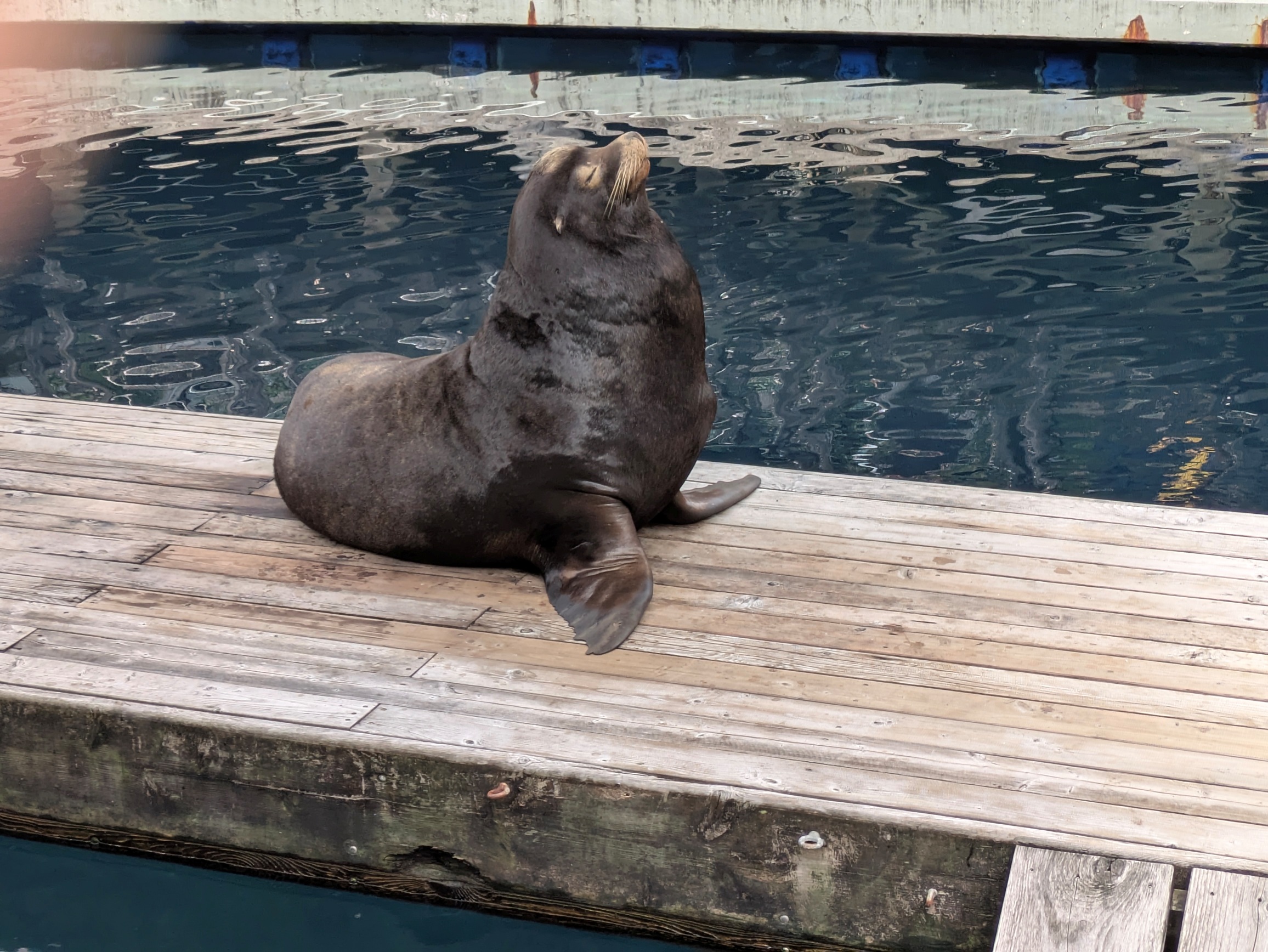    We had a short ice cream break before leaving the Wild
Coast area, then moved on to some of the garden areas of the
park. We passed some lovely, well-kept displays on our way to the
Rose Garden. Most of the roses are not labelled but there are a
couple of exceptions. The pink ones on the left are Hybrid Tea
roses and on the right are the yellow Julia Child roses. We had a short ice cream break before leaving the Wild
Coast area, then moved on to some of the garden areas of the
park. We passed some lovely, well-kept displays on our way to the
Rose Garden. Most of the roses are not labelled but there are a
couple of exceptions. The pink ones on the left are Hybrid Tea
roses and on the right are the yellow Julia Child roses.Below are one of the individual floral displays between gardens; in the center is John posing with a section of the Shakespeare Garden and on the right is another area of the Shakespeare Garden. The Shakespeare garden started (in 1916) with an oak tree planted to honor the 300th anniversary of his death. Other trees that were specifically mentioned in his works were added and then later, other types of flowers and herbs that occurred in his writings.      It seemed a long hike back to the hotel along the
harbor. We enjoyed observing the skyline and the yachts of
various shapes and sizes that were moored in the harbor. By the
time we got back to the hotel, we were tired out and chose to have
supper there at Preston's Restaurant which was very good. I had
crab cakes, John had halibut and we shared an amazing Elderflower
Posset for dessert! We are pictured all worn out, hat-head and
all! Then we had to get ready to leave the next morning as we
were catching a ferry over to Vancouver Island and the city of
Victoria. Below are the Ferry Terminal, a view from the back of
the boat and what our guide, Joan, tells me is a view of Mt. Baker in
the
Washington Cascades. Interestingly, to get from the Tswassen
Terminal on the mainland to Swartz Bay on Vancouver Island we actually
have to pass through a small patch of US waters! The trip
continues on Vancouver Island in Part II. It seemed a long hike back to the hotel along the
harbor. We enjoyed observing the skyline and the yachts of
various shapes and sizes that were moored in the harbor. By the
time we got back to the hotel, we were tired out and chose to have
supper there at Preston's Restaurant which was very good. I had
crab cakes, John had halibut and we shared an amazing Elderflower
Posset for dessert! We are pictured all worn out, hat-head and
all! Then we had to get ready to leave the next morning as we
were catching a ferry over to Vancouver Island and the city of
Victoria. Below are the Ferry Terminal, a view from the back of
the boat and what our guide, Joan, tells me is a view of Mt. Baker in
the
Washington Cascades. Interestingly, to get from the Tswassen
Terminal on the mainland to Swartz Bay on Vancouver Island we actually
have to pass through a small patch of US waters! The trip
continues on Vancouver Island in Part II.   |


