(This
section of the trip log
includes our bus trip to Étretat, Le Havre and Honfleur, boarding the
MS Seine Princess and our river cruise back down the Seine to Rouen.
You can enlarge any picture in this narrative by
clicking on it - it
will open in a separate window and in many cases, show detail you can't
see in the smaller version.)
Thursday May 9

 We
left at 8 am this morning, heading to Étretat
to see the famous cliffs that so many artists have painted. We
drove over the Tancarville Bridge (at left) over the Seine near Le
Havre.
It is known as the "new"
suspension
bridge completed in 1959; then in the 1990's the cables and shoulders
were completely replaced.
We
left at 8 am this morning, heading to Étretat
to see the famous cliffs that so many artists have painted. We
drove over the Tancarville Bridge (at left) over the Seine near Le
Havre.
It is known as the "new"
suspension
bridge completed in 1959; then in the 1990's the cables and shoulders
were completely replaced.
Arriving at Étretat
it was windy, cloudy and drizzly but we
walked along the seafront (English Channel) and took pictures.
The classic, most-painted view is the one at the right.
Below are three different impressions of that view!
Claude Monet (left) and Gustav Courbet (center) that we saw at the
Musée D'Orsay earlier in the week. On the right is one by Eugène
Boudin that we saw in Le Havre later this afternoon!
Impressionism, remember: they aren't supposed to look the same but
the rock formation at the right of the cliff is unmistakable.

 More
pictures - to the left is the "other" direction on the beach.
There are some paintings done of that view, that include the church up
on the cliff, but not so many. This one is facing northeast,
whereas the ones above are facing southwest - does it have to do with
the best lighting? And then on the right is the view looking back at
the town (with souvenir stalls lining the road) from the
boardwalk. The ice cream looked good, but the day was just too
chilly for it to be appealing. We had a great lunch at the Salamandre
Restaurant
– cod and
potatoes with cream sauce plus scrumptious apple tart for
dessert. Very nice – and a better portion size than we found in
Paris. I bought
a lovely scarf (promised to a friend) and John bought a
classic French horizontal striped blue and white "sailor"shirt.
There is a story about
the shirt - later on, when we get to Giverny!
More
pictures - to the left is the "other" direction on the beach.
There are some paintings done of that view, that include the church up
on the cliff, but not so many. This one is facing northeast,
whereas the ones above are facing southwest - does it have to do with
the best lighting? And then on the right is the view looking back at
the town (with souvenir stalls lining the road) from the
boardwalk. The ice cream looked good, but the day was just too
chilly for it to be appealing. We had a great lunch at the Salamandre
Restaurant
– cod and
potatoes with cream sauce plus scrumptious apple tart for
dessert. Very nice – and a better portion size than we found in
Paris. I bought
a lovely scarf (promised to a friend) and John bought a
classic French horizontal striped blue and white "sailor"shirt.
There is a story about
the shirt - later on, when we get to Giverny!

 After
lunch, we headed back southwest along the coast to Le Havre to the André
Malraux Museum of Art.
The huge sculpture to the left is made of shipping containers -
appropriate to Le Havre which is a major port. A big exhibition
of Dufy is coming and we had a peek of some of the set-up (including
meticulous cleaning of some of the paintings and frames) but it wasn't open for public viewing yet.
We did, however, enjoy a lot of Boudin, Renoir, Pissarro and other
impressionists. I have to share at least one painting.
Though there was a multitude of Boudins, including about a dozen of
grazing cows, I chose a Pissarro to share: "Sunrise in Éragny." You
really have to enlarge it to get a feel for it. Éragny is now a northern suburb of
Paris but in the late 1800's when Pissarro lived there, it was still
very rural.
After
lunch, we headed back southwest along the coast to Le Havre to the André
Malraux Museum of Art.
The huge sculpture to the left is made of shipping containers -
appropriate to Le Havre which is a major port. A big exhibition
of Dufy is coming and we had a peek of some of the set-up (including
meticulous cleaning of some of the paintings and frames) but it wasn't open for public viewing yet.
We did, however, enjoy a lot of Boudin, Renoir, Pissarro and other
impressionists. I have to share at least one painting.
Though there was a multitude of Boudins, including about a dozen of
grazing cows, I chose a Pissarro to share: "Sunrise in Éragny." You
really have to enlarge it to get a feel for it. Éragny is now a northern suburb of
Paris but in the late 1800's when Pissarro lived there, it was still
very rural.

 Then
we went back over a Seine estuary on the Pont de Normandie to
Honfleur. That bridge (left) was opened in January 1995 and is the
longest cable-stayed bridge ever built. At Honfleur we boarded the MS
Seine Princess (a Croisi Europe ship) that was our home for the rest of
our trip. Boarding
went easily – they were ready for us and very experienced in loading
groups of travellers! The cabin was small but adequate. It was
hot when we arrived but cooled down nicely when I turned on the
AC! We only get 1 key, but that really ended up not being a big
deal.
Then
we went back over a Seine estuary on the Pont de Normandie to
Honfleur. That bridge (left) was opened in January 1995 and is the
longest cable-stayed bridge ever built. At Honfleur we boarded the MS
Seine Princess (a Croisi Europe ship) that was our home for the rest of
our trip. Boarding
went easily – they were ready for us and very experienced in loading
groups of travellers! The cabin was small but adequate. It was
hot when we arrived but cooled down nicely when I turned on the
AC! We only get 1 key, but that really ended up not being a big
deal.  The ship is small enough that we could track down the one
  with
the key pretty easily and, when you leave the ship, you leave the key
at the desk. The safe is too small even for my tiny netbook (it
held passports, cameras and money) and there were only two outlets,
though (surprisingly) that didn't prove to be a problem for us.
WiFi only worked in the lounge - while a little inconvenient that
wasn't a major issue.
with
the key pretty easily and, when you leave the ship, you leave the key
at the desk. The safe is too small even for my tiny netbook (it
held passports, cameras and money) and there were only two outlets,
though (surprisingly) that didn't prove to be a problem for us.
WiFi only worked in the lounge - while a little inconvenient that
wasn't a major issue.
Nice stained glass plaque in the main reception area (right, above) and Honfleur Seine sunset at the left. We had a 7 pm
welcome gathering in the lounge, followed by dinner. Tomorrow morning
we are
invited on a walking tour at the very civilized hour of 10 am!
 Friday – May 10
This morning we wandered the town and harbor of Honfleur.
The first picture (right) is of the Rue des Petites Boucheries
(Little Butchers St) in the heart of "Old Town." The name comes
from the 17th century when  butcher
stalls lined the street. You can see the old half-timbered
construction and at the end of the street the back and steeple of Saint
Stephen's Church,
originally built in 1369, which is now a museum of Honfleur's heritage,
primarily
the naval history. (It's hard for me to even conceptualize "built in 1369!")
butcher
stalls lined the street. You can see the old half-timbered
construction and at the end of the street the back and steeple of Saint
Stephen's Church,
originally built in 1369, which is now a museum of Honfleur's heritage,
primarily
the naval history. (It's hard for me to even conceptualize "built in 1369!")
We spent some time exploring the area of Honfleur
Harbor. The houses along the harbor remind me a lot of Amsterdam
canal houses. They are so narrow for exactly the same reason:
real estate was taxed by the "frontage." So they tended to be
quite narrow, but very tall - many were five stories high! Some
of the sights of the harbor area: left below is the old
Harbormaster's House, the carousel and some interesting "modern art!"

 St.
Catherine's
church is made entirely
of wood. The existing church was built in the 15th century (replacing a
stone structure that was destroyed during the Hundred Years' War) using
the skills of the local ship builders, which explains why the interior
shape is that of an
overturned
double hull ship. The picture at the right faces the back of the church
but you can see the ceiling shape. John tried out the acoustics
with a spiritual.
St.
Catherine's
church is made entirely
of wood. The existing church was built in the 15th century (replacing a
stone structure that was destroyed during the Hundred Years' War) using
the skills of the local ship builders, which explains why the interior
shape is that of an
overturned
double hull ship. The picture at the right faces the back of the church
but you can see the ceiling shape. John tried out the acoustics
with a spiritual.

 The
bell tower of the church is a self-standing building across the
street. It is now an annex to the Boudin Museum housing various
religious works. At the left is the actual Bell Tower; you can
see John (in his beret) admiring it and Jennifer (in her red beret and
scarf) telling us stories about it. To the right is a painting of
it by Eugène Boudin that has an interesting story. The painting
was found among a large collection of the son of Claude Monet.
After he died, it was assumed to be Monet's (since most of the works in
his collection were) and was therefore stamped (but not "signed") with
Monet's signature that you can see in the lower left if you enlarge it. However, the experts have now determined that
it was actually the work of Boudin, who was a mentor and friend to
Monet. It was part of Monet's personal collection but painted by his friend, not by himself.
The
bell tower of the church is a self-standing building across the
street. It is now an annex to the Boudin Museum housing various
religious works. At the left is the actual Bell Tower; you can
see John (in his beret) admiring it and Jennifer (in her red beret and
scarf) telling us stories about it. To the right is a painting of
it by Eugène Boudin that has an interesting story. The painting
was found among a large collection of the son of Claude Monet.
After he died, it was assumed to be Monet's (since most of the works in
his collection were) and was therefore stamped (but not "signed") with
Monet's signature that you can see in the lower left if you enlarge it. However, the experts have now determined that
it was actually the work of Boudin, who was a mentor and friend to
Monet. It was part of Monet's personal collection but painted by his friend, not by himself.
Wandering around the town on our own, we saw numerous war
memorials, lots of nice shops, lovely gardens. We stopped at a
bank to get another 90€ that will last us for the rest of the
trip. We visited St. Leonard's Place, a well-kept park adjacent
to the church, and saw a new-to-us bird: a white wagtail (pictured
below left). The lighthouse (center) was photogenic and has been
painted by several masters (Boudin and Seurat for example) but it isn't
working. Finally, one of the many "art in the roundabouts" we saw
on the trip. This one in Honfleur is (translated) "the mussel
gatherers."
 After
lunch,
we went to the Boudin museum but photography was not permitted.
We saw a lot of impressionists - not surprisingly, heavy on Boudin,
also Jungkind. The special exhibit was by Denis Rivière known as
the "sky guy" - he has many studies of skies primarily in France and
Egypt. He was born in Honfleur but now lives in Paris. He
said that his goal for this project was to record as many skies as he
could in 1999-2000 on the eve of the new millenium. I found it
very interesting, but alas, I am a rule-follower, so took no photos to
illustrate! I offer instead a painting (on the right above) by Albert Lebourg "The
Port of Honfleur at Low Tide" which we saw later in the Musée des Beaux
Arts in Rouen.
After
lunch,
we went to the Boudin museum but photography was not permitted.
We saw a lot of impressionists - not surprisingly, heavy on Boudin,
also Jungkind. The special exhibit was by Denis Rivière known as
the "sky guy" - he has many studies of skies primarily in France and
Egypt. He was born in Honfleur but now lives in Paris. He
said that his goal for this project was to record as many skies as he
could in 1999-2000 on the eve of the new millenium. I found it
very interesting, but alas, I am a rule-follower, so took no photos to
illustrate! I offer instead a painting (on the right above) by Albert Lebourg "The
Port of Honfleur at Low Tide" which we saw later in the Musée des Beaux
Arts in Rouen.
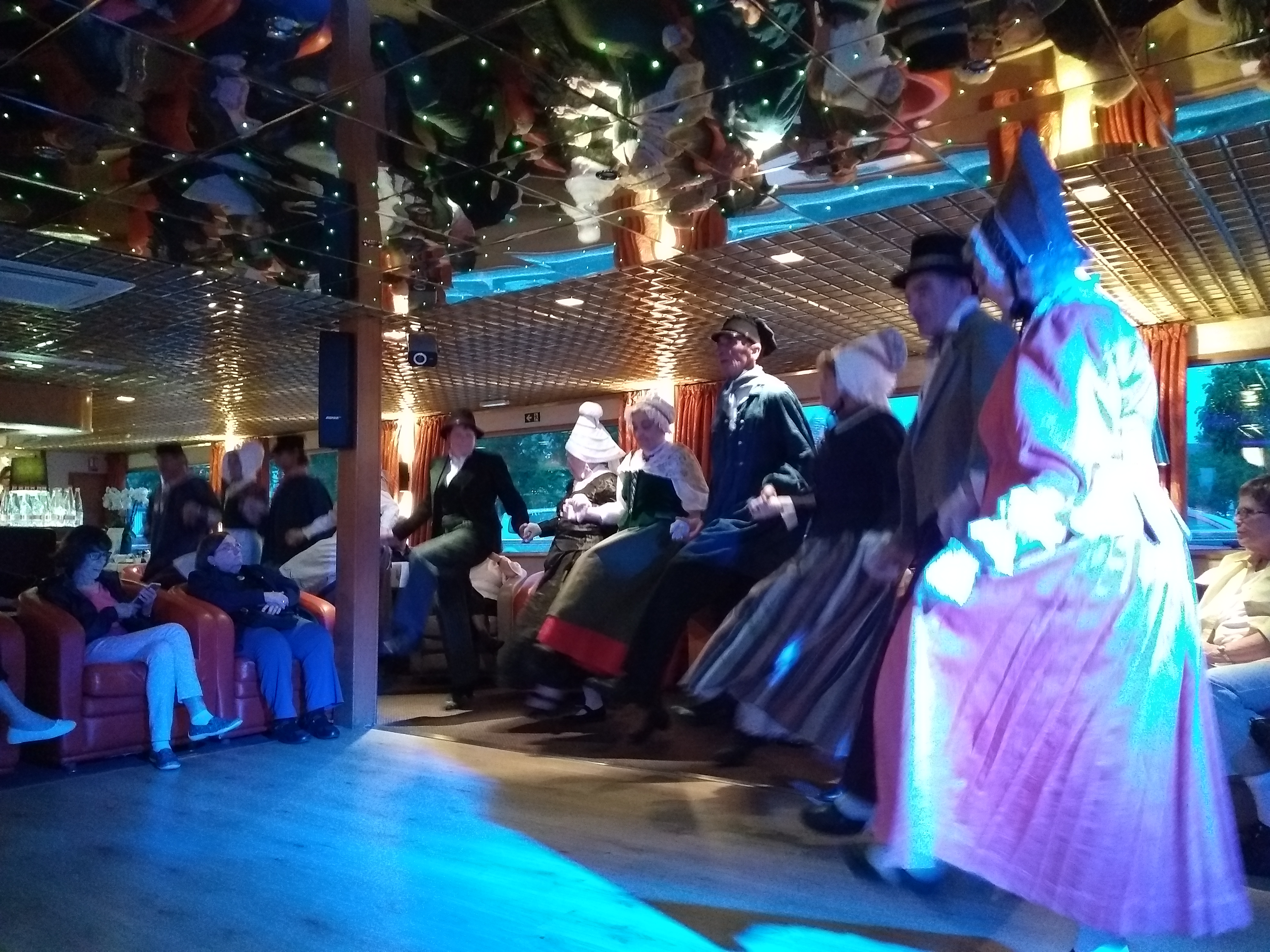
Entertainment
tonight was a presentation from a local group -
they
performed several traditional dances in authentic costume (left above).
Saturday May 11

 Overnight the boat moved to Caudebec and
this morning we bussed to
the Abbey of St.
Wandrille of Fontenelle (founded in 648) - gate at the left. This
was nothing at all like the flamboyant Melk Abbey we visited in
Austria! The current buildings date from around 1300 – 1500 but
they were destroyed several times. The Abbey was the target
of Viking raids early in its history and was totally burned to the
ground in 852. A new church was destroyed by a lightning strike in
1012 and another replacement burned in 1250. After years of chaos
during which the monks were evicted numerous times, they finally
regained some stability only to face bombing in 1944. The picture
at the right shows
much damage still remains. A new church was consecrated
in 1970. We attended a Latin Mass where the monks chanted the
entire service. It was also the first Catholic Church of any sort
that I've ever been in where we were all invited to
communion! He used almost the same words we do in our church
every Sunday - he said it was "God's table" and anyone was welcome!
Overnight the boat moved to Caudebec and
this morning we bussed to
the Abbey of St.
Wandrille of Fontenelle (founded in 648) - gate at the left. This
was nothing at all like the flamboyant Melk Abbey we visited in
Austria! The current buildings date from around 1300 – 1500 but
they were destroyed several times. The Abbey was the target
of Viking raids early in its history and was totally burned to the
ground in 852. A new church was destroyed by a lightning strike in
1012 and another replacement burned in 1250. After years of chaos
during which the monks were evicted numerous times, they finally
regained some stability only to face bombing in 1944. The picture
at the right shows
much damage still remains. A new church was consecrated
in 1970. We attended a Latin Mass where the monks chanted the
entire service. It was also the first Catholic Church of any sort
that I've ever been in where we were all invited to
communion! He used almost the same words we do in our church
every Sunday - he said it was "God's table" and anyone was welcome!
Pictured below left
is the front of the
"new" church; in the center is a courtyard undergoing renovation.
If you enlarge the picture you will better be able to
see that each archway has a unique pattern and you may be able to see
the scaffolding on the right side. Finally, in the picture to the
right below, the carved leaves providing decoration over the old door were
pointed
out to us. They are hops!

 During the middle ages, monks and
nuns were expected to live by their
own labors and thus, France's only remaining monastic brewery was
established here and the hops became their symbol! In the
gift shop you can peek through a
(very dirty so no usable photos) window and watch the brewing
process. (Jennifer bought a few bottles to share this evening so
all could have a taste!)
During the middle ages, monks and
nuns were expected to live by their
own labors and thus, France's only remaining monastic brewery was
established here and the hops became their symbol! In the
gift shop you can peek through a
(very dirty so no usable photos) window and watch the brewing
process. (Jennifer bought a few bottles to share this evening so
all could have a taste!)
The picture to the
left here just shows some of the remaining
ruins that need to be restored. And, in case we feared the monks
were still living as they had centuries ago, we spotted this cute
little robot mowing the grounds!

 After
we finished at the Abbey, the bus took us to Duclair where we
re-boarded our boat and had lunch. This afternoon we had
lectures on board while we cruised down to Rouen. Jennifer talked about the background of
impressionism – it wasn't anything new but I found it helpful to have
it all pulled together! At
left is what the residents do when there isn't a bridge: they use these
small car ferries that go back and forth between the banks. And on the right - swans are a frequent
sighting on
the Seine.
After
we finished at the Abbey, the bus took us to Duclair where we
re-boarded our boat and had lunch. This afternoon we had
lectures on board while we cruised down to Rouen. Jennifer talked about the background of
impressionism – it wasn't anything new but I found it helpful to have
it all pulled together! At
left is what the residents do when there isn't a bridge: they use these
small car ferries that go back and forth between the banks. And on the right - swans are a frequent
sighting on
the Seine.

 We just
arrived at Rouen - they have lovely red
chestnut (the shorter ones) and paulownia (the purple ones) trees along
the riverside (photo at right). Our afternoon walk took us
through crowded streets set up for Market Day (Saturday - left) and
then to the "flamboyant Gothic" Saint-Maclou church. This
building was initially inaugurated in 1521. The original spires
were destroyed in the 1700's and the current one was built between
1868-70. Not surprisingly for a building of this age, restoration
work is constantly ongoing! Below see the facade of church (yep -
pretty flamboyant), the detail from one of the front doors and a
picture from the interior.
We just
arrived at Rouen - they have lovely red
chestnut (the shorter ones) and paulownia (the purple ones) trees along
the riverside (photo at right). Our afternoon walk took us
through crowded streets set up for Market Day (Saturday - left) and
then to the "flamboyant Gothic" Saint-Maclou church. This
building was initially inaugurated in 1521. The original spires
were destroyed in the 1700's and the current one was built between
1868-70. Not surprisingly for a building of this age, restoration
work is constantly ongoing! Below see the facade of church (yep -
pretty flamboyant), the detail from one of the front doors and a
picture from the interior.

 Our next destination was the the huge Notre Dame
Cathedral that was famously painted by many impressionists (Monet
himself painted it more than 30 times). On the way we passed this
"bourdaloue" in a shop window (left) and the Great Clock (right).
The bourdaloue looks somewhat like a gravy boat (NOT!). It was
said to get its name from a priest (Louis Bourdaloue) whose sermons
lasted so long that women could not sit through them without emptying
their bladders! Yes, this is a type of portable chamber pot that
could be easily hidden under the huge skirts of the Georgian era - pity
the poor ladies' maids! (One of the many little tidbits that made
traveling with Jennifer such fun.) The Great Clock (Gros-Horloge) is an astronomical
clock installed in a Renaissance arch - its mechanism was made in 1389
making it one of the oldest in the world.
Our next destination was the the huge Notre Dame
Cathedral that was famously painted by many impressionists (Monet
himself painted it more than 30 times). On the way we passed this
"bourdaloue" in a shop window (left) and the Great Clock (right).
The bourdaloue looks somewhat like a gravy boat (NOT!). It was
said to get its name from a priest (Louis Bourdaloue) whose sermons
lasted so long that women could not sit through them without emptying
their bladders! Yes, this is a type of portable chamber pot that
could be easily hidden under the huge skirts of the Georgian era - pity
the poor ladies' maids! (One of the many little tidbits that made
traveling with Jennifer such fun.) The Great Clock (Gros-Horloge) is an astronomical
clock installed in a Renaissance arch - its mechanism was made in 1389
making it one of the oldest in the world.

 The history of the Notre Dame Cathedral
began with a 4th century basilica and an 11th century Romanesque
cathedral on which foundations the existing church stands. Its
construction began in the 12th century and has been described as
"perpetually evolving." The church was destroyed by Vikings in
841 and then repeatedly by fires, religious wars and finally bombing in
WWII (1944). The final cast iron spire was added (after the
previous one was lost to lightning) and became the tallest in the
world in 1876. It is still the tallest in France. The
cathedral contains bits of architecture that span the entire Gothic
period and it is clear that it was built over different time
periods. The cathedral is so massive, and the surrounding area so
congested, that is was impossible to get the whole facade in one
picture without a very wide angle lens! The best I could do is at
the right. On the left is the north side of the church where we
entered through a small courtyard at what is known as the Bookseller's
Portal.
The history of the Notre Dame Cathedral
began with a 4th century basilica and an 11th century Romanesque
cathedral on which foundations the existing church stands. Its
construction began in the 12th century and has been described as
"perpetually evolving." The church was destroyed by Vikings in
841 and then repeatedly by fires, religious wars and finally bombing in
WWII (1944). The final cast iron spire was added (after the
previous one was lost to lightning) and became the tallest in the
world in 1876. It is still the tallest in France. The
cathedral contains bits of architecture that span the entire Gothic
period and it is clear that it was built over different time
periods. The cathedral is so massive, and the surrounding area so
congested, that is was impossible to get the whole facade in one
picture without a very wide angle lens! The best I could do is at
the right. On the left is the north side of the church where we
entered through a small courtyard at what is known as the Bookseller's
Portal.

 More
pictures. At the left, the heart (only the heart!) of King
Richard the Lionhearted, Duke of Normandy, is entombed here; on the
right is part of the series of statues of the prophets that is planned
to be donated to a museum in the future. Below on the left is one
of
Monet's many paintings of the cathedral - we saw this one - titled "in
bad weather"- in the Rouen Musée des Beaux Arts. In the center is a
contrasting painting from the Marmottan Museum in Paris: "Cathédrale de
Rouen, effect de soleil, fin de journée" showing the "effects of the
sun at the end of the day." And to
the right, one of the many stained glass windows that date back as far
as 1210 (thanks to the foresight of those who had them removed for
safety at the start of World War II.)
More
pictures. At the left, the heart (only the heart!) of King
Richard the Lionhearted, Duke of Normandy, is entombed here; on the
right is part of the series of statues of the prophets that is planned
to be donated to a museum in the future. Below on the left is one
of
Monet's many paintings of the cathedral - we saw this one - titled "in
bad weather"- in the Rouen Musée des Beaux Arts. In the center is a
contrasting painting from the Marmottan Museum in Paris: "Cathédrale de
Rouen, effect de soleil, fin de journée" showing the "effects of the
sun at the end of the day." And to
the right, one of the many stained glass windows that date back as far
as 1210 (thanks to the foresight of those who had them removed for
safety at the start of World War II.)

 Another walk through busy pedestrian streets
and a market
place brought us to a new church - Saint-Joan of Arc Church - a totally
different experience! This church was built in 1979 on the site
of
Joan's death. She was burned at the stake in 1341 in the
center of an ancient market square known as "Place du Vieux-Marché."
This is very modern architecture, though the stained glass
windows, depicting Christ's life and lives of St. Peter, St. Anne and
Saint Anthony of Padua, were rescued from the 16th century Church of
Saint
Vincent. The windows had been removed for safe storage during
World War II, but the church itself was totally destroyed (ruins
pictured at right).
Another walk through busy pedestrian streets
and a market
place brought us to a new church - Saint-Joan of Arc Church - a totally
different experience! This church was built in 1979 on the site
of
Joan's death. She was burned at the stake in 1341 in the
center of an ancient market square known as "Place du Vieux-Marché."
This is very modern architecture, though the stained glass
windows, depicting Christ's life and lives of St. Peter, St. Anne and
Saint Anthony of Padua, were rescued from the 16th century Church of
Saint
Vincent. The windows had been removed for safe storage during
World War II, but the church itself was totally destroyed (ruins
pictured at right).
With permission of the staff, John
tried out the acoustics in this interesting building with a song,
then led us all in a couple rounds of "Allejuiah." You can tell I
am old; I keep forgetting that both my camera and my phone will record
video. Alas, I didn't catch any of these musical
interludes. Below are pictures of "Le Bucher" (translates as "the
pyre" - the site of Joan's
execution), an overview of the interior of the interesting church and
John singing in front of the windows.
We walked back to the boat after that. A beer tasting
from the Abbey brew was at 6:30 pm and supper at 7. We skipped
the fun and games after supper - it was a very full day and we were
exhausted! Rouen continues in the next section as we visited the
Musée des Beaux Arts in the morning.
Click here to
continue with Part 3 of the France Trip
Click here to
return to
the France Trip Index
Click here to
return to
Barb's Index
Click
here to return to Fotos 'n Stuff Home Page


