(This
final section of the trip log
includes our visit to the Rouen art museum, a day at Giverny and the
last two days back in Paris. You can enlarge any picture in this
narrative by
clicking on it - it
will open in a separate window and in many cases, show detail you can't
see in the smaller version.)
Sunday May 12
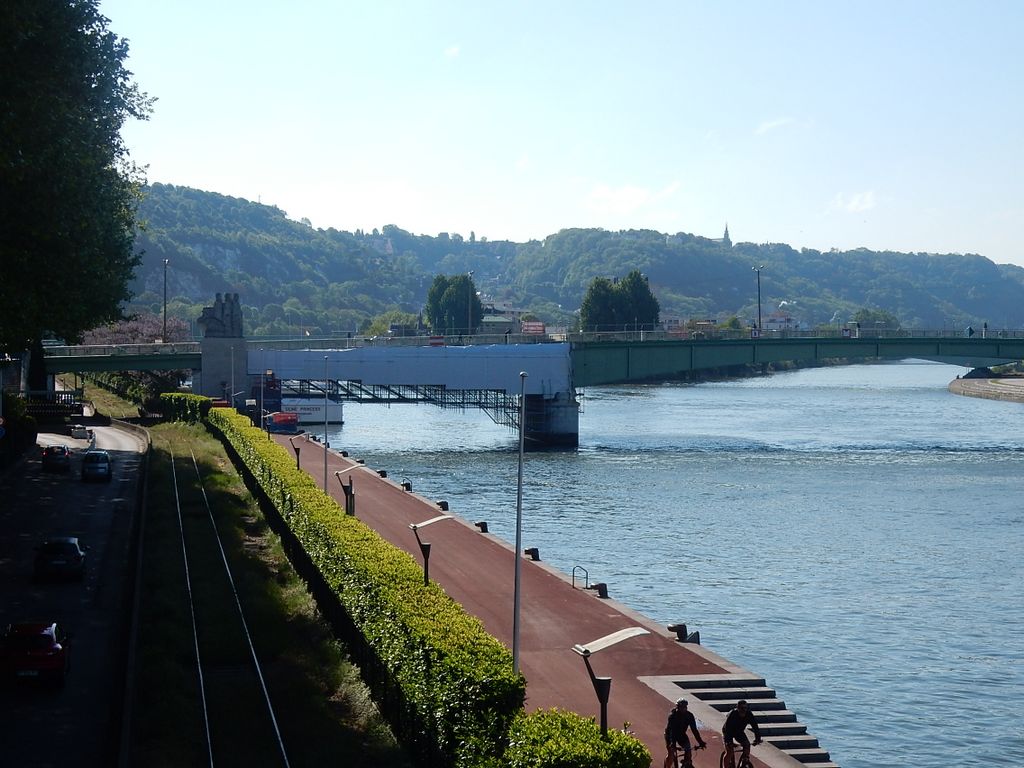
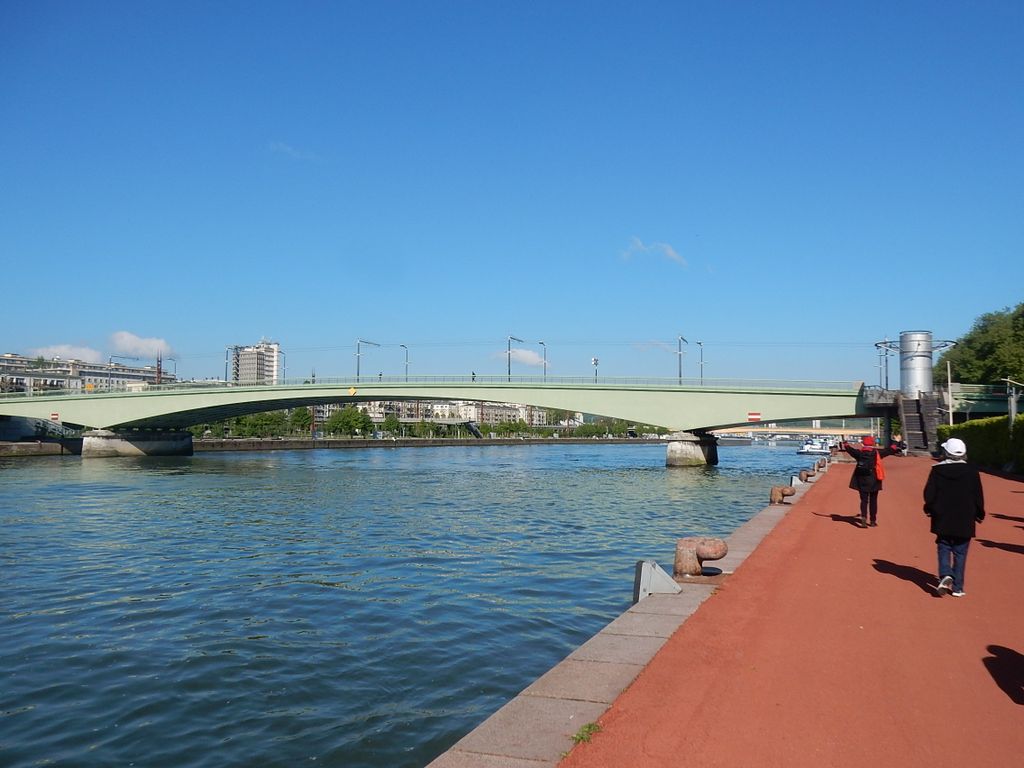 This morning we walked into Rouen again,
passing under the Pont
Boieldieu because it is under construction and we can't use the stairs
there. The statues at each end, including the Viking sculpture
you can see at the left in the picture (left) were created by sculptors
Saupiquet and Beaumel. The next bridge down is the Joan of Arc
Bridge - that's the one we used to get back and forth to town.
What looks like a round silo is actually an elevator, permitting access
from the riverwalk to the street level for those who can't (or don't
want to) hike the stairs.
This morning we walked into Rouen again,
passing under the Pont
Boieldieu because it is under construction and we can't use the stairs
there. The statues at each end, including the Viking sculpture
you can see at the left in the picture (left) were created by sculptors
Saupiquet and Beaumel. The next bridge down is the Joan of Arc
Bridge - that's the one we used to get back and forth to town.
What looks like a round silo is actually an elevator, permitting access
from the riverwalk to the street level for those who can't (or don't
want to) hike the stairs.

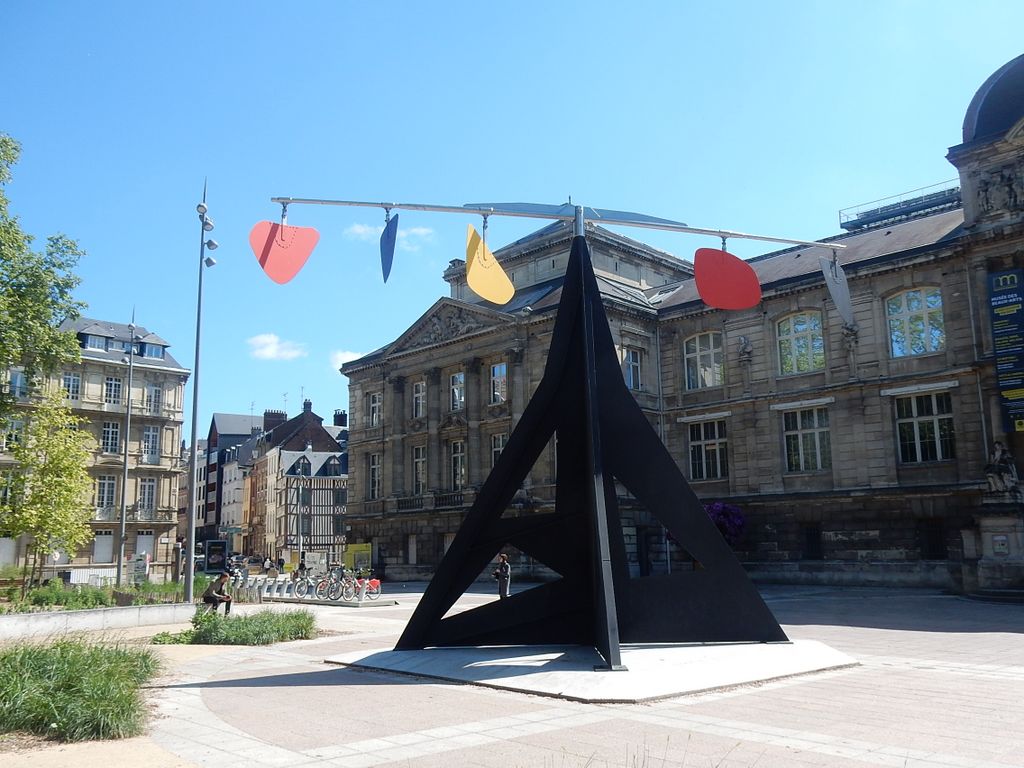 We passed the Tour Saint-André - all that remains of
the old church. The church dated back to at least 1027; it was
rebuilt in 1486 and the tower between 1541-46. By 1861, when Rue
Jeanne d'Arc was built, the church had been damaged so extensively that
it was just removed, leaving only the tower. When we got to the
Musée des Beaux Arts, the first art we saw was a nice surprise - a
delightful Alexander Calder mobile in front of the entrance!
We passed the Tour Saint-André - all that remains of
the old church. The church dated back to at least 1027; it was
rebuilt in 1486 and the tower between 1541-46. By 1861, when Rue
Jeanne d'Arc was built, the church had been damaged so extensively that
it was just removed, leaving only the tower. When we got to the
Musée des Beaux Arts, the first art we saw was a nice surprise - a
delightful Alexander Calder mobile in front of the entrance!
The museum covers a huge period of time and had lots of both paintings
and sculpture. I'm only including a few here that struck me in
some way (lots more can be seen in the "pictures only"
collection). The one at left, below, is "Poplars by the Water" by
Blanche Horschedé-Monet (stepdaughter and daughter-in-law of Claude
Monet) who is one of the few recognized female impressionists. In
the center is Pissarro's "Tuileries Garden in the Snow," and on the
right Monet's "Fête de Saint Denis" (June 30) from 1878. The
technique used here are a bit different from the one he eventually
worked into that is evident in his later works.

 On the way back to the boat we passed this
charming sign in a shop window - I think it needs no translation!
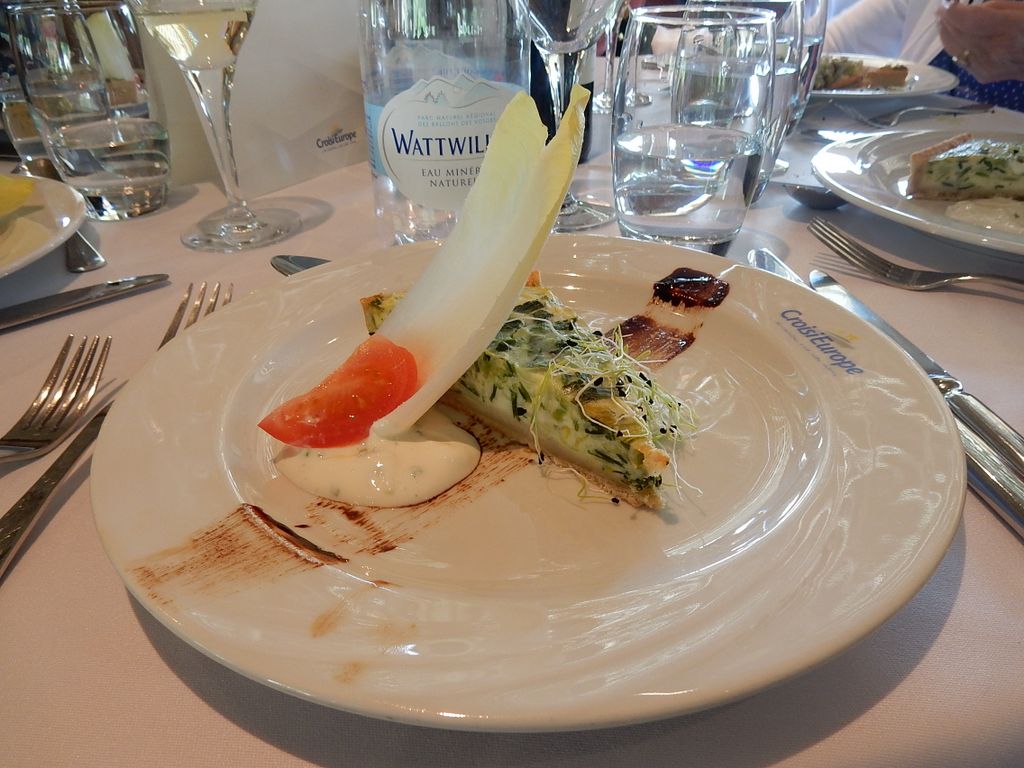
And to the right is our appetizer
for lunch (leek quiche). We ate very well!
On the way back to the boat we passed this
charming sign in a shop window - I think it needs no translation!
And to the right is our appetizer
for lunch (leek quiche). We ate very well!
When we got back to the boat around noon we
headed south (to
Poissy). It was a beautiful day so I sat up on the sun deck a bit
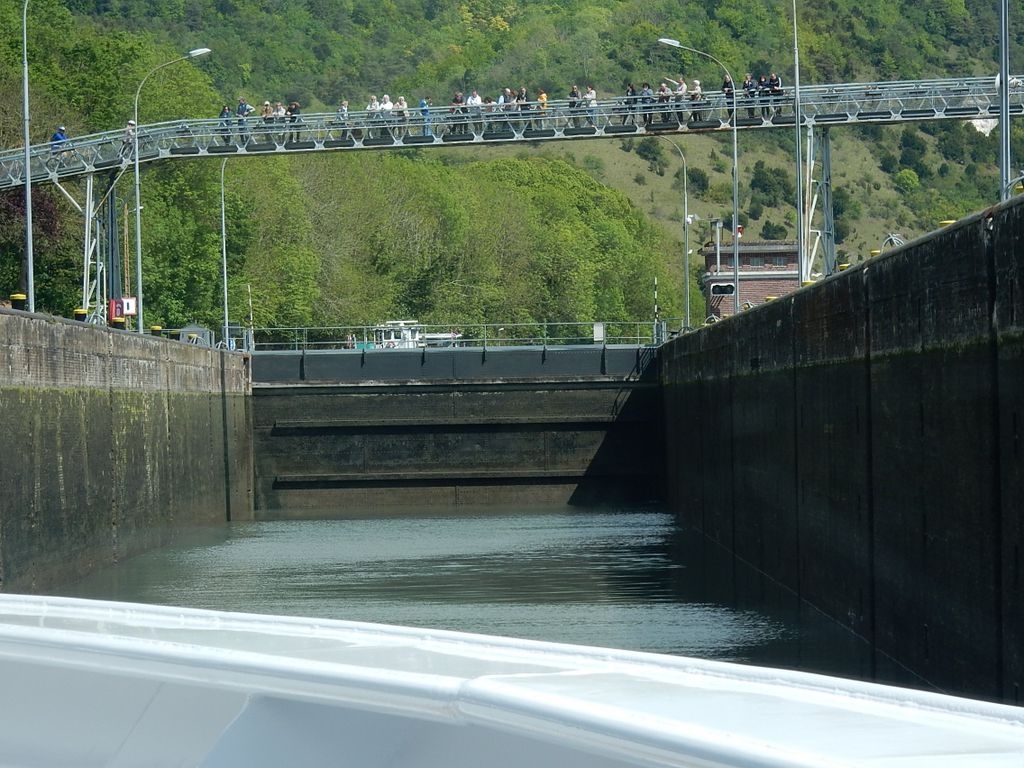
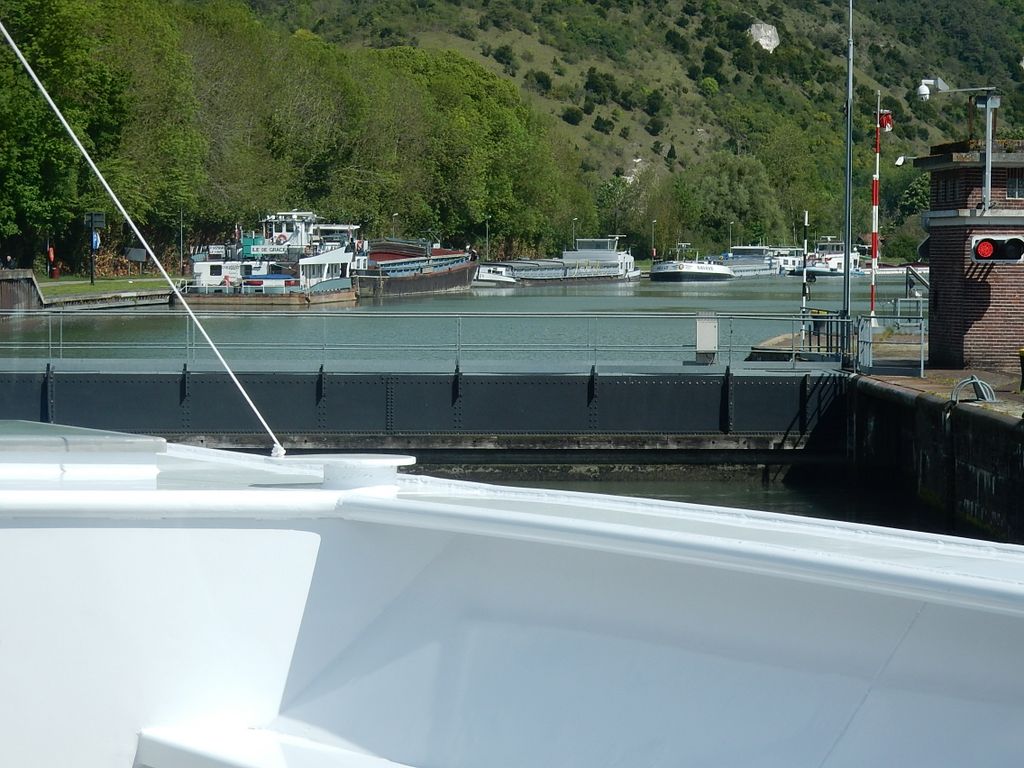
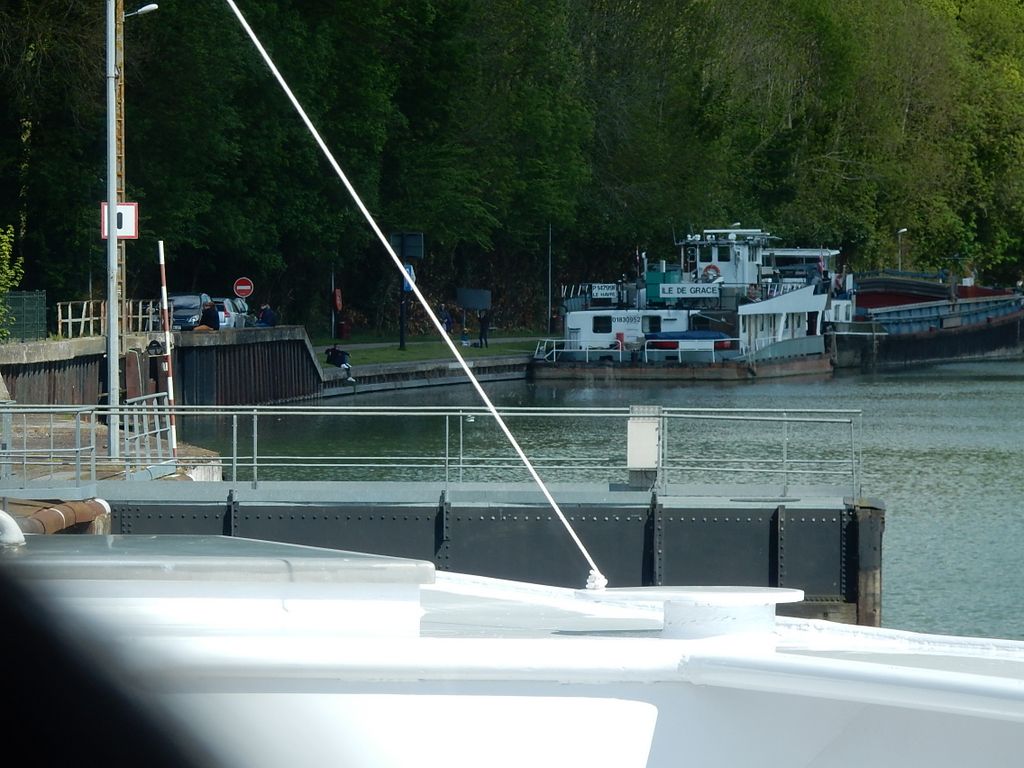
before lunch. After lunch we went through the first lock at Amfreville
Sous Les Monts. I think we went up about 5
meters. In the next series of pictures I'll go through the
process since it's kind of fun to watch. Once. There are 5
more locks and I promise not to illustrate all of them!
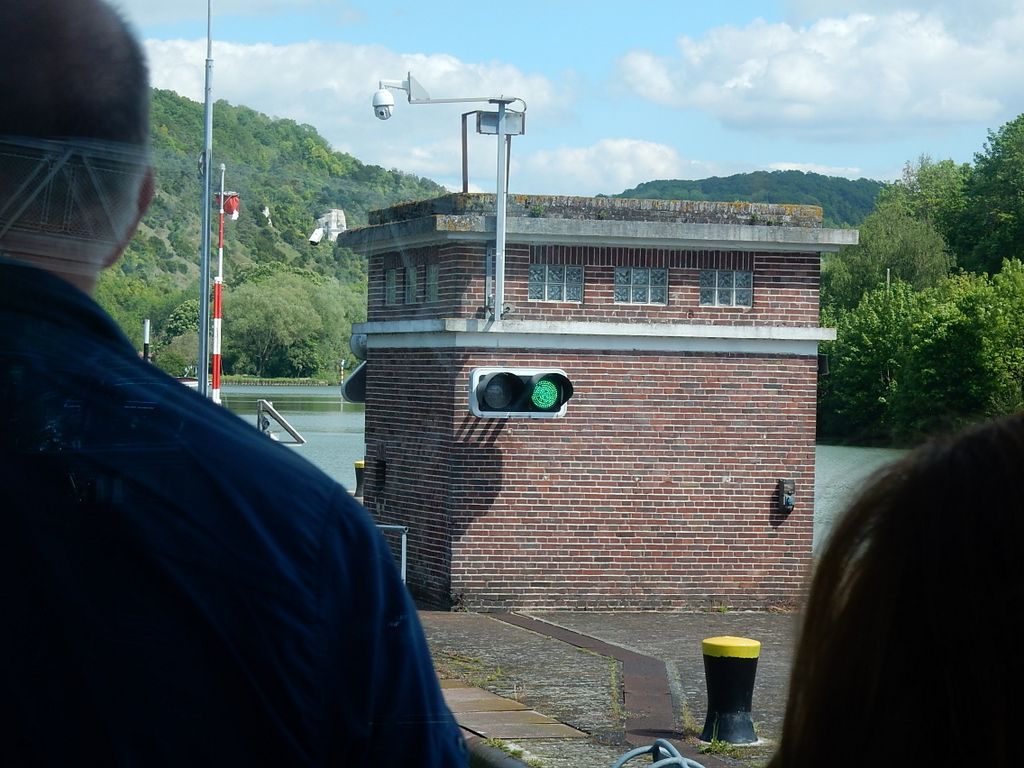
The first set of pictures shows us pulling into the lock: you can see
we have an audience on the pedestrian bridge! You can also see
from the side of the lock how much lower we are than the river level on
the other side. In the center, we are almost all the way up, but
the traffic light is still red, meaning we can't move on yet! On
the right you can see the gate sliding open - when it is all the way
open, the light will turn green and we can proceed.
The last two below show that the light is now green so we can
move forward and, in the last one, we are back out on the river!

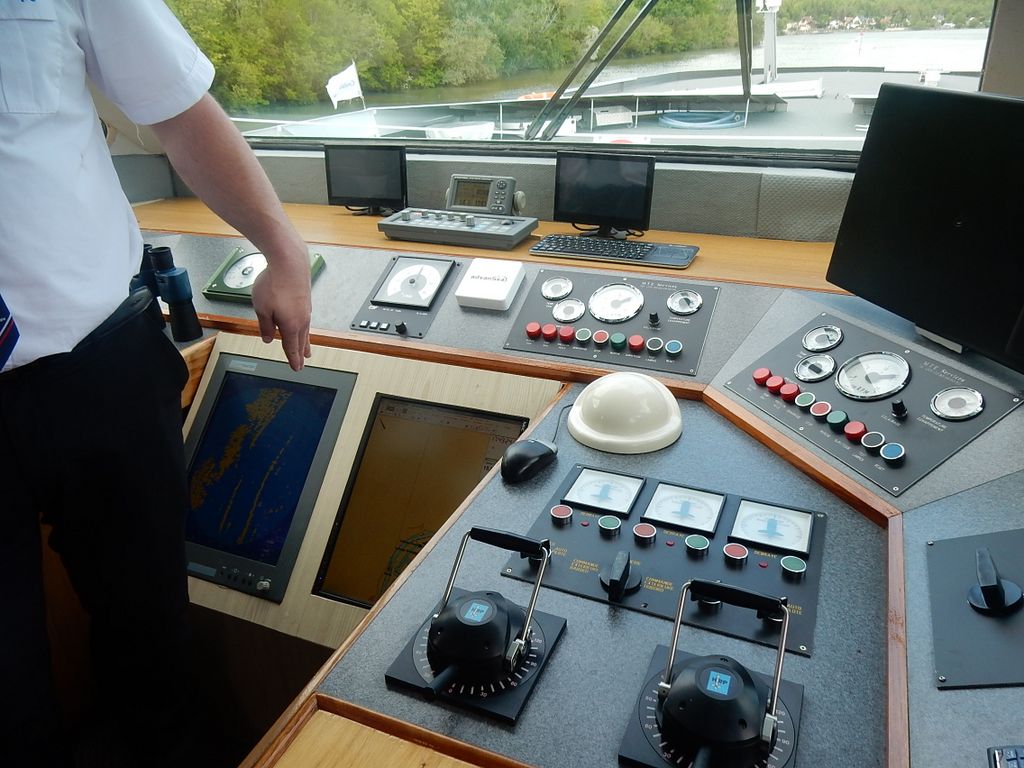 Jennifer's presentation this afternoon was
Impressionism on the Seine - again, she summarized and pulled together
various things we had seen and heard. I'm surprised at how
helpful that is. One thing she said this afternoon was that
Pissarro (one of my favorites) was often called the "Father of
Impressionism" because he was somewhat older than most ofthe others and
was a mentor to many of them. Throughout the afternoon, we
were invited to go in small groups up to the wheelhouse and have a
"tour." The captain and co-captain were very pleasant, spoke
reasonable English and I enjoyed watching where we were going on the
radar!
Jennifer's presentation this afternoon was
Impressionism on the Seine - again, she summarized and pulled together
various things we had seen and heard. I'm surprised at how
helpful that is. One thing she said this afternoon was that
Pissarro (one of my favorites) was often called the "Father of
Impressionism" because he was somewhat older than most ofthe others and
was a mentor to many of them. Throughout the afternoon, we
were invited to go in small groups up to the wheelhouse and have a
"tour." The captain and co-captain were very pleasant, spoke
reasonable English and I enjoyed watching where we were going on the
radar!
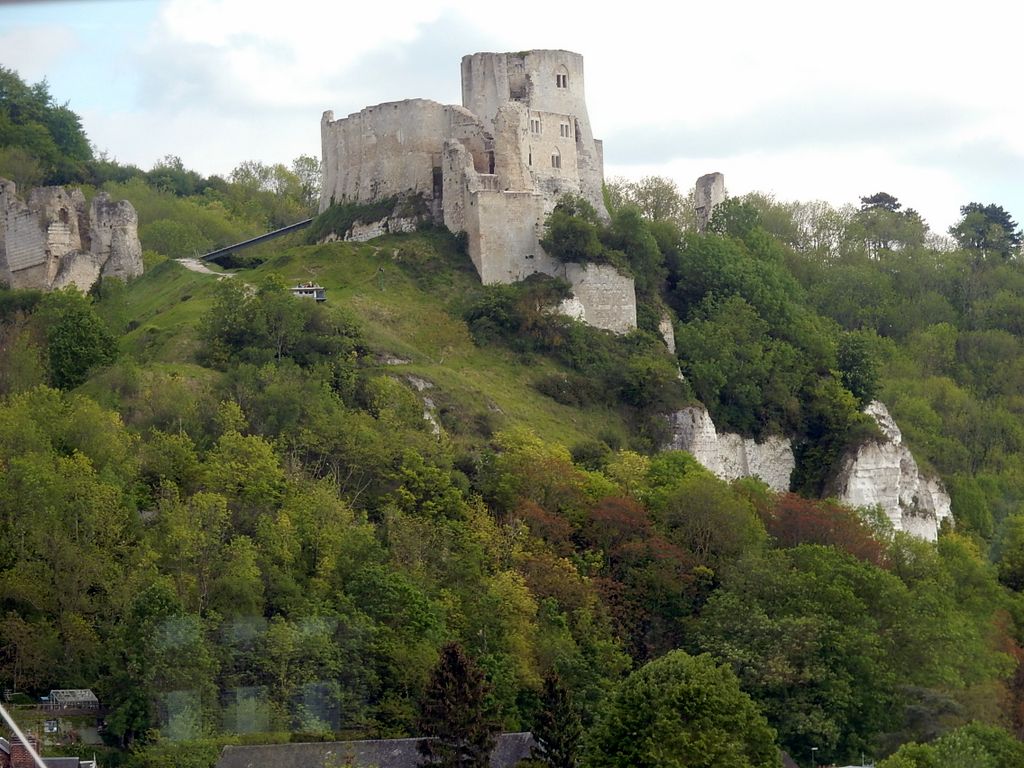
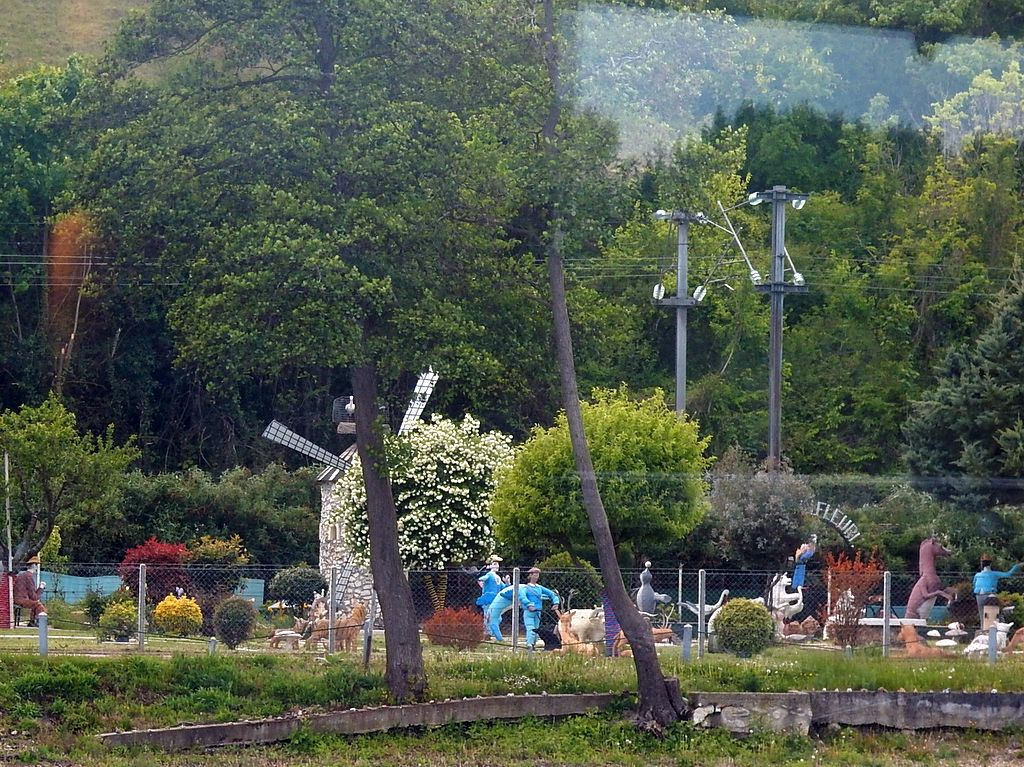
Some sights as we moved
along this afternoon. The ruins of Chateau Gaillard - we passed
this just after the lock above - sit above the community of Les
Andelys. It was built in the late 1190's by Richard the
Lionhearted when he was Duke of Normandy. It changed hands
numerous times and has basically been in ruins since about 1600.
In the center is just a small camping area along the river and to the
right a miniature golf course.

Tonight's
entertainment was the
Crew Show. That's a sort of a variety/ talent show involving crew
members. I wanted to support them and some parts were quite good,
but it didn't
even start til 9:45 pm so I
didn't stay very long.
Monday
May 13

 We were up early today
to go to Giverny, leaving before 8. We had a wonderful time
walking through
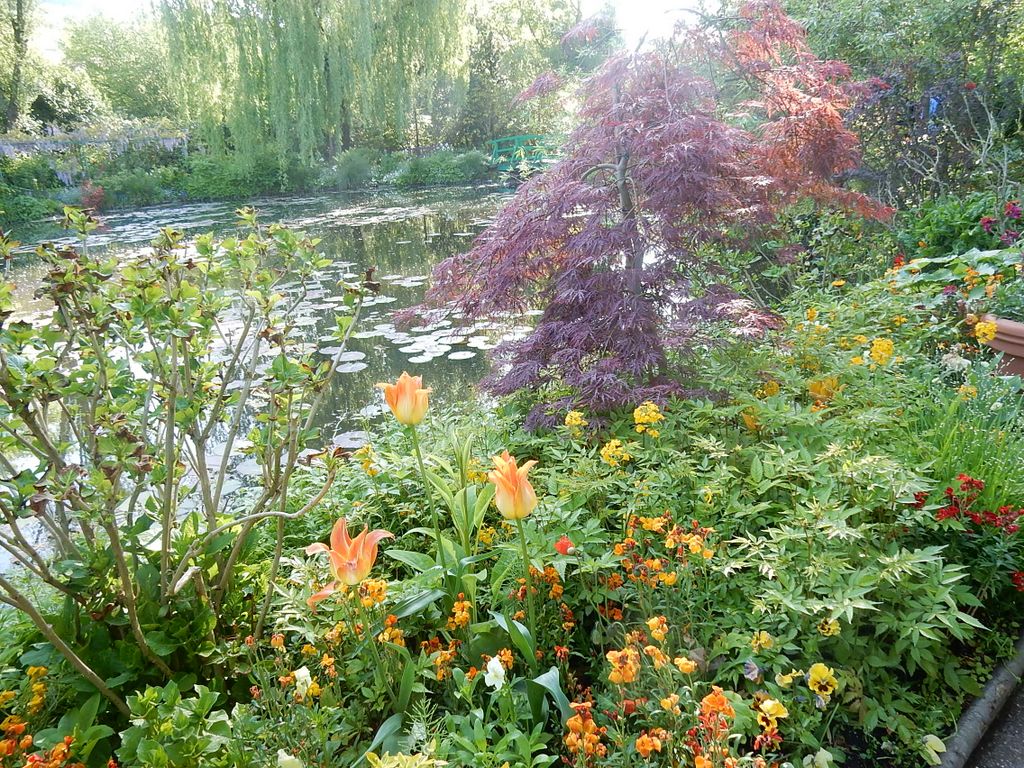
Monet's Water Pond Garden, then the big house garden. I also went
through the house, though John preferred to spend that extra time out
in the garden! I had a really hard time picking which (few)
of the pictures best ilustrates this day. The one on the left is
as you are walking from the entry to the well-known lily pond. It
is all beautifully kept up. The "famous" view of the bridge to the
right was painted hundreds of times by Monet and also by many of his
contemporaries. Hold that thought!
We were up early today
to go to Giverny, leaving before 8. We had a wonderful time
walking through
Monet's Water Pond Garden, then the big house garden. I also went
through the house, though John preferred to spend that extra time out
in the garden! I had a really hard time picking which (few)
of the pictures best ilustrates this day. The one on the left is
as you are walking from the entry to the well-known lily pond. It
is all beautifully kept up. The "famous" view of the bridge to the
right was painted hundreds of times by Monet and also by many of his
contemporaries. Hold that thought!
Some
other views - the boats in front of the large bamboo planting (both the
boats and the bamboo show up in many of his paintings as well) and then
a view of the pond (one of hundreds - remember the first day when we
were at L'Orangerie, there were 2 whole rooms of full-wall murals of
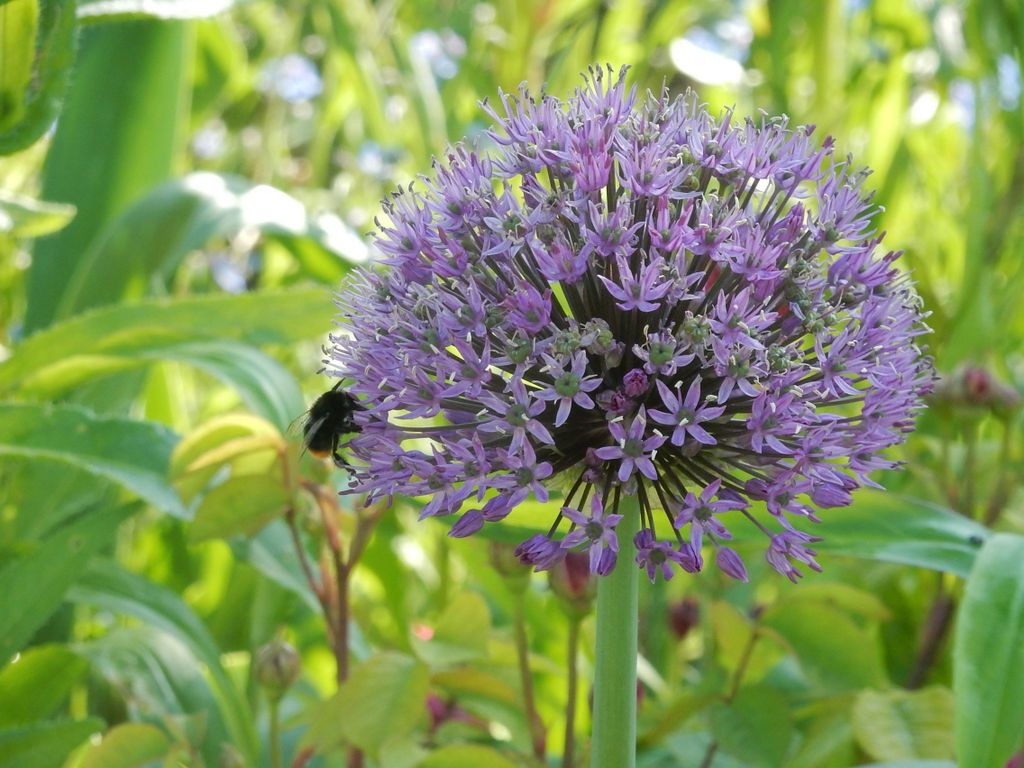
the pond, its willows, lilies and surrounds). On the right is
just a "busy bee" I couldn't resist as we walked by.

 The house, where Monet moved in 1883 (and
pretty much stayed until his death in 1926) is intended to look much as
it was when he was living there. It was interesting, and almost
made me want to go home and paint my kitchen yellow, but it was fairly
crowded with tourists so I just walked through and got a feel of the
time. The gardens, as well, have tried to replicate his own in
which he spent many many hours - not only painting but also tending
them. He included a large kitchen garden as well as the many more
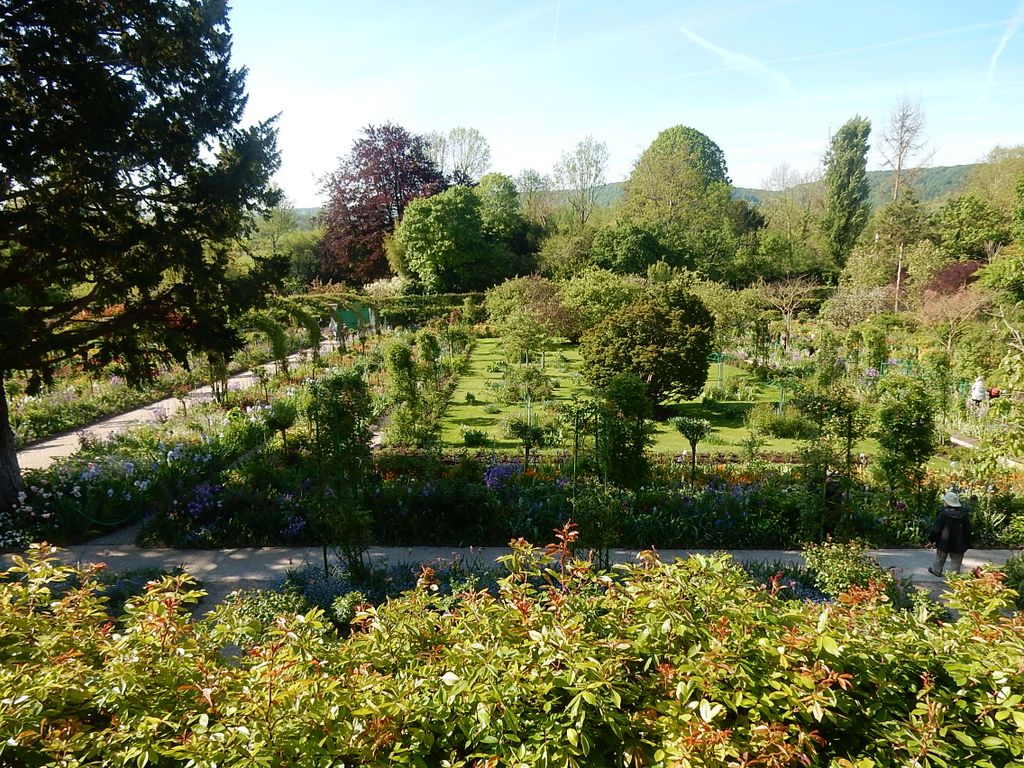
colorful floral and sculpted areas. The picture to the right was
taken from one of the upper bedroom windows in the house - it gives an
overview of just a tiny portion ofthe garen. Below are more
outside pictures: the living archway of vines leading to the back of
the house; then two views of the many different types of flowers that
were in bloom when we were there in May.
The house, where Monet moved in 1883 (and
pretty much stayed until his death in 1926) is intended to look much as
it was when he was living there. It was interesting, and almost
made me want to go home and paint my kitchen yellow, but it was fairly
crowded with tourists so I just walked through and got a feel of the
time. The gardens, as well, have tried to replicate his own in
which he spent many many hours - not only painting but also tending
them. He included a large kitchen garden as well as the many more
colorful floral and sculpted areas. The picture to the right was
taken from one of the upper bedroom windows in the house - it gives an
overview of just a tiny portion ofthe garen. Below are more
outside pictures: the living archway of vines leading to the back of
the house; then two views of the many different types of flowers that
were in bloom when we were there in May.


 Finally, we moved on down the road, walking through the
"village" to the museum that was currently hosting a special exhibit
exploring the works of Monet and Auburtin. Before I get to the
paintings, I promised the story of John's "sailor" shirt. While
we were still in the lobby area, a bubbly lady came over and asked if
she could take his picture. Of course he was pleased to be
noticed but he did tell her "I'm not an artist or anything
special." Well, it turns out that the group she was with was
doing a "scavenger hunt" of sorts and one of the things on her list was
a picture of a Frenchman wearing a striped shirt and a beret! He
did confess that he was just a tourist and not a Frenchman, but she was
undeterred, saying "they'll never know!" I didn't take a picture
of his pose, but here is another from that day, out in the garden -
with his striped shirt (under the oxford one - enlarge it to see
better) and beret. If he didn't talk, he could easily be taken as
French!
Finally, we moved on down the road, walking through the
"village" to the museum that was currently hosting a special exhibit
exploring the works of Monet and Auburtin. Before I get to the
paintings, I promised the story of John's "sailor" shirt. While
we were still in the lobby area, a bubbly lady came over and asked if
she could take his picture. Of course he was pleased to be
noticed but he did tell her "I'm not an artist or anything
special." Well, it turns out that the group she was with was
doing a "scavenger hunt" of sorts and one of the things on her list was
a picture of a Frenchman wearing a striped shirt and a beret! He
did confess that he was just a tourist and not a Frenchman, but she was
undeterred, saying "they'll never know!" I didn't take a picture
of his pose, but here is another from that day, out in the garden -
with his striped shirt (under the oxford one - enlarge it to see
better) and beret. If he didn't talk, he could easily be taken as
French!
It was
very interesting to compare the
similar paintings of Monet and Auburtin. Monet's tended to be
more active, more colorful, to have more depth. Auburtin used
water color at times so those colors were not as vibrant but had a
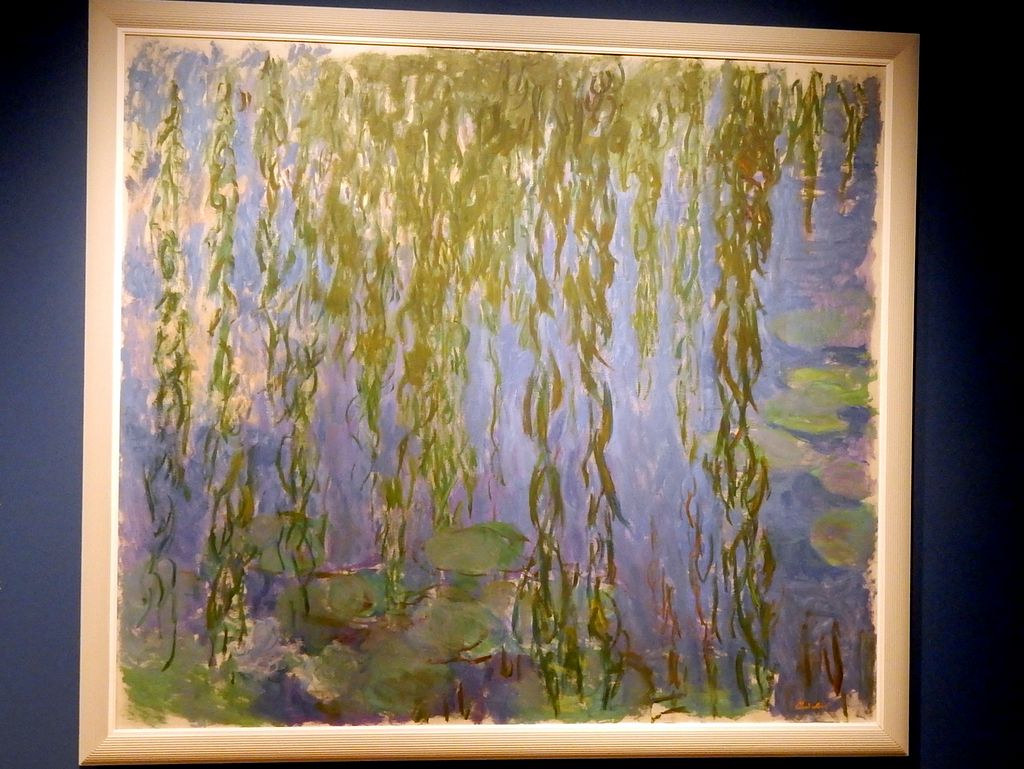
different feel to them. Showing great restraint, I share only 3
paintings: Étretat paintings from Monet (left) and Auburtin
(center) and a pond and willow painting by Monet.


If we
come back to Paris again, one thing I would do would be to take a full
day trip to Giverny so we could spend more time in the gardens as well
as the museum. We spent some time in the gift shops (at the house
and again at the museum). We came home with several souvenirs
including an artistic pillow cover, a Monet t-shirt, some seeds and a
2020 calendar.

 On the way back to the boat, we passed the
Old Mill at Vernon. In the 16th century, it sat on a 12th century
bridge that spanned the whole river - obviously the bridge isn't there
any more! At one time there were 5 mills along the bridge that
ground corn, a mjor crop in the area. We were back on board the
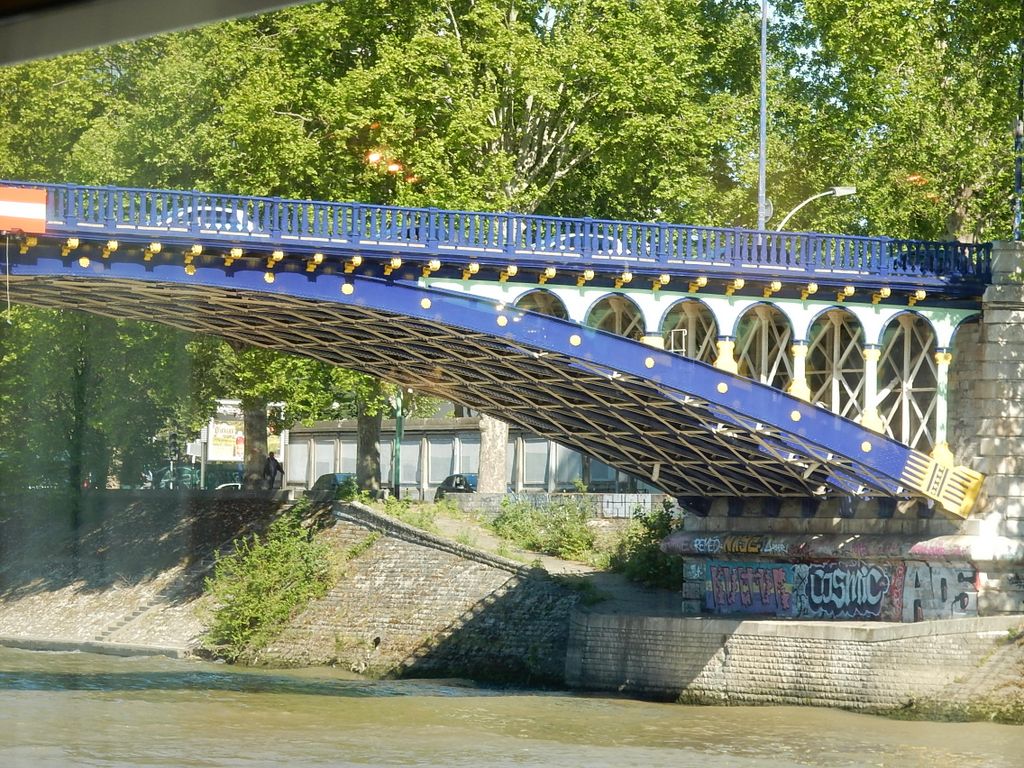
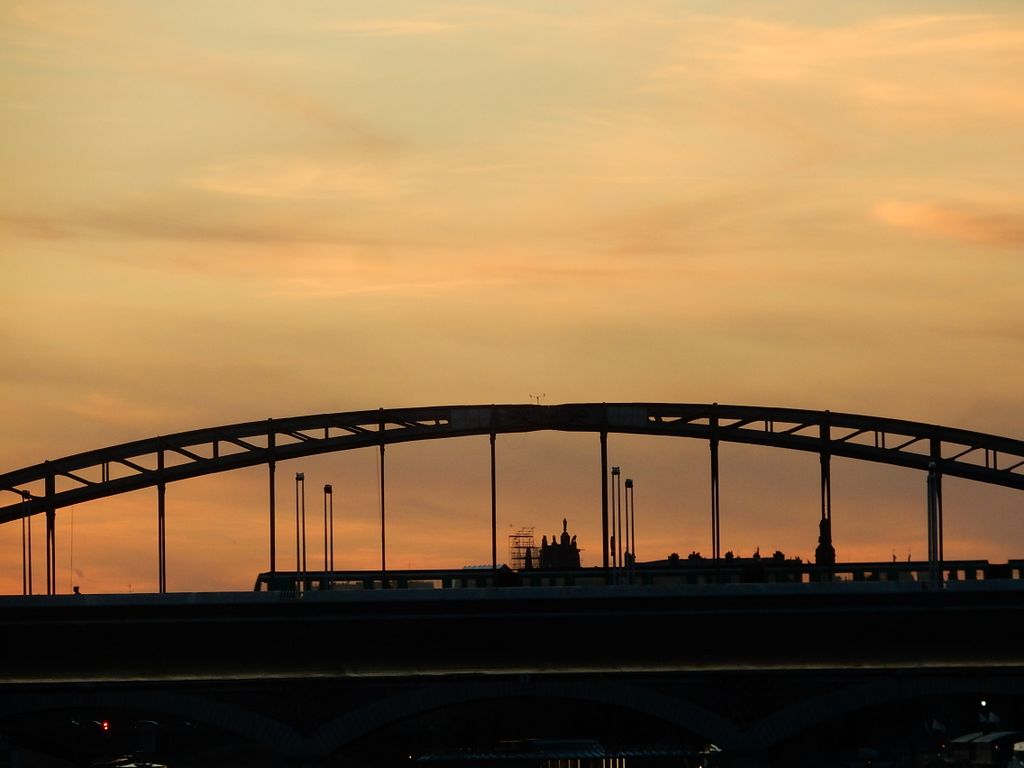
Seine Princess for lunch. The bridge to the right is in one of
the Paris suburbs as we neared the city - I was attracted by the color
and know nothing else about it!
On the way back to the boat, we passed the
Old Mill at Vernon. In the 16th century, it sat on a 12th century
bridge that spanned the whole river - obviously the bridge isn't there
any more! At one time there were 5 mills along the bridge that
ground corn, a mjor crop in the area. We were back on board the
Seine Princess for lunch. The bridge to the right is in one of
the Paris suburbs as we neared the city - I was attracted by the color
and know nothing else about it!
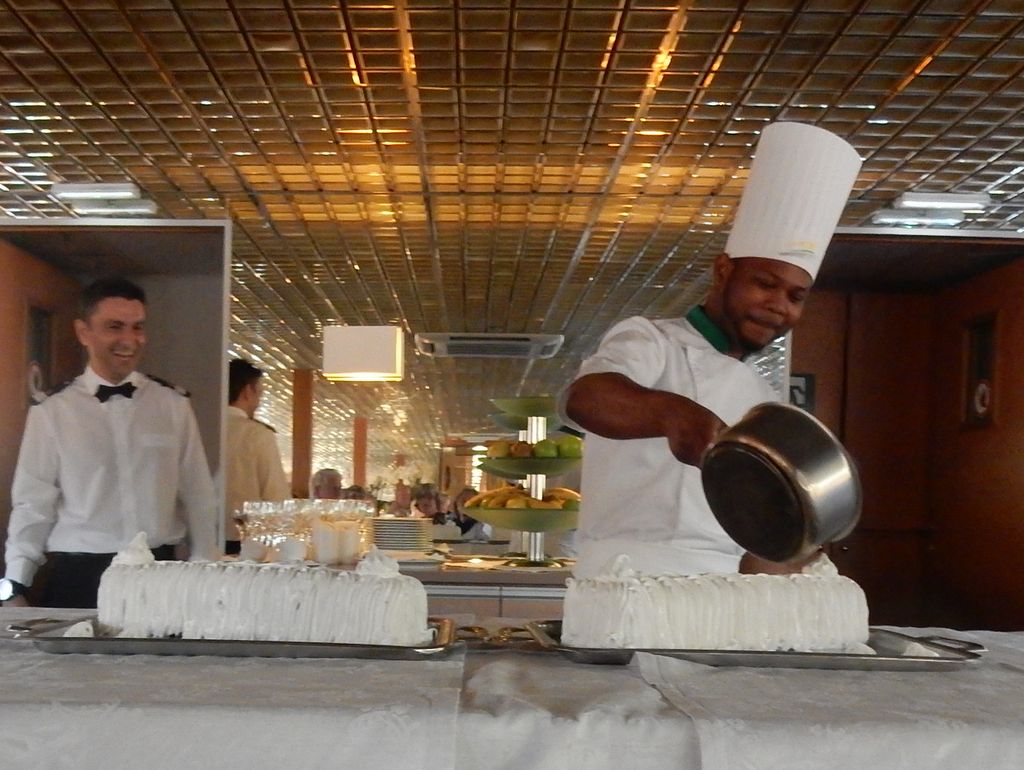
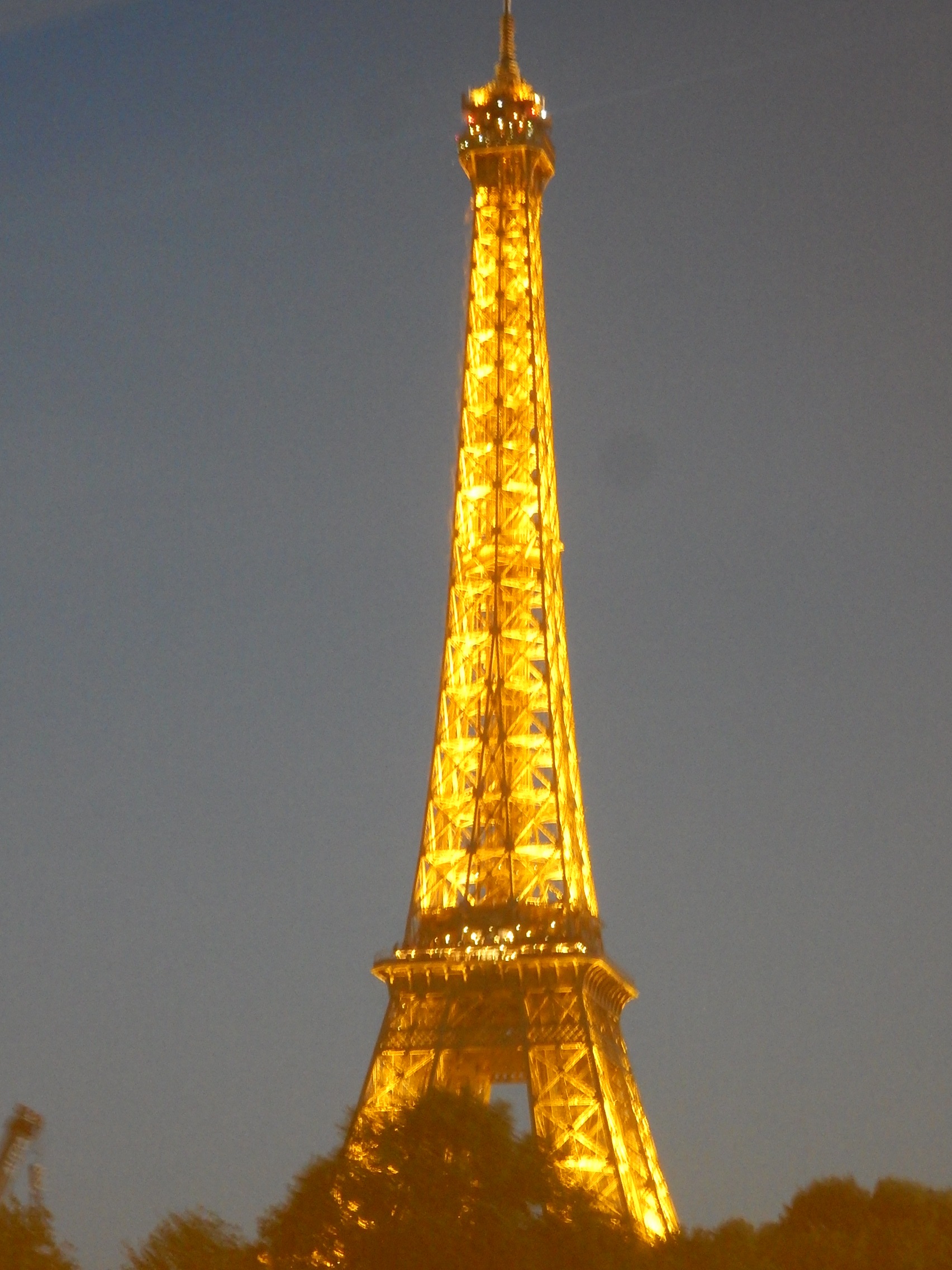
Last pictures of the
evening: we are back in Paris now, docked at the foot of the Eiffel
tower. I enjoyed the sunset from the sun deck; we had Baked
Alaska (that they prepared for us to watch) for dessert and then the
tower lit up
at night!
Tuesday May 14

 This morning we were dropped
off on Pont Neuf (meaning the "new" bridge, not the 9th!) even though I
think that stop was forbidden by traffic laws! Pont Neuf is
at the far west of Île de la Cité (our destination for the morning) and
is the oldest standing bridge in Paris. Construction began on it
in 1578 and was completed in 1607. It is also unusually long and
wide - it connects the right bank and left bank via Île de la Cité -
there are a total of 12 arches. A good view of one side of the
bridge is at the left. Detail of the rounded alcoves is at
the right. Those are where craftsmen, merchants and performers
set up and did business. Just opposite where the bridge crosses
the island is an equestrian statue of Henri IV (who was ruling at its
completion). It was destroyed and melted down during the French
Revolution but has been replaced in 1818 using bronze melted down from
the Napoleon statue in Place Vendome (among other sources) from a
surviving cast of the original. Below is a picture of the famous
statue as well as a painting by Pissarro.
This morning we were dropped
off on Pont Neuf (meaning the "new" bridge, not the 9th!) even though I
think that stop was forbidden by traffic laws! Pont Neuf is
at the far west of Île de la Cité (our destination for the morning) and
is the oldest standing bridge in Paris. Construction began on it
in 1578 and was completed in 1607. It is also unusually long and
wide - it connects the right bank and left bank via Île de la Cité -
there are a total of 12 arches. A good view of one side of the
bridge is at the left. Detail of the rounded alcoves is at
the right. Those are where craftsmen, merchants and performers
set up and did business. Just opposite where the bridge crosses
the island is an equestrian statue of Henri IV (who was ruling at its
completion). It was destroyed and melted down during the French
Revolution but has been replaced in 1818 using bronze melted down from
the Napoleon statue in Place Vendome (among other sources) from a
surviving cast of the original. Below is a picture of the famous
statue as well as a painting by Pissarro.


We walked through the
Place Dauphine (the triangular "square" at that end of the island) and
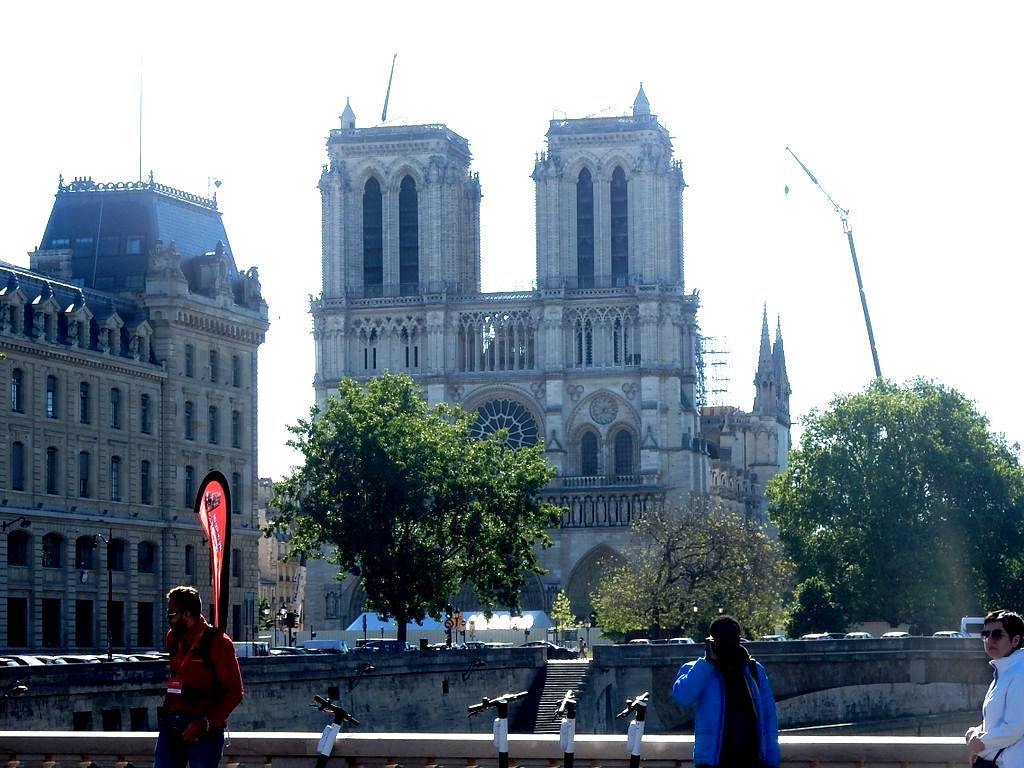
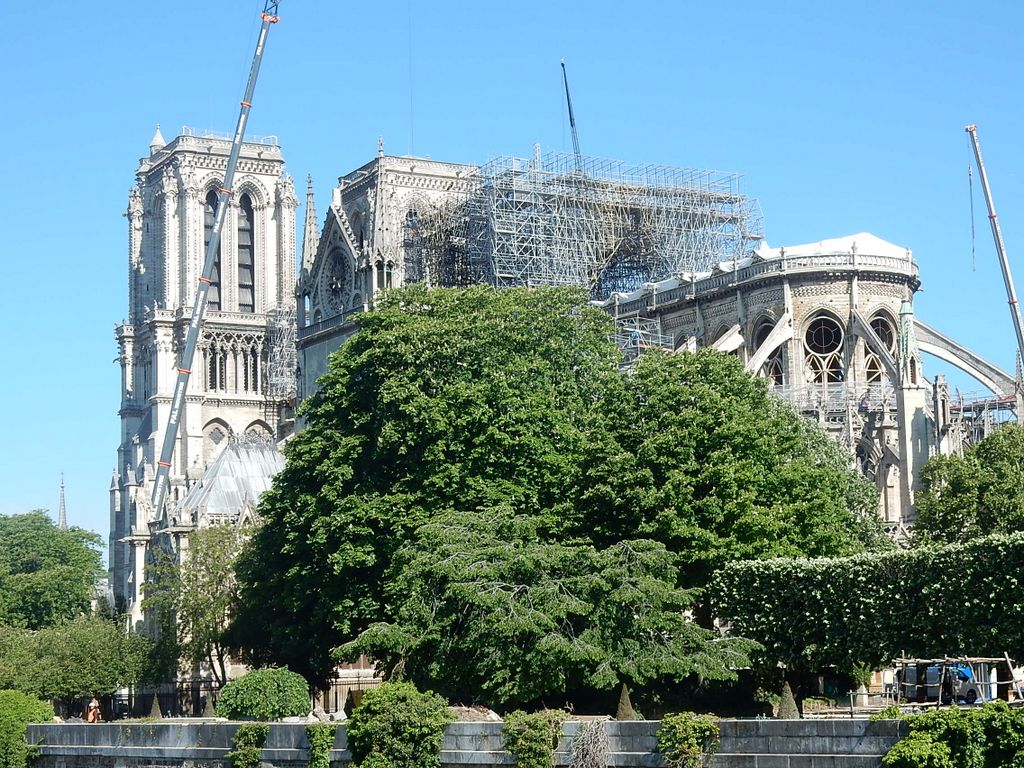
then dispersed for sightseeing. We saw Notre
Dame (after its devastating fire just a few weeks earlier);
there were opportunities to visit Sainte Chapelle and other sights
which we skipped
since we
had done that on a previous trip.I am
amazed at how well the firemen were able to contain the damage of the
cathedral. It is all off-limits to tourists, of course, but we
could easily see it. Below, views from the front, the side and
the back. You can see (particularly if you enlarge the center
view) that the large rose window is still intact
and has protective shields over it; the smaller one above it however,
suffered much damage.

 We walked along the Seine,
browsed the left bank, stopped for a rest in a small park across from
the Cathedral: Square René Viviani, opened in 1928 and named for the
Socialist Prime Minister of France early in World War I.
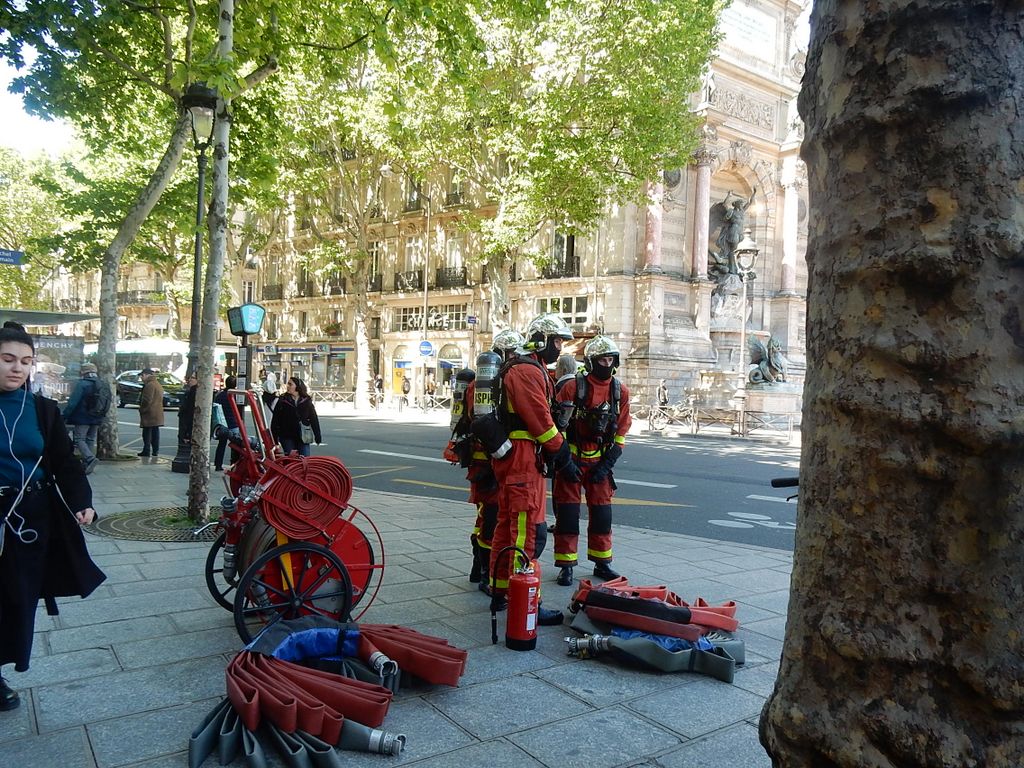
Around the corner we got a demonstration of the efficiency of the
Parisian Fire Department - apparently they were called for a possible
fire in the Metro near there; however it wasn't necessary to close it
off or for them to go in. They were geared up and ready,
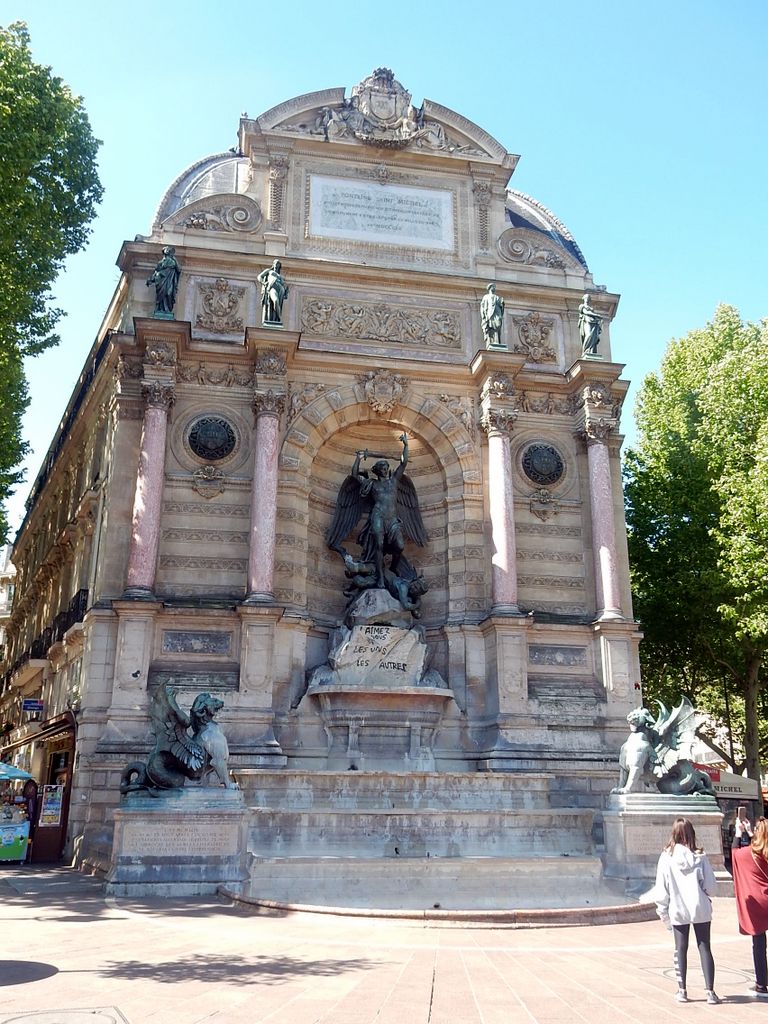
though! We met the group back at the Fontaine
Saint-Michel (at right) and bussed back to the boat for lunch.
We walked along the Seine,
browsed the left bank, stopped for a rest in a small park across from
the Cathedral: Square René Viviani, opened in 1928 and named for the
Socialist Prime Minister of France early in World War I.
Around the corner we got a demonstration of the efficiency of the
Parisian Fire Department - apparently they were called for a possible
fire in the Metro near there; however it wasn't necessary to close it
off or for them to go in. They were geared up and ready,
though! We met the group back at the Fontaine
Saint-Michel (at right) and bussed back to the boat for lunch.
 One sight we passed regularly was the mini-Liberty by
the Pont de Grenell - our bus picked us up along the river walk and
then went up and over that bridge. I only got the back of it
since we were always on the bridge behind it! It's one quarter of
the size of the one in New York, given by the French to the US in
1886. This one was sent to France by the US in 1889 to
commemorate the centennial of the French Revolution.
One sight we passed regularly was the mini-Liberty by
the Pont de Grenell - our bus picked us up along the river walk and
then went up and over that bridge. I only got the back of it
since we were always on the bridge behind it! It's one quarter of
the size of the one in New York, given by the French to the US in
1886. This one was sent to France by the US in 1889 to
commemorate the centennial of the French Revolution.
 After lunch and a short rest
we were off to our last museum: Musée Marmottan.
It has one of the most complete collections of impressionists and the
most Monet works anywhere in the world. It
was really a good way to end the exploration of impressionists!
Showing great restraint, I have only included four paintings
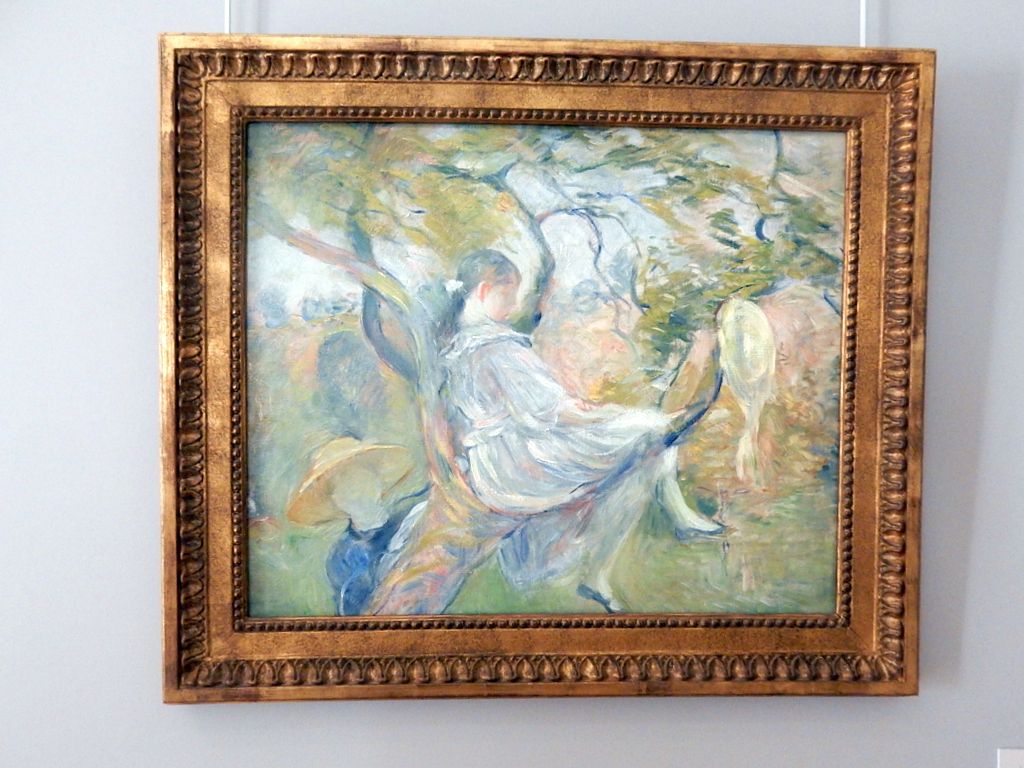
here. One
(at right) is by Berthe Morisot. She was a friend and colleague
of Edouard Manet and married his younger brother Eugène. She
joined the group of impressionists in 1874 who refused to show their
work at the Salon (which has rejected much of the impressionist art)
and instead launched their own independent show. I was very taken
by her paintings of children, including the one at the right "In The Apple Tree." (She was considered one of the 3
great women impressionists, along with Mary Cassatt and Marie
Bracquemond.)
After lunch and a short rest
we were off to our last museum: Musée Marmottan.
It has one of the most complete collections of impressionists and the
most Monet works anywhere in the world. It
was really a good way to end the exploration of impressionists!
Showing great restraint, I have only included four paintings
here. One
(at right) is by Berthe Morisot. She was a friend and colleague
of Edouard Manet and married his younger brother Eugène. She
joined the group of impressionists in 1874 who refused to show their
work at the Salon (which has rejected much of the impressionist art)
and instead launched their own independent show. I was very taken
by her paintings of children, including the one at the right "In The Apple Tree." (She was considered one of the 3
great women impressionists, along with Mary Cassatt and Marie
Bracquemond.)
Below on
the left is Monet's 1872 painting "Impression, Sunrise" which is
credited with coining the name of the Impressionist movement. I
found it striking that Monet continued painting as he
lost his sight – though he could no longer see it, he was still
painting his Japanese bridge. Below in the center is an early
painting of the Giverny Bridge (from the Musée D'Orsay around
1900) and on the right, about 20 years later: if you didn't know
what it was, it would be very difficult to discern.


Our last dinner included
an appetizer of smoked salmon stuffed with cream cheese; beef steak
with Bordelaise sauce; Comté from Jura (cheese course) and dessert was
"Chocolate Emotion." Yes, that's pretty much how we ate all week!
So, how was the
experiment? Overall I think we both enjoyed it very much. Yes,
with a tour group, there are compromises – we had to  wait
for people, bathroom breaks took a longer time, e.g.; but it was nice
to
have
someone else, who knew what they were doing and spoke the language, do
all the planning! Jennifer was great. She really made good use of
the
"whisper" audio system and she
is so very knowledgeable. Even
though I won't retain half of what I learned, it made an
impression - that was not intended, but it would
be a Jennifer joke!
wait
for people, bathroom breaks took a longer time, e.g.; but it was nice
to
have
someone else, who knew what they were doing and spoke the language, do
all the planning! Jennifer was great. She really made good use of
the
"whisper" audio system and she
is so very knowledgeable. Even
though I won't retain half of what I learned, it made an
impression - that was not intended, but it would
be a Jennifer joke! 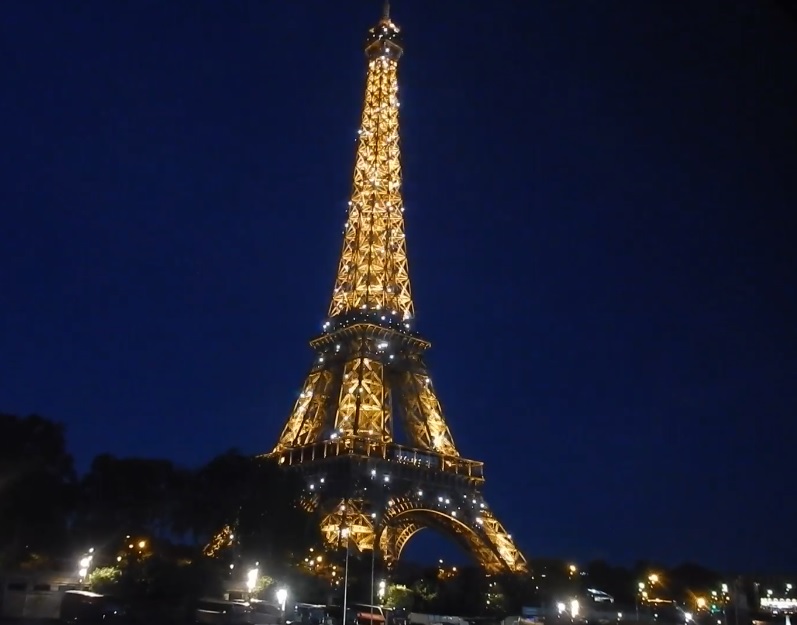 She could be
talking about a monument or a painting and then suddenly you realize
you
just
heard the punch line to a joke – she slid them in so subtley.
She could be
talking about a monument or a painting and then suddenly you realize
you
just
heard the punch line to a joke – she slid them in so subtley.
We
were up and off to
the airport (the airport farewell at left) early Wednesday morning. For reasons none of us,
including the crew, understood, the "Comfort Plus" area only had about
10 passengers which meant we each had plenty of room to stretch out and
nap! When we got back to Minneapolis, we slept again; had pizza
with Katie that night then drove home the next day.
I leave you with
the Eiffel Tower "sparkling" as it does every hour after dark until 1
am. Click the image of the tower to start the video.
Click here to
return to
the France Trip Index
Click here to
return to
Barb's Index
Click
here to return to Fotos 'n Stuff Home Page