|
Saturday March 30
  We
arrived in Budapest this morning and started right off getting great
views from the river before we even docked! (House of Parliament at the
left.) We had a wonderful
tour with our guide Sonja. Again, we chose an "up close" walking tour
where we used public transportation instead of the Viking Bus - it was
a total of 4 hours with one hour free time in the market.
This was much, much better than the Vienna
one. Since we were docked right by the Chain Bridge on the
Pest side, we started our walk by crossing the bridge over to
the Buda side of the city (right photo). The Chain Bridge
was the first permanent bridge over the Danube to connect Buda
and
Pest. The road is suspended by iron chains, hence the name "Chain
Bridge;" it was inaugurated in 1849. We
arrived in Budapest this morning and started right off getting great
views from the river before we even docked! (House of Parliament at the
left.) We had a wonderful
tour with our guide Sonja. Again, we chose an "up close" walking tour
where we used public transportation instead of the Viking Bus - it was
a total of 4 hours with one hour free time in the market.
This was much, much better than the Vienna
one. Since we were docked right by the Chain Bridge on the
Pest side, we started our walk by crossing the bridge over to
the Buda side of the city (right photo). The Chain Bridge
was the first permanent bridge over the Danube to connect Buda
and
Pest. The road is suspended by iron chains, hence the name "Chain
Bridge;" it was inaugurated in 1849.   We
saw a few sites of interest, including the only tunnel in Budapest
(opened in 1856, it runs under Buda Castle to provide a shortcut to the
other side of Castle Hill) and
the "zero kilometer" marker (left) - all roads in Hungary start
counting from this point - and then we took the funicular (right) to the
top of the hill. From there, of course we had to take
pictures of the view, looking back at Pest! At the left
below you'll see Barb's "tourist" picture. If you follow the
Chain Bridge back across the Danube, just to the left of it is the
Prestige, our ship (to the right of the bridge is a different Viking
ship). If the bridge kept going, it would go right into
Gresham Palace (which is now a Four Seasons Hotel). To the
right of the palace (as we're looking at it) is the Ministry of the
Interior; and behind it is St. Stephen's Basilica. We
saw a few sites of interest, including the only tunnel in Budapest
(opened in 1856, it runs under Buda Castle to provide a shortcut to the
other side of Castle Hill) and
the "zero kilometer" marker (left) - all roads in Hungary start
counting from this point - and then we took the funicular (right) to the
top of the hill. From there, of course we had to take
pictures of the view, looking back at Pest! At the left
below you'll see Barb's "tourist" picture. If you follow the
Chain Bridge back across the Danube, just to the left of it is the
Prestige, our ship (to the right of the bridge is a different Viking
ship). If the bridge kept going, it would go right into
Gresham Palace (which is now a Four Seasons Hotel). To the
right of the palace (as we're looking at it) is the Ministry of the
Interior; and behind it is St. Stephen's Basilica. In the center, below, is Sandor Palace, the President's home, and to the right is the Hilton Hotel. The Buda side of the river is the "old" side and building codes insist that any new construction must be compatible with the old buildings that remain. The Hilton was built with reflective siding so what you see when you look at it are the old buildings around it - from this view, St. Matthias Church. Apparently they were able to convince the board that this was acceptable! Pretty clever. 

 The main attraction at the top of the hill is the Royal Palace (aka Buda Castle) that now houses the Hungarian National Library and Hungarian National Gallery, among other things. There will be a night picture of it later on but there wasn't time to do it all, so we didn't visit the palace on this trip. Also in the area is the oldest theater, opened in 1790, that has a plaque commemorating a concert there by Beethoven on May 7, 1800. Below are pictures of St. Matthias Church (left), which was closed to tourists because of Easter weekend; the Fisherman's Bastion (center); and the Trinity Monument, that commemorates the end of the plague - very similar to the one we saw in Vienna. 

   Of
course, up on the Fisherman's Bastion we had to take more pictures!
The one on the left gives you an overview of the area - you
can see St. Matthias church, the monument to Saint Stephen I, also the
first King of Hungary, and more of the bastion as it wrapped
defensively above the river. The picture to the
right was taken
looking north east from the bastion, you can see Parliament across the
river
and, on this side, the top of the distinctive Buda
Reformed Church. Of
course, up on the Fisherman's Bastion we had to take more pictures!
The one on the left gives you an overview of the area - you
can see St. Matthias church, the monument to Saint Stephen I, also the
first King of Hungary, and more of the bastion as it wrapped
defensively above the river. The picture to the
right was taken
looking north east from the bastion, you can see Parliament across the
river
and, on this side, the top of the distinctive Buda
Reformed Church. We stopped briefly in the lobby of the
Hilton Hotel - it's quite interesting and they are apparently tolerant
of tourists using their rest rooms! We were rather taken
aback at first by all of the people in kilts until we realized there
was a Scots wedding being hosted there this weekend. We stopped briefly in the lobby of the
Hilton Hotel - it's quite interesting and they are apparently tolerant
of tourists using their rest rooms! We were rather taken
aback at first by all of the people in kilts until we realized there
was a Scots wedding being hosted there this weekend.  The Hilton is
actually built around the site of medieval ruins that are still being
excavated. So one can sit in the very modern lobby and look
out into a courtyard from antiquity (pictured at left). The Hilton is
actually built around the site of medieval ruins that are still being
excavated. So one can sit in the very modern lobby and look
out into a courtyard from antiquity (pictured at left).We looked around the Castle District a bit more, saw some buildings of note and then took a bus back across the river to the Pest side. At Vörösmarty Square, the main activity was an Easter Market. At left below is some of the entertainment - they were quite good. In the center is a statue of beloved Hungarian poet Mihály Vörösmarty - he is surrounded by people of all different classes as he was a "father" to them all. It was erected in 1908 and paid for entirely by donations. The very first coin raised for this project is imbedded in it. It's hard to see, so I helpfully enlarged it on the right! On the right side of the poet (as we look at the statue) is a mother who is holding a little girl. The coin is to the left of the child's head and shows up as a darker circle in the stone. 

   From there we walked down Vaci Utca
(shown at left) - a major shopping area that is mostly pedestrian -
ending up at the Great Market Hall. On the way down to the
end we passed the Elizabeth Bridge (shown on the right).
That's one of the newer bridges in Budapest, built in the
early 1960's, and named for Elisabeth of Bavaria (aka Sisi) who was
well-loved by the Austrian and Hungarian people but assassinated by an anarchist in
1898. From there we walked down Vaci Utca
(shown at left) - a major shopping area that is mostly pedestrian -
ending up at the Great Market Hall. On the way down to the
end we passed the Elizabeth Bridge (shown on the right).
That's one of the newer bridges in Budapest, built in the
early 1960's, and named for Elisabeth of Bavaria (aka Sisi) who was
well-loved by the Austrian and Hungarian people but assassinated by an anarchist in
1898.  The Market Hall, shown at the right,
was built at the end of the 19th century. We had about an
hour in
the market to wander around. We started at the ATM to get
some HUF's (Hungarian Forints - the local currency; when we were there
the exchange rate was roughly 230 HUF = $1). There is just
about anything you could possibly want at this giant marketplace.
On the main level, mostly food (fresh fruits and veggies,
meats and seafood plus every sort of spice, herb or accompaniment you
could think of); upstairs were all sorts of textiles, crafts,
accessories and some "food to go" places. Each is
its own little stall so it is much like an upscale flea market.
I bought some paprika and goulash paste to take home;
Katie bought a purple leather purse that she fell in love with.
The picture at left below was taken from the second
floor looking down the main aisle. In the center is one of the
vegetable displays (remember the exchange rate before you gasp at the
prices) and on the right a butcher shop - all right there in the
marketplace! The Market Hall, shown at the right,
was built at the end of the 19th century. We had about an
hour in
the market to wander around. We started at the ATM to get
some HUF's (Hungarian Forints - the local currency; when we were there
the exchange rate was roughly 230 HUF = $1). There is just
about anything you could possibly want at this giant marketplace.
On the main level, mostly food (fresh fruits and veggies,
meats and seafood plus every sort of spice, herb or accompaniment you
could think of); upstairs were all sorts of textiles, crafts,
accessories and some "food to go" places. Each is
its own little stall so it is much like an upscale flea market.
I bought some paprika and goulash paste to take home;
Katie bought a purple leather purse that she fell in love with.
The picture at left below was taken from the second
floor looking down the main aisle. In the center is one of the
vegetable displays (remember the exchange rate before you gasp at the
prices) and on the right a butcher shop - all right there in the
marketplace! 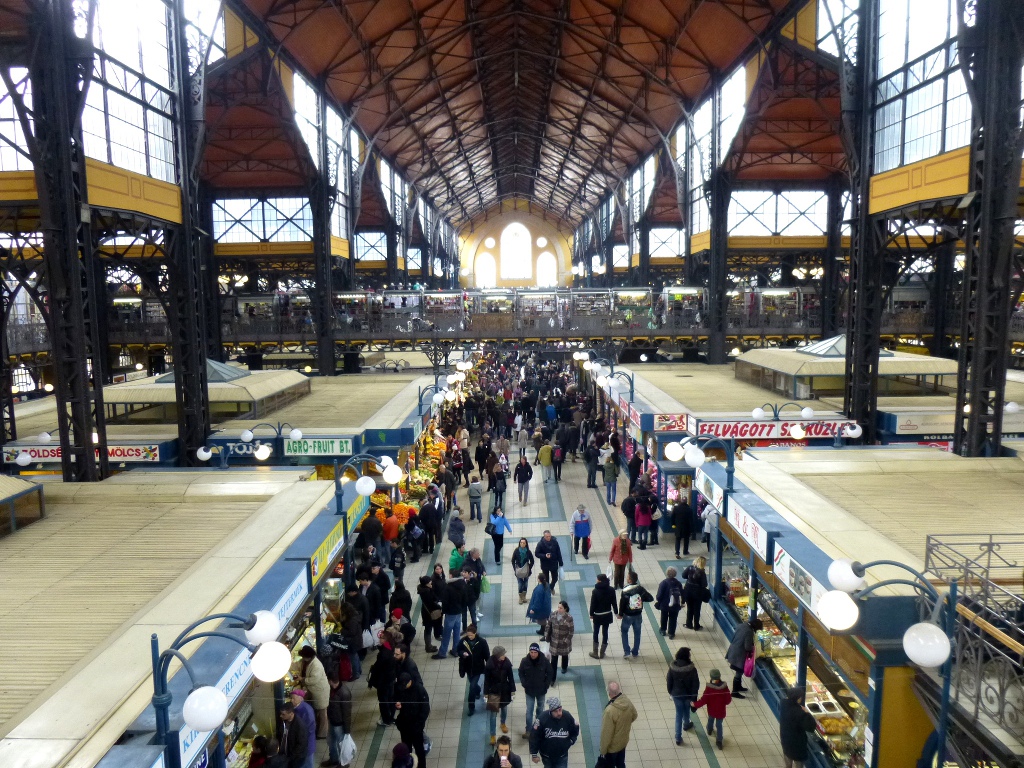     One
more market picture at the left - one of the textile stalls upstairs.
As we left the market, looking west over the Danube, we could
see the Liberty Statue (aka Freedom Statue), shown at the right - she
is holding a palm leaf above her head. Initially erected in
1947, it was first intended to commemorate the Soviets who freed
Hungary from the Nazi reign. After 1989, however, at the end
of communist rule, the inscription was changed to read (translation):
To the memory
of all those who sacrificed their lives for the
independence, freedom, and prosperity of Hungary. One
more market picture at the left - one of the textile stalls upstairs.
As we left the market, looking west over the Danube, we could
see the Liberty Statue (aka Freedom Statue), shown at the right - she
is holding a palm leaf above her head. Initially erected in
1947, it was first intended to commemorate the Soviets who freed
Hungary from the Nazi reign. After 1989, however, at the end
of communist rule, the inscription was changed to read (translation):
To the memory
of all those who sacrificed their lives for the
independence, freedom, and prosperity of Hungary. We
then caught Tram #2, that runs along the river, to take us back to the
Chain Bridge, and our ship, for lunch. I had to take a
picture of
the Prestige bell (left) just because. That afternoon we were
both exhausted and, since we knew we had 2 more days in Budapest, we
didn't go back out after lunch. We got a start on packing
and I actually fell asleep for about an hour; Katie had
a good
time just resting in bed taking pictures of people who passed
by
as they walked along the river! We
then caught Tram #2, that runs along the river, to take us back to the
Chain Bridge, and our ship, for lunch. I had to take a
picture of
the Prestige bell (left) just because. That afternoon we were
both exhausted and, since we knew we had 2 more days in Budapest, we
didn't go back out after lunch. We got a start on packing
and I actually fell asleep for about an hour; Katie had
a good
time just resting in bed taking pictures of people who passed
by
as they walked along the river!We had a great dinner for our last night on board (rack of lamb). I went up to the lounge and listened to the Hungarian Folk Group for a little while. They were very good but we had to finish packing and reset our clocks. Although we had already lost an hour for Daylight Savings Time in the US, in Europe the time change is the last Sunday in March so we lost another hour. Somehow that doesn't seem fair! And we had to take a walk around the ship to see all the great views outside. At left is the Chain Bridge with the Royal Palace behind it; on the right is St. Matthias Church and the Fisherman's Bastion in front of it. It's all rather fairy tale like isn't it? 
   We
slept until 7 this morning and didn't even hear those who had to leave
at 3 AM to get their early flights out. (Our turn will come
Tuesday!) Since they have a new
tour coming aboard this afternoon, we had to be out of our cabins by
8:30AM so they could begin cleaning; but then we had time for breakfast
and to read in
the lounge until about 9:25 when the bus came to take us to Le Meridien
Hotel for our last two nights. Ah, the last time we get the red carpet
(at left) until our next cruise! The hotel is very
elegant
(see the staircase at the right above) but our rooms were not ready yet
so they stored our luggage for us and we went off to explore on this
rainy afternoon. We
slept until 7 this morning and didn't even hear those who had to leave
at 3 AM to get their early flights out. (Our turn will come
Tuesday!) Since they have a new
tour coming aboard this afternoon, we had to be out of our cabins by
8:30AM so they could begin cleaning; but then we had time for breakfast
and to read in
the lounge until about 9:25 when the bus came to take us to Le Meridien
Hotel for our last two nights. Ah, the last time we get the red carpet
(at left) until our next cruise! The hotel is very
elegant
(see the staircase at the right above) but our rooms were not ready yet
so they stored our luggage for us and we went off to explore on this
rainy afternoon.  We
decided that, given the weather, it
would be a good day to do an inside thing, like a museum. So
we set off for the Hungarian National Museum (which is walking
distance). But we had only gone a block or so when we saw the
Great Synagogue (picture at left) so we made the detour across the
street to see the synagogue first. There were no tours this
week because of Passover but we could see the various memorials that
were outside. The building has miraculously existed since
1859. We walked
around it, saw the arcade area with old tombstones, the Garden of
Heroes (at right) where over 2000 Jews who died in 1944-45 are buried.
At the end of the courtyard is the Holocaust Memorial (left
below) and behind the Synagogue is
Raoul
Wallenberg Holocaust Memorial Park. The most striking feature
of
the park is the Memorial of the Hungarian Jewish Martyrs - more
commonly known as the Tree of Life sculpture (center, below).
Created by Imre Varga, it has the form of a weeping willow on
which each leaf is inscribed with the names and tattoo numbers of over
400,000 Jews who died at the hands of the Nazis. Katie got a
closeup of a cluster of the leaves (on the right). I was
extremely moved by the little teardrops (remember it was a rainy day)
at the end of each leaf. We
decided that, given the weather, it
would be a good day to do an inside thing, like a museum. So
we set off for the Hungarian National Museum (which is walking
distance). But we had only gone a block or so when we saw the
Great Synagogue (picture at left) so we made the detour across the
street to see the synagogue first. There were no tours this
week because of Passover but we could see the various memorials that
were outside. The building has miraculously existed since
1859. We walked
around it, saw the arcade area with old tombstones, the Garden of
Heroes (at right) where over 2000 Jews who died in 1944-45 are buried.
At the end of the courtyard is the Holocaust Memorial (left
below) and behind the Synagogue is
Raoul
Wallenberg Holocaust Memorial Park. The most striking feature
of
the park is the Memorial of the Hungarian Jewish Martyrs - more
commonly known as the Tree of Life sculpture (center, below).
Created by Imre Varga, it has the form of a weeping willow on
which each leaf is inscribed with the names and tattoo numbers of over
400,000 Jews who died at the hands of the Nazis. Katie got a
closeup of a cluster of the leaves (on the right). I was
extremely moved by the little teardrops (remember it was a rainy day)
at the end of each leaf. 

 Then we went on down Múzeum Körút to the Hungarian National Museum (pictured at left)  which was interesting primarily in
pointing out
how totally ignorant I was about Hungarian history. which was interesting primarily in
pointing out
how totally ignorant I was about Hungarian history.  There was a fairly hefty fee to take pictures inside so we
decided against that. The museum was founded in 1802 and is a
wonderful collection of artifacts, exhibits, photos, etc. relating to
the nation's history. We saw some impressive archeological
finds
dating back to around the 5th century BC, a coronation mantle
handed down from St. Stephen in 1031 AD, and a portable clavichord
originally bought for Mozart to practice on during tours, among many
other items. But it
was when we got into the 20th Century that I was totally humbled.
I suppose at some point I had learned about the
Austro-Hungarian
Empire breakup after WWI, and subsequent loss of much of Hungary to
surrounding countries, but the significance of it all hadn't "stuck"
until I visited the country and walked through so much of
its history.
There was a fairly hefty fee to take pictures inside so we
decided against that. The museum was founded in 1802 and is a
wonderful collection of artifacts, exhibits, photos, etc. relating to
the nation's history. We saw some impressive archeological
finds
dating back to around the 5th century BC, a coronation mantle
handed down from St. Stephen in 1031 AD, and a portable clavichord
originally bought for Mozart to practice on during tours, among many
other items. But it
was when we got into the 20th Century that I was totally humbled.
I suppose at some point I had learned about the
Austro-Hungarian
Empire breakup after WWI, and subsequent loss of much of Hungary to
surrounding countries, but the significance of it all hadn't "stuck"
until I visited the country and walked through so much of
its history.
I think we got ripped off at a food stand on the way back to our hotel, but we were starving by then and saw some very yummy shiska-bobs. I thought we asked for the price of 2 of them and he quoted us 2430HUF. But then he only gave us one. It was very big and enough to share, but I think that was way more than one should have cost. However, not knowing the language is a serious disadvantage and it just didn't seem worth fussing about since it WAS very good and held our hunger at bay until dinner. So we paid a tourist penalty for our street food!  Back at the hotel we got into our room – the luggage was already brought up and ready for us. It's large and fancy; a nice bathroom with both tub and shower and a heated floor! We have a wonderful Viking Host here at the Le Meridien. His name is Andas and he was very helpful; so he made us reservations for supper tonight at Pilvax. It's a nice bistro very close to the hotel. I had "chicken supreme" which was a breast and wing with gnocchi and tomato sauce above it and pesto below it (for the red, white, green Hungarian flag) and it was wonderful - and deserved a picture. Katie had duck and it also was great. While the entrée prices were very reasonable ($10 for mine, $15 for hers) we also had dessert and 3 glasses of wine so it added up! We just need more moderation. It's probably good that we only have 2 days here on our own. Monday April 1  We
slept in this morning - had breakfast around 9:30 in the very nice
breakfast room (left - and closeup of the skylight on the right) and it
was 10:30 or so before we left the hotel. We
slept in this morning - had breakfast around 9:30 in the very nice
breakfast room (left - and closeup of the skylight on the right) and it
was 10:30 or so before we left the hotel.  But
the sky was
blue, the sun was out and it was in the 40's. And oh my, we
packed a lot into the day! We started at St. Stephen's
Basilica,
not sure if it would be open for tourists on Easter Monday. It was not
only open (200 HUF) but they let us in during a Mass! I was
glad
to see that the tourists were respectful and we had the super treat of
hearing the organ and choir perform the Hallelujah Chorus by Handel in
addition to a couple of other pieces: hymns and a postlude.
Awesome. Pictured below, left to right: front of the
basilica, sanctuary and ceiling. But
the sky was
blue, the sun was out and it was in the 40's. And oh my, we
packed a lot into the day! We started at St. Stephen's
Basilica,
not sure if it would be open for tourists on Easter Monday. It was not
only open (200 HUF) but they let us in during a Mass! I was
glad
to see that the tourists were respectful and we had the super treat of
hearing the organ and choir perform the Hallelujah Chorus by Handel in
addition to a couple of other pieces: hymns and a postlude.
Awesome. Pictured below, left to right: front of the
basilica, sanctuary and ceiling.

 Then we hiked the 364 steps up the spiral staircase to the dome. Wonderful views all around but very windy - I tried to keep the pictures limited but there were so many good ones. Sigh.
First, looking down the stairs about half way up; Katie's
tourist picture and a view that includes the Parliament building by the
river - do notice the beautiful blue sky! 

 The next row shows the view from the front of the basilica all the way to the Danube and across to Buda. In the enlarged view, you can see the Royal Palace on the left and St. Matthias and the Fisherman's Bastion on the right. If you follow the street through the square (which is where we were standing to take the first picture above) and keep going, the light brown patch is the river! The center picture shows you we were right up there as high as the towers! The clocks, by the way, do show the right time. Finally, after we were back down, we walked around to the back and took this picture of the other side of the basilica. 

   Next
we walked up Andrássy Ut, a very well-known street, passing many
interesting buildings on the
way. Just to highlight a couple I've included the opera house
(left) and some of the pictures of holocaust victims all
around the front of the House of Terror museum (right).
We
saw many office buildings and apartment buildings with statues of such
disparate folks as Mór Jókai (19th century Hungarian writer), Szondy
Gyorgy (captain of Drégely Castle in 1544) and Rennaissance poet
Balassi Balint. We sighted a functional public telephone
booth
and passed a Segway tour (left below)! Next
we walked up Andrássy Ut, a very well-known street, passing many
interesting buildings on the
way. Just to highlight a couple I've included the opera house
(left) and some of the pictures of holocaust victims all
around the front of the House of Terror museum (right).
We
saw many office buildings and apartment buildings with statues of such
disparate folks as Mór Jókai (19th century Hungarian writer), Szondy
Gyorgy (captain of Drégely Castle in 1544) and Rennaissance poet
Balassi Balint. We sighted a functional public telephone
booth
and passed a Segway tour (left below)! Finally we arrived at Heroes Square, the entrance to Városliget Park (pictured in center below) which was our destination for the afternoon. We started at the Fine Arts Museum (pictured at right). 

   We
spent about 2 hours in the Fine Arts Museum - their fee for a photo
pass was much more reasonable (I think it was 300HUF - less
than
$1.50) and so we purchased one. Since Katie had the better
camera
I assigned her custody of the permit. At left is the Marble
Hall
- as you can see, the building is a great "fine art" itself.
And to the right some of the jewelry in the Classical
Antiquities
collection; such amazing detail and of course, all done by
hand. We
spent about 2 hours in the Fine Arts Museum - their fee for a photo
pass was much more reasonable (I think it was 300HUF - less
than
$1.50) and so we purchased one. Since Katie had the better
camera
I assigned her custody of the permit. At left is the Marble
Hall
- as you can see, the building is a great "fine art" itself.
And to the right some of the jewelry in the Classical
Antiquities
collection; such amazing detail and of course, all done by
hand.
 Among
my favorite paintings were a Pissarro landscape, a painting of "Garden
of Eden with the Fall of
Man" (Jan Breughel, the younger - photo at left) and a wonderful
painting of a "Centaur at the
Village
Blacksmith’s Shop" (Arnold Böcklin). There are many
Garden
of Eden paintings by both the younger and the elder Breughel - it was
something of a challenge to track down which one this was since I was
careless enough not to note the precise artist while we were there.
I liked it in part because the emphasis was on the "Eden" -
beautiful animals and landscape, and you only noticed the "fall" if you
were looking for it. Among
my favorite paintings were a Pissarro landscape, a painting of "Garden
of Eden with the Fall of
Man" (Jan Breughel, the younger - photo at left) and a wonderful
painting of a "Centaur at the
Village
Blacksmith’s Shop" (Arnold Böcklin). There are many
Garden
of Eden paintings by both the younger and the elder Breughel - it was
something of a challenge to track down which one this was since I was
careless enough not to note the precise artist while we were there.
I liked it in part because the emphasis was on the "Eden" -
beautiful animals and landscape, and you only noticed the "fall" if you
were looking for it.  Way
in the background, very small, you can see Eve, apparently excited
about presenting Adam with an apple. When
we felt overwhelmed, it was time to go back out in the sun and enjoy
the park, even though there was much more to see in the museum. Way
in the background, very small, you can see Eve, apparently excited
about presenting Adam with an apple. When
we felt overwhelmed, it was time to go back out in the sun and enjoy
the park, even though there was much more to see in the museum.Directly across the square from the Fine Arts Museum is the Palace of Art (at right), which we skipped this trip. Városliget Park is a huge city park that includes, besides several museums, a zoo, a circus, a pond and a large "castle" on an island (left).  Well,
the lake
had been drained when we were there so it wasn't exactly an
island! When we told our host in the hotel that we were
setting
off for Városliget today he laughed and said that would take a week!
He's right. But we had to settle for a few hours.
The
vendors around the castle were all selling corn on
the
cob, big soft pretzels and mulled cider. Well,
the lake
had been drained when we were there so it wasn't exactly an
island! When we told our host in the hotel that we were
setting
off for Városliget today he laughed and said that would take a week!
He's right. But we had to settle for a few hours.
The
vendors around the castle were all selling corn on
the
cob, big soft pretzels and mulled cider. Vajdahunyad Castle was built around 1900 as part of the Millennial Exhibition which celebrated the 1000 years of Hungary since the Conquest of the Carpathian Basin in 895. It was originally made of cardboard! But it proved so popular that it was rebuilt with permanent materials between 1904 and 1908. It contains replicas of buildings from different time periods and architectural style. Below, left to right, are just a few of the different styles: the entrance to the castle (looks very Disney-like, doesn't it?), a gothic section and the Romanesque Church of Jak.      The
Agricultural Museum is housed in a very Baroque portion of the castle
(left). At right is the main building of the Széchenyi Thermal
Bath Complex. In talking with people who took the time to visit,
it sounds like a giant waterpark - with a "lazy river" and many
different kinds of pools - all naturally heated. They said the
water comes in so hot that it actually has to be diluted by cool water
to make it usable! When we go back to Budapest and have more
time, I will definitely try out one of the many baths in the city! The
Agricultural Museum is housed in a very Baroque portion of the castle
(left). At right is the main building of the Széchenyi Thermal
Bath Complex. In talking with people who took the time to visit,
it sounds like a giant waterpark - with a "lazy river" and many
different kinds of pools - all naturally heated. They said the
water comes in so hot that it actually has to be diluted by cool water
to make it usable! When we go back to Budapest and have more
time, I will definitely try out one of the many baths in the city!Other views within the park include some Andean musicians - playing pipes, singing and selling CD's, a nice pond near the zoo and circus with the requisite ducks, and the Müjégpálya Pavilion (opened in 1870) that overlooks the largest ice skating rink in Europe during the winter months. In the summer, it is used primarily for recreational boating. When we were there it was between seasons and the lake had been mostly drained.    Heading back to the hotel, we decided to take the underground (the Yellow, millenium line goes right down Andrássy) to save time.  When we went down in the Hosok station (the nearest one) there was
some sort of problem – 2 cars were sitting there
with doors open and people hanging around waiting for them to "fix"
it.
So we walked on down to the Kodaly station, where there was someone in
a booth to sell us tickets, and took the train back to Deak Ferenc Ter
which is right in front of the hotel. I recalled hearing
about the Underground Museum that was supposed to be at that station.
It's not perfectly obvious, however, since three lines cross at
Deak Ferenc Ter - but one of the security people told us it was at the
Blue Line
entrance so we walked across the street and found it. It's very
small but only cost 350HUF (less than $2) and we found it
interesting. It follows the chronology of the
construction
and inauguration of the underground – English translations were
provided for almost all of the displays that included models of cars and parts; many photos and some actual
retired
cars
are on display as well (picture at left). The Budapest Underground
opened in 1896 and was the first on continental Europe.
When we went down in the Hosok station (the nearest one) there was
some sort of problem – 2 cars were sitting there
with doors open and people hanging around waiting for them to "fix"
it.
So we walked on down to the Kodaly station, where there was someone in
a booth to sell us tickets, and took the train back to Deak Ferenc Ter
which is right in front of the hotel. I recalled hearing
about the Underground Museum that was supposed to be at that station.
It's not perfectly obvious, however, since three lines cross at
Deak Ferenc Ter - but one of the security people told us it was at the
Blue Line
entrance so we walked across the street and found it. It's very
small but only cost 350HUF (less than $2) and we found it
interesting. It follows the chronology of the
construction
and inauguration of the underground – English translations were
provided for almost all of the displays that included models of cars and parts; many photos and some actual
retired
cars
are on display as well (picture at left). The Budapest Underground
opened in 1896 and was the first on continental Europe. Finally, before going back to our room, I wanted to walk down the "fair" (read: flea market, souvenir booths) behind the hotel since I did not yet have any souvenir to bring home. I used to get prints wherever we went but now I'm about out of wall space so I have to find smaller items: I bought some lovely silk earrings.  As
we went into the hotel, tired and ready to crash, I stopped and asked
Andas, our Viking host,
if the "shoe memorial" was nearby. We had heard people talking
about how poignant it was and I wondered if we could stop there before
going to dinner.
As
we went into the hotel, tired and ready to crash, I stopped and asked
Andas, our Viking host,
if the "shoe memorial" was nearby. We had heard people talking
about how poignant it was and I wondered if we could stop there before
going to dinner.  He
showed us on the map where it was (near the
Parliament on the riverbank) and
also eagerly showed us a route that would take us by several other
things we had not
seen yet. His enthusiasm was enough to get us going again!
So, instead of crashing for 90 minutes, we made a quick room stop and
then went back
out. We easily found the shoes… the display honors those who were
shot by the Arrow Cross Militiamen in 1944-45; Jews were ordered to
remove their shoes then lined up along the edge of the river and shot
so that their bodies fell into the river to be washed away. There are supposed to
be several plaques explaining this, but we didn't see them. These
are
cast iron replicas of shoes, permanently mounted on the Danube bank as
a remembrance. Due to construction and cleaning activities at the
Parliament Building, we had to walk almost all the way up to the
Margaret
Bridge (see a tram crossing it in the picture above, right) to cross
the street again. He
showed us on the map where it was (near the
Parliament on the riverbank) and
also eagerly showed us a route that would take us by several other
things we had not
seen yet. His enthusiasm was enough to get us going again!
So, instead of crashing for 90 minutes, we made a quick room stop and
then went back
out. We easily found the shoes… the display honors those who were
shot by the Arrow Cross Militiamen in 1944-45; Jews were ordered to
remove their shoes then lined up along the edge of the river and shot
so that their bodies fell into the river to be washed away. There are supposed to
be several plaques explaining this, but we didn't see them. These
are
cast iron replicas of shoes, permanently mounted on the Danube bank as
a remembrance. Due to construction and cleaning activities at the
Parliament Building, we had to walk almost all the way up to the
Margaret
Bridge (see a tram crossing it in the picture above, right) to cross
the street again.  Following
Andas' route, we walked along the back of Parliament past the
Ethnographical Museum and then Ministry of Agriculture building that
hosts a memorial (round bullets in the wall - left) to Red
Thursday, when the Soviets open fired on students October 25,
1956. Following
Andas' route, we walked along the back of Parliament past the
Ethnographical Museum and then Ministry of Agriculture building that
hosts a memorial (round bullets in the wall - left) to Red
Thursday, when the Soviets open fired on students October 25,
1956.  Next we found the little bridge with a statue of Imre Nagy (and today,
Katie) standing on it. He was the prime minister during the 1956
revolution and was executed by the soviets. Next was the Ronald
Reagan bronze statue erected in 2011 commemorating his role in the fall
of communism, where Barb posed with him.
Next we found the little bridge with a statue of Imre Nagy (and today,
Katie) standing on it. He was the prime minister during the 1956
revolution and was executed by the soviets. Next was the Ronald
Reagan bronze statue erected in 2011 commemorating his role in the fall
of communism, where Barb posed with him.  You may notice the Parliament dome directly behind us. You may notice the Parliament dome directly behind us.Reagan stands at one end of the Liberty Square (sometimes translated as Freedom Square) that has many great buildings surrounding it, including the Stock Exchange building, the Hungarian  National
Bank, and the Hungarian National Television headquarters. The one
that intrigued us the most had big signs up saying No Admittance and
icons for "no photos" along with armed guards. We obeyed the
threatening signs and didn't take a picture of it. After we got home, I
learned it was the American Embassy! Also in Liberty Square
is one of the last Soviet monuments. It honors the members of the
Red Army who died in 1944-45 during the liberation of Budapest from the
Nazi regime. The gold emblem in the center (you can see it if you
enlarge the picture) is the Communist symbol: hammer and sickle.
At the top is the Communist 5 pointed star. Its proximity
to the Reagan statue, celebrating the liberation from communism, is
rather ironic. National
Bank, and the Hungarian National Television headquarters. The one
that intrigued us the most had big signs up saying No Admittance and
icons for "no photos" along with armed guards. We obeyed the
threatening signs and didn't take a picture of it. After we got home, I
learned it was the American Embassy! Also in Liberty Square
is one of the last Soviet monuments. It honors the members of the
Red Army who died in 1944-45 during the liberation of Budapest from the
Nazi regime. The gold emblem in the center (you can see it if you
enlarge the picture) is the Communist symbol: hammer and sickle.
At the top is the Communist 5 pointed star. Its proximity
to the Reagan statue, celebrating the liberation from communism, is
rather ironic. The timing was perfect. We finished up in St. Stephen's Square
where we rested for about 15 minutes and took some more pictures of the
basilica with the sun behind us. Then we went to supper just down
the block at the bistro Rezkakas - "the Copper Rooster." Again
Andas did well for us; it was a great
place! I
had
goulash soup as appetizer and then braised pike-perch with spinach
gnocchi and a very yummy sauce. Katie had a duck appetizer –
thinly
sliced
on greens with apple and sesame seeds - and chicken paprikash
entrée.
We
were both very full and very happy with our meals.
The timing was perfect. We finished up in St. Stephen's Square
where we rested for about 15 minutes and took some more pictures of the
basilica with the sun behind us. Then we went to supper just down
the block at the bistro Rezkakas - "the Copper Rooster." Again
Andas did well for us; it was a great
place! I
had
goulash soup as appetizer and then braised pike-perch with spinach
gnocchi and a very yummy sauce. Katie had a duck appetizer –
thinly
sliced
on greens with apple and sesame seeds - and chicken paprikash
entrée.
We
were both very full and very happy with our meals. Back at the hotel we had to pack up and get ready to get up at 3 AM for a 3:45 pickup for a 6:15 AM plane. Tired but feeling good about all we got done today! Tuesday April 2 The hotel had croissants and juice in the lobby for us at 3:30 AM; the bus got us to airport in plenty of time. Budapest airport was easy. AMS was a pain. Passport control was a short line and quick this time (unlike when we were returning from Italy).  But
then at the gate we had to go through not only regular security
screening
again (where they take away our water...) but also an interview. It was a nusiance for us, but a real
obstacle for the many non-English speakers who were ticketed on the flight. But
then at the gate we had to go through not only regular security
screening
again (where they take away our water...) but also an interview. It was a nusiance for us, but a real
obstacle for the many non-English speakers who were ticketed on the flight.  However, we got back safely to Minneapolis with no difficulties at MSP customs and no lost luggage! We went to bed about 4:30 PM local time (11:30 PM by "body" time) so of course we were awake before dawn. But that gave us an opportunity to watch the lovely sunrise from Katie's 10th floor condo. I arrived back home in Iowa around 1:30 PM. It took me 3 or 4 days to get my body back on US time, but it was a wonderful trip and I'd love to do it again!
Click here to
return to
the River Cruise Trip Index
|