Sunday,
March 24:
 We left
Minneapolis late Saturday afternoon. The first
flight, to Amsterdam,
was long but nothing unusual. Well, wait - we discovered as
we got settled in our A and B seats that the video equipment under the
seats in front of us made it impossible to fit our carry-on backpacks
under the seat. We have flown in Airbuses before and never
had that problem - but apparently those were not 330s. That
meant some rearranging but there was plenty of room overhead so nothing
major. We changed to a CityHopper flight in AMS - very quick
to get through immigration this time - and landed in Nuremberg, Germany
around
9:30 AM.
We left
Minneapolis late Saturday afternoon. The first
flight, to Amsterdam,
was long but nothing unusual. Well, wait - we discovered as
we got settled in our A and B seats that the video equipment under the
seats in front of us made it impossible to fit our carry-on backpacks
under the seat. We have flown in Airbuses before and never
had that problem - but apparently those were not 330s. That
meant some rearranging but there was plenty of room overhead so nothing
major. We changed to a CityHopper flight in AMS - very quick
to get through immigration this time - and landed in Nuremberg, Germany
around
9:30 AM.
We were very tired but glad to meet our
Viking greeter! She
directed us to rest rooms and ATMs while we waited about half an hour
for everyone else who was expected that morning, then we loaded into
the Viking Bus and were delivered to the Prestige at the dock.
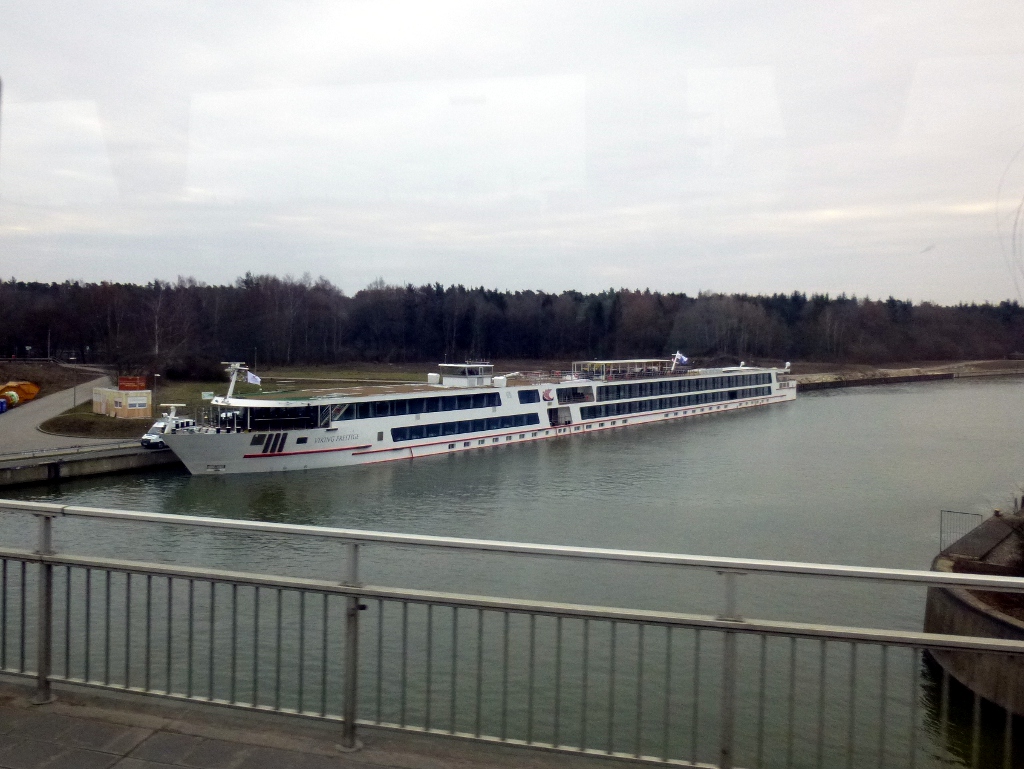
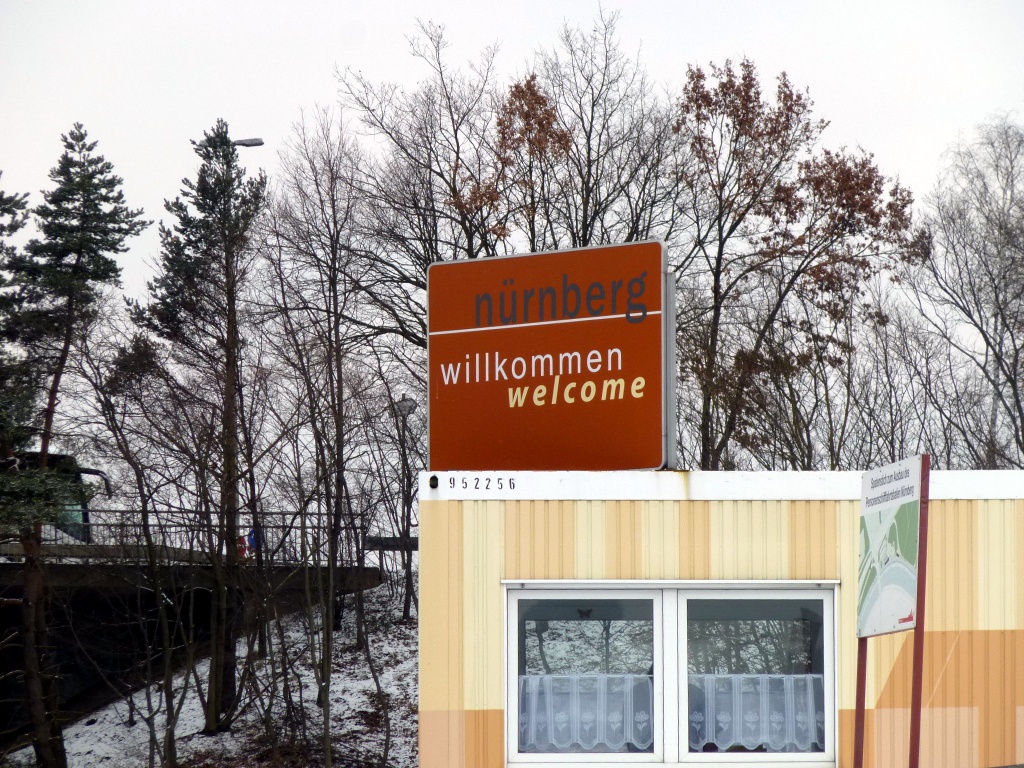
(In the picture to the right above we are approaching the
docked Prestige, the
left picture is the welcome sign at the dock.)
To set the context a bit, depending on when you're reading this, you
may not remember that 2013 was the year we didn't have much Spring in
the midwest. It continued to be very cold and we had
snowstorms right on into May, so we were leaving nasty
weather. Unfortunately, central Europe was having
the same sort of non-spring. Everywhere we went the locals
were exclaiming about how unusual the weather was. We checked
the weather ahead of time so were prepared with warm clothes but it was
still somewhat disappointing that the snow followed us!
We
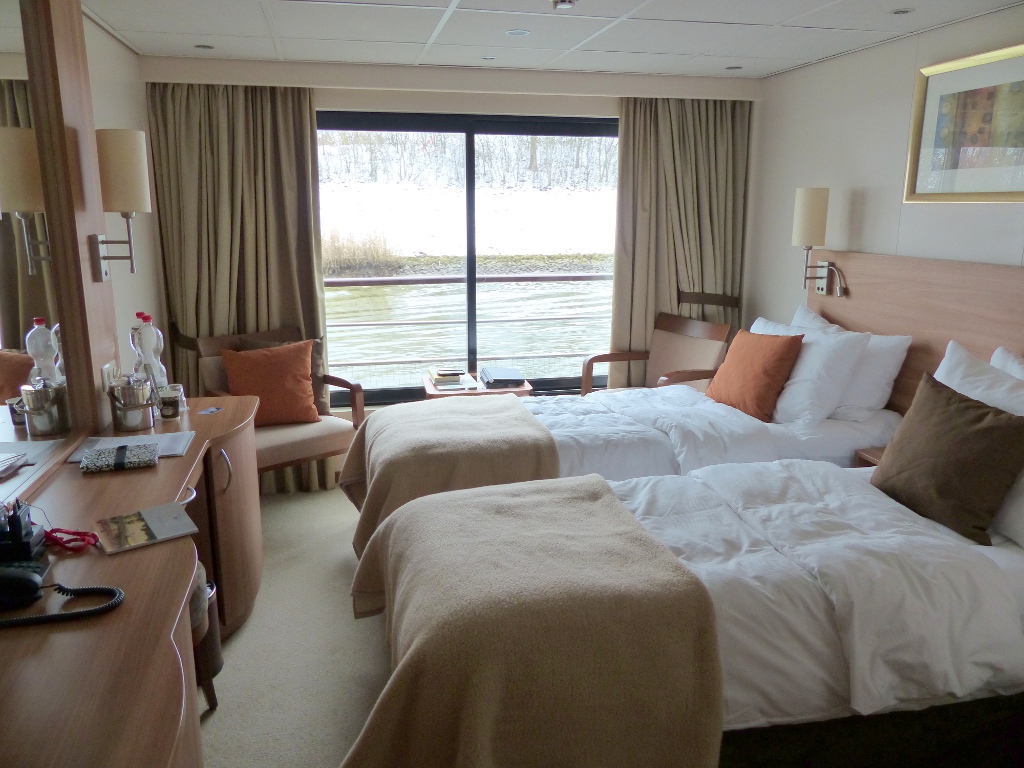
were pleased with the ship and with our cabin (pictured left).
They separated the halves of the Queen sized
bed so we each had our own bed. They are a
little
narrower than a typical twin but were very comfortable.
Our
room, on the second floor, had a French balcony,
which means the large sliding window opens! (That would have
been more appreciated had the weather not been so cold.) There
are 3 US outlets
+ (I think) 4 Europlug ones (and we had 2 adapters) so we could easily
keep
our electronics charged.
There was a nice
sized closet, 3 drawers, several
shelves,
a generous cabinet in the bathroom; bedside lights on both sides
– a small spotlight for personal
reading as
well as larger lights.
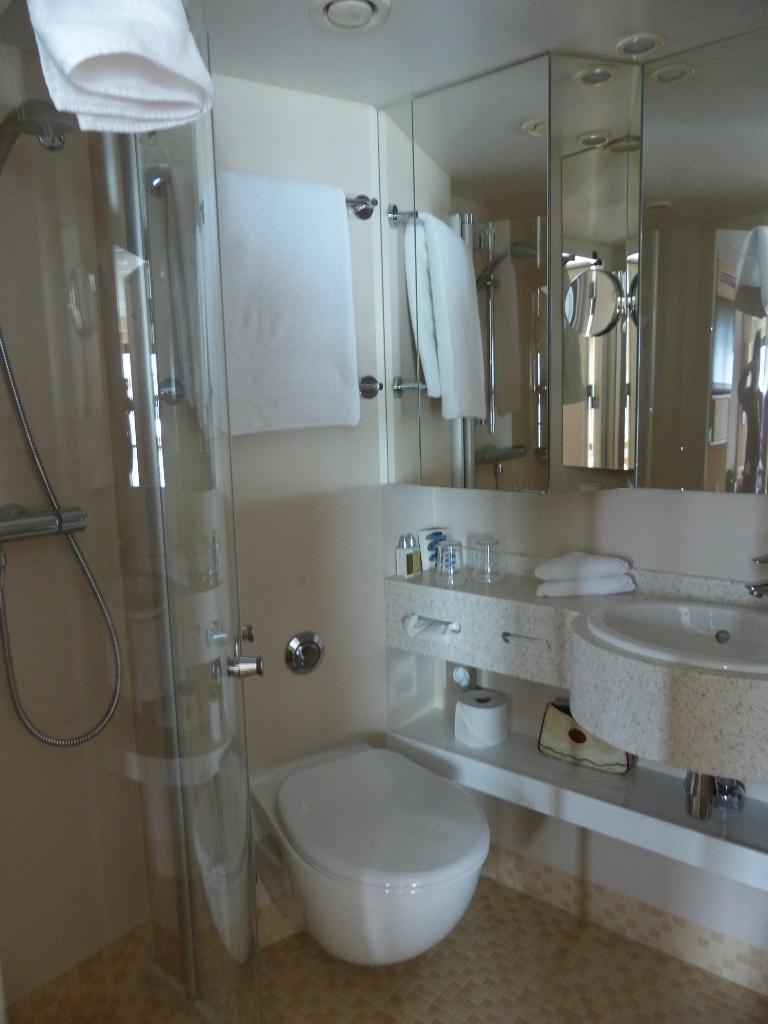
The only thing that we could call a "problem" is a design
flaw
in the bathroom (right): there's about 1/2" of space under the shower
doors so
it is impossible to keep the floor dry during a shower. But
two bath mats
were provided and they were replaced with dry ones every morning so it
wasn't really a serious issue for us.
 We
unpacked, checked
out the internet, which proved to be adequate but sometimes
spotty – we usually got the best
reception in the library.
We explored the ship a little and then went
to
lunch, which was not officially provided on embarkation day
but
they had a nice buffet available for those of us who arrived early -
lots of
sandwiches and pasta salads with pear streudel as dessert.
We
unpacked, checked
out the internet, which proved to be adequate but sometimes
spotty – we usually got the best
reception in the library.
We explored the ship a little and then went
to
lunch, which was not officially provided on embarkation day
but
they had a nice buffet available for those of us who arrived early -
lots of
sandwiches and pasta salads with pear streudel as dessert.
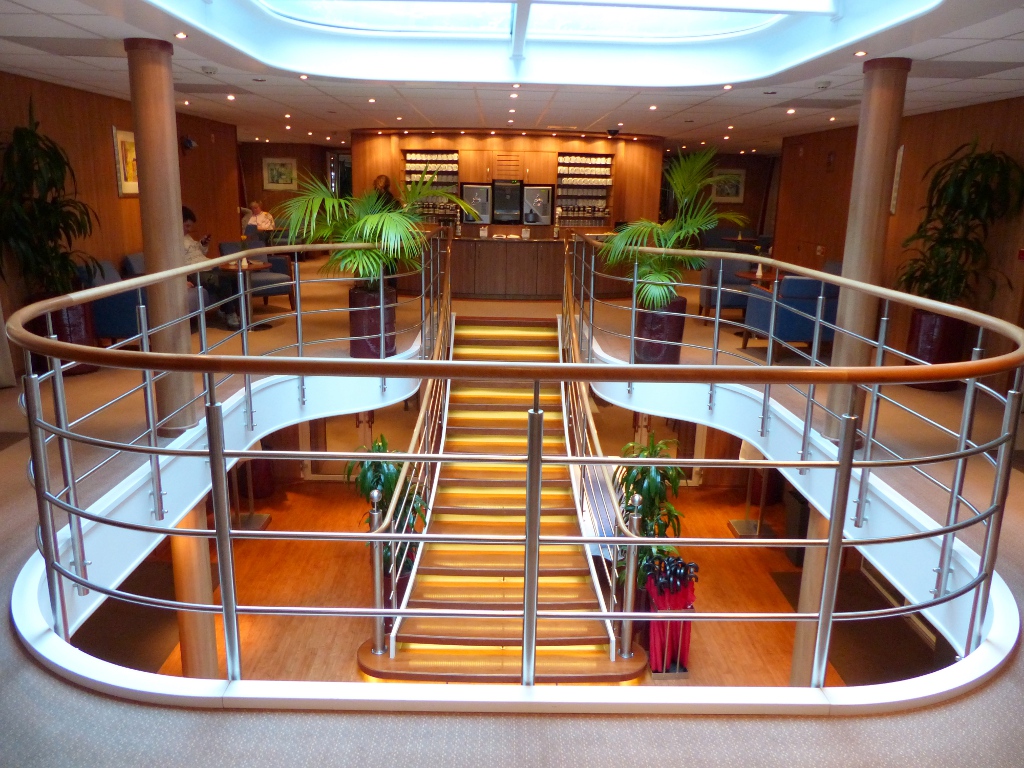
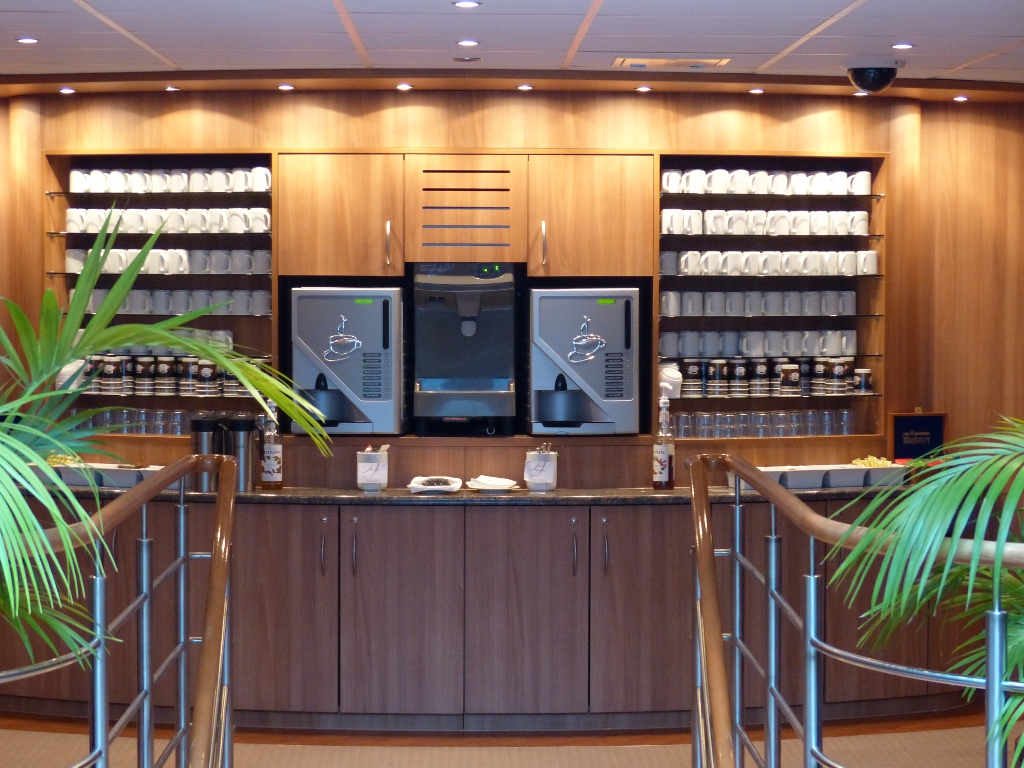 The
view at the left was taken from the third floor at the center of the
ship: the beverage center at the top of the stairs (closeup at
right) was available 24/7 (several types of coffee, assorted teas, hot
cocoa, water, ice and usually cookies or other snacks); behind it is
the bar and lounge (where buffet lunch and information sessions are
held); at the opposite end of the ship on that floor is the library; at
the foot of the stairs is the main lobby and reception desk with the
dining room below the lounge.
The
view at the left was taken from the third floor at the center of the
ship: the beverage center at the top of the stairs (closeup at
right) was available 24/7 (several types of coffee, assorted teas, hot
cocoa, water, ice and usually cookies or other snacks); behind it is
the bar and lounge (where buffet lunch and information sessions are
held); at the opposite end of the ship on that floor is the library; at
the foot of the stairs is the main lobby and reception desk with the
dining room below the lounge.
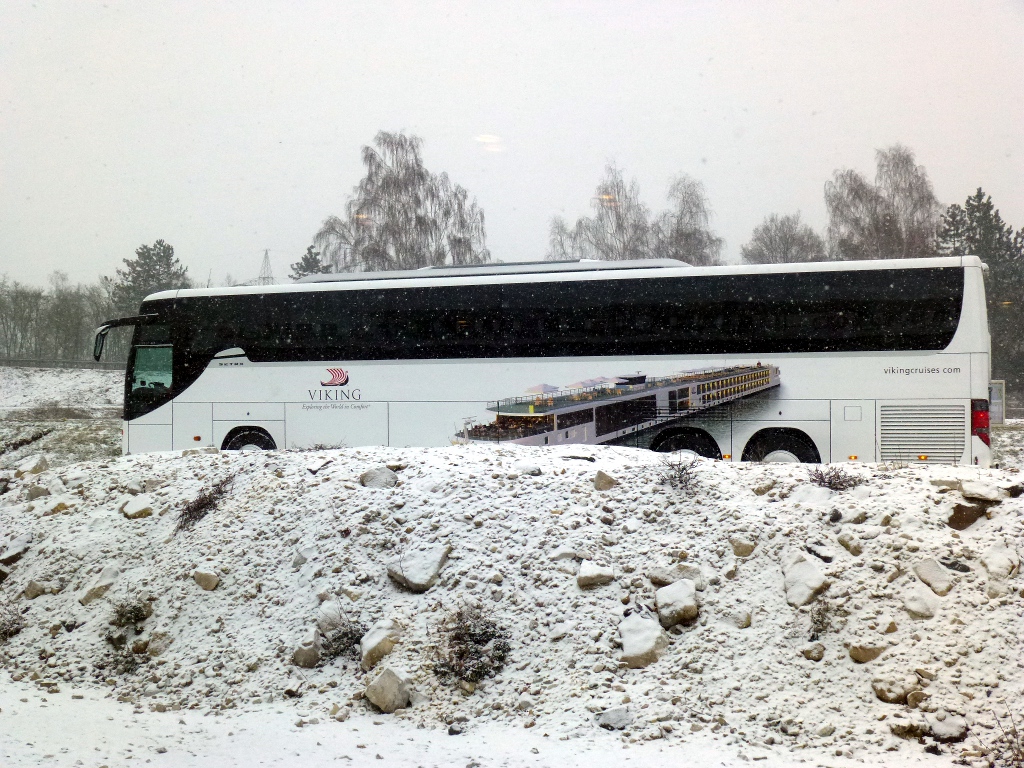
Sunday
afternoon, Viking offered several shuttles to Old Town Nuremberg
(one of the tour buses pictured at left) if we wanted to see some of
the area that day. But we were so
jet lagged, we elected to just settle into our cabin and catch a little
nap
after lunch. At our information session late in the afternoon
we
met some of the key staff and were introduced to the "Viking Daily"
which is a 4-page newsletter that appears in our rooms during dinner
each night explaining all about the next day: where we would be, times
of various activities (tours, presentations, meals, cast off), what the
afternoon
and/or evening entertainment would be. It also often includes
some history of the area and tips on things we might want to see or do.
Dinner
is a 2 hour, 3 or 4 course
affair, usually starting at 7 PM - but dress was very casual.
We
did meet some interesting
people and enjoyed the conversation, but there were a couple
of
nights that we were so exhausted, we would have preferred grabbing
something quick and going to bed early! There
were typically 3 or 4 choices of main course each evening (often
highlighting local specialties) plus a selection of some basic
"always available" items including roast chicken and roast
beef. That first night, I had an asparagus cream
soup, roast salmon with brussel sprouts and mashed potatoes; dessert
was panna cotta (a
sort of
custard with apricot garnish), complete with "squiggles."
After
dinner, there is
entertainment in the lounge - sometimes local musicians. I
was
interested at the wide range of ages on this cruise. There
were
several family groups, some friends travelling together, a few solos
and one couple on their honeymoon. We met two other
mother-daughter pairs and two brothers who were cruising with their mom.
Monday
March 25:
I'm
glad we went to bed early last
night since busses were leaving at 8:15 this morning if we wanted to
join the Nuremberg
tour. We got up at 6:30 AM to shower, dress, eat
and
be ready to leave on time.
We had a
great buffet breakfast - anything you could want including cereals (hot
and cold), yogurt, eggs, pancakes, fruits, pastries. Viking
is extremely organized - you turn in your room key and get a "boarding
pass" for your assigned bus or tour group. By checking the
key file, they can keep track of who is missing and avoid stranding
anyone! Each day they also provided cards that had
the name
of the ship, its phone number and its exact docking
location so we
always had contact information in case of any problems.
 It
was snowing this morning with the temperature right
around freezing, so I guess it was good that much of this tour was on
the bus. In general, though, we much preferred walking!
It
was snowing this morning with the temperature right
around freezing, so I guess it was good that much of this tour was on
the bus. In general, though, we much preferred walking!
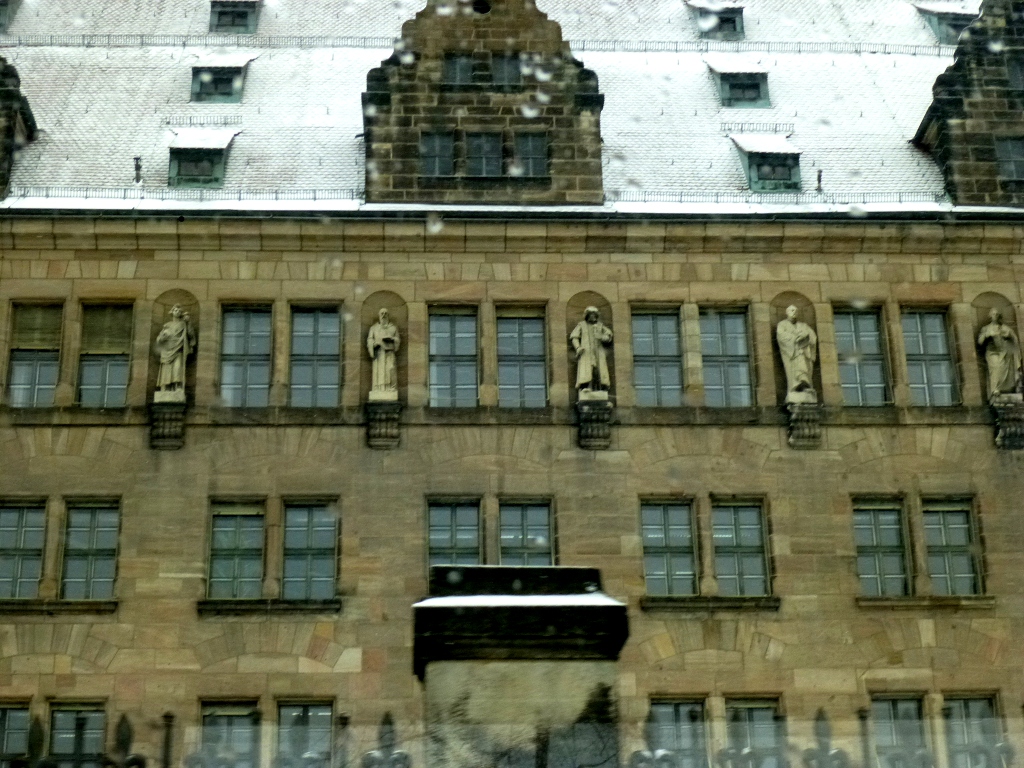
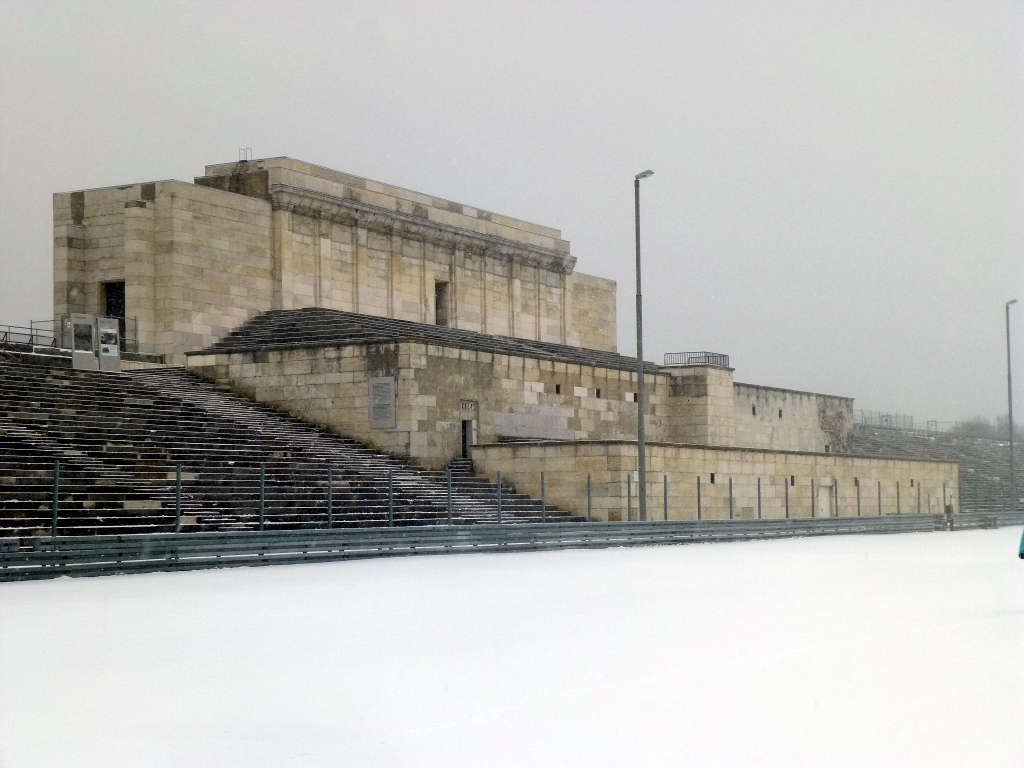 We passed a number of historical sites,
as well as some of the modern areas. At left is the Palace
of Justice (taken from the bus through snow) - the site of the
Nuremberg War Crimes trials. We had a brief stop at the Nazi
Rally Grounds (right) - today the whole area is a war memorial.
We rode past lots of old city gates, old walls, churches and
cemeteries (more pictures are in the picture collection if you want to
see additional sites).
We passed a number of historical sites,
as well as some of the modern areas. At left is the Palace
of Justice (taken from the bus through snow) - the site of the
Nuremberg War Crimes trials. We had a brief stop at the Nazi
Rally Grounds (right) - today the whole area is a war memorial.
We rode past lots of old city gates, old walls, churches and
cemeteries (more pictures are in the picture collection if you want to
see additional sites). 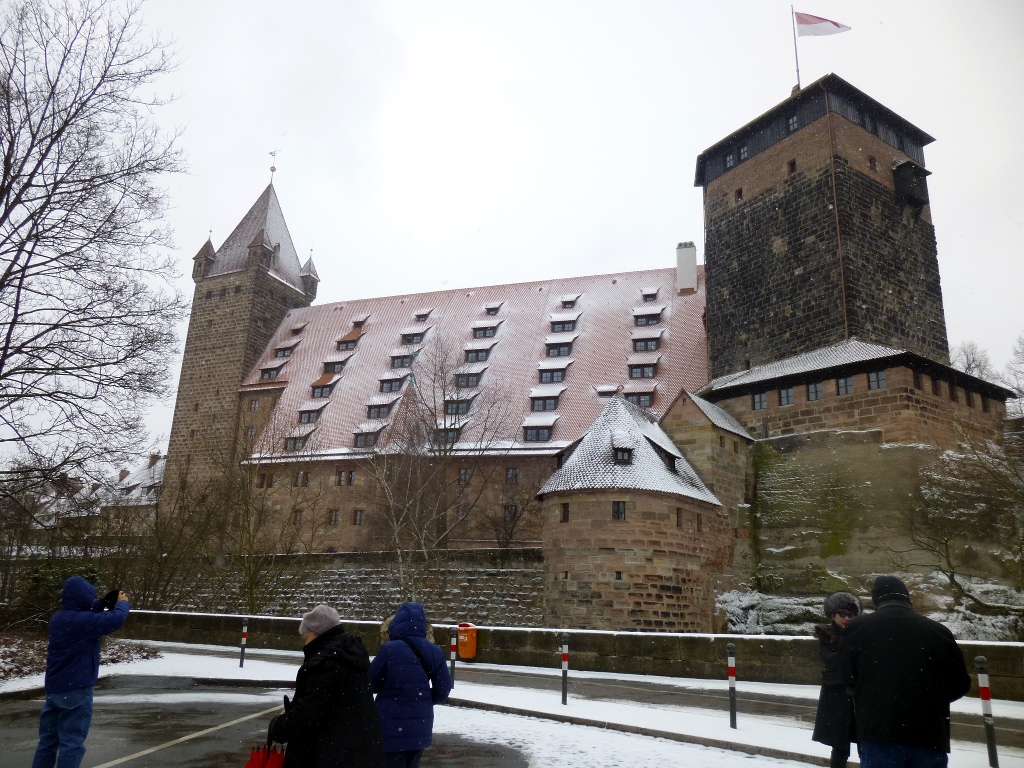 Then we made a stop at the Imperial
Castle of Nuremberg (left picture). The earliest mention of
the castle in historical documents is around 1150 AD so at least parts
of it were built by then. We didn't go inside but we did walk
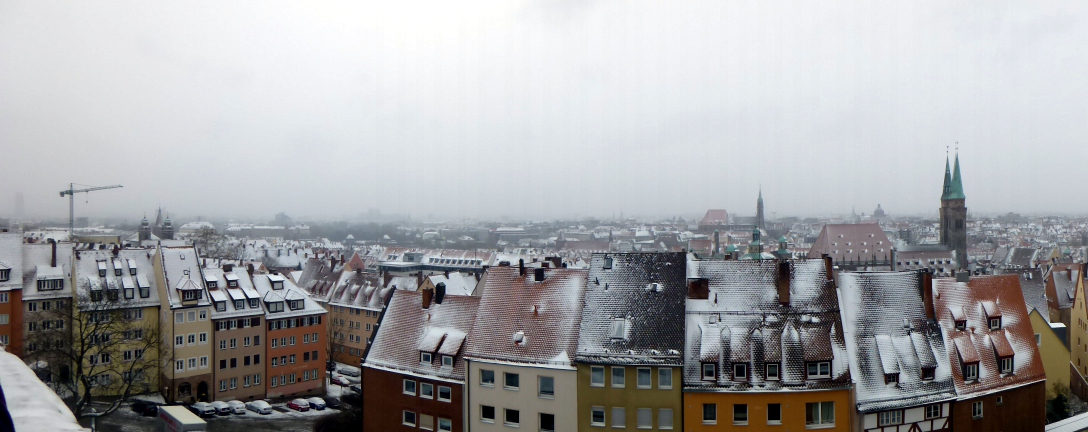
through the grounds and had a wonderful photo op on one of the
terraces! (See the panorama picture of old town Nuremberg
below.
Then we made a stop at the Imperial
Castle of Nuremberg (left picture). The earliest mention of
the castle in historical documents is around 1150 AD so at least parts
of it were built by then. We didn't go inside but we did walk
through the grounds and had a wonderful photo op on one of the
terraces! (See the panorama picture of old town Nuremberg
below. 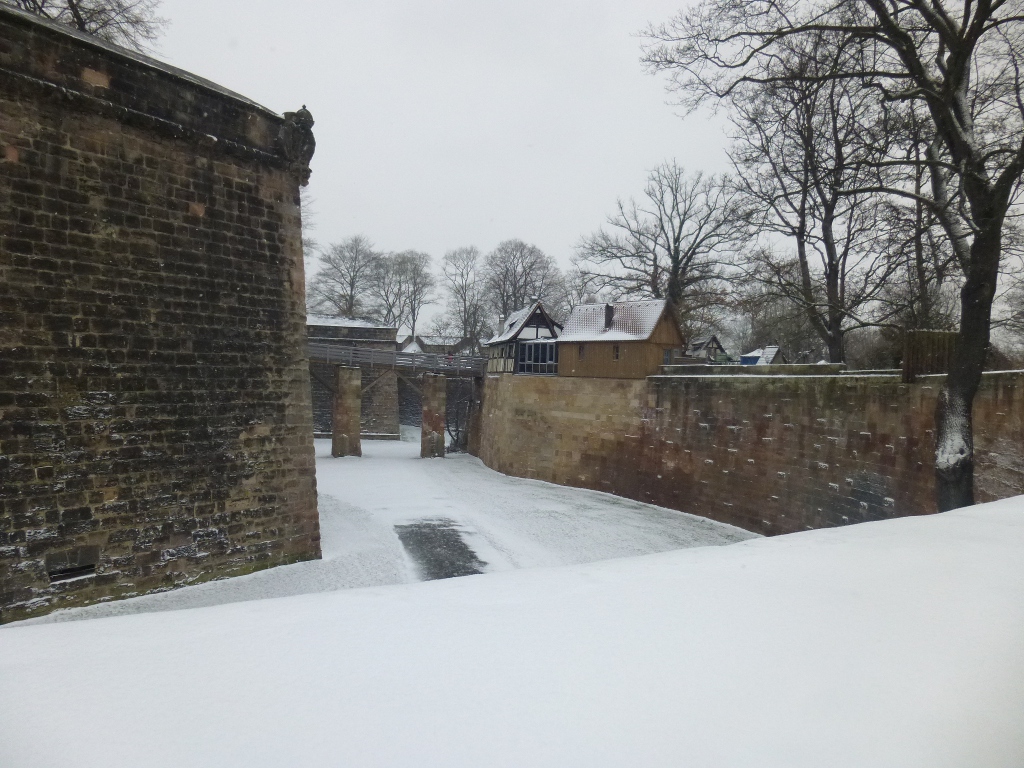 I
love the little dusting of
snow on the rooftops - it seems almost make-believe.)
Our guide added lots of comments and history as we
went along. For example, she said the moat (pictured at
right) was never filled with water. Instead they used it for
game so that the King and his guests could hunt whenever he wanted to.
There were two sets of city wall: the inside, tall, one -
left in the picture - was to protect the castle. The outer,
smaller, wall was just to keep people out of the moat.
Nuremberg
is also well known
for toys - toys were being manufactured there as long ago as the 14th
century.
Early pocket watches and the earliest existing globe were
also built in Nuremberg in the 15th
century when the population was about 25,000.
I
love the little dusting of
snow on the rooftops - it seems almost make-believe.)
Our guide added lots of comments and history as we
went along. For example, she said the moat (pictured at
right) was never filled with water. Instead they used it for
game so that the King and his guests could hunt whenever he wanted to.
There were two sets of city wall: the inside, tall, one -
left in the picture - was to protect the castle. The outer,
smaller, wall was just to keep people out of the moat.
Nuremberg
is also well known
for toys - toys were being manufactured there as long ago as the 14th
century.
Early pocket watches and the earliest existing globe were
also built in Nuremberg in the 15th
century when the population was about 25,000.
 After the castle stop, we were dropped
off in
Nuremberg's Hauptmrkt - the city center's largest market square
-
After the castle stop, we were dropped
off in
Nuremberg's Hauptmrkt - the city center's largest market square
- for about an hour of free time (we had to be back
on the ship for a noon departure).
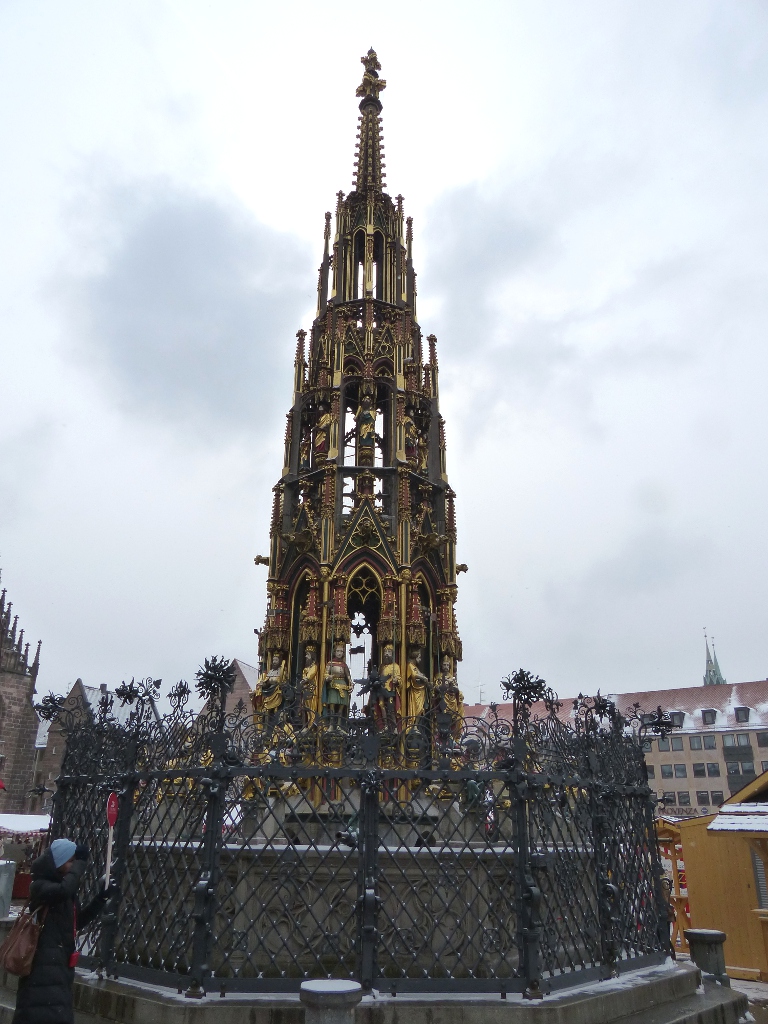
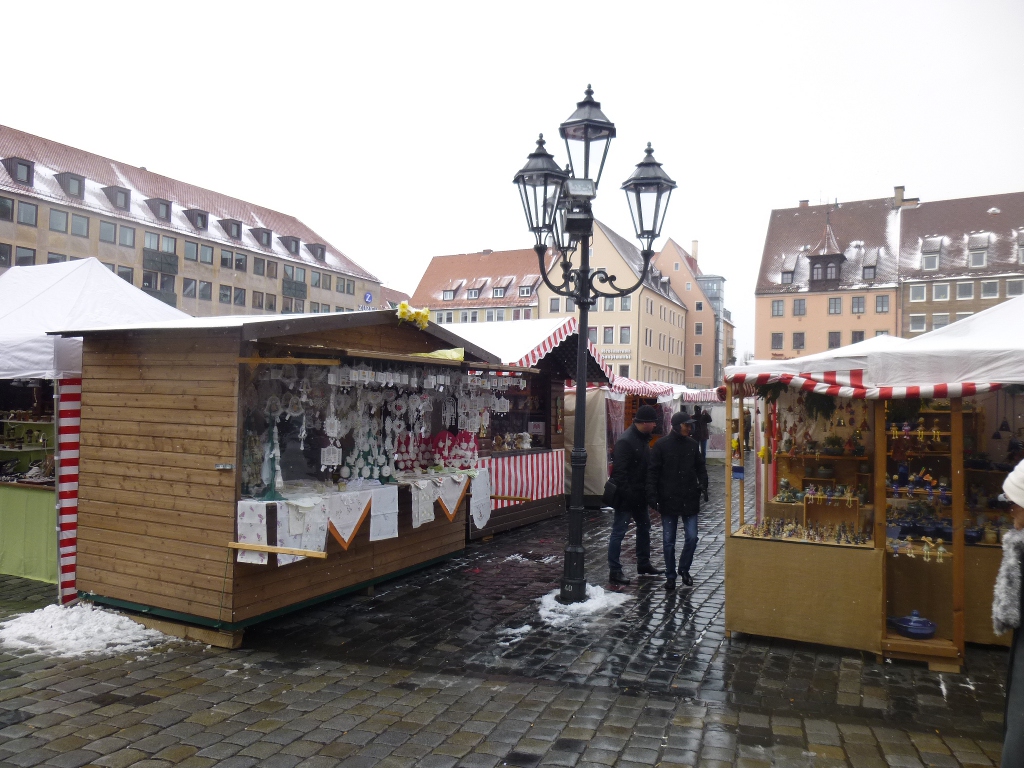
This is the home of the
"Beautiful Fountain" (picture at left) - the original was built in the
late 1300's and there is a legend about a ring in the latticework that
will bring you luck if turned 3 times. Since this was Easter
week, there was a huge Easter Market going on in the center of the
square (right). This is like a flea market with many food
items as well as arts and crafts for sale. However, since
neither of us is big on shopping,
we wandered through for a few minutes but then got out of the
cold by visiting the two churches nearby.
for about an hour of free time (we had to be back
on the ship for a noon departure).
This is the home of the
"Beautiful Fountain" (picture at left) - the original was built in the
late 1300's and there is a legend about a ring in the latticework that
will bring you luck if turned 3 times. Since this was Easter
week, there was a huge Easter Market going on in the center of the
square (right). This is like a flea market with many food
items as well as arts and crafts for sale. However, since
neither of us is big on shopping,
we wandered through for a few minutes but then got out of the
cold by visiting the two churches nearby.
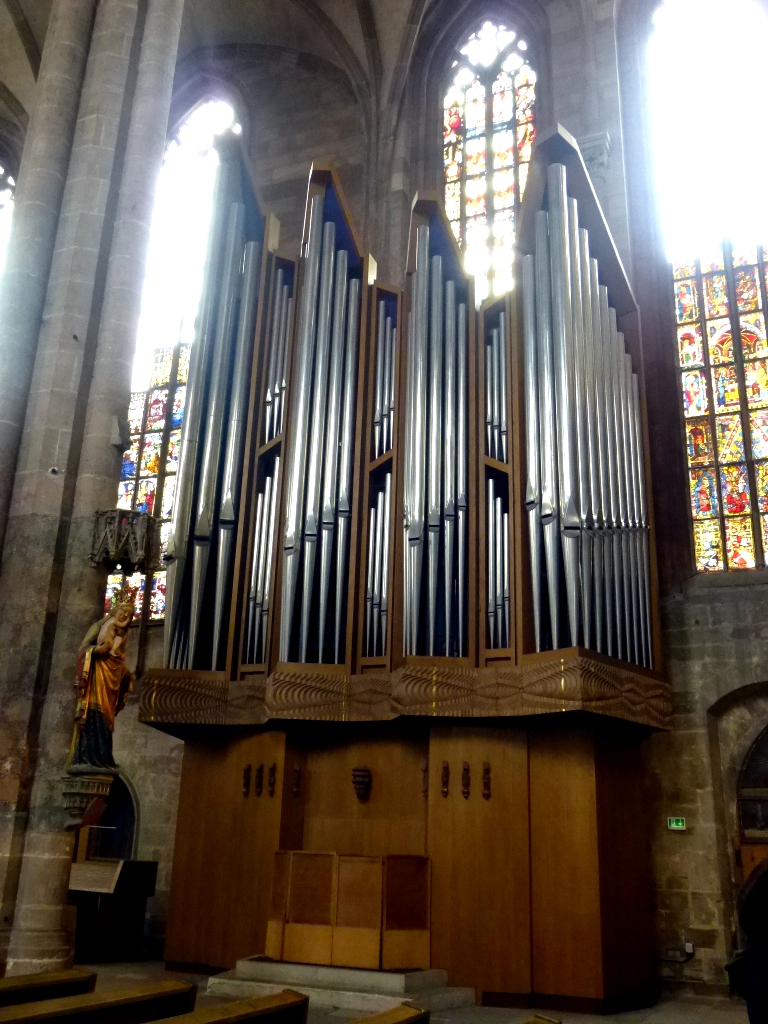
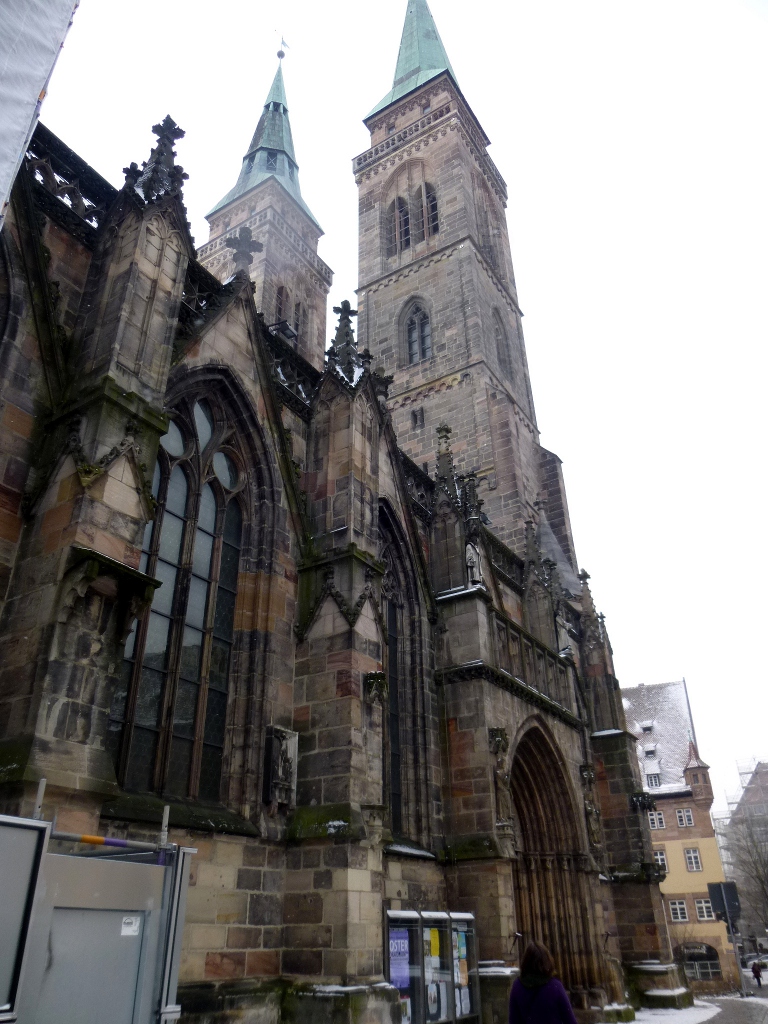 The
church of St. Sebaldus, at right,
is the oldest in Neuremberg. Its organ is shown in the left
photo. The church contains relics of the saint and
also a display of photos showing the extensive devastation from World
War II. Considered a Monument for Peace, each photograph
contains a poem, translated into several languages. One
example:
The
church of St. Sebaldus, at right,
is the oldest in Neuremberg. Its organ is shown in the left
photo. The church contains relics of the saint and
also a display of photos showing the extensive devastation from World
War II. Considered a Monument for Peace, each photograph
contains a poem, translated into several languages. One
example:
Peace
- what is peace?
that we can go through the
ruins
without fear of bombs?
That the sun warms people and stone
as if nothing had happened?
That the horror is already beginning
to belong to the past?
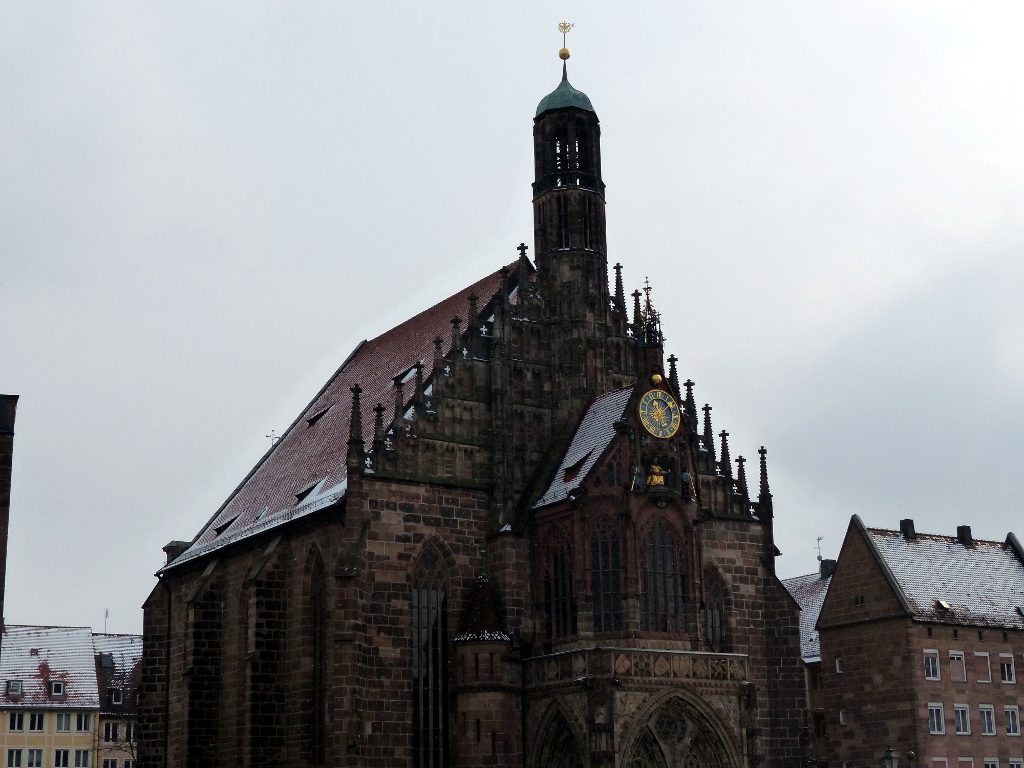 Frauenkirche, or the Church of Our
Lady, is located right on the square and has a
rather ugly
history. There was originally a synagogue at that location;
King Charles IV had it
torn down during a pogrom in 1349 and, in 1352,
Frauenkirche, or the Church of Our
Lady, is located right on the square and has a
rather ugly
history. There was originally a synagogue at that location;
King Charles IV had it
torn down during a pogrom in 1349 and, in 1352,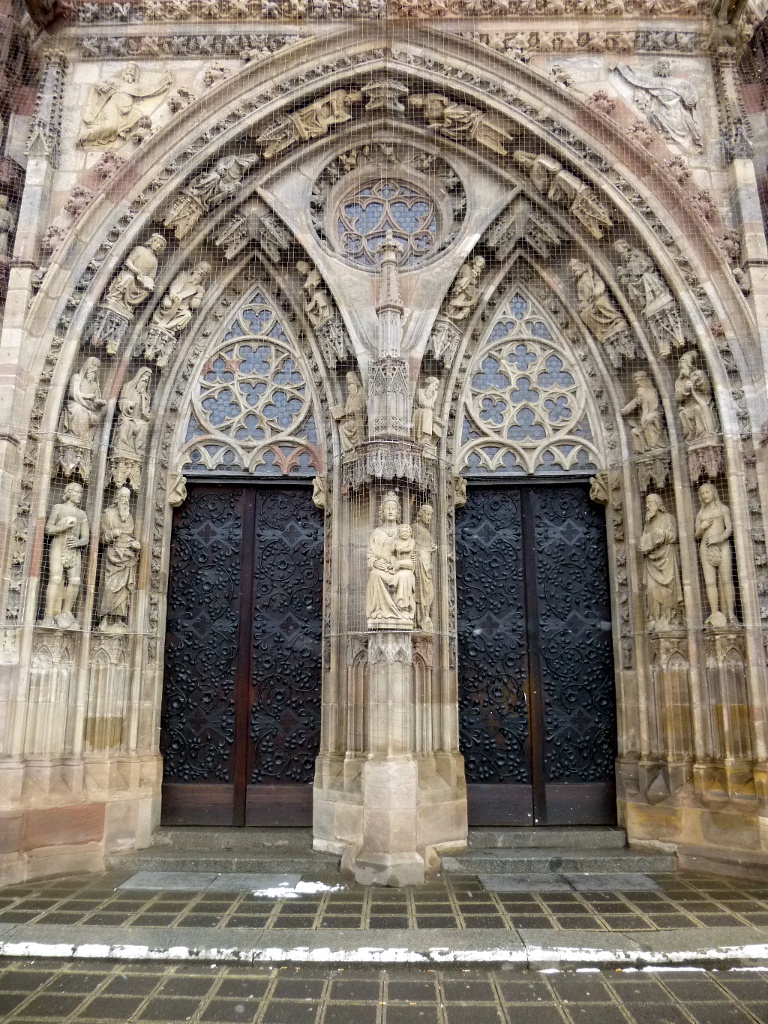 commissioned this new Gothic church built in its place.
Because
of the market, it was hard to get a full view of the church - the
picture at left cuts off the bottom where the market stalls were!
If you enlarge the picture, you can see Charles IV on his
throne, just below the clock (installed in 1506); each day at noon,
electors surrounding him come out and pay homage. On the
right is a view of the elaborately carved front doors that are missing
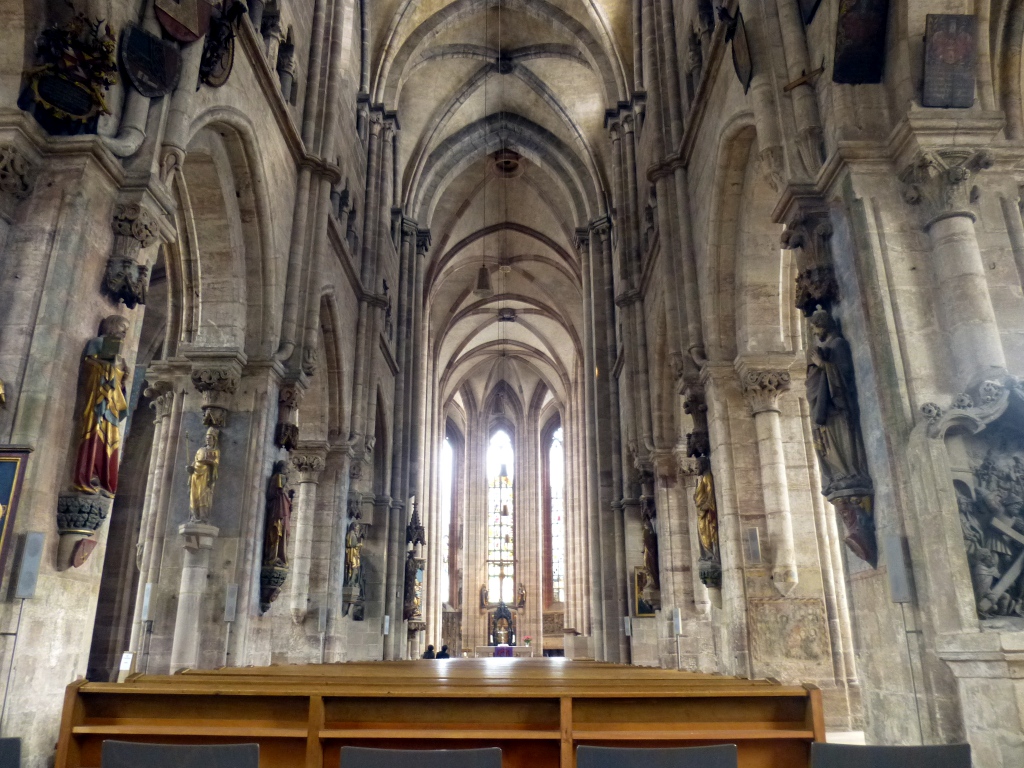
in the left view. On the lower left is a view of the
sanctuary inside the church. It is, indeed, quite Gothic and
we'll see more examples of that style later on in the trip.
commissioned this new Gothic church built in its place.
Because
of the market, it was hard to get a full view of the church - the
picture at left cuts off the bottom where the market stalls were!
If you enlarge the picture, you can see Charles IV on his
throne, just below the clock (installed in 1506); each day at noon,
electors surrounding him come out and pay homage. On the
right is a view of the elaborately carved front doors that are missing
in the left view. On the lower left is a view of the
sanctuary inside the church. It is, indeed, quite Gothic and
we'll see more examples of that style later on in the trip.
 On
the way back to the ship, we passed more sites of interest, including
the Mississippi Queen pictured below at the right - a riverboat
restaurant on the Danube that made me laugh each time we went by it!
We were chilled when we got back and
On
the way back to the ship, we passed more sites of interest, including
the Mississippi Queen pictured below at the right - a riverboat
restaurant on the Danube that made me laugh each time we went by it!
We were chilled when we got back and 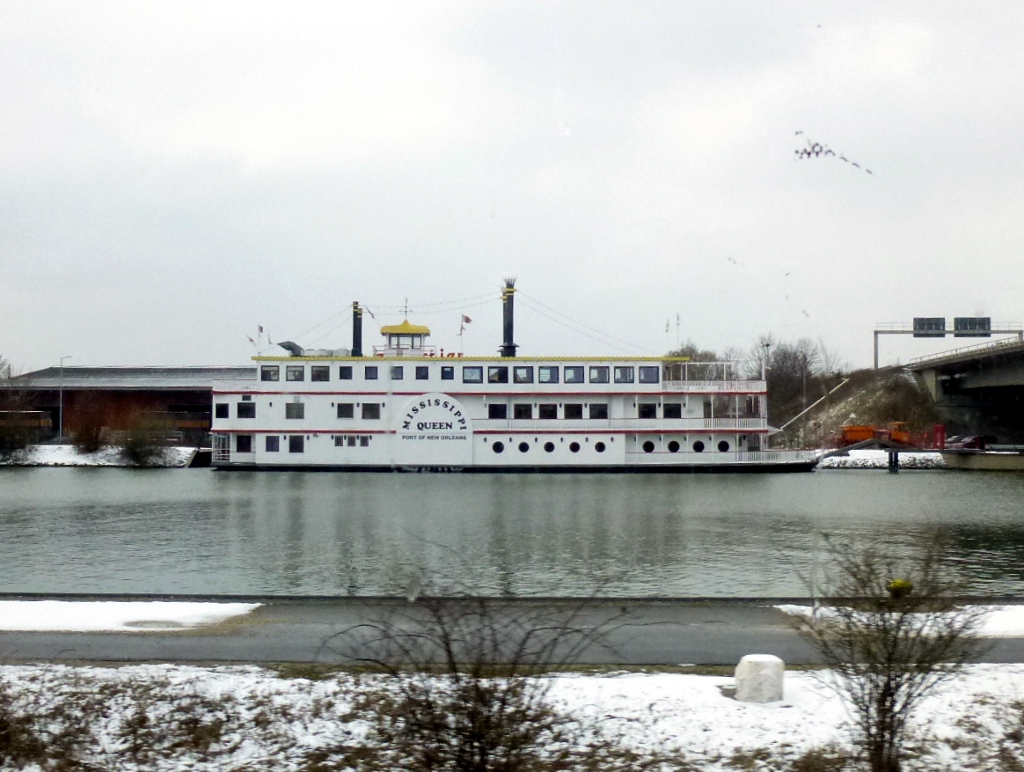 it was nice to be able to grab a mug of
hot tea or cocoa at the beverage station right away. Then we
shed our coats and went to lunch. I chose the buffet again
because it was quick and the salads and pasta were very good.
We had "Forest Berry
Stew" for dessert today –
what I would probably call a compote.
it was nice to be able to grab a mug of
hot tea or cocoa at the beverage station right away. Then we
shed our coats and went to lunch. I chose the buffet again
because it was quick and the salads and pasta were very good.
We had "Forest Berry
Stew" for dessert today –
what I would probably call a compote.
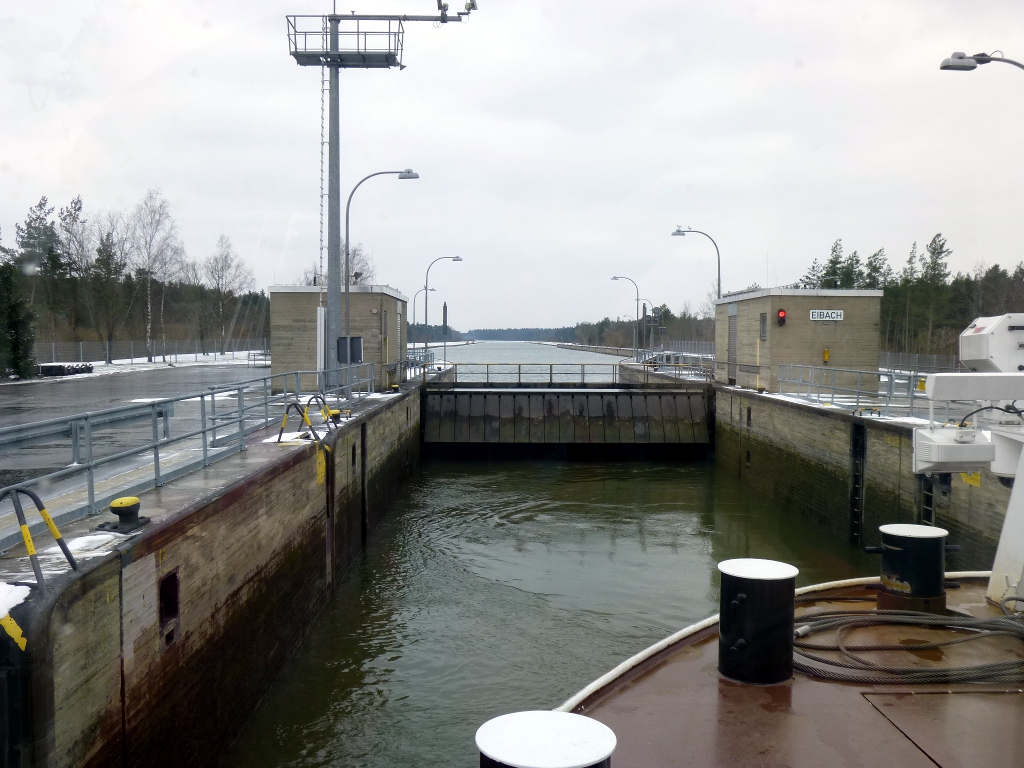
We cast off at noon, while we were at lunch, and went
through the Rhine-Main- Danube Canal this afternoon. What an
interesting experience! Katie and I found ourselves going
from the front to the back of the ship to get pictures from various
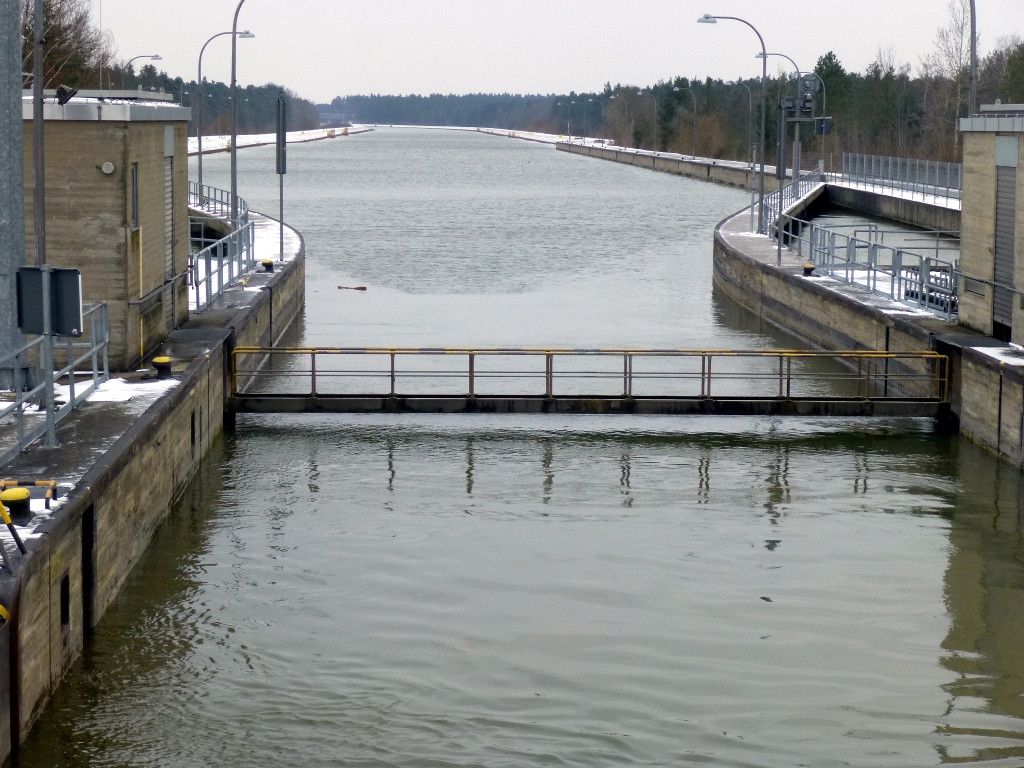
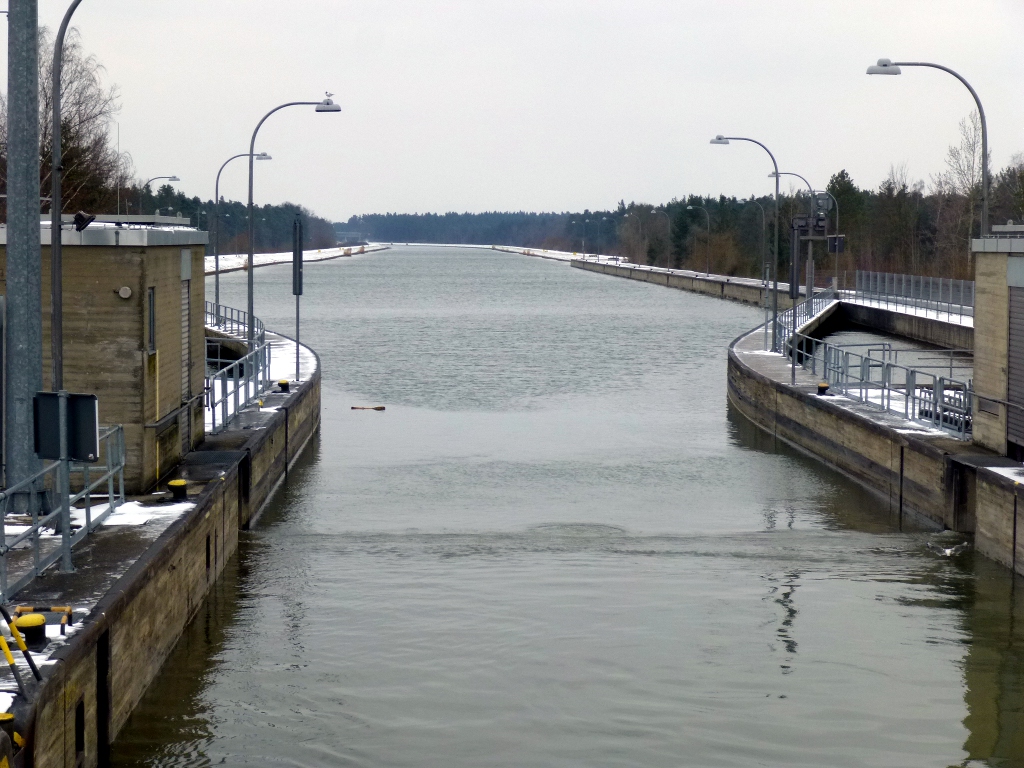
positions. I'll just share a sequence of three. We
pull into a lock (by the way, the ships are built to be as wide as
possible and still fit in the locks - so there is only about two inches
of
space on each side) - in the left picture, you can see the water level
on the sides. At that point it has already filled more than
half way up: the
water keeps coming in, and raising the ship - in this lock, by about
25 feet - until it's even with the water level on the other side
(center picture). Then the gate lowers and we move out into
the next segment of the river. Each lock is just a little
different but all of them were fun to watch.
 At
some point this afternoon we had an emergency safety drill.
We all had to grab our life jackets and meet in the lounge to
be counted. We passed.
At
some point this afternoon we had an emergency safety drill.
We all had to grab our life jackets and meet in the lounge to
be counted. We passed.  There were various activities
going on all afternoon: a discussion about the European Union, German
Easter Egg decorating, a German high tea and a language lesson.
I wandered in and out, being more interested in watching the
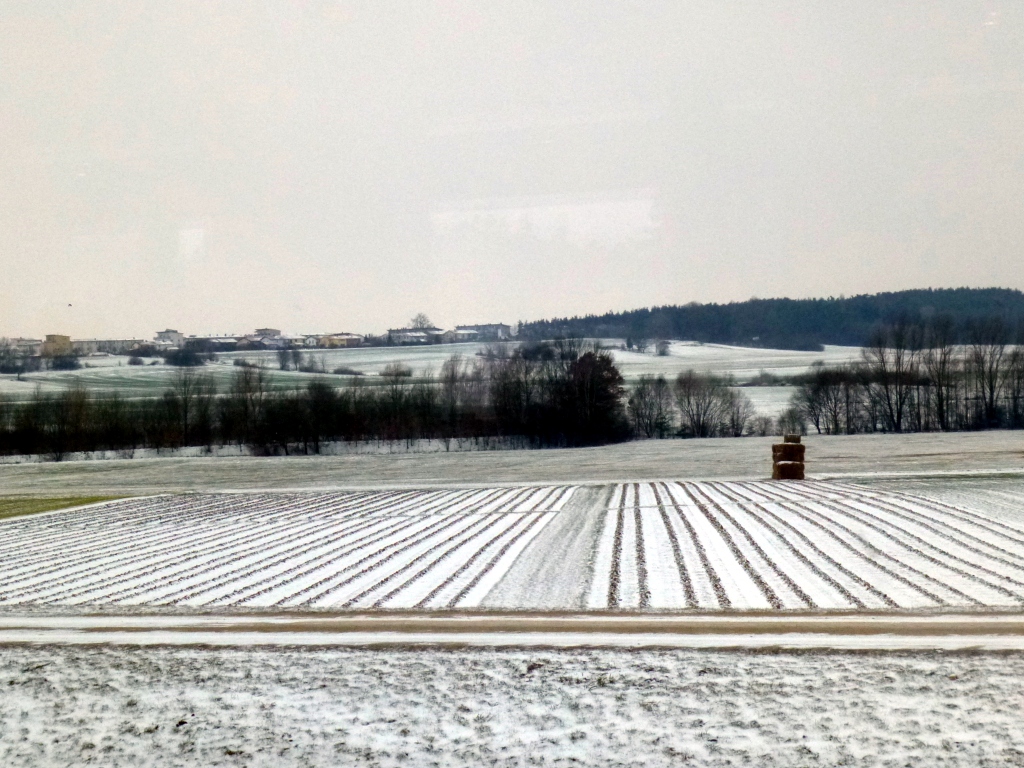
locks and the riverside! Some of the rural farming areas
(left) looked a lot like Iowa! I saw ducks and cormorants but
nothing very exotic in the way of wildlife; it was fun to
wave to the people who were walking along the canal path. I
spent most of the afternoon in the library at the rear of the ship (it
has a terrace so I could pop out whenever I wanted to for picture
taking), but also walked up to the Aquavit Terrace at the front end now
and then.
There were various activities
going on all afternoon: a discussion about the European Union, German
Easter Egg decorating, a German high tea and a language lesson.
I wandered in and out, being more interested in watching the
locks and the riverside! Some of the rural farming areas
(left) looked a lot like Iowa! I saw ducks and cormorants but
nothing very exotic in the way of wildlife; it was fun to
wave to the people who were walking along the canal path. I
spent most of the afternoon in the library at the rear of the ship (it
has a terrace so I could pop out whenever I wanted to for picture
taking), but also walked up to the Aquavit Terrace at the front end now
and then.
I
did go to the presentation about the canal and locks just
before dinner and it was quite interesting. After we went up
through about 4 locks and before we started back down, we were
each offered a "Blue Danube" cocktail and we toasted the
highest navigable
point in Europe that we passed along the canal.
For dinner
I had a ravioli
appetizer and zucchini with other vegetables and french goat cheese
plus a dessert tray that included
a bit of apple streudel, a strawberry, some crème, and a scoop of
fruit
sorbet.
Tuesday March 26
We
woke up to a very COLD Regensburg. The tour didn't leave
until 10 AM this morning so we got to stay warm under our covers a
little bit longer! We
elected the extended walking tour that would include a bit more about
Jewish
history.
Our
guide
Geraldine was wonderful –
she is from New Zealand but has lived in Regensburg for 20 years.
She
knew loads of history and also understood how to use the great audio
system that Viking provides - we all had receivers and earbuds so we
could hear what she said even if we were a block behind, taking
pictures, still in the church, etc. (Eventually we decided
that the main difference between an okay guide and a great guide was
whether or not they made the best use of that audio system!)
The recorded
history
of Regensburg dates from
179 AD when it was mentioned in a document written there by Marcus
Aurelius.
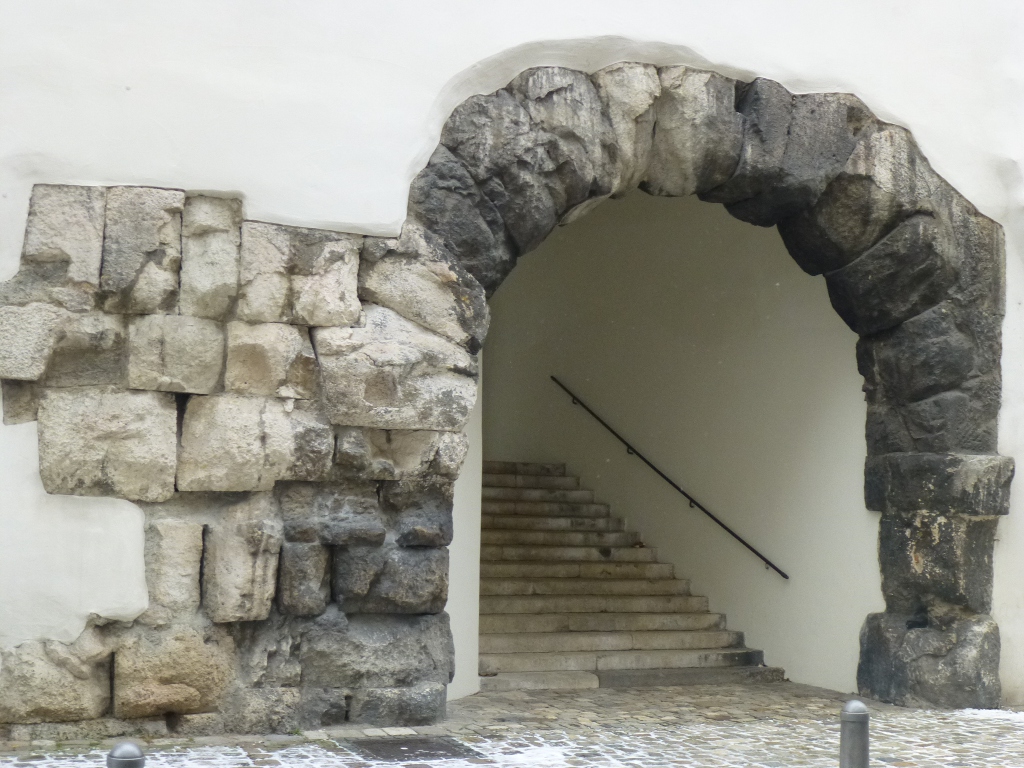
The picture at left, above, is a portion of the old Roman
wall and the
Porta Praetoria - an old gate to the Roman military camp Castra
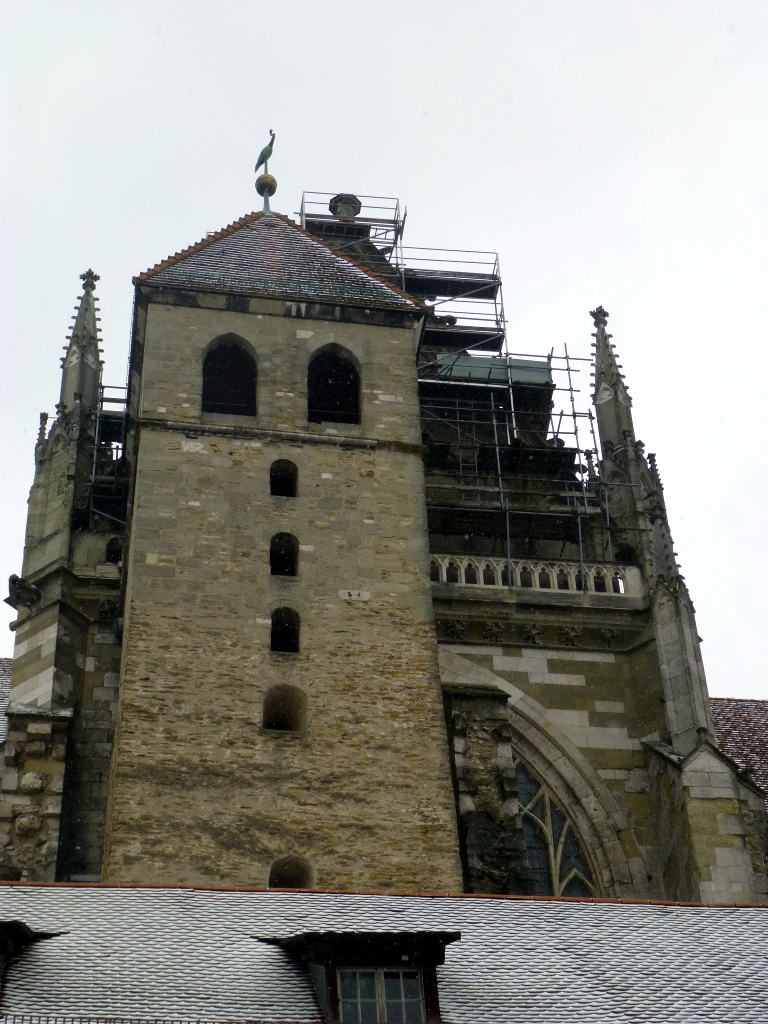
Regina. Going up those stairs leads us to a
courtyard where we can see the back of a partially completed tower on
St. Peter's Cathedral - pictured at the right. It's an old
Roman tower; they had planned to remove it
after the
church was built but then discovered it had become an integral part of
the structure
and
couldn't be taken down safely. The next plan was to cover it
up with
"new" wall - you can see that was partly done, but they ran out of
money and so it remains as is.
 Regensburg remains a very medieval
town. There was very little damage during WWII but there
also wasn't much money allocated to the town to rebuild and so
most of the
historical buildings
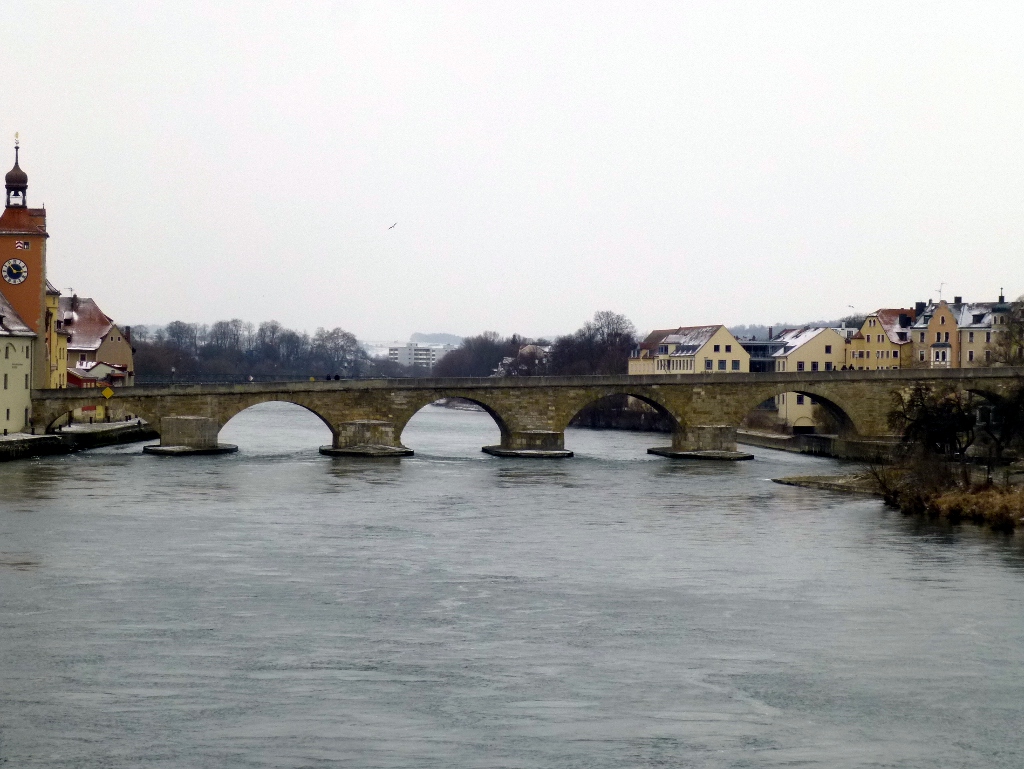
survive, many of them dating back to 1200 or earlier. The Old
Stone Bridge (shown at left, built between
1135 and 1146) made
Regensburg a major commerce center because
existing wooden bridges elsewhere kept getting washed out or knocked
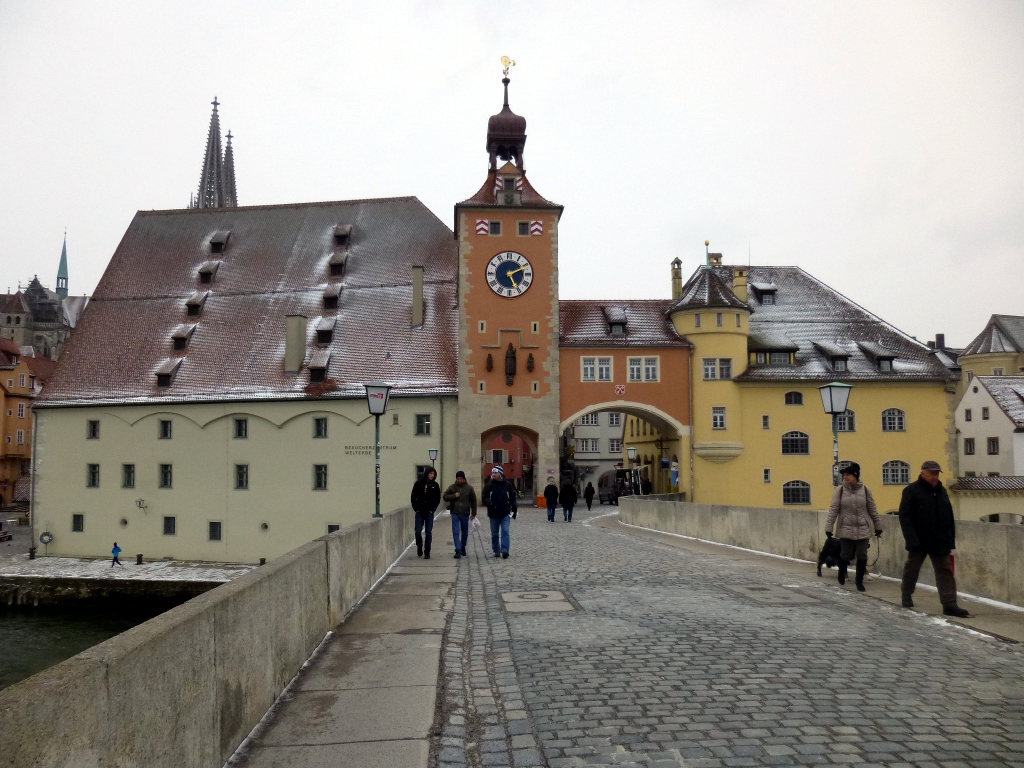
down. The picture on the right was taken looking back from
the middle of the bridge. It shows the old
Salt Barn on the left: salt imported from Passau was stored
there; it is now the home of the UNESCO
World Heritage
Site and houses a nice museum. To the right of the
salt barn you see an old city gate leading back into the town and an
old clock tower.
Regensburg remains a very medieval
town. There was very little damage during WWII but there
also wasn't much money allocated to the town to rebuild and so
most of the
historical buildings
survive, many of them dating back to 1200 or earlier. The Old
Stone Bridge (shown at left, built between
1135 and 1146) made
Regensburg a major commerce center because
existing wooden bridges elsewhere kept getting washed out or knocked
down. The picture on the right was taken looking back from
the middle of the bridge. It shows the old
Salt Barn on the left: salt imported from Passau was stored
there; it is now the home of the UNESCO
World Heritage
Site and houses a nice museum. To the right of the
salt barn you see an old city gate leading back into the town and an
old clock tower.
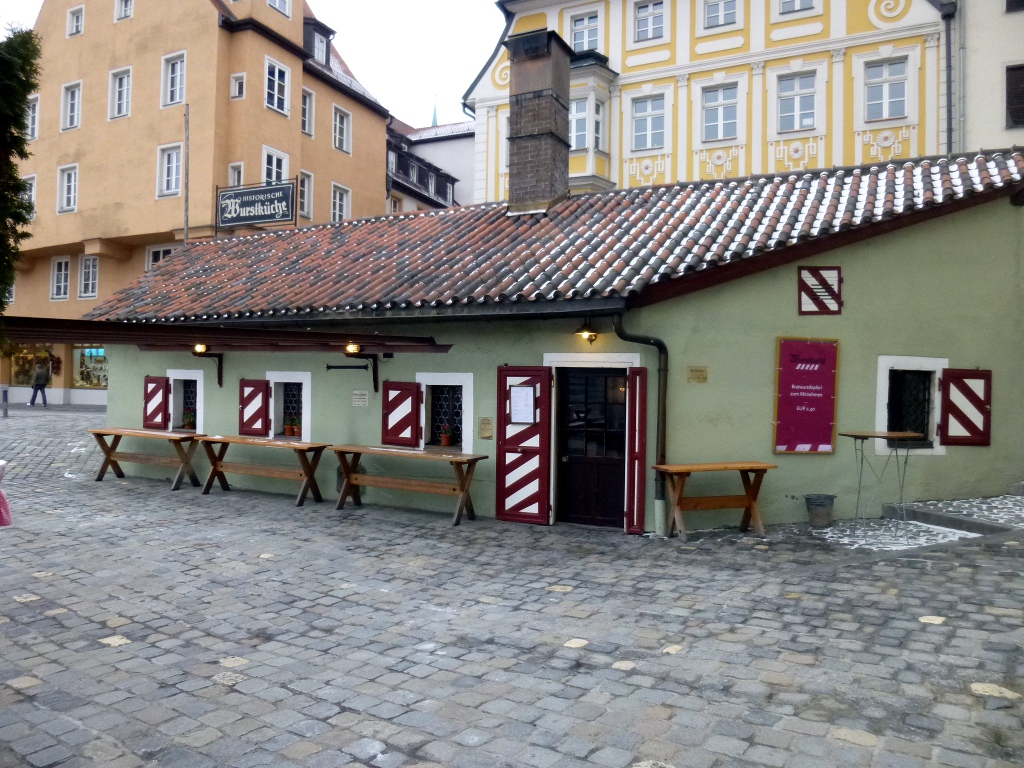 While
the old bridge was being built, of course lots of workers were needed.
So that they could take minimal breaks for meals, a sausage
house was constructed on site. Alte Wurstküche (Old Sausage
Kitchen), pictured at left, has remained on that same site since 1135!
We did go back in the afternoon and bought some of their
famous sweet mustard to bring home.
While
the old bridge was being built, of course lots of workers were needed.
So that they could take minimal breaks for meals, a sausage
house was constructed on site. Alte Wurstküche (Old Sausage
Kitchen), pictured at left, has remained on that same site since 1135!
We did go back in the afternoon and bought some of their
famous sweet mustard to bring home.
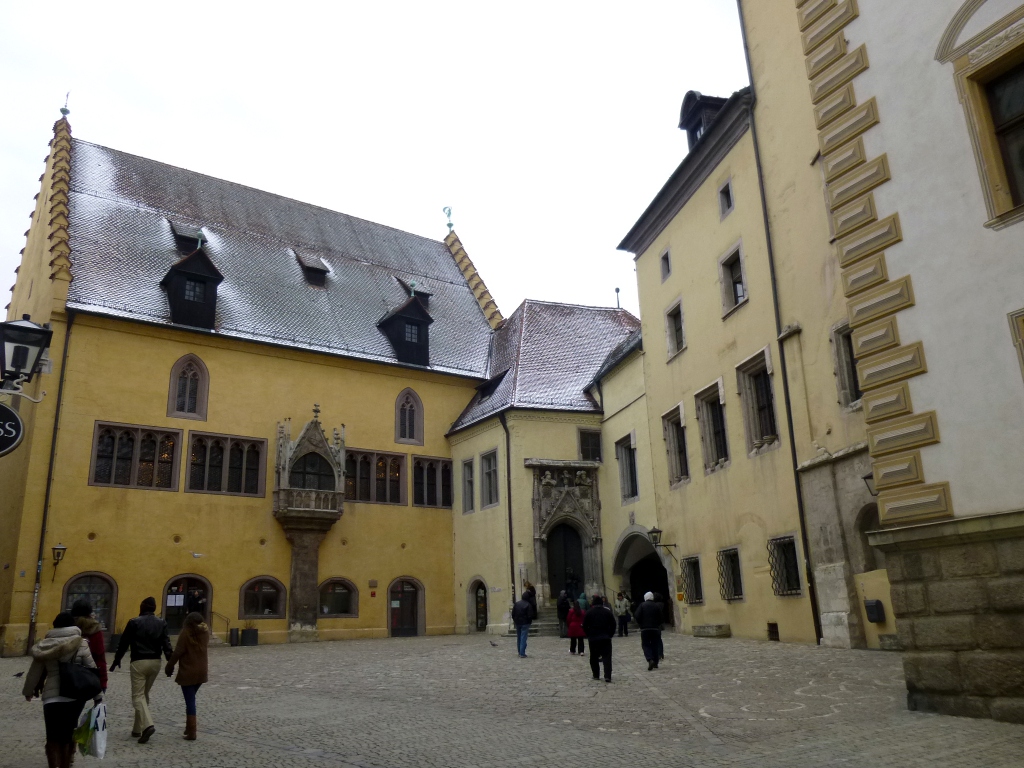
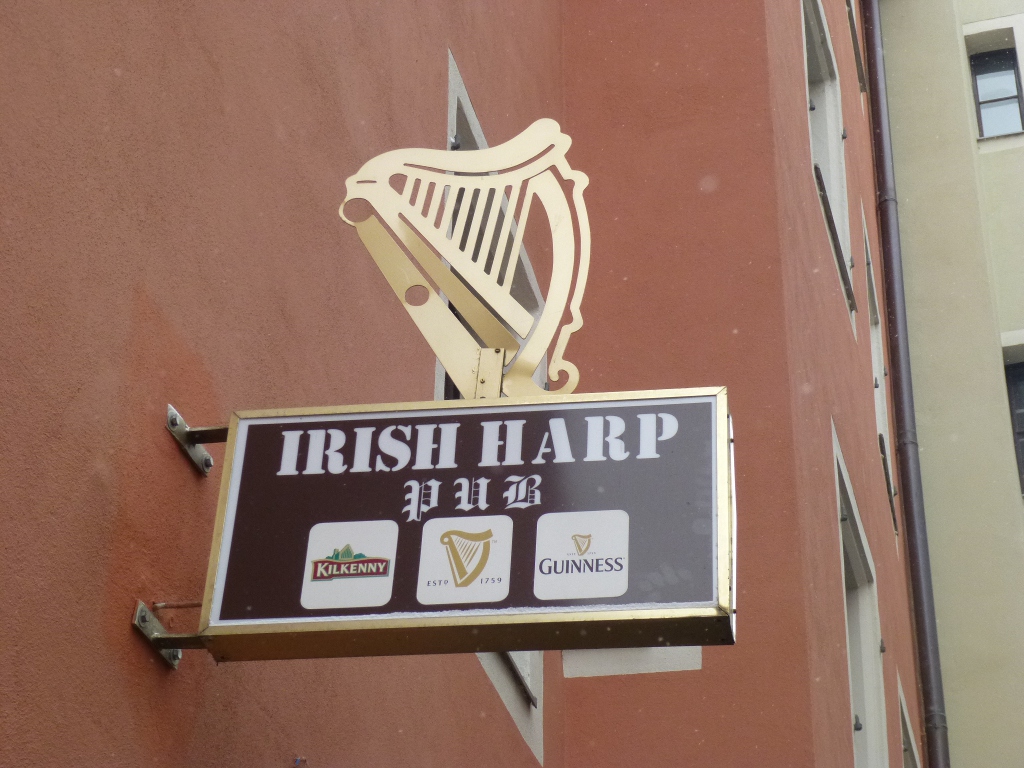 We
then walked through parts of the town, passing an Irish pub -
apparently they are international since we have plenty of them here in
the US, too. We stopped at the Old Town Hall (below left)
and heard more history. The early part was built in 1250;
the darker yellow building about 100 years later. There is a
small building and an archway connecting the original with the
annex.
We
then walked through parts of the town, passing an Irish pub -
apparently they are international since we have plenty of them here in
the US, too. We stopped at the Old Town Hall (below left)
and heard more history. The early part was built in 1250;
the darker yellow building about 100 years later. There is a
small building and an archway connecting the original with the
annex.
 Persecution
of Jews goes way back to well before the Nazis. During the
medieval times, Christians claimed they couldn't morally
charge interest so they therefore
couldn't be lenders, which meant the Jews were only ones who
lent
money.
This was fine until enough
people owed enough money, and couldn't pay it, or decided
they didn't want to pay it. Then
Persecution
of Jews goes way back to well before the Nazis. During the
medieval times, Christians claimed they couldn't morally
charge interest so they therefore
couldn't be lenders, which meant the Jews were only ones who
lent
money.
This was fine until enough
people owed enough money, and couldn't pay it, or decided
they didn't want to pay it. Then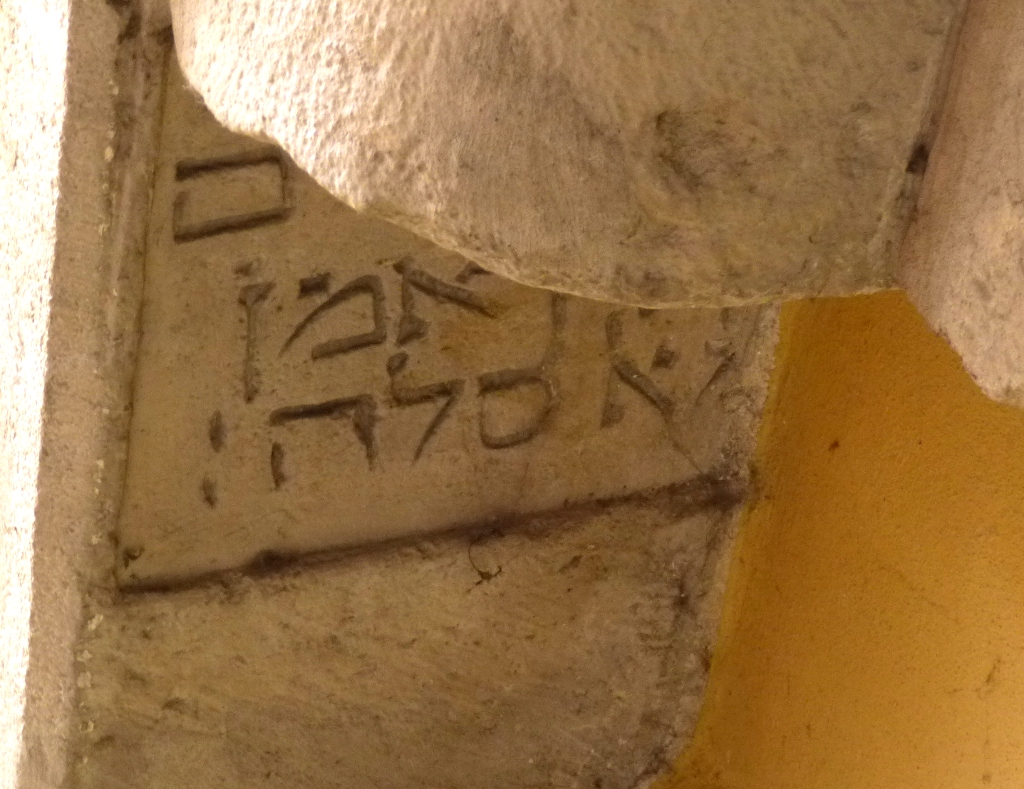 the borrowers decided to run them out of town.
In 1519, they were given 4 days to leave
town. After those 4 days, their homes, the
synagogue and even their cemetery was destroyed. The vandals
stole tombstones as souvenirs and used them in walls of their homes to
"brag" to others about their part in
the desecration. An example of an old tombstone found in an
ancient wall is shown at the right.
the borrowers decided to run them out of town.
In 1519, they were given 4 days to leave
town. After those 4 days, their homes, the
synagogue and even their cemetery was destroyed. The vandals
stole tombstones as souvenirs and used them in walls of their homes to
"brag" to others about their part in
the desecration. An example of an old tombstone found in an
ancient wall is shown at the right.
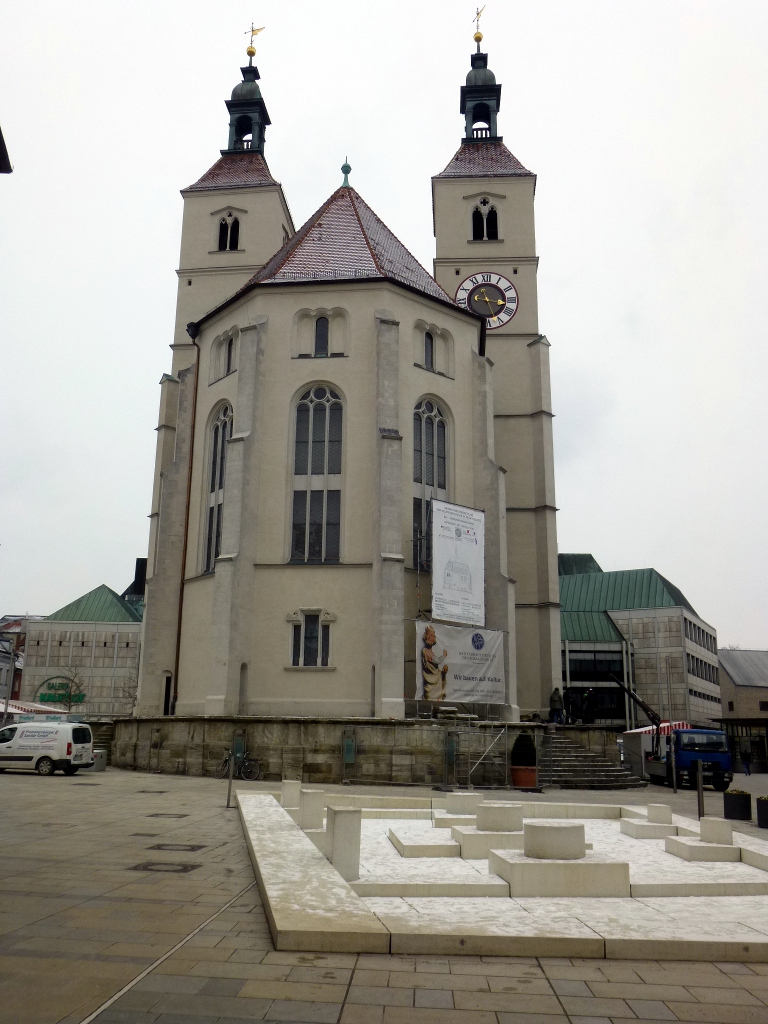 Shortly
after that, an
Evangelical Lutheran church (Neupfarrkirche) was begun on
the site of the old synagogue but not completed until 1860. In the
1990's, excavation for an electrical project
uncovered some of the ruins of the original synagogue, showing
that the location was slightly different than what had been believed.
A white marble memorial created by Israeli sculptor Dani
Karavan,
depicting the
foundation of the old synagogue and known as the "Meeting Place," was
installed in 2005 at that site in NeupfarrPlatz. This walk-in
and
sit-on sculpture seems
Shortly
after that, an
Evangelical Lutheran church (Neupfarrkirche) was begun on
the site of the old synagogue but not completed until 1860. In the
1990's, excavation for an electrical project
uncovered some of the ruins of the original synagogue, showing
that the location was slightly different than what had been believed.
A white marble memorial created by Israeli sculptor Dani
Karavan,
depicting the
foundation of the old synagogue and known as the "Meeting Place," was
installed in 2005 at that site in NeupfarrPlatz. This walk-in
and
sit-on sculpture seems 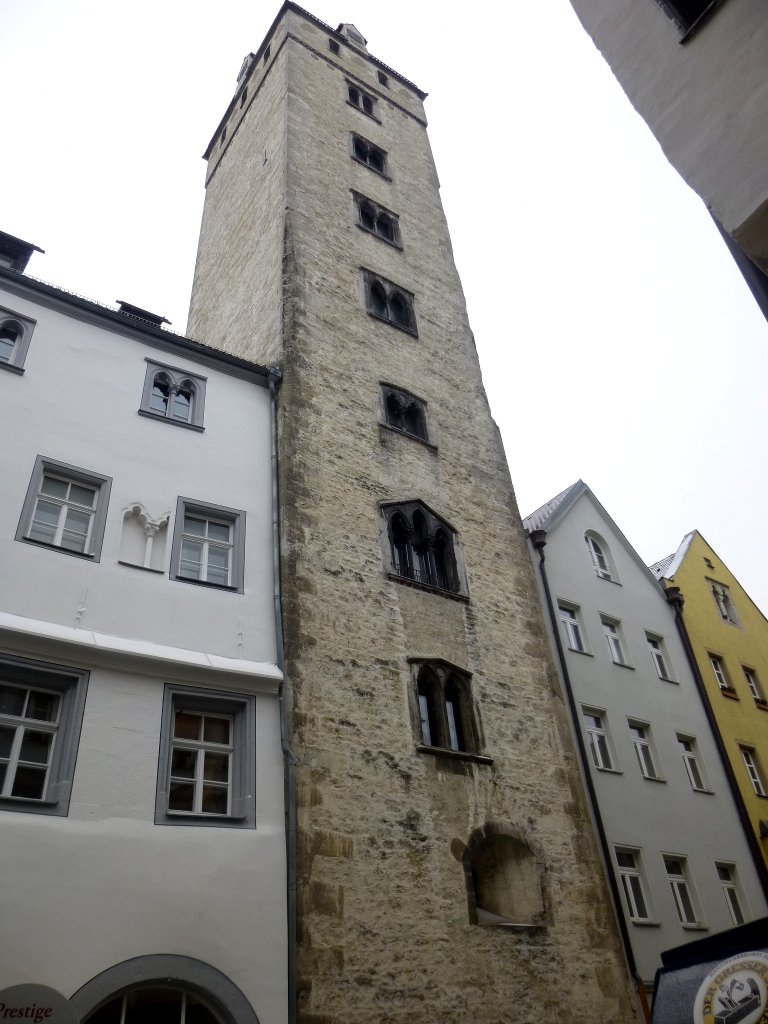 to
make a nice resting place (when it is warmer than 24°) there in front
of Neupfarrkirche, both pictured at left.
to
make a nice resting place (when it is warmer than 24°) there in front
of Neupfarrkirche, both pictured at left.
The Goldener
Turm (golden
tower - picture on the right) was built, and grew,
as rich folks tried to outdo each other on heights of towers.
The
original 4 stories date back to the mid-1200's; another 4 were added
around 1300. Around 1600 courtyard arcades and a new roof
were
added; in 1985 it was fully restored and became a student dormitory for
the university. I can't even imagine living in
something
that was built 800+ years ago!
 About
this time we were quite frozen so we went back to the ship for lunch
and warm tea. We
stayed in and
warmed up until about 2:00 then ventured out again. We went
back
to the stone
bridge and town hall
to get pictures that were hard to take this morning with so many
tourists
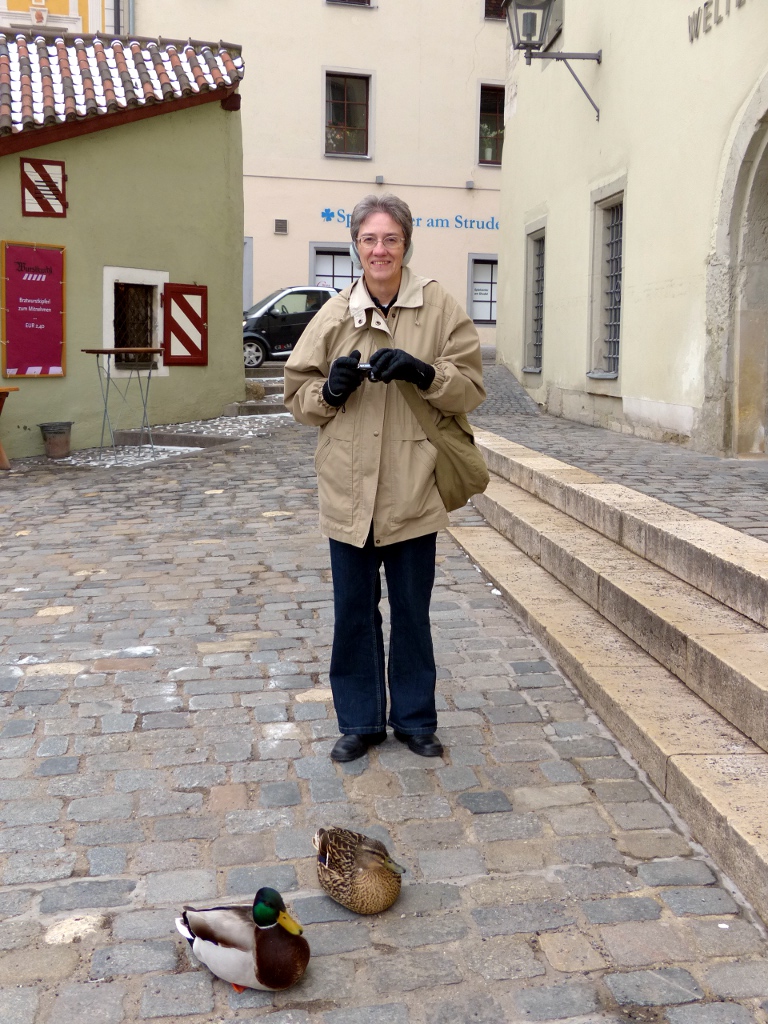
around and stopped and got sweet mustard at the sausage kitchen! Katie
snapped this picture of me and my duck friends while we were
there.
About
this time we were quite frozen so we went back to the ship for lunch
and warm tea. We
stayed in and
warmed up until about 2:00 then ventured out again. We went
back
to the stone
bridge and town hall
to get pictures that were hard to take this morning with so many
tourists
around and stopped and got sweet mustard at the sausage kitchen! Katie
snapped this picture of me and my duck friends while we were
there.
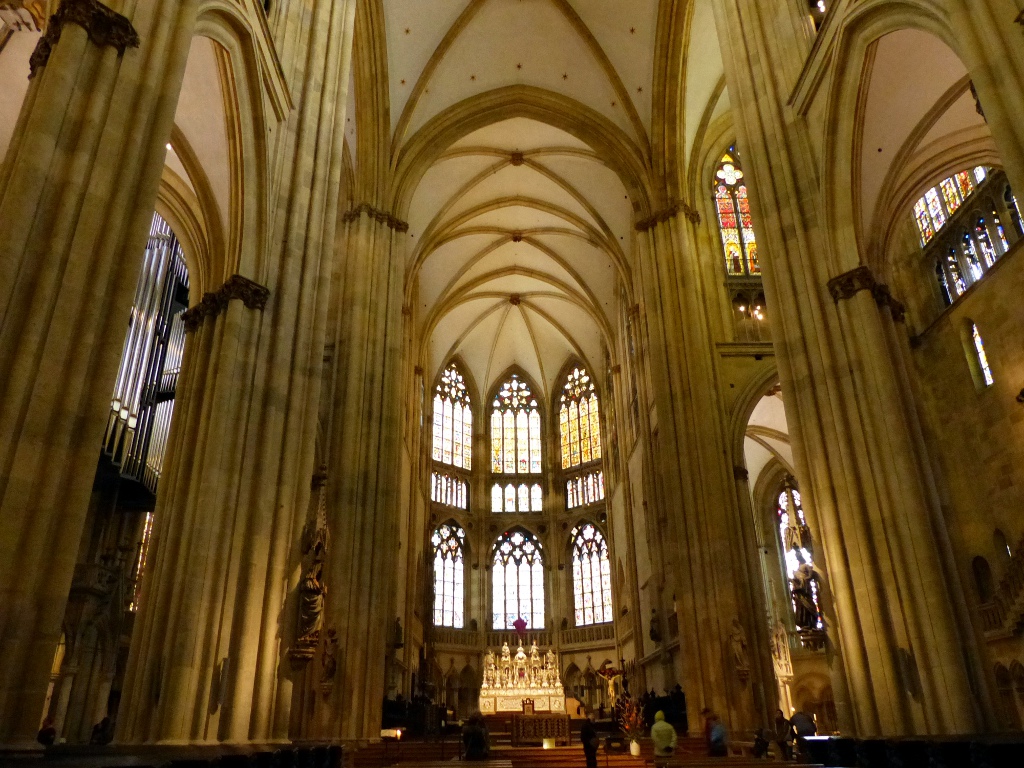 Then
we spent some
time in St. Patrick's Cathedral – it was very dark and cold but had
some
beautiful stained glass. A general view of the sanctuary is shown at
the right. The
church was begun in 1273, parts were ready for use in 1320 and it was
mostly complete around 1520 but it wasn't completed until 1871
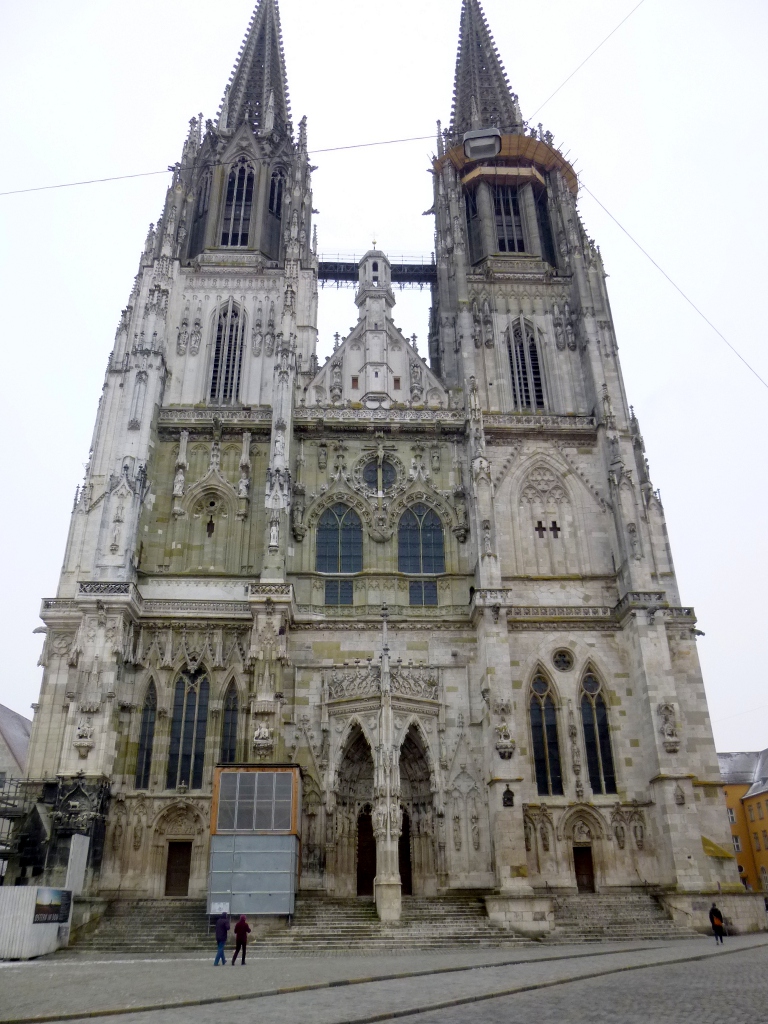
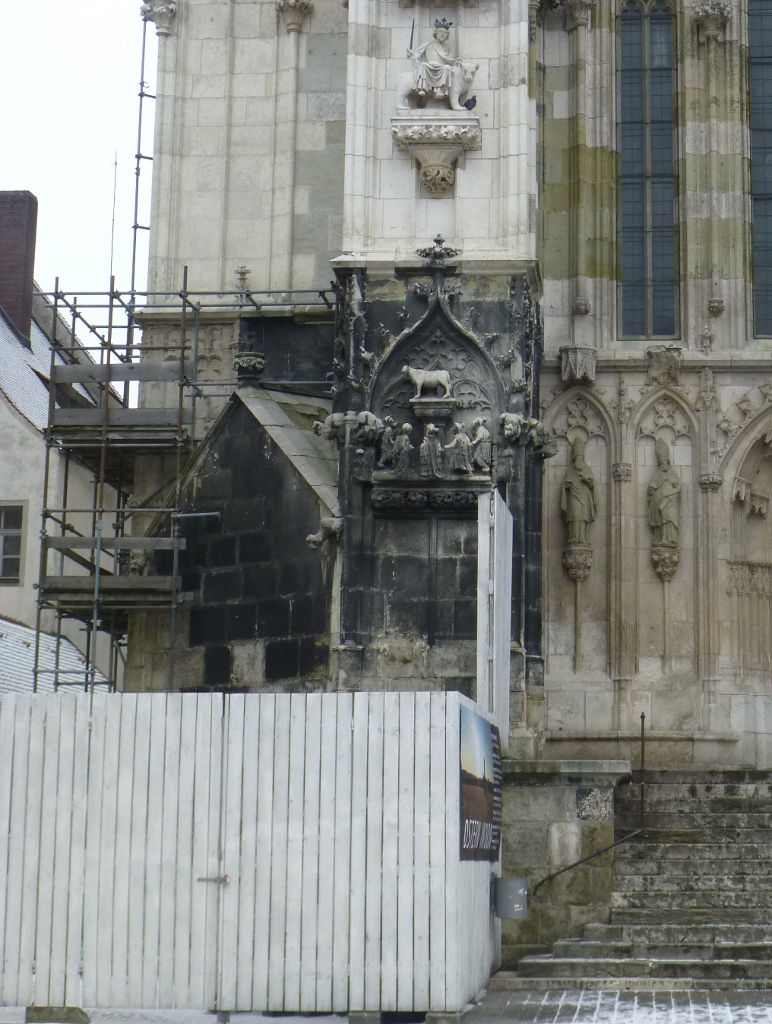
when the towers and spires were finished. The pictures below
show, from left to right, a front view of this Gothic cathedral, and a
closer view of the lower left hand corner: that's how dark the whole
building looked until they started restoration around 2000.
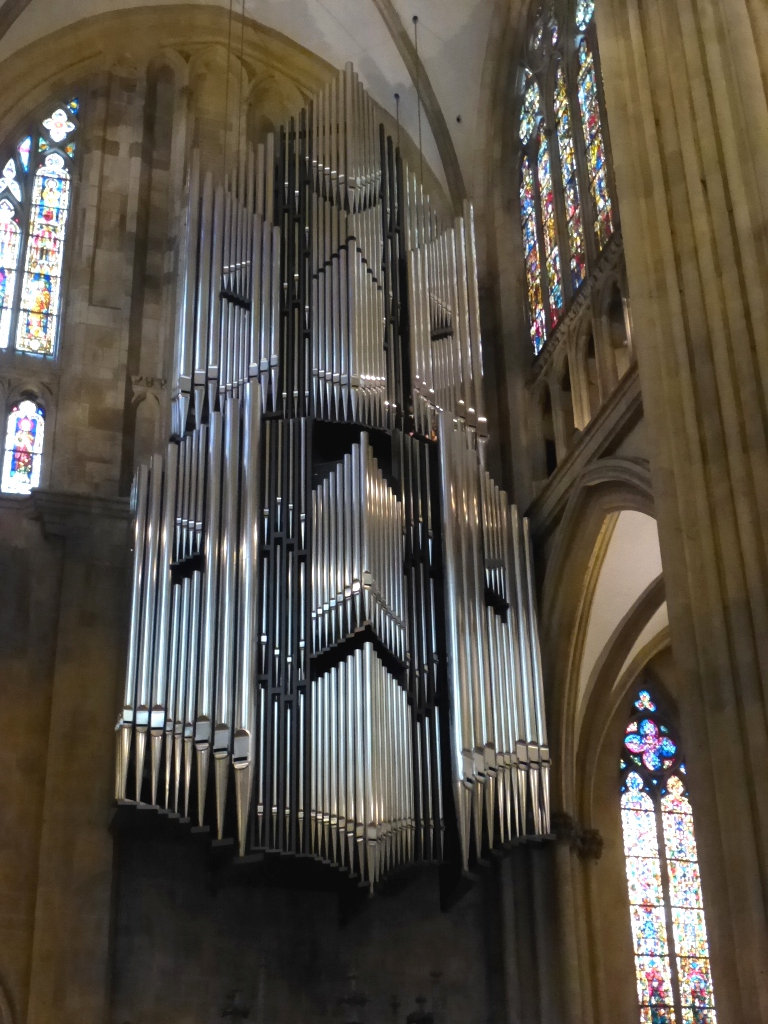
Finally, the organ and some of the windows!
Then
we spent some
time in St. Patrick's Cathedral – it was very dark and cold but had
some
beautiful stained glass. A general view of the sanctuary is shown at
the right. The
church was begun in 1273, parts were ready for use in 1320 and it was
mostly complete around 1520 but it wasn't completed until 1871
when the towers and spires were finished. The pictures below
show, from left to right, a front view of this Gothic cathedral, and a
closer view of the lower left hand corner: that's how dark the whole
building looked until they started restoration around 2000.
Finally, the organ and some of the windows!
THEN
we went to hunt up Alte
Kapelle around the
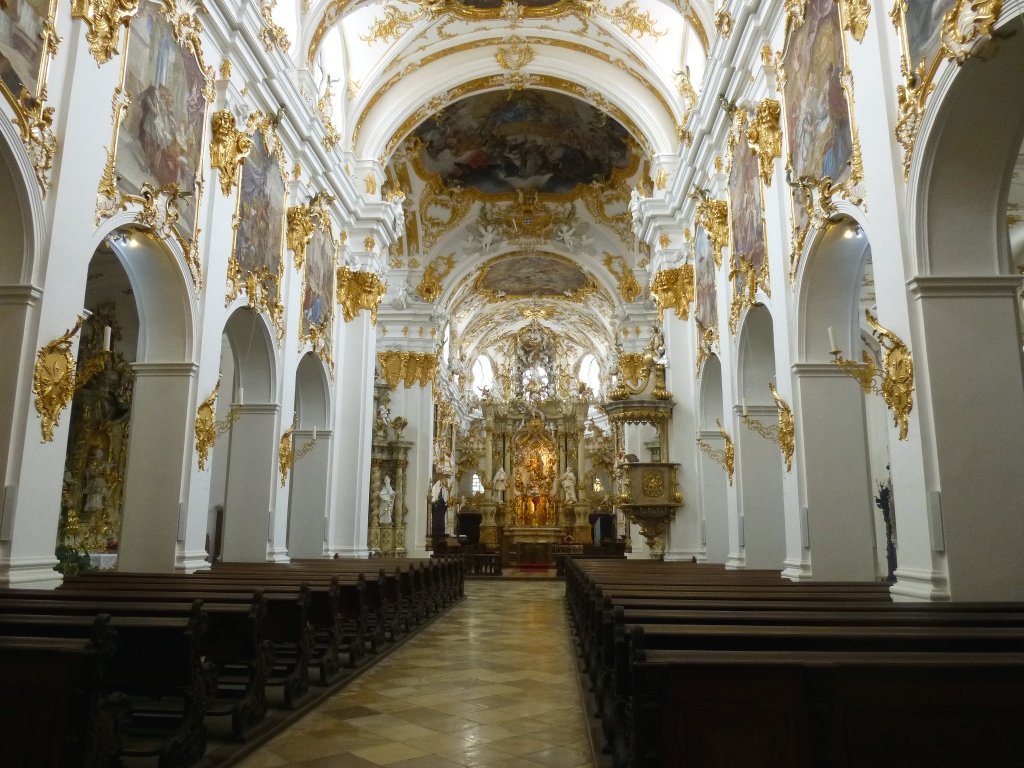
corner. It wasn't easy to find but Oh My!
I
had read that it was
ornate – it's
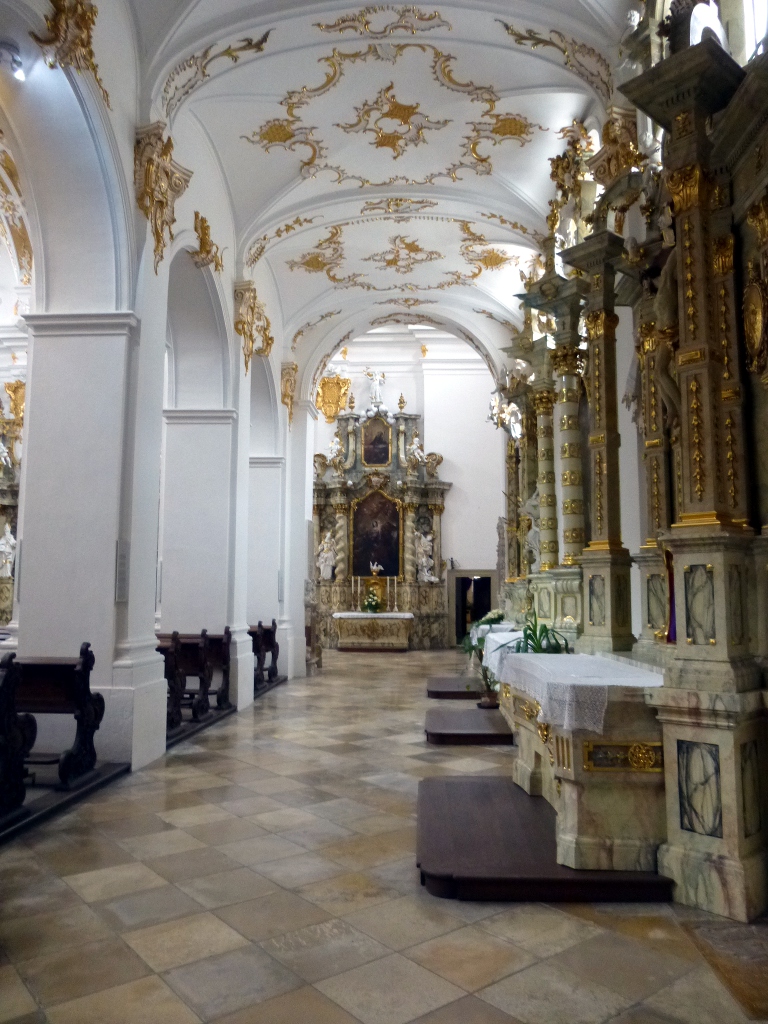
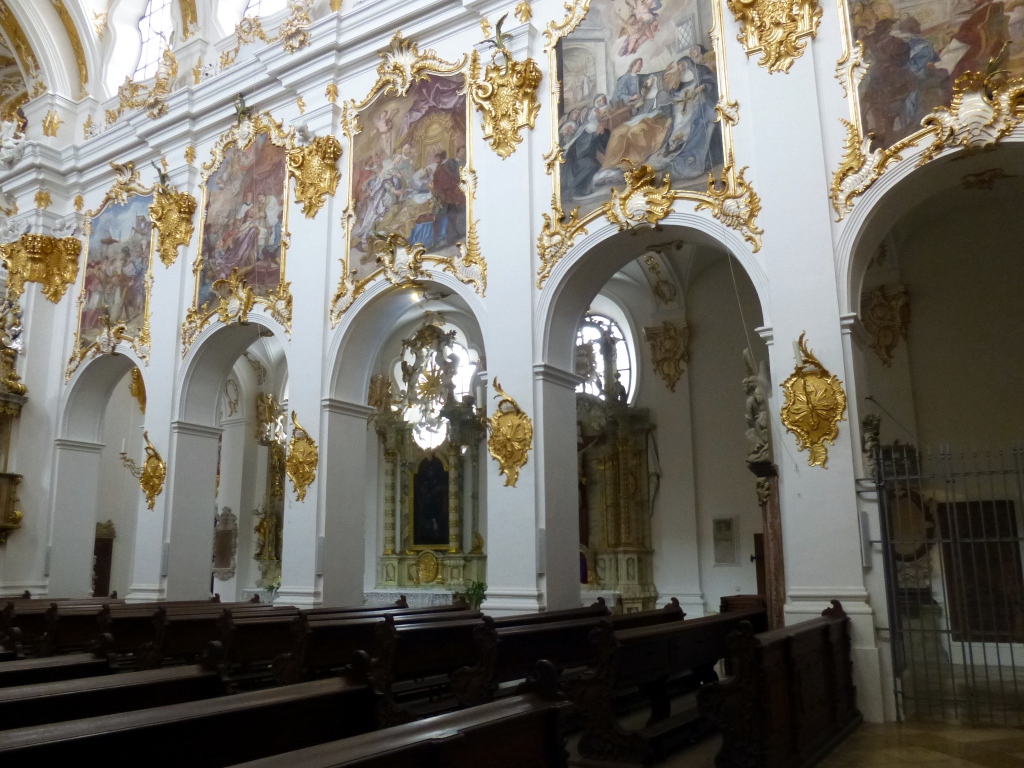
actually rather overwhelming. What a total contrast to St.
Peter's! The church has been through a number of incarnations
since it was first mentioned in a document from 875 AD but the current
presentation dates from the 18th century. It was refurbished
in
Rococo style from 1747-1796 and the interior was restored again more
recently, finishing in 2003. The pictures below clearly
illustrate how different Baroque is from Gothic! As I
understand
it, the style is directly related to the philosophy: Gothic emphasizes
simplicity on earth - you'll get your reward in heaven; Baroque is more
like "God wants us to enjoy heaven on earth!"
 After
that we felt the need for some "heaven on earth" so went to Café
Princezz
After
that we felt the need for some "heaven on earth" so went to Café
Princezz
(opened
in 1686) and
bought
chocolate truffles! We were very restrained considering how
cheap
they were. The fancy ones were 2.1 €
but the "plain ones" were
only 45
cents each. (The posted prices were "per 100 grams" but not
being able to quickly compute what that meant, I couldn't estimate it
in my brain so
I was pleasantly surprised that they were so affordable.)
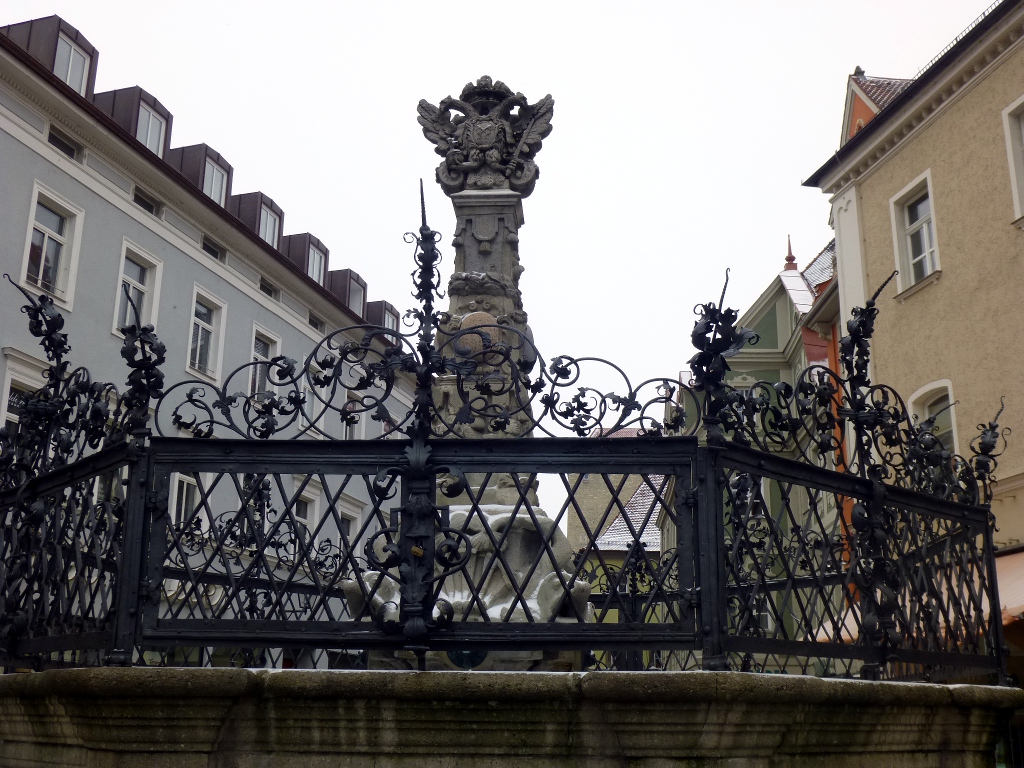
Finally, at the left is one of the many monuments and
fountains
scattered throughout the city.
Back at the ship, we took hot
cocoa to the evening port talk, and then had dinner. We left
Regensburg
about 10:15 PM, turned out the cabin lights and enjoyed watching the
town
and then
the farms go by until we got too tired and went to sleep.
Wednesday, March 27
We
arrived at
Passau this morning – we got to watch the process of going through the
Kachlet lock and then there were only about 3km and a few more bridges
to go under until we were parked and ready for our morning
tour at
10
AM.
 Our guide this morning
(Conrad) was good as far as his knowledge but he needed help on group
management (like making sure
that we all got across the street safely) and use of the mic (telling
us where
he was
turning so people at the end could find the group). He didn't
keep talking
while walking even though
we could hear him and it would have been helpful.
He also actually covered the mic at times when
people asked questions instead of repeating the
questions and letting us all hear the answers. But if we kept
up with him so we could see where he went, he did have a lot of good
information to share.
Our guide this morning
(Conrad) was good as far as his knowledge but he needed help on group
management (like making sure
that we all got across the street safely) and use of the mic (telling
us where
he was
turning so people at the end could find the group). He didn't
keep talking
while walking even though
we could hear him and it would have been helpful.
He also actually covered the mic at times when
people asked questions instead of repeating the
questions and letting us all hear the answers. But if we kept
up with him so we could see where he went, he did have a lot of good
information to share.
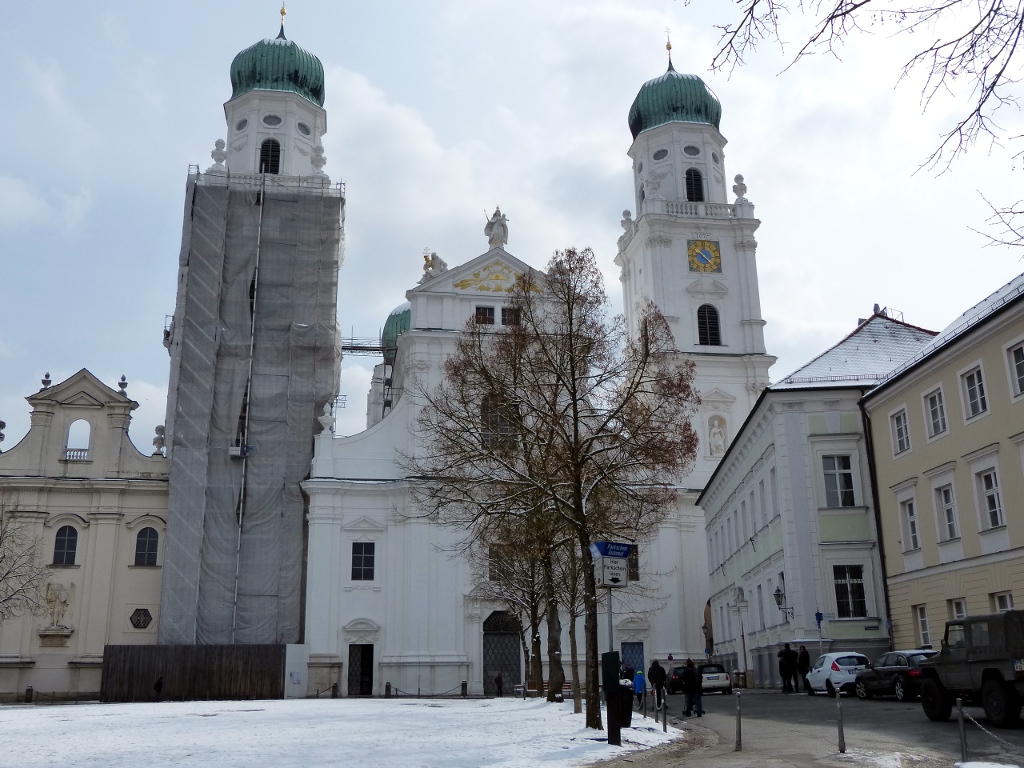 Passau didn't retain much of its
medieval presence because of fires in 1662 and 1680
that
destroyed most
of the town. It was then rebuilt in a more Baroque style.
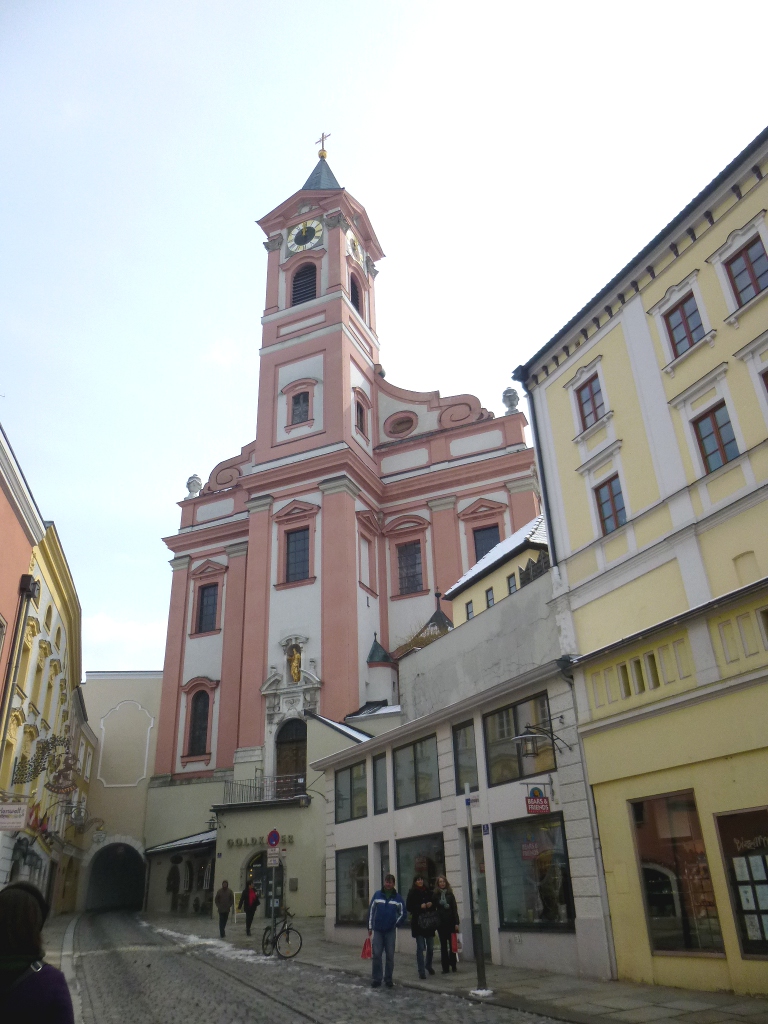
We started our walk going past St. Paul's church (the pink
one in the left picture) and through the city gate (just left of the
church) into the old town area.
Passau didn't retain much of its
medieval presence because of fires in 1662 and 1680
that
destroyed most
of the town. It was then rebuilt in a more Baroque style.
We started our walk going past St. Paul's church (the pink
one in the left picture) and through the city gate (just left of the
church) into the old town area.
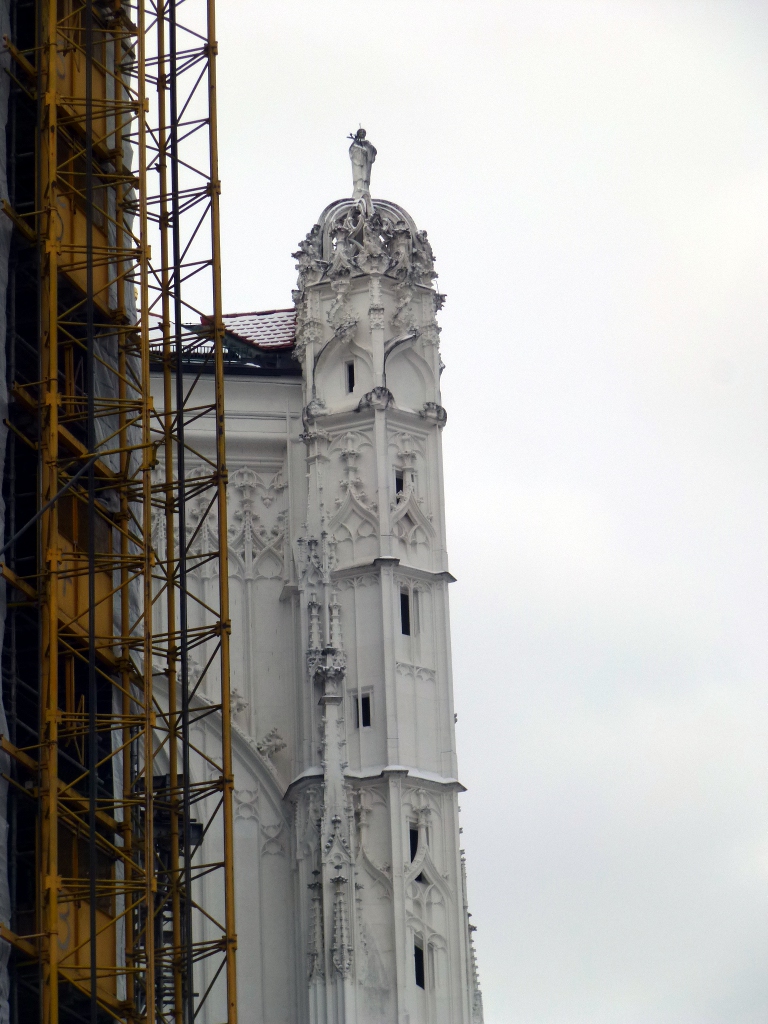 The streets
were all very narrow, and mostly stone or brick, as we've seen in other
old city areas. The first major stop was at St. Stephen's
Cathedral (right). You can see there was restoration work
going on. I think with a church this old that's a continual
process! There has been some sort of church at this site
since the 700's. It was rebuilt from 1668-1693 in
the current Baroque form after
its Gothic predecessor burned in the city fires. If you walk
around the building, you'll note that some of the old stones were
re-used in the current building and that there is one Gothic tower
remaining (the east tower, pictured at the left) that was not
destroyed.
The streets
were all very narrow, and mostly stone or brick, as we've seen in other
old city areas. The first major stop was at St. Stephen's
Cathedral (right). You can see there was restoration work
going on. I think with a church this old that's a continual
process! There has been some sort of church at this site
since the 700's. It was rebuilt from 1668-1693 in
the current Baroque form after
its Gothic predecessor burned in the city fires. If you walk
around the building, you'll note that some of the old stones were
re-used in the current building and that there is one Gothic tower
remaining (the east tower, pictured at the left) that was not
destroyed.
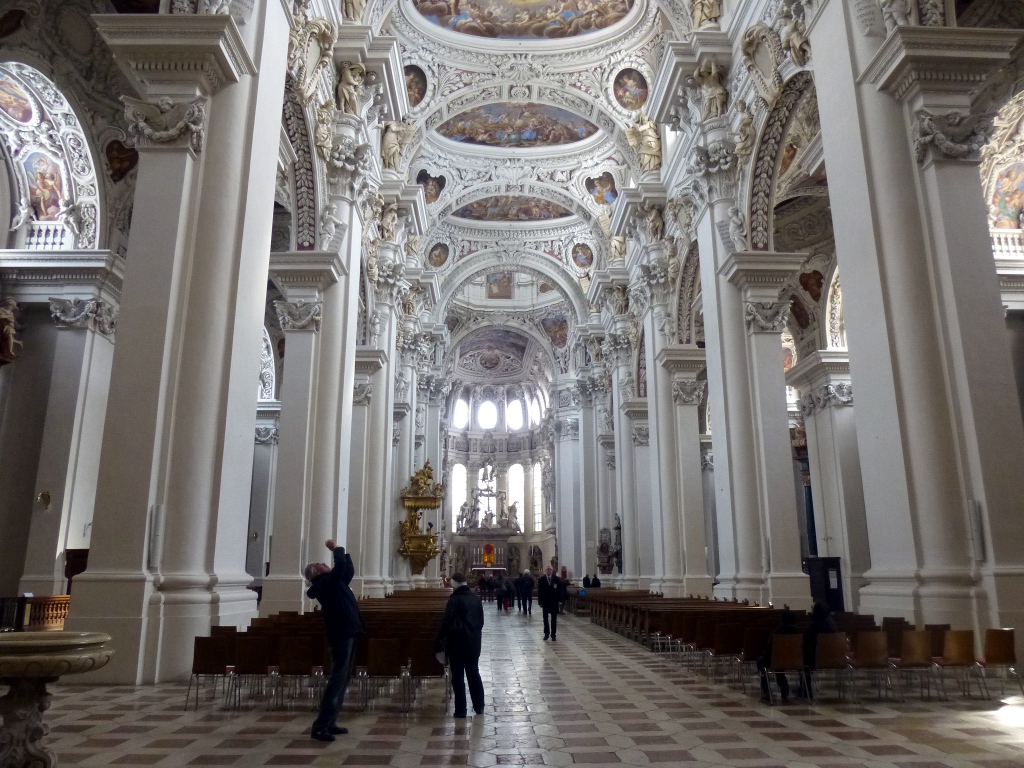
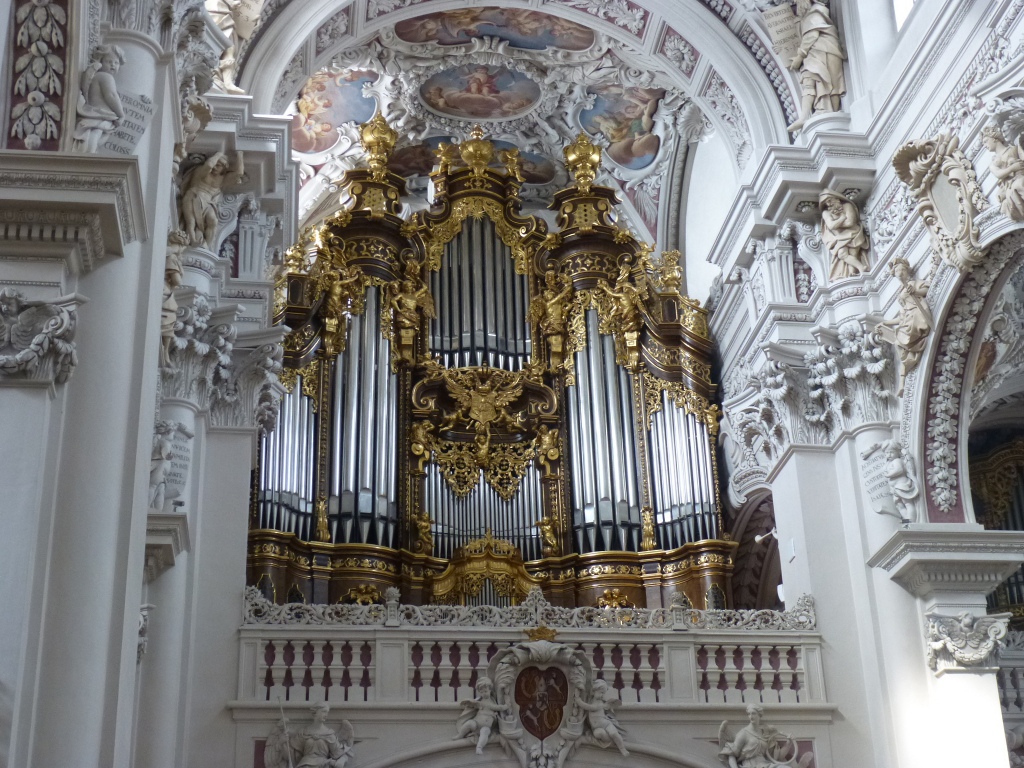
You can see from the pictures
below that
the interior is now definitely baroque rather than gothic!
The organ,
with over 17,000 pipes is the
largest cathedral organ in the world - unfortunately, there weren't any
concerts at the time we were here; it would have been wonderful to
hear! It is actually comprised of several organs but they are
all controlled from the same
console. At left is the sanctuary; the center shows
the main organ and the picture at the right shows one of the remote
organs set
right in the center of a ceiling painting - talk about "surround
sound!"
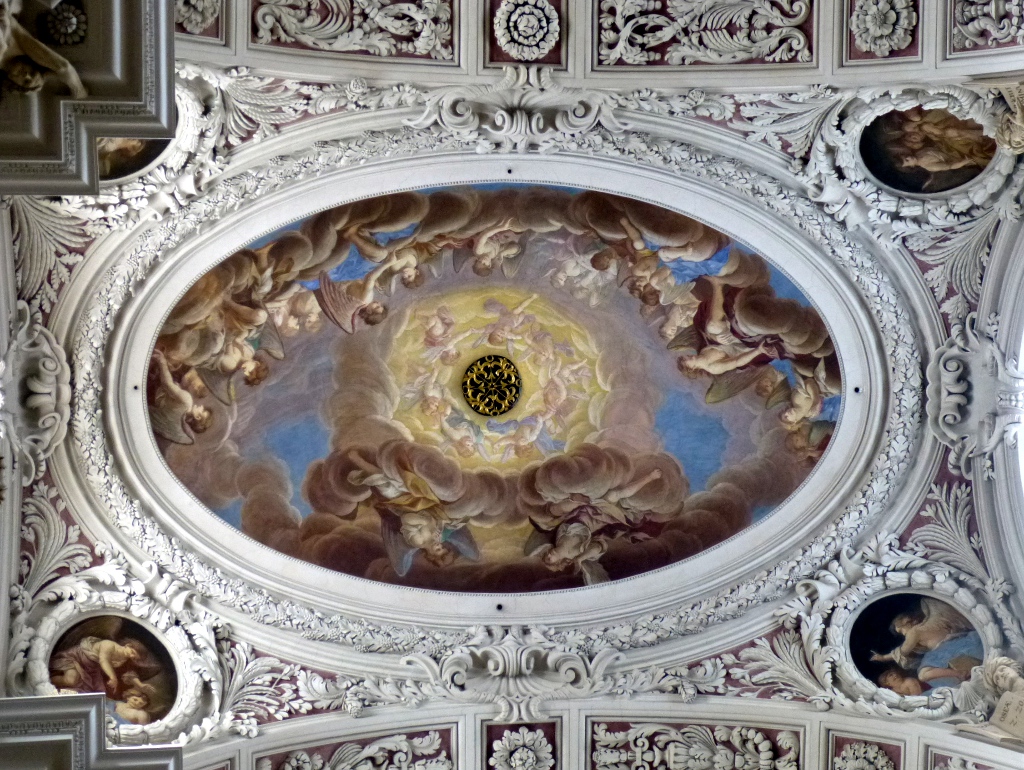
 After
admiring the central staircase in the equally gaudy Old Bishop's
Residence, we walked down to the Inn River that is one side of the
Passau peninsula.
After
admiring the central staircase in the equally gaudy Old Bishop's
Residence, we walked down to the Inn River that is one side of the
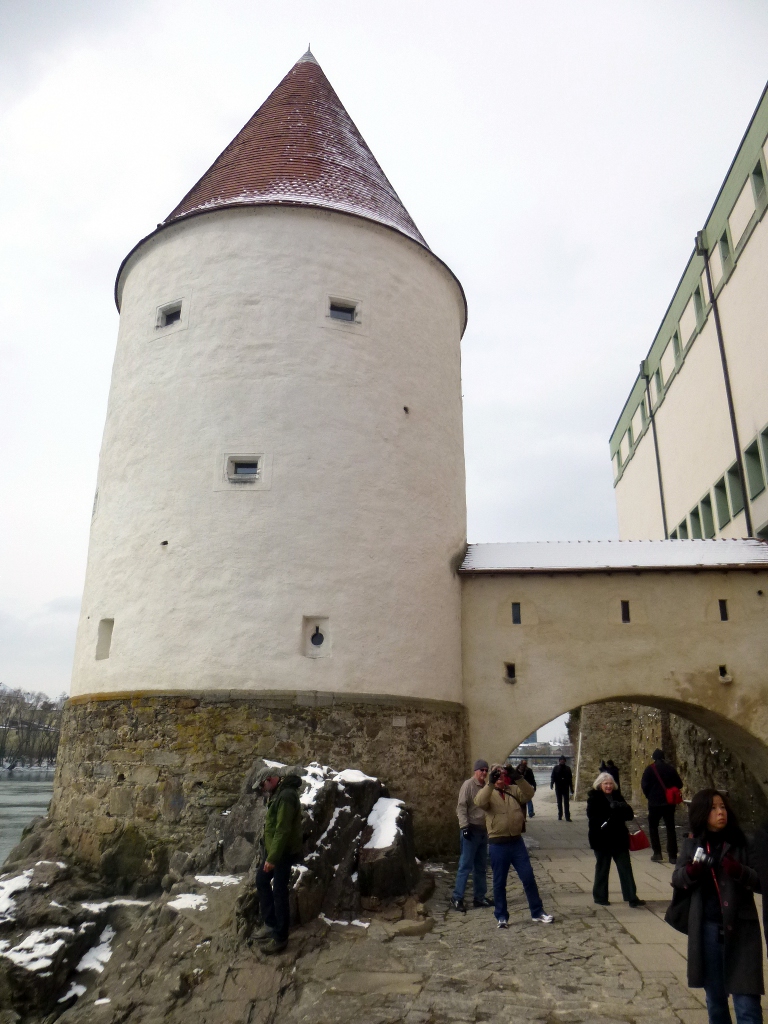
Passau peninsula. 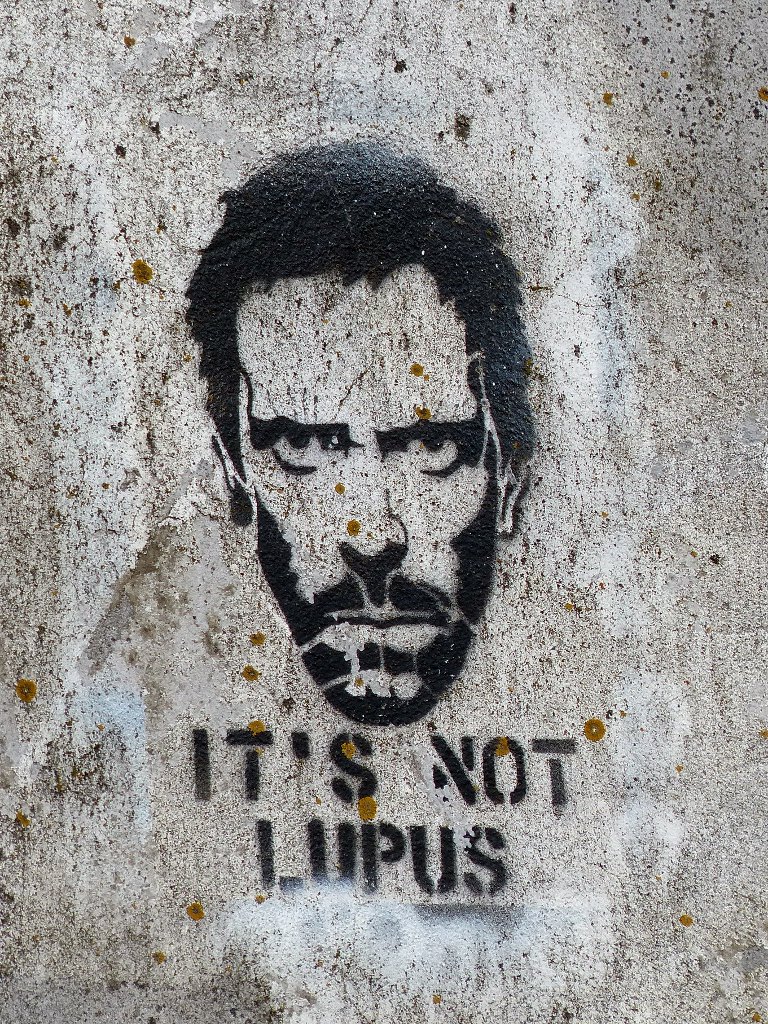 Much
of the old city wall still exists and the Schaiblingsturm Stone Tower
at the left was originally erected to protect the salt port.
(Remember in Regensburg they imported the salt from Passau?
Salt was of huge importance to the Passau economy in the
middle ages.) Now it is owned by the university and we were
told it contains a "classroom in the round" - where the instructor
teaches from the center.
Much
of the old city wall still exists and the Schaiblingsturm Stone Tower
at the left was originally erected to protect the salt port.
(Remember in Regensburg they imported the salt from Passau?
Salt was of huge importance to the Passau economy in the
middle ages.) Now it is owned by the university and we were
told it contains a "classroom in the round" - where the instructor
teaches from the center.
Katie found this
wonderful House graffiti (on the right) along the river walk.
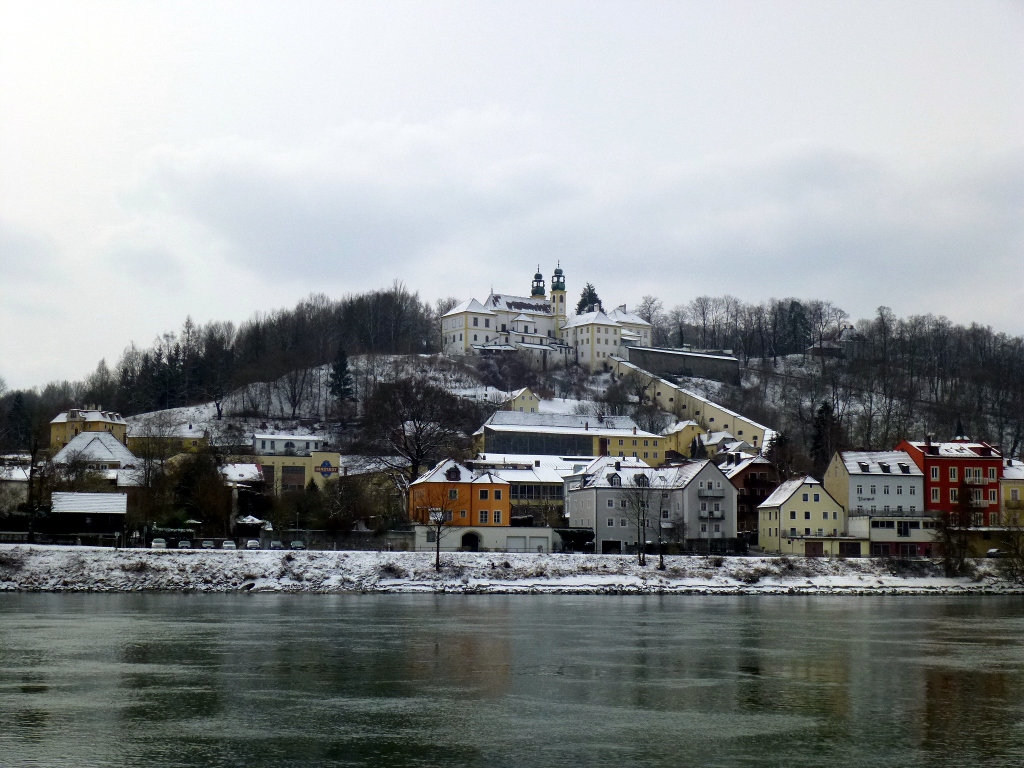
Across the Inn River is the Mariahilf Monastery and
Pilgrimage Church. We did not have time to
visit it, but the covered staircase
you can see going up the hill (below, left) contains 321 steps
and is
called "the heavenly ladder." Part of the pilgrimage is to
climb all the stairs!
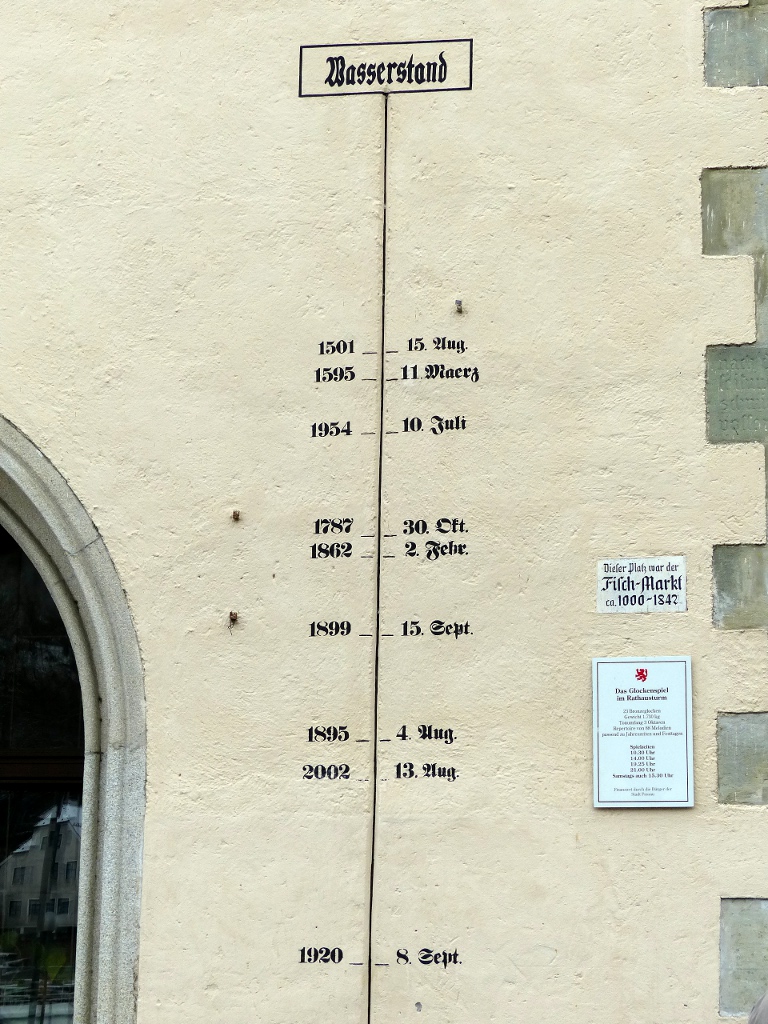
 As
one might imagine of a peninsula, there have been numerous floods over
the years. On the side of the Town
Hall is a record of water levels and dates, pictured at the left below.
Having been through some floods here, I have great sympathy
for them! If you click the picture to enlarge it, you can
read the dates. The highest one (the worst flood) was in
1501; the most recent (second from the bottom) was 2002.
As
one might imagine of a peninsula, there have been numerous floods over
the years. On the side of the Town
Hall is a record of water levels and dates, pictured at the left below.
Having been through some floods here, I have great sympathy
for them! If you click the picture to enlarge it, you can
read the dates. The highest one (the worst flood) was in
1501; the most recent (second from the bottom) was 2002.
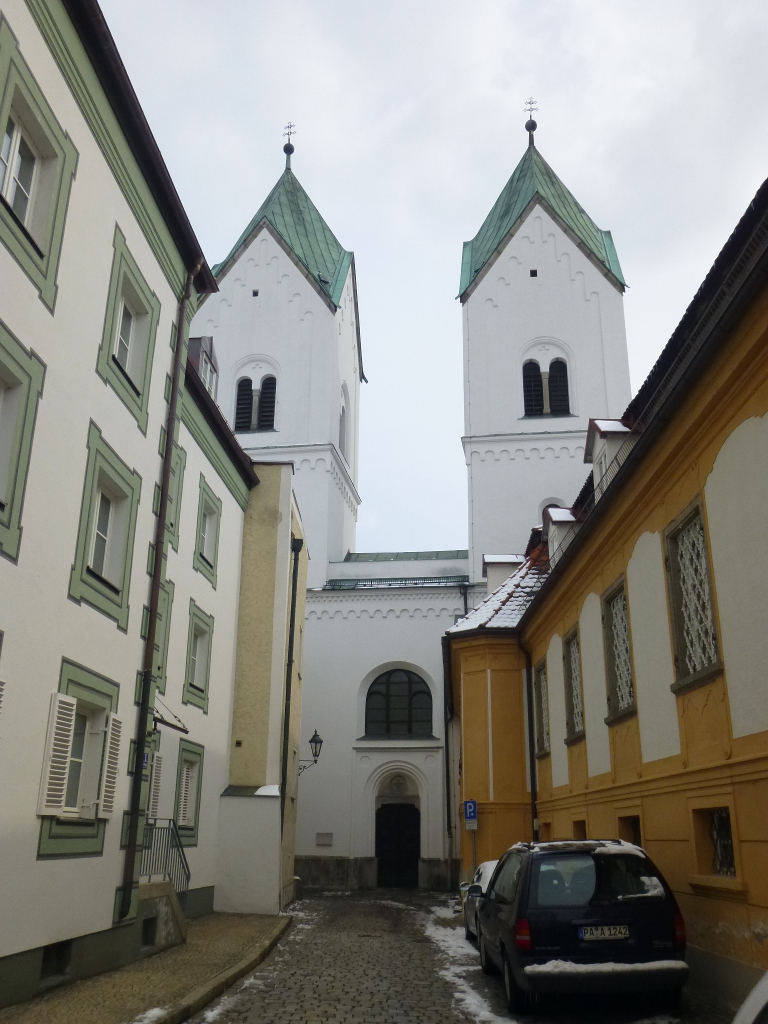
The
center picture below is of Niedernburg Abbey where Gisela, the first
Queen of Hungary, died and is buried. It now houses a girls'
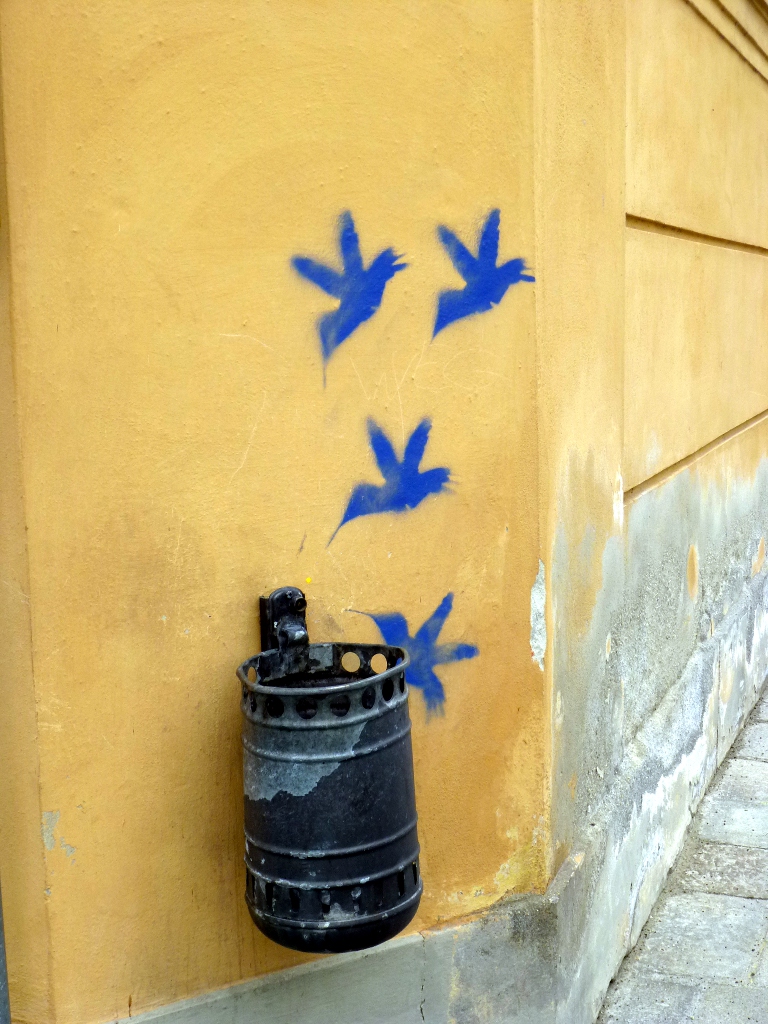
school. Finally, on the right is just a picture I snapped as
we walked along a street because I liked it! I hope it helps
with litter control!
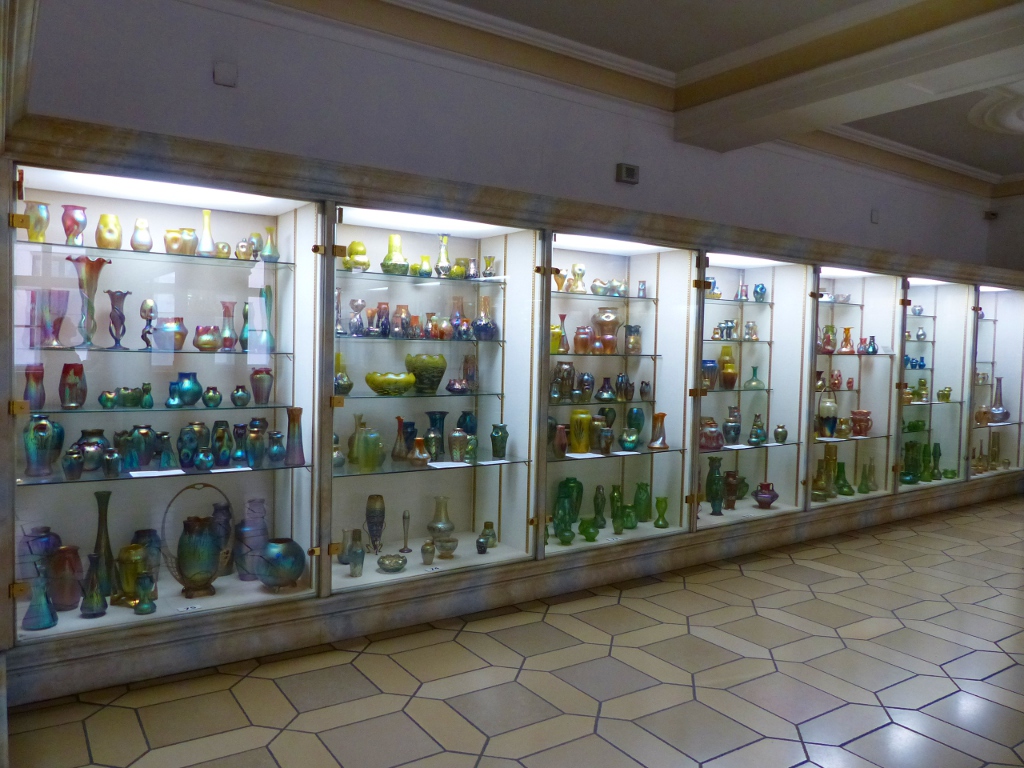
After
our lunch buffet on board, we headed back out with two destinations in
mind. First, the Glass Museum and then to Veste
Oberhaus for the views! The Glass Museum was amazing but we
probably spent too long there - it
just goes on and on, like a maze. It
would make a wonderful setting for a murder mystery.
Regular admission is 7€ but they charged us only 5€ because
we
were from a
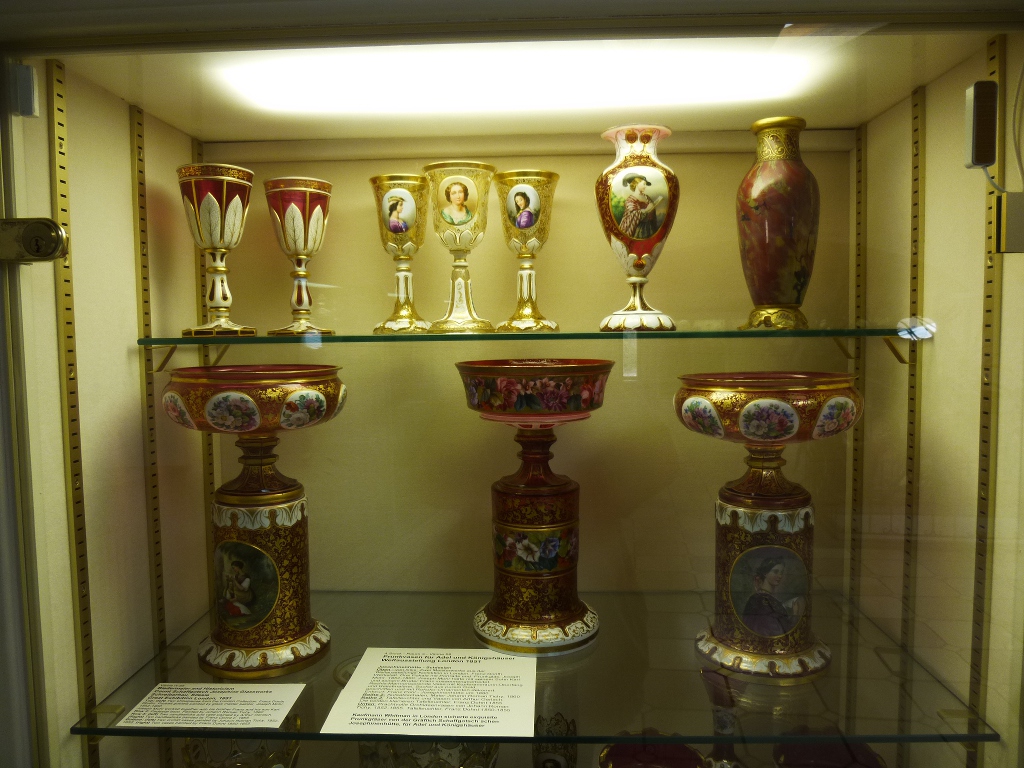
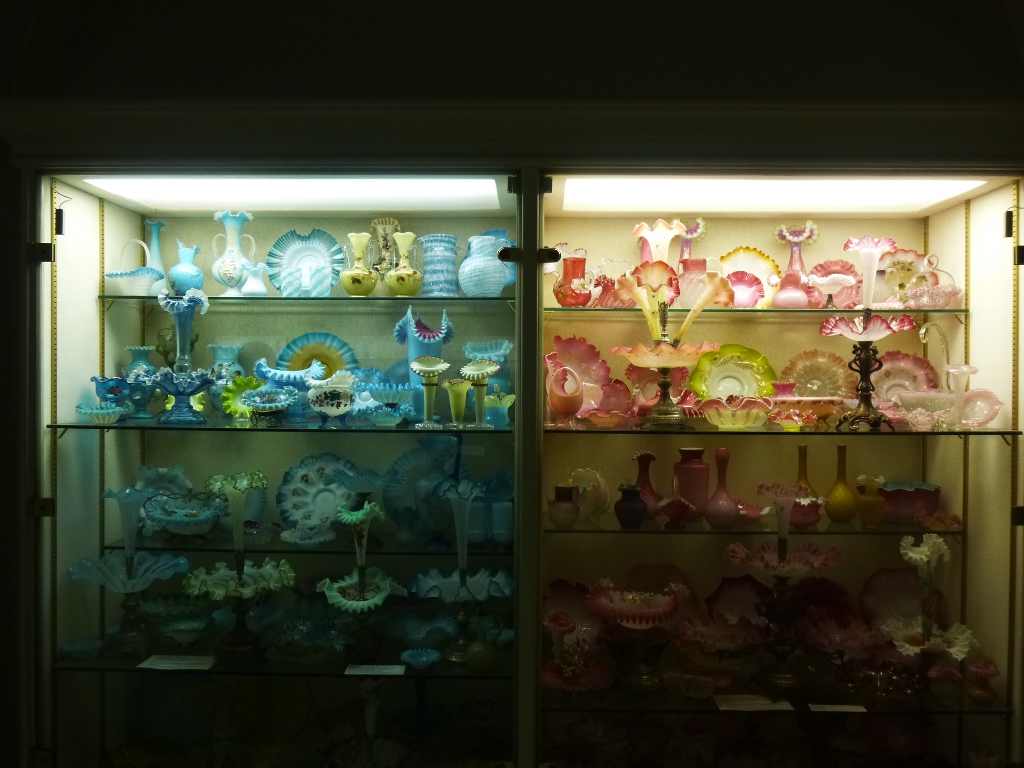
ship. Each case is labelled and most of them
include English translations explaining about the items in that case -
when and where they were made, how they got the colors, etc.
Here are a few pictures just to give you the idea -
we
were overwhelmed and left without seeing all of it, but it was still
worth the visit!
 Then
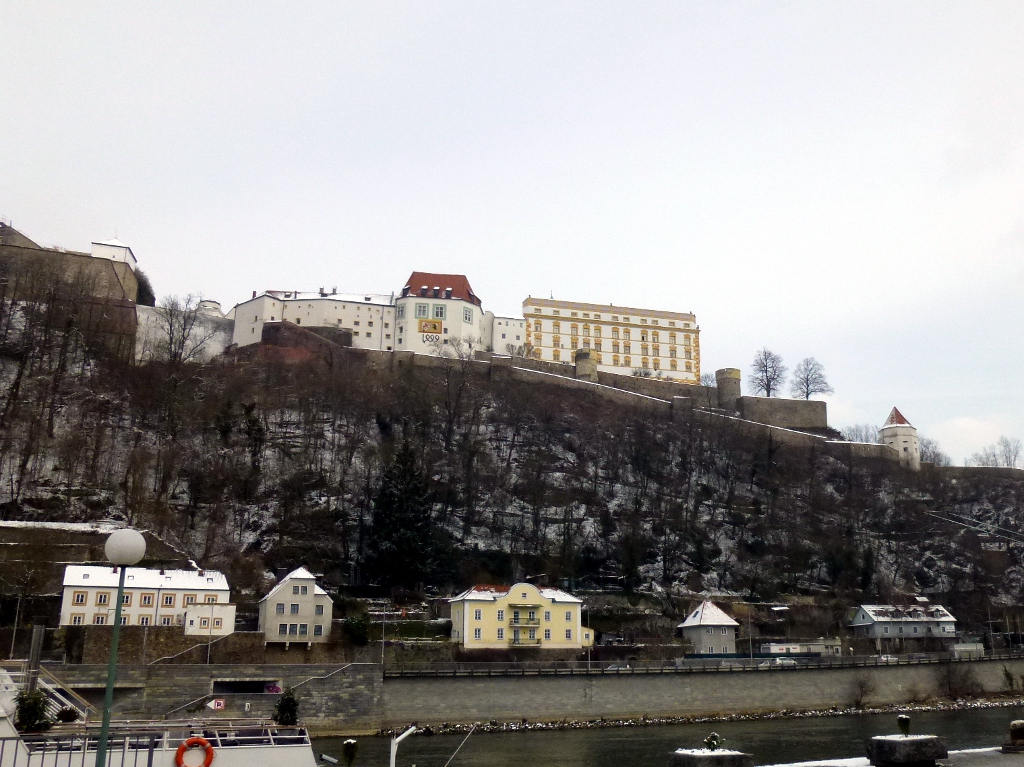
we took the
shuttle bus up to Veste Oberhaus - pictured at left - for 1.7€
each. This is a huge fortress founded in 1219.
If you enlarge the picture (click on it) you can see the old
walls around it. Even enlarged, the picture is probably too
small to see that
the bottom row of "windows" are just painted on - they aren't real
windows! Now it is a museum.
Then
we took the
shuttle bus up to Veste Oberhaus - pictured at left - for 1.7€
each. This is a huge fortress founded in 1219.
If you enlarge the picture (click on it) you can see the old
walls around it. Even enlarged, the picture is probably too
small to see that
the bottom row of "windows" are just painted on - they aren't real
windows! Now it is a museum. 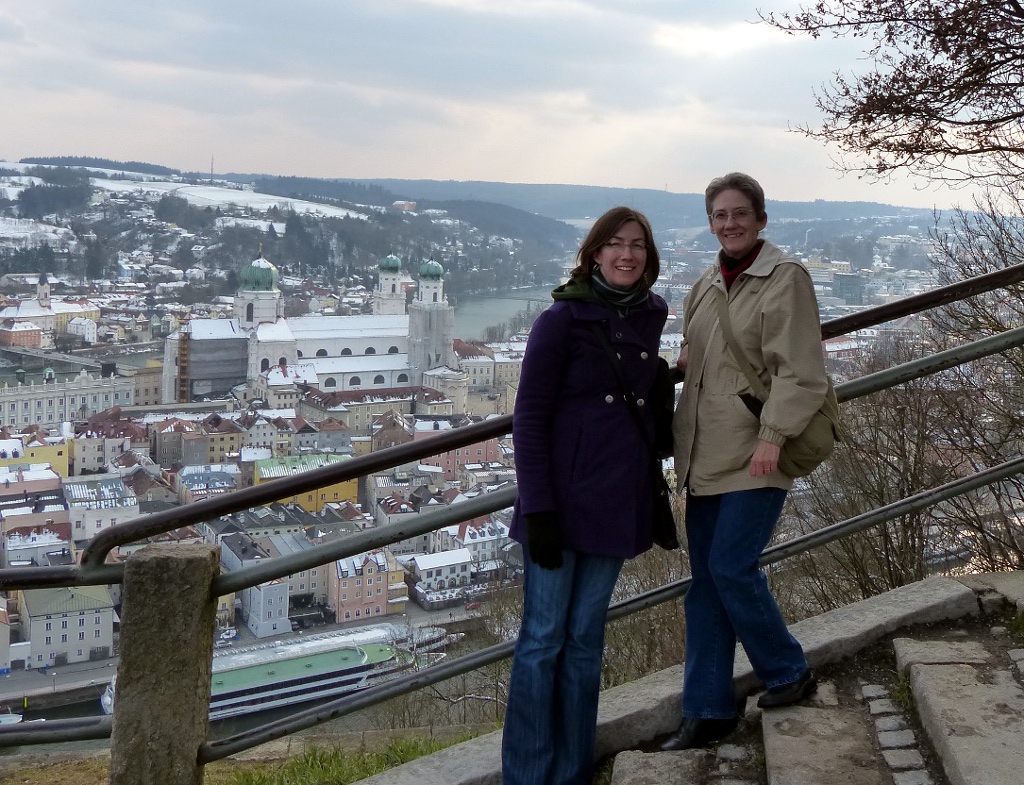 During tourist season
there is also a restaurant on site. We didn't really want
to see the museum, we were just looking for a nice
view. Unfortunately,
once we got up there, we found out the
footpath and the battlement (where you would typically go to look down
over the city) were
closed due to ice and mud. But the kind lady in the ticket
office
showed us another path that took us to the Ludwigsteig
viewpoint very near by, which was exactly what we were seeking!
To the
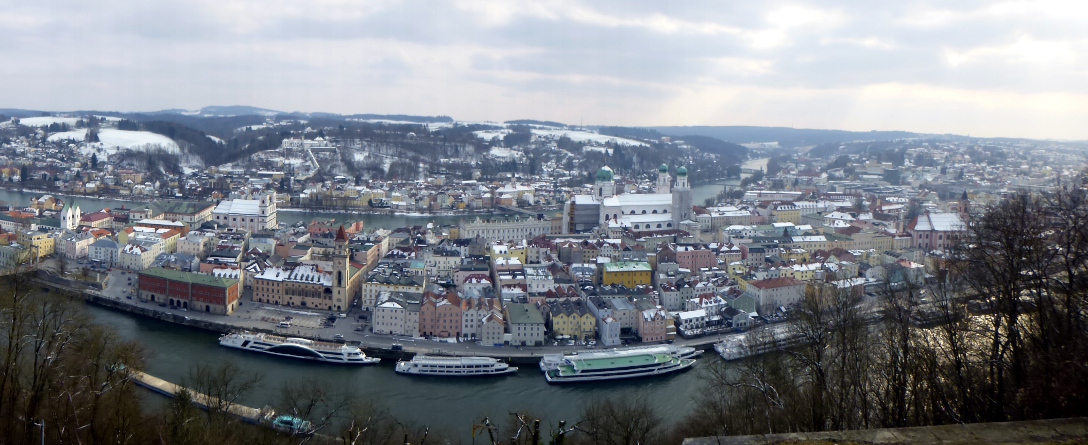
right is our tourist picture of us with Passau in the
background. Below is my panorama of Passau from that point.
The Danube is in the foreground, our ship is way to the
right, barely visible between the branches of the trees.
The Inn (where we were walking this morning) is the
second river, behind the town; you can easily spot St. Stephen's
Cathedral with its three blue-green domes. If you look
closely you'll also see Mariahilf on the hill across the Inn.
During tourist season
there is also a restaurant on site. We didn't really want
to see the museum, we were just looking for a nice
view. Unfortunately,
once we got up there, we found out the
footpath and the battlement (where you would typically go to look down
over the city) were
closed due to ice and mud. But the kind lady in the ticket
office
showed us another path that took us to the Ludwigsteig
viewpoint very near by, which was exactly what we were seeking!
To the
right is our tourist picture of us with Passau in the
background. Below is my panorama of Passau from that point.
The Danube is in the foreground, our ship is way to the
right, barely visible between the branches of the trees.
The Inn (where we were walking this morning) is the
second river, behind the town; you can easily spot St. Stephen's
Cathedral with its three blue-green domes. If you look
closely you'll also see Mariahilf on the hill across the Inn.
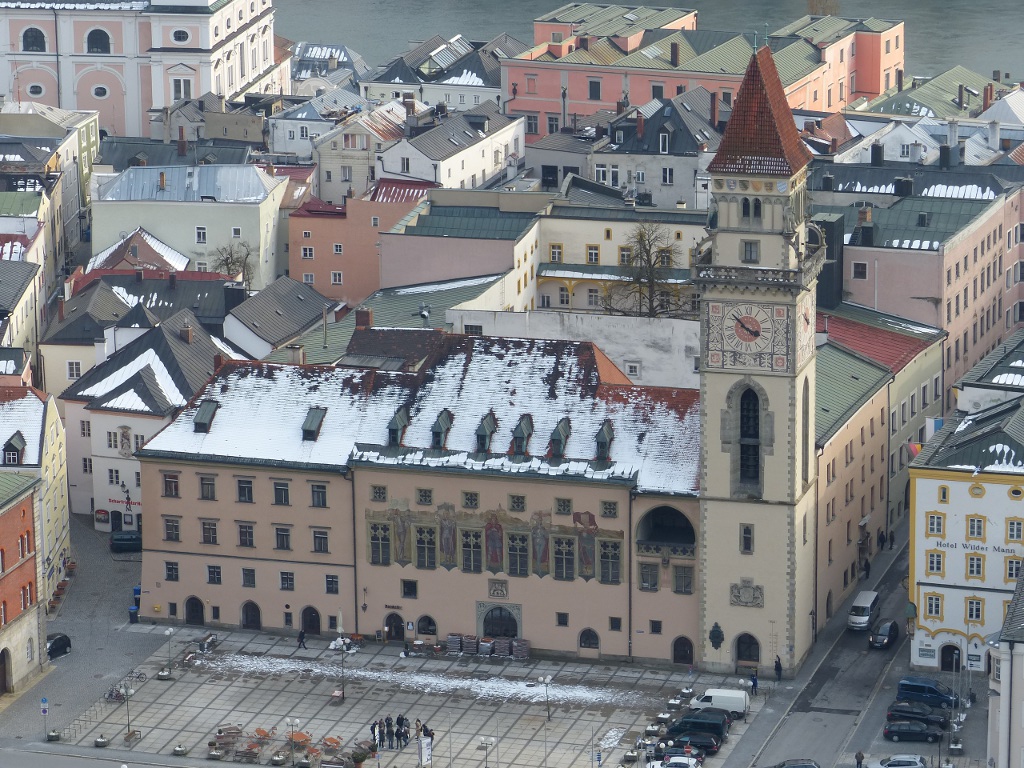
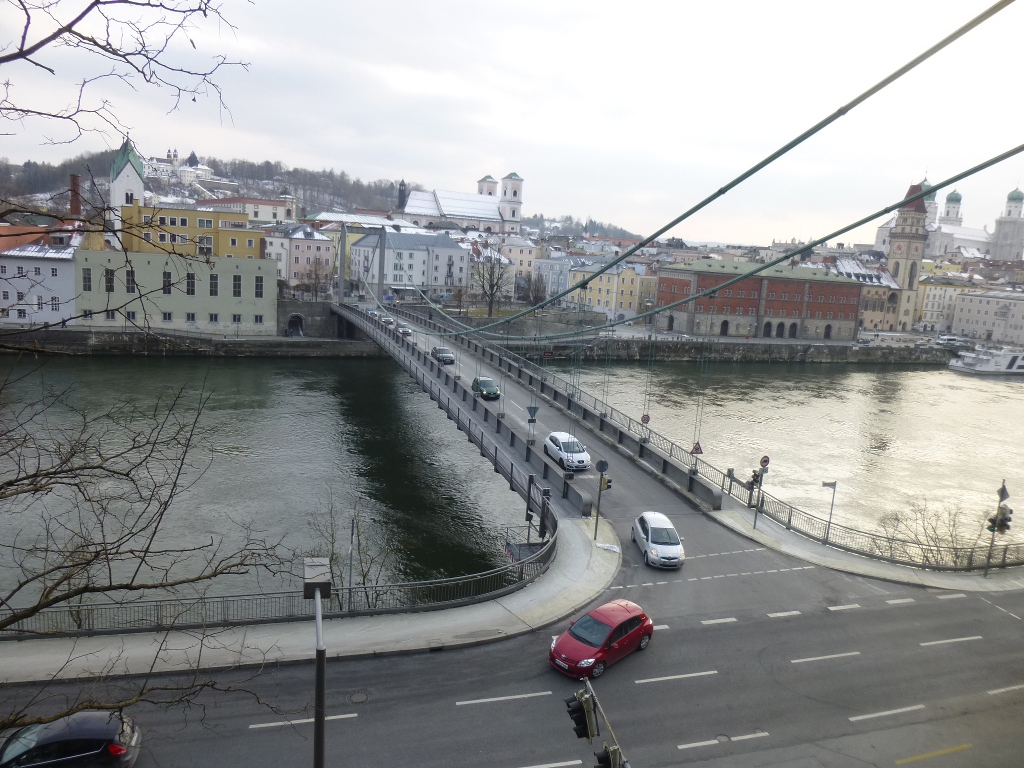
At
left, below, is a picture of the Town Hall that Katie took from our
viewpoint. You can also see it (smaller) in the
front
of my panorama, behind the first ship on the left. The
shuttle bus that brought us up here stops
right in front of the Town Hall. The main part of it was
built between 1298 and 1408 and it somehow escaped damage in the fire.
The tower at the right was added in 1893. We hiked
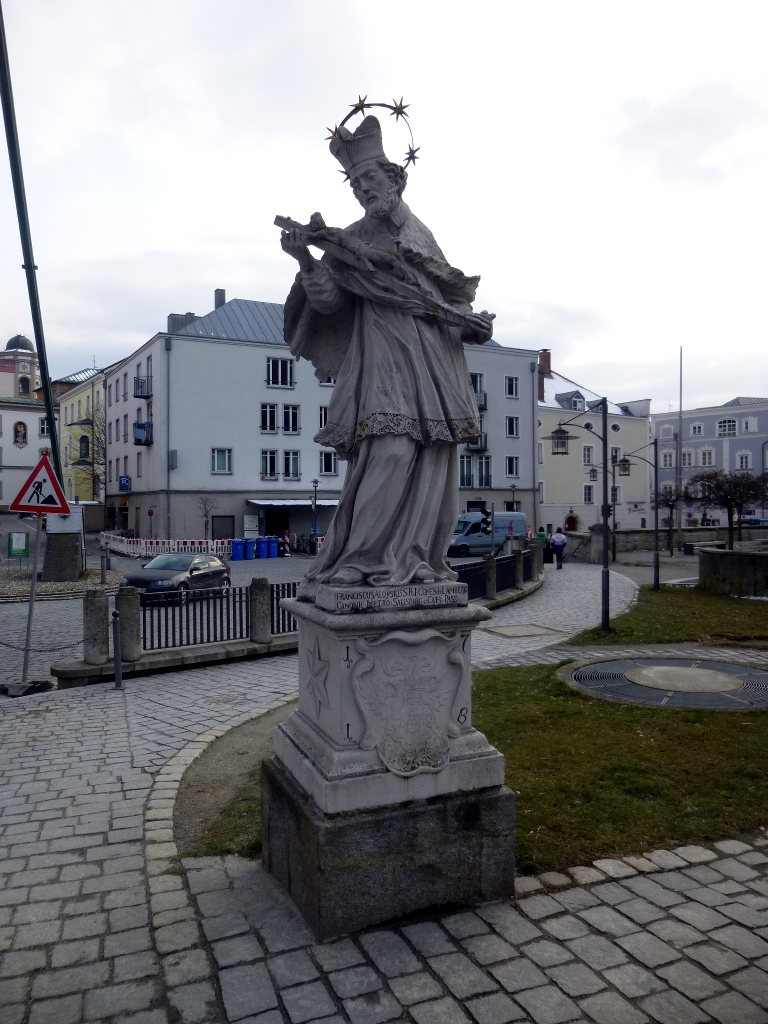
back down a switchback trail and ended up going down a staircase that
took us to the suspension bridge over the Danube
(center picture). At the end of the bridge is the
statue pictured at the right - St. Nepomuk, the patron saint of
bridges.
We
walked through the
shopping area of town
briefly but we were getting tired and cold. We got
back to the ship shortly after 5 PM so still had plenty of time before
we cast off at 6:00 PM heading for Austria. We
had
supper tonight with a group of 6 Cuban-Americans who have
been friends and vacationed together for 30+ years. One is a
cardiologist, one is a teacher, another an
engineer - so many interesting people on this ship! The other day we
had dinner with
a woman who runs a
hunting lodge in Kansas,
of all places! She says people
come from all over the country for their deer season. The
things we learned!
After supper we again enjoyed sitting in the dark cabin
with the curtains
open, watching the world go by. We will wake up in Austria so
that's a new page!