|
[This part of the Trip Log begins
when we flew into San José, joined a Road Scholar Trip and spent time
in the city then in the cloud forest around Sarapiquí. The rest of the
trip will be divided into 2 more sections - Parts 2 and 3.
You can enlarge any picture in this narrative by
clicking on it - it
will open in a separate window and in many cases, show detail you can't
see in the smaller version. (Click on the back arrow to return to
the text.) Many more pictures can be found here.]
Thursday Jan 16 We drove up to Minneapolis this afternoon; Dave kindly offered to babysit the car so we left the car in his driveway and then we three went out to supper at the Pinstripes restaurant. We had never been there before, but it was near our overnight hotel and it was a good pick! We spent the night at La Quinta Inn in Bloomington. It's tricky to get to unless you've been there before (Dave researched it so knew where he was going) but it's a nice place and they shuttled us to the airport in the morning. Due to a couple of odd occurrences (some chaos and paperwork around a drunken passenger with a young child and a dog who had to be removed from the plane; then the battery died in the "tug" that pushes us out of the gate...), we didn't get to the Balmoral Hotel until close to midnight - but our taxi driver knew exactly where to take us; he called and got someone to come open the "motor lobby" (the hotel is located on a pedestrian boulevard so it is rather tricky to drive to) and the attendant welcomed us and got us checked in. Friday Jan 17 We slept well, had the free breakfast at the hotel restaurant (El Patio) and then set off for the National Museum (photo below left shows the sculptures of the José Figuéres Ferrer monument in the Plaza de la Democracia adjacent to the museum). 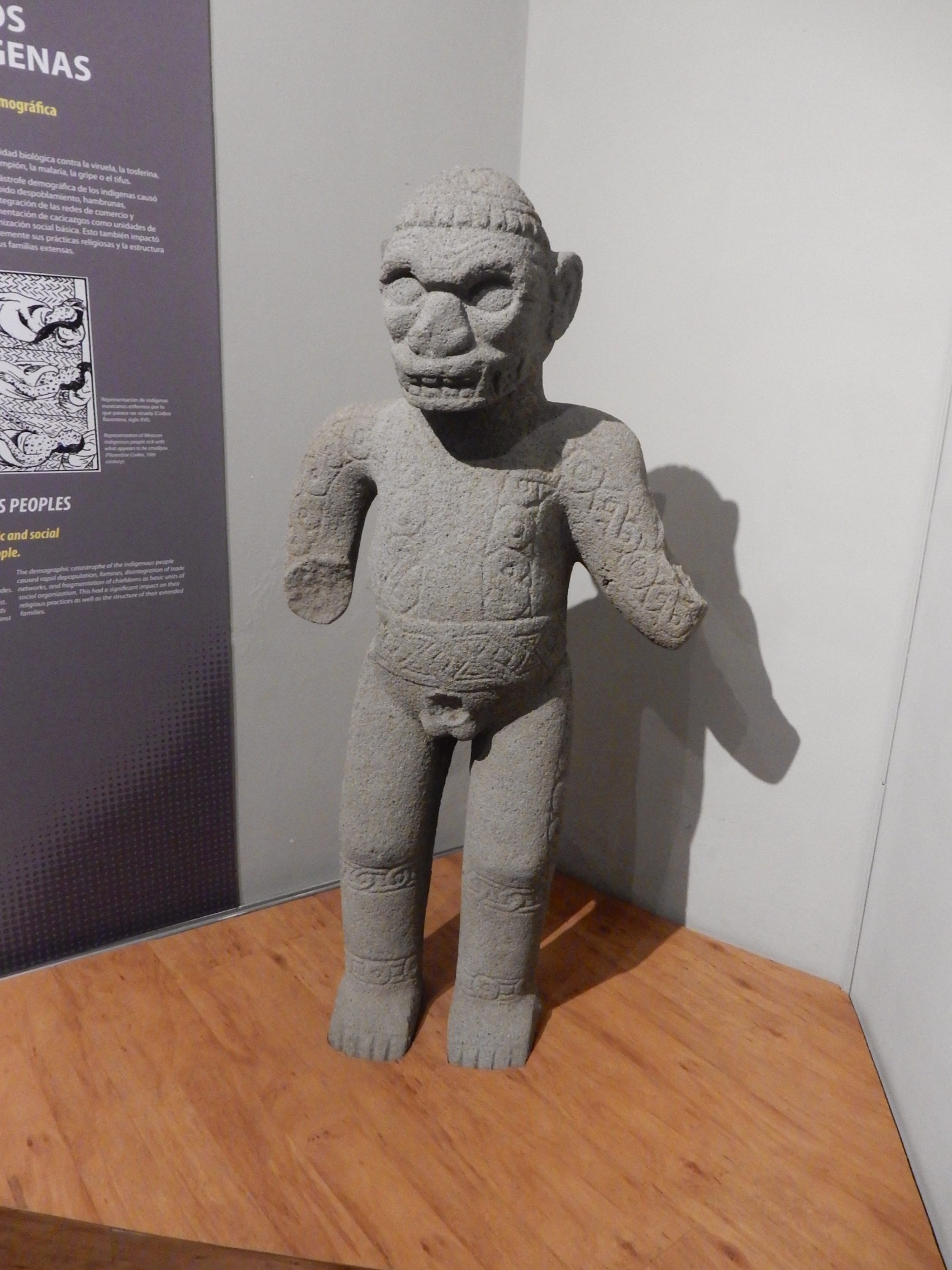 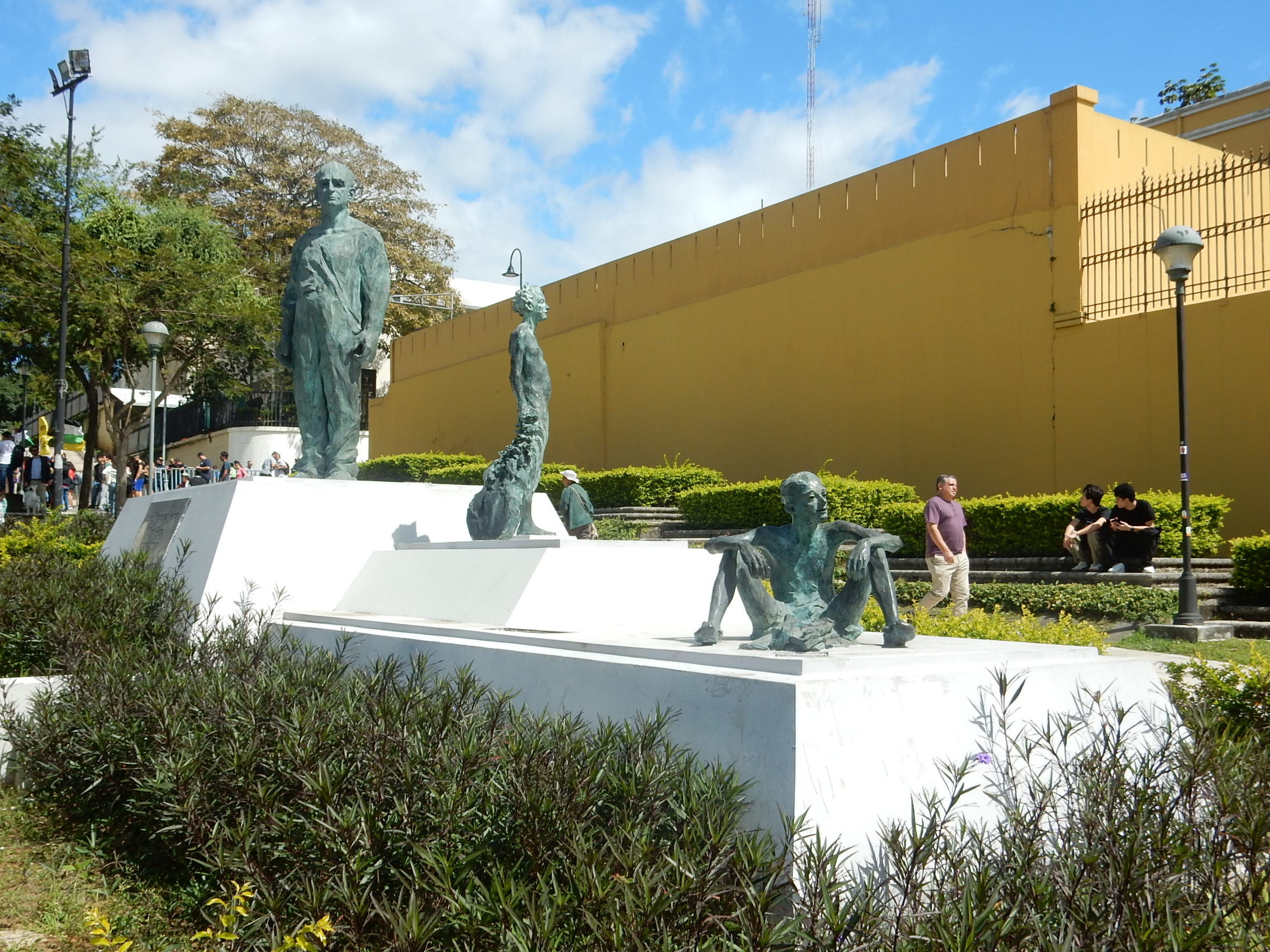 The
admission was $11 each which was fair. As you enter, you walk
through a butterfly garden which was somewhat disappointing - lots of
lovely tropical plants but very few butterflies. We went through
the old dungeons,
walked through the "history" of the country and enjoyed the interior
gardens as well. At the right is one example of pre-Columbian art
- the displays are arranged mostly chronologically and the art is also
interspersed with the explanations of the historical and political
situations at each time period. There are lots more pictures in
the photos
only section if you want to see more. The
admission was $11 each which was fair. As you enter, you walk
through a butterfly garden which was somewhat disappointing - lots of
lovely tropical plants but very few butterflies. We went through
the old dungeons,
walked through the "history" of the country and enjoyed the interior
gardens as well. At the right is one example of pre-Columbian art
- the displays are arranged mostly chronologically and the art is also
interspersed with the explanations of the historical and political
situations at each time period. There are lots more pictures in
the photos
only section if you want to see more.  We had lunch at Nuestra Tierra
- it was recommended and apparently caters to tourists. The food
was very good and shortly after it arrived, a photographer showed up,
plunked hats on our heads and took a picture! So we have a
souvenir photo (it was scanned and lost some resolution). There
was also a Costa Rican version of a "jug band" that played - they were
actually quite good and not so loud as to be intrusive. We had lunch at Nuestra Tierra
- it was recommended and apparently caters to tourists. The food
was very good and shortly after it arrived, a photographer showed up,
plunked hats on our heads and took a picture! So we have a
souvenir photo (it was scanned and lost some resolution). There
was also a Costa Rican version of a "jug band" that played - they were
actually quite good and not so loud as to be intrusive. 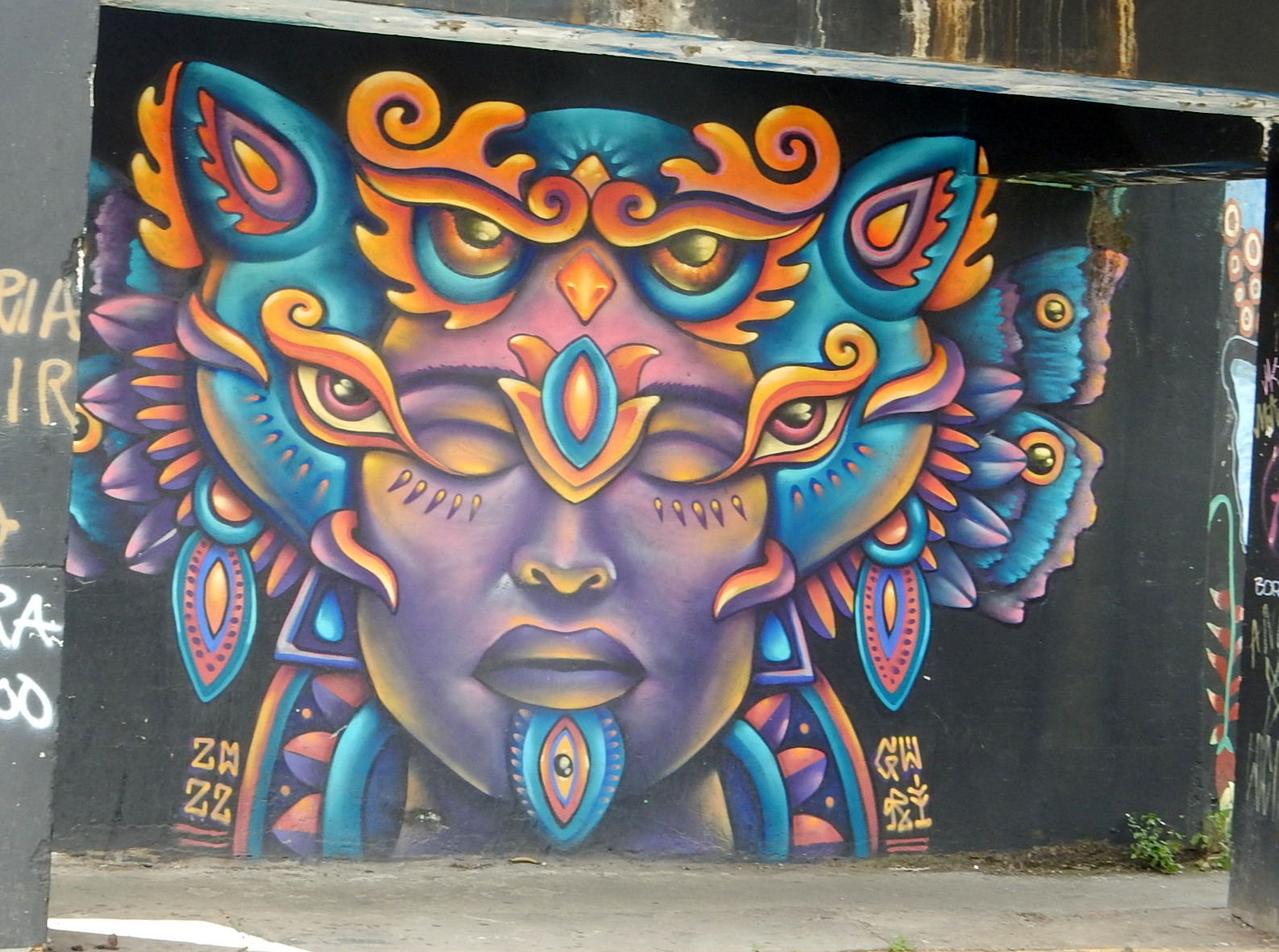 Some
of the tunes were familiar so, of course, John had to go sing with them
for a bit. Some
of the tunes were familiar so, of course, John had to go sing with them
for a bit.On the way back to the hotel, we walked by some street art (one sample at the right). After a short rest, we set out again - this time heading west along the pedestrian boulevard to the National Bank that does not charge for ATM withdrawals. This is correct - a great deal since we have a card that also doesn't charge for out of network activities so we got a very good exchange rate for colones. I'm glad we only got $100 worth - we actually spent the balance at the grocery store the day before we came home! Pretty much everywhere either took credit cards (we have several that don't add an international currency charge) or US dollars. 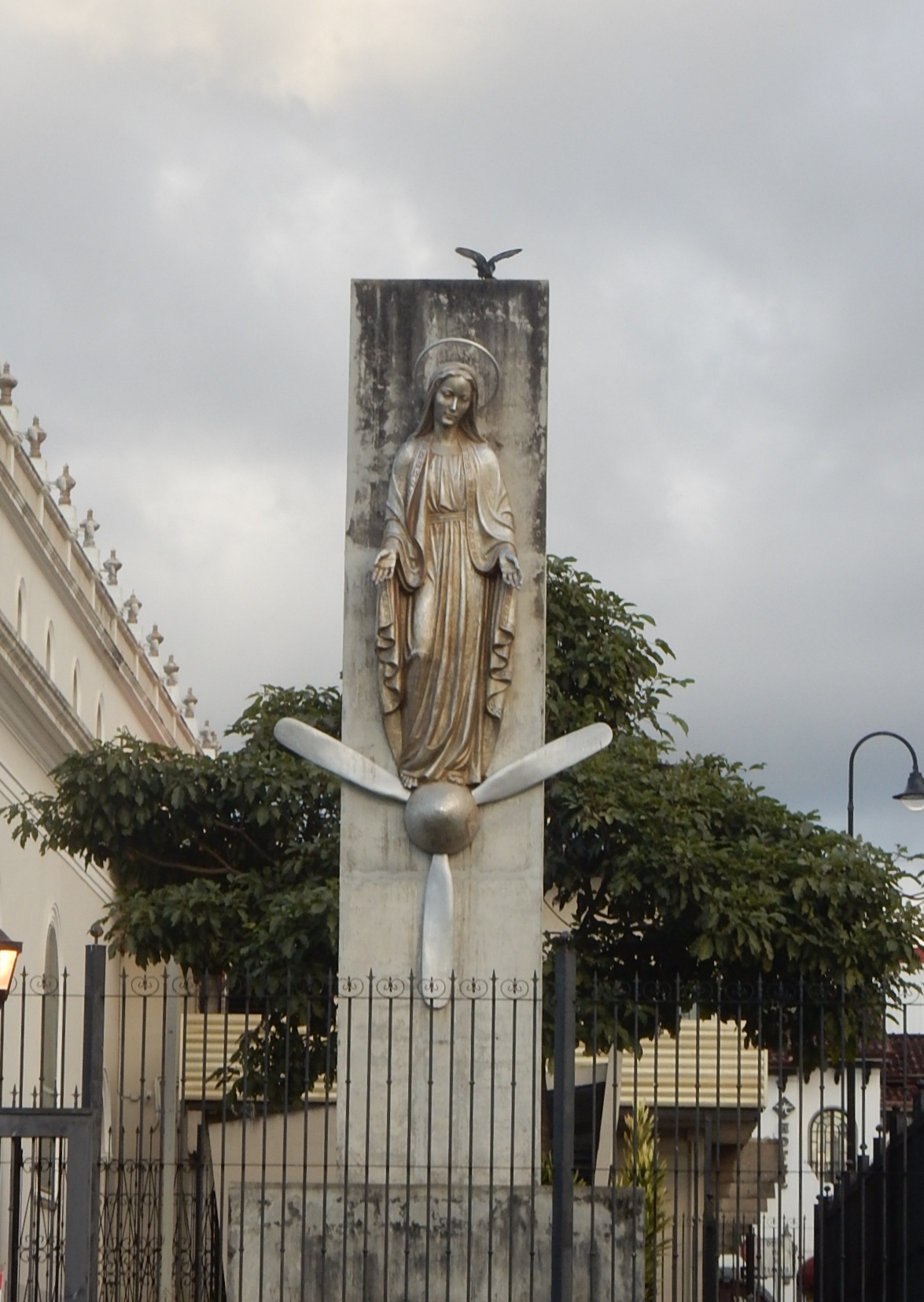 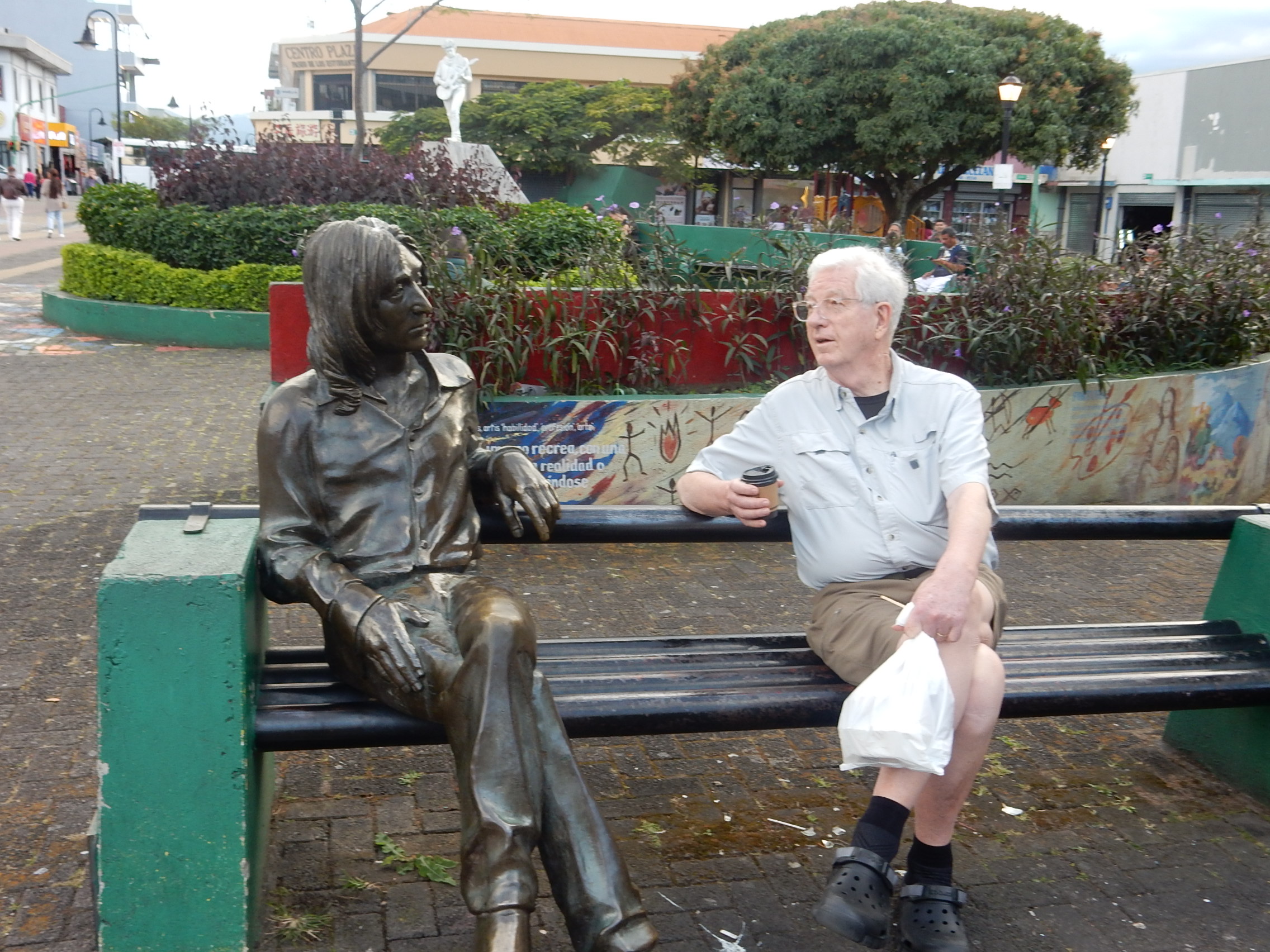 Our
last destination for the day was the Plaza
de las Artes. We were mostly seeking the John Lennon statue
(John, at right, in conversation with him) but there were several other
music-related sculptures as well. Across the street is the
Iglesia del Soledad (Church of Solitude) that has a statue worthy of
note (see left). I asked many people about it and dug into Google
to try
to find its story and, while most were aware of it, and one
even said they thought it had something to do with President Kennedy,
nobody could give me the scoop! Finally, after we were home, I
found the story. It was in Our Lady of the Skies Chapel at JFK
airport. During a remodelling in 2016, its owner, the Diocese of
Brooklyn, was told it had to be removed, so they donated it to the
Iglesia del Soledad in San José! One still wonders how this
location was selected - but at least I now know where it came
from! We had supper at El Patio at the hotel, which was
convenient, reasonably priced and had good food. Our
last destination for the day was the Plaza
de las Artes. We were mostly seeking the John Lennon statue
(John, at right, in conversation with him) but there were several other
music-related sculptures as well. Across the street is the
Iglesia del Soledad (Church of Solitude) that has a statue worthy of
note (see left). I asked many people about it and dug into Google
to try
to find its story and, while most were aware of it, and one
even said they thought it had something to do with President Kennedy,
nobody could give me the scoop! Finally, after we were home, I
found the story. It was in Our Lady of the Skies Chapel at JFK
airport. During a remodelling in 2016, its owner, the Diocese of
Brooklyn, was told it had to be removed, so they donated it to the
Iglesia del Soledad in San José! One still wonders how this
location was selected - but at least I now know where it came
from! We had supper at El Patio at the hotel, which was
convenient, reasonably priced and had good food.Saturday Jan 18 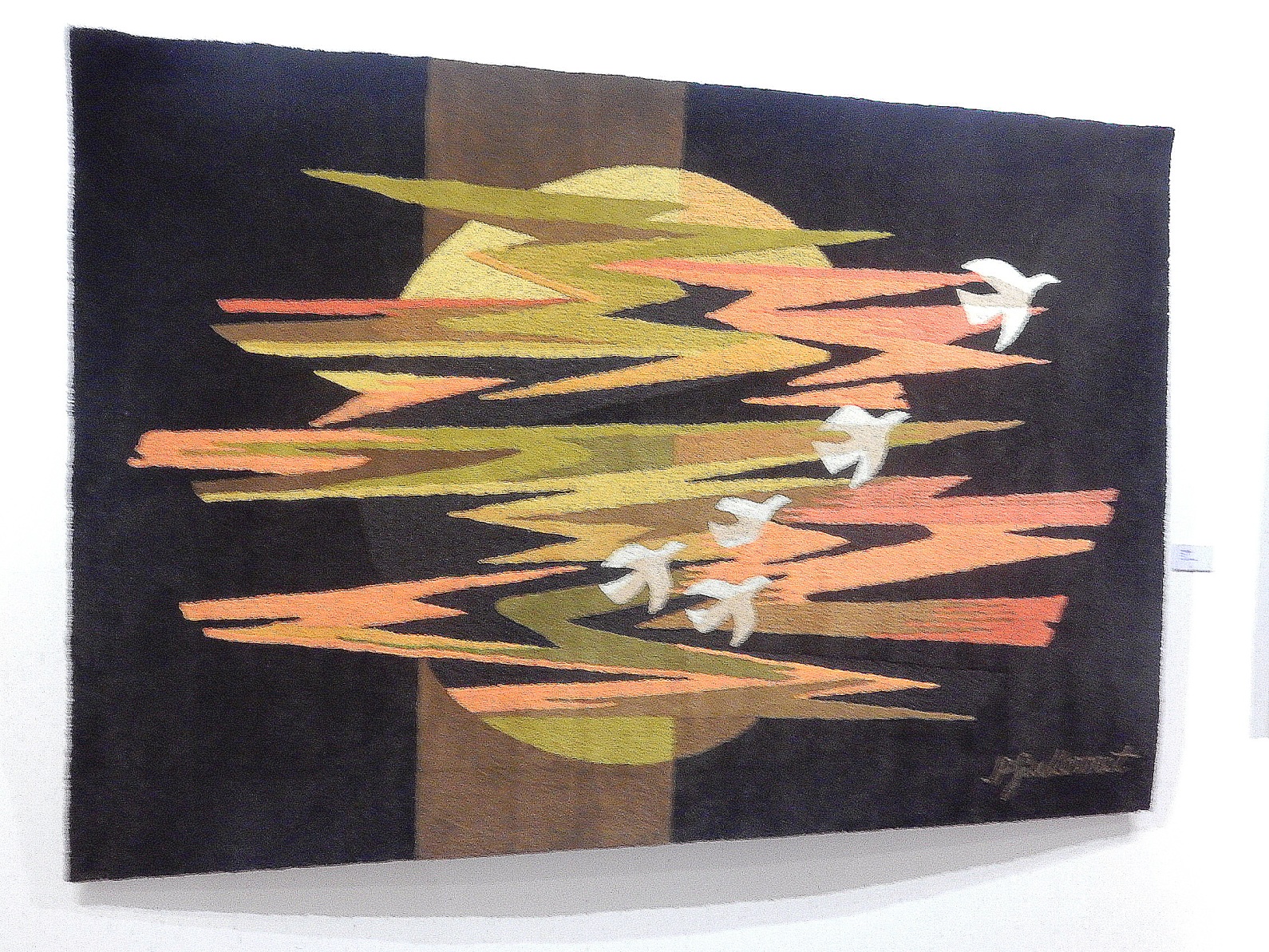 After
breakfast, we walked to the nearest pharmacy to pick up one of the few
drugs we didn't bring with us, then grabbed an Uber to the Museo de Arte
Costarricense. It could be construed as walking
distance (just over 2 miles) but parts
of it go through a "not so good" part of town and it was very hot, so I
had no regrets about paying the few dollars for Uber. This museum
is totally free, but there is no English translation of anything so
there are pros and cons! After
breakfast, we walked to the nearest pharmacy to pick up one of the few
drugs we didn't bring with us, then grabbed an Uber to the Museo de Arte
Costarricense. It could be construed as walking
distance (just over 2 miles) but parts
of it go through a "not so good" part of town and it was very hot, so I
had no regrets about paying the few dollars for Uber. This museum
is totally free, but there is no English translation of anything so
there are pros and cons!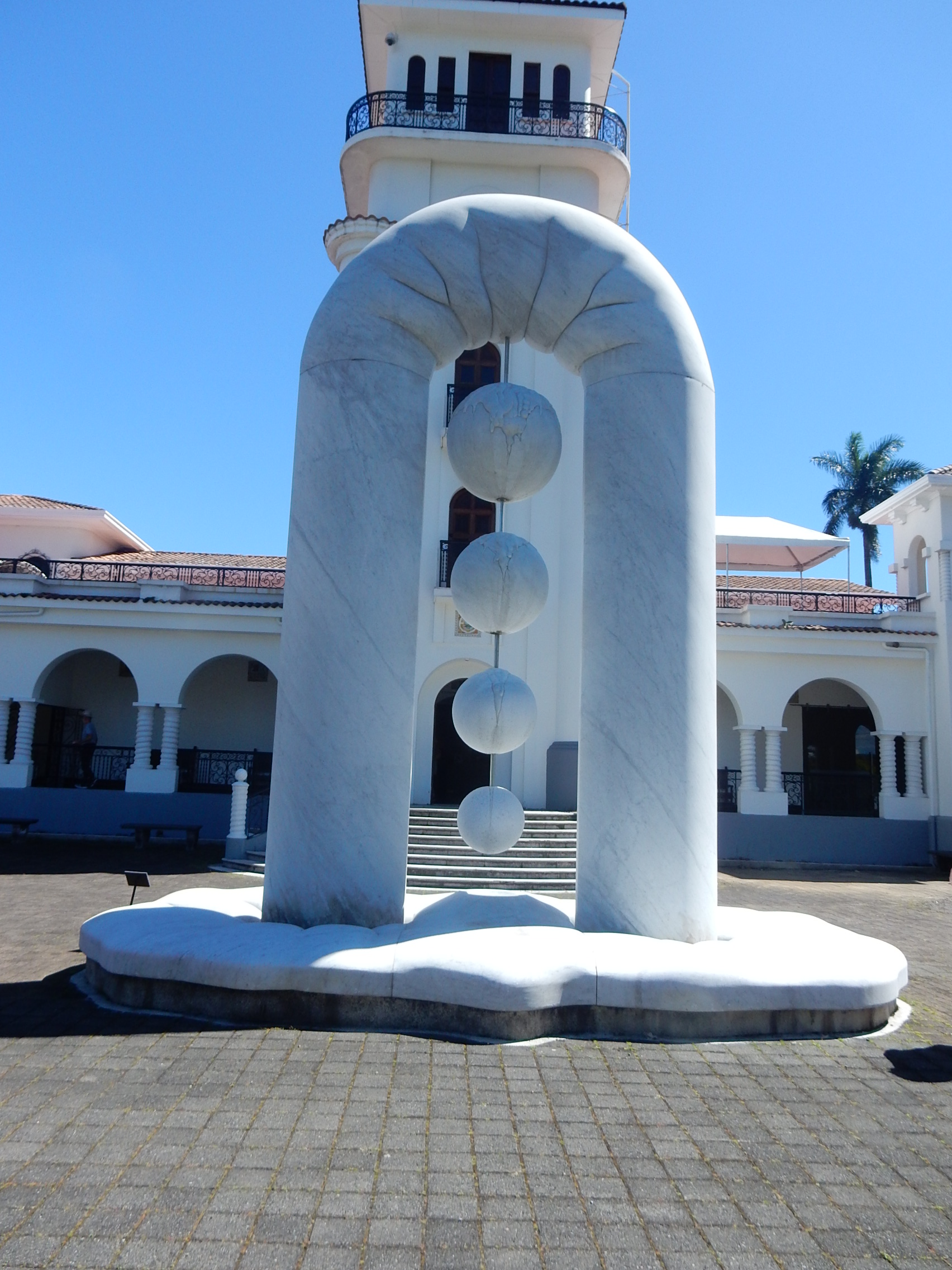 It is the site of the first
airport
(inaugurated April 1940). It continued in use for small private
planes until the early 1970's and was inaugurated as a museum in
1978. The
museum is housed in the original building and what used to be the
control tower and the former acres of
runways are now Sabana Park - a large city park that, on a Saturday,
was full of vendors and families having fun. My favorite of the tapestries is
at the right above ("Pura Vida") but I think we enjoyed the
outdoor sculpture garden more than the works inside. It is the site of the first
airport
(inaugurated April 1940). It continued in use for small private
planes until the early 1970's and was inaugurated as a museum in
1978. The
museum is housed in the original building and what used to be the
control tower and the former acres of
runways are now Sabana Park - a large city park that, on a Saturday,
was full of vendors and families having fun. My favorite of the tapestries is
at the right above ("Pura Vida") but I think we enjoyed the
outdoor sculpture garden more than the works inside.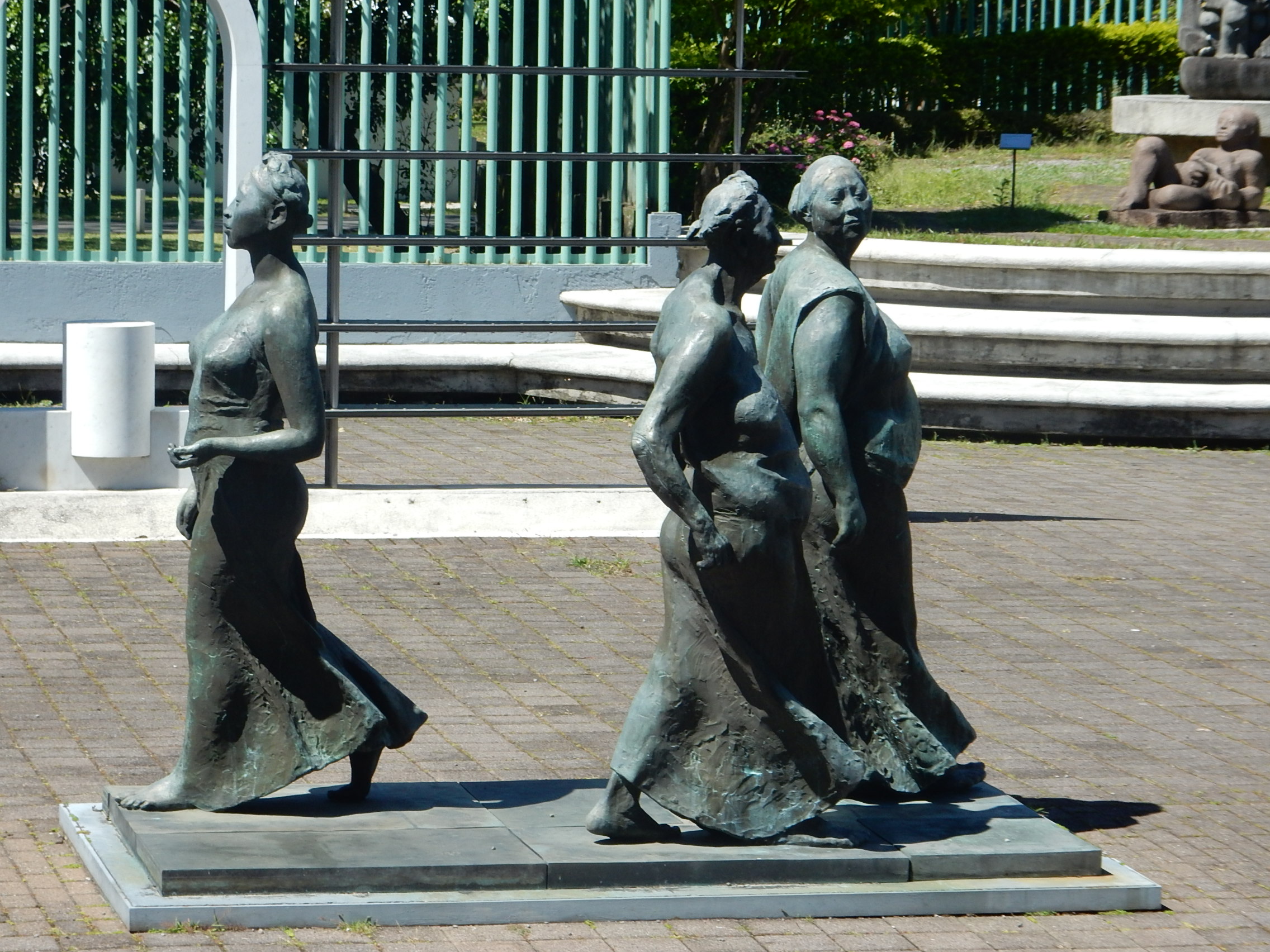 At left is "Cosmic Image" by Jorge
Jiménez Deridia; to the lower right is a
sculpture by Francisco Zúñiga "Three Women Walking" - we
immediately felt like we knew at
least one of those women! At left is "Cosmic Image" by Jorge
Jiménez Deridia; to the lower right is a
sculpture by Francisco Zúñiga "Three Women Walking" - we
immediately felt like we knew at
least one of those women!We took an Uber back to the hotel and had lunch at the Gusta Pan - a panadería just across the pedestrian street from the hotel. We had gotten some good baked goods there yesterday so thought we'd try a meal today. It was great. Afternoon was rest time, then we had our first meeting with the Road Scholar group. Introductions, dinner at El Patio and then back to the room to pack up and get some sleep before leaving in the morning! Sunday Jan 19 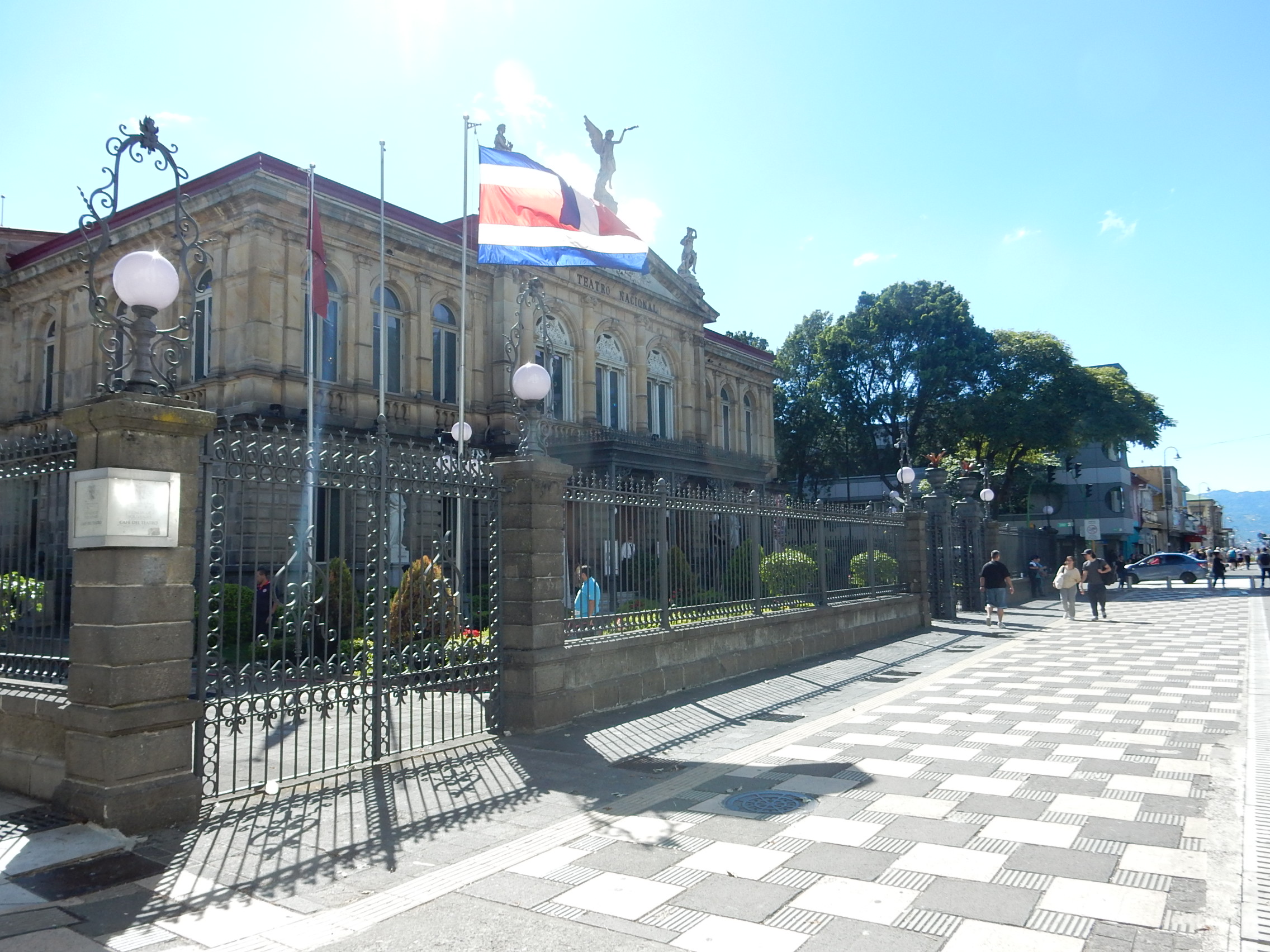 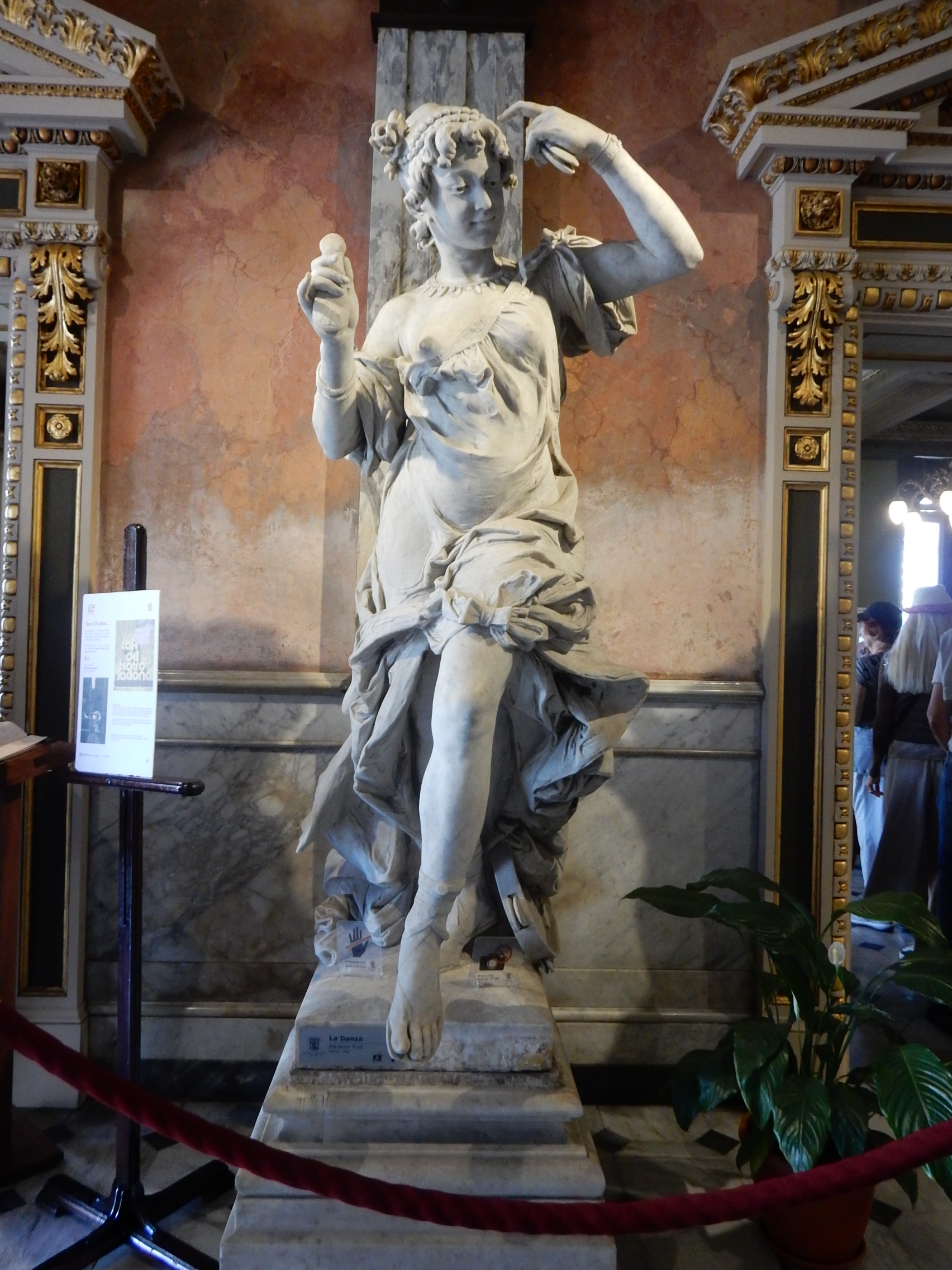 This morning
our luggage was picked up and loaded on the bus while we visited the National
Theater (left) and the Gold Museum, just a short walk from the
hotel. The National Theater could stand as an art museum; it was
opened in 1897, is a great example of neoclassical architecture and is
full of art! At the right is "Dance" by Pietro Bulgarelli, one of
the scuptures in the lobby. Also notice the ornate, gold
decoration around the doorways on either side. This morning
our luggage was picked up and loaded on the bus while we visited the National
Theater (left) and the Gold Museum, just a short walk from the
hotel. The National Theater could stand as an art museum; it was
opened in 1897, is a great example of neoclassical architecture and is
full of art! At the right is "Dance" by Pietro Bulgarelli, one of
the scuptures in the lobby. Also notice the ornate, gold
decoration around the doorways on either side.Below on the left is the parquet floor in the Foyer, a second floor ballroom. It is hand laid using all native Costa Rican wood. Now there are laws prohibiting harvest of many of these trees so it will remain unique. In the center is a ceiling painting "Allegory of Coffee and Bananas." Costa Rican currency includes copies of many works of art, flora and fauna of the country. This painting used to be on the 5 colone note but that small denomination has been discontinued and is now a coin (roughly one cent). At the right, you can see an actor (costumed on the left) who was giving us a tour of the building, and an actress (at the center in red) who came running in to exclaim that she just "fell out of that painting!" (Do you see her in the front, right, of the painting?) It was a very funny, as well as educational, sketch. Eventually he explained to her how to get up on the roof and lower herself back into the painting! 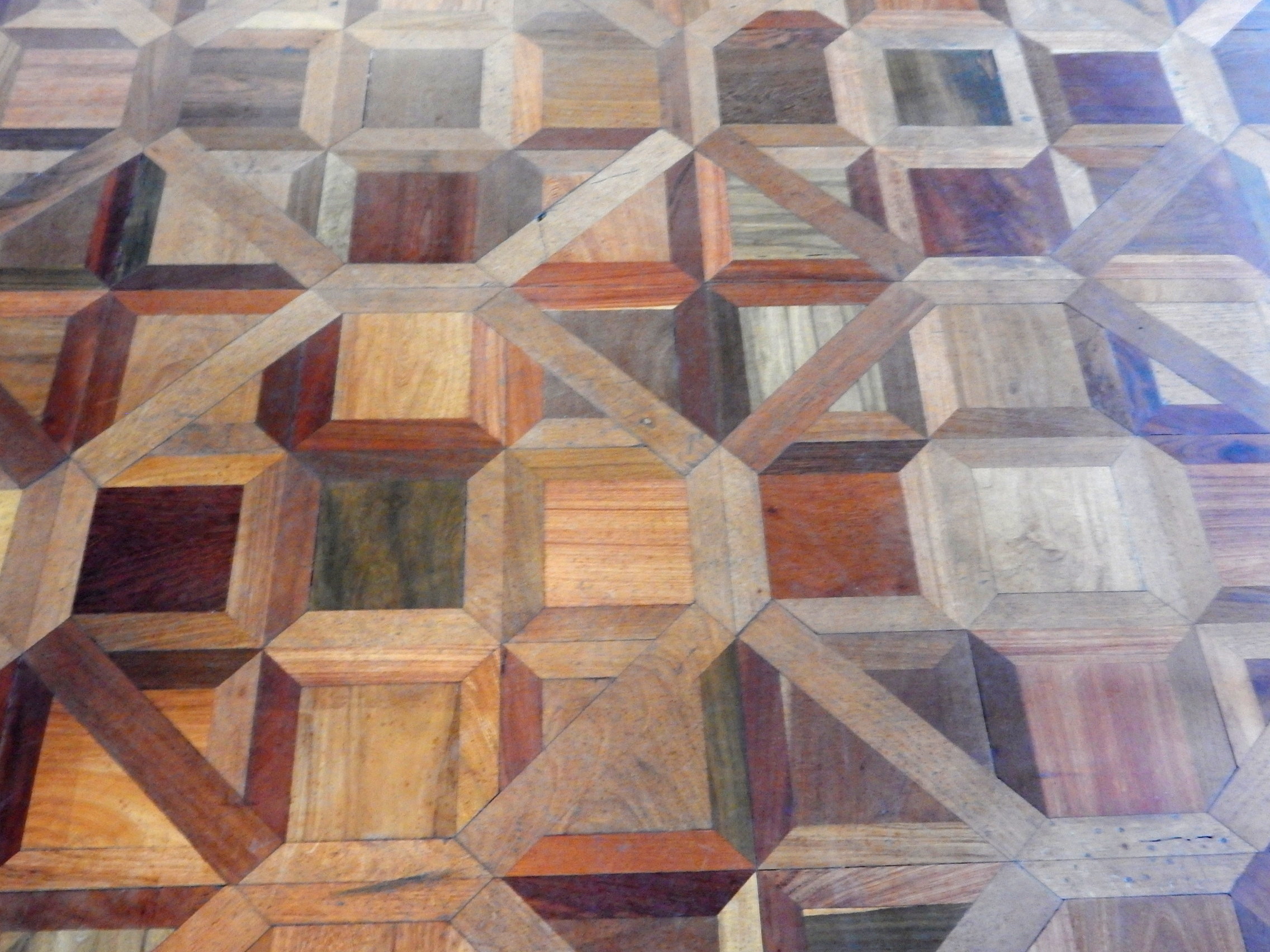 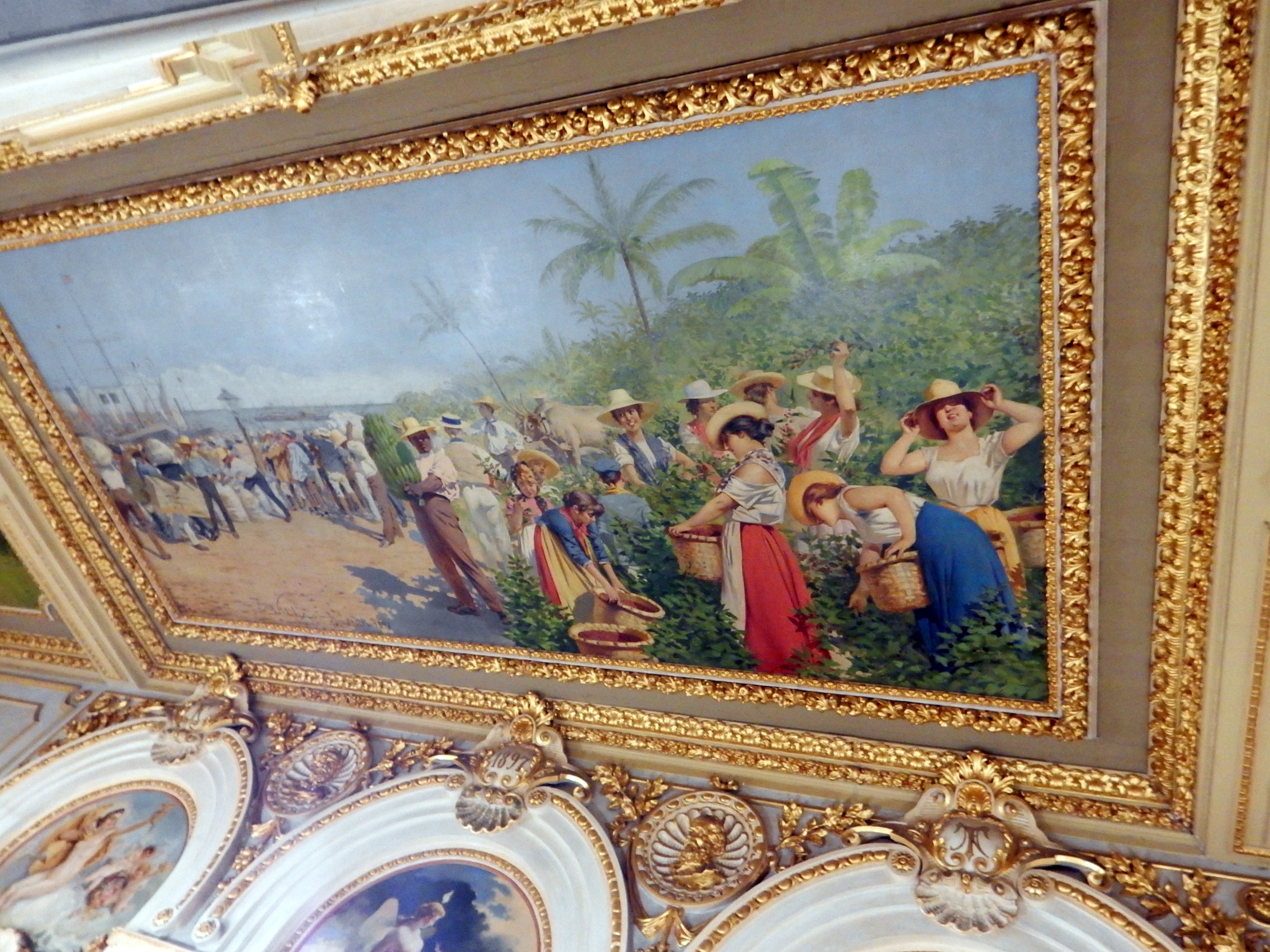 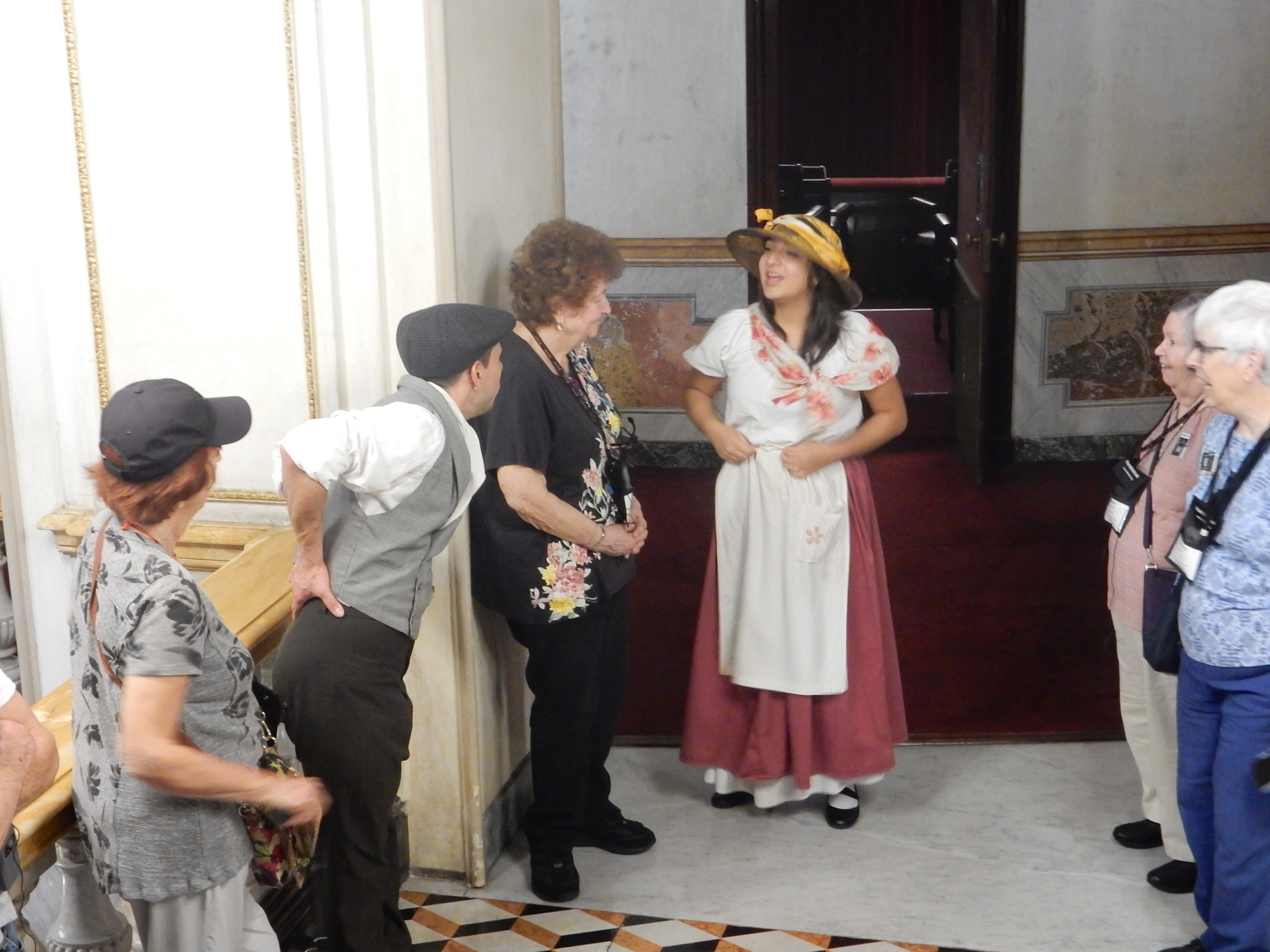  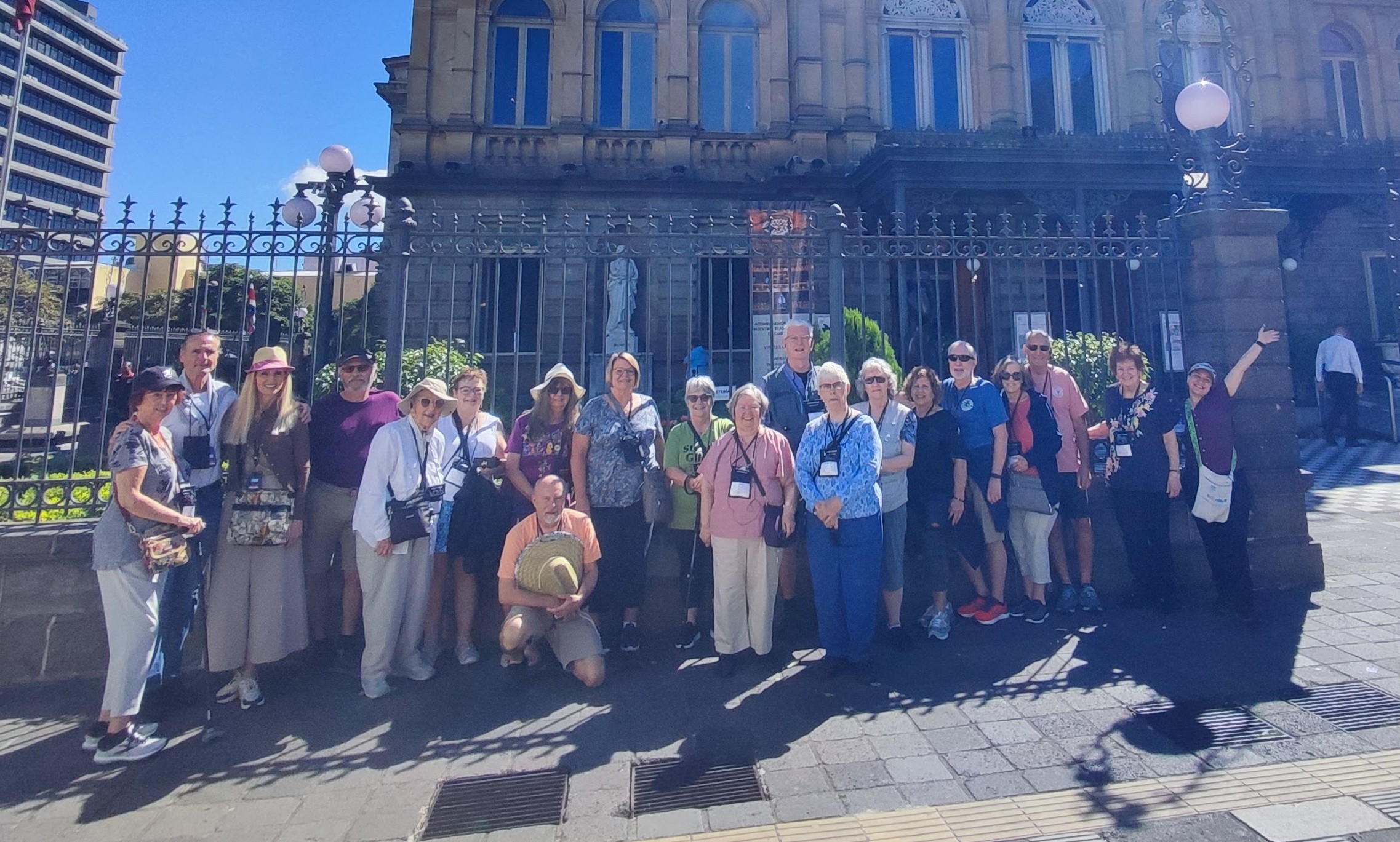 While we were in the theater, they kept talking about
the wonderful acoustics so John offered to go demonstrate!
He went down in front of the stage and gave us a couple lines from
"Some
Enchanted Evening" that earned a round of applause. (If you have
your sound on, I think you can get a 5 second excerpt by clicking on
the picture at the left - then use the "back" arrow to get back to this
page.) As we were leaving, our leaders gathered us for our first
group photo in front of the theater. While we were in the theater, they kept talking about
the wonderful acoustics so John offered to go demonstrate!
He went down in front of the stage and gave us a couple lines from
"Some
Enchanted Evening" that earned a round of applause. (If you have
your sound on, I think you can get a 5 second excerpt by clicking on
the picture at the left - then use the "back" arrow to get back to this
page.) As we were leaving, our leaders gathered us for our first
group photo in front of the theater. The Gold Museum is underground in the National Theater plaza so it was a short walk. We had one of the docents from the museum take us through and share a lot about the pre-Columbian history and culture. Near the entrance is a model of a pre-Columbian village (left, below). That helped give us some background for much of the cultural information we heard throughout the trip. As you'll see, at our next stop we stayed in a replica of one of the palenques for a few nights! Frogs and toads played a large role in the mythology of the time and so many of the artifacts found were gold images of those amphibians (center, below). And the last picture here is from the plaza looking north at the mountains - that's where we're heading next! 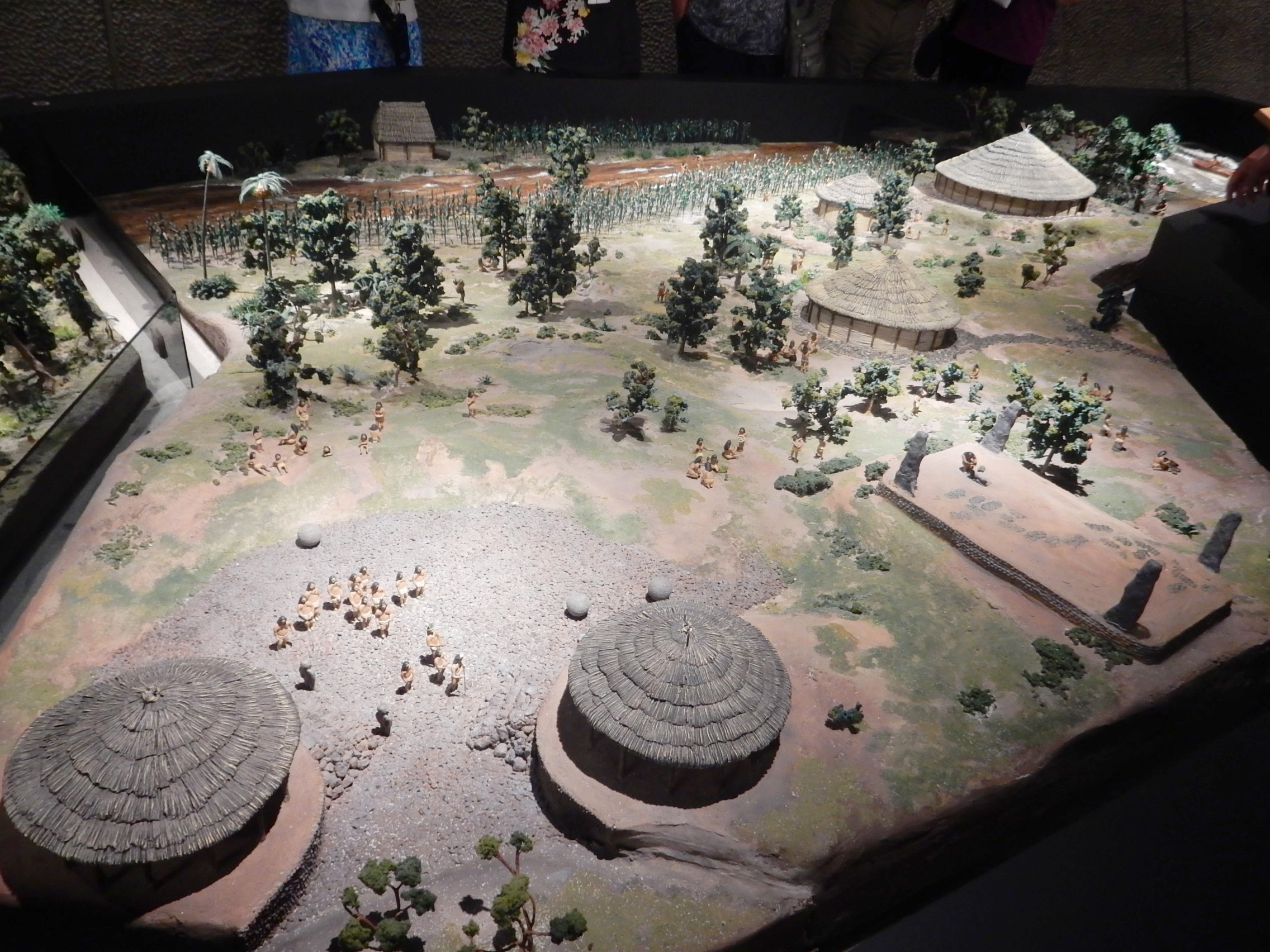 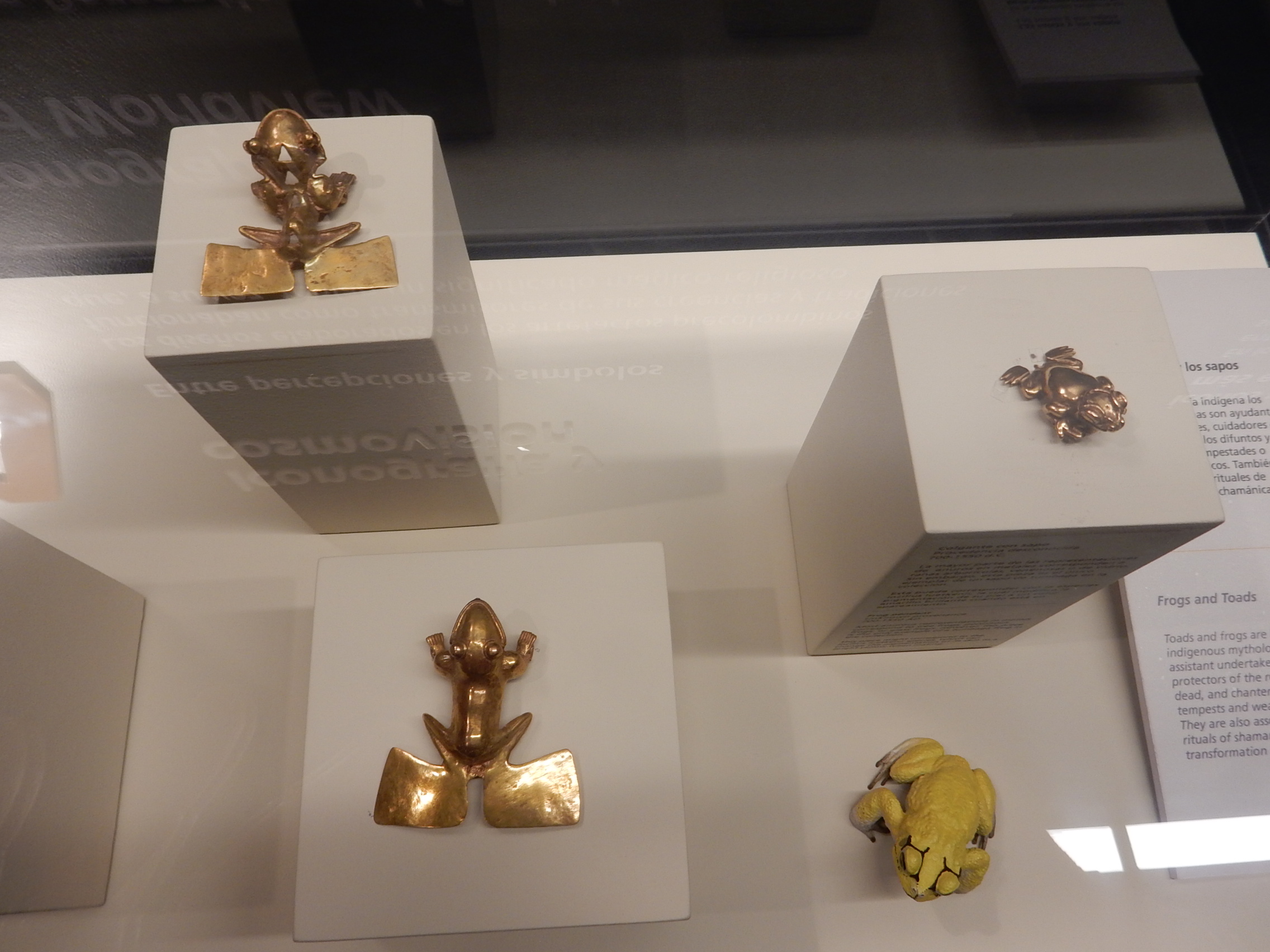 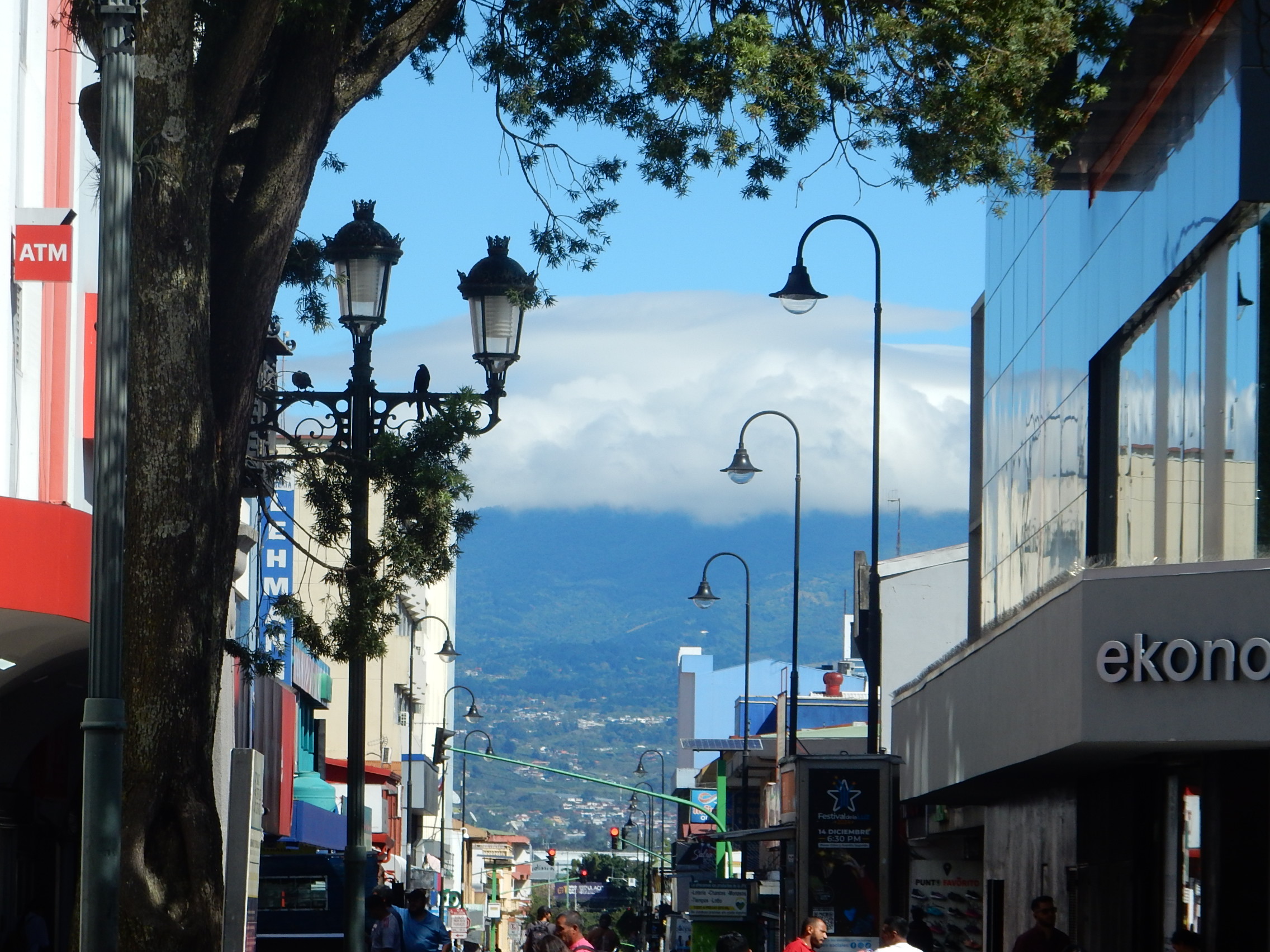 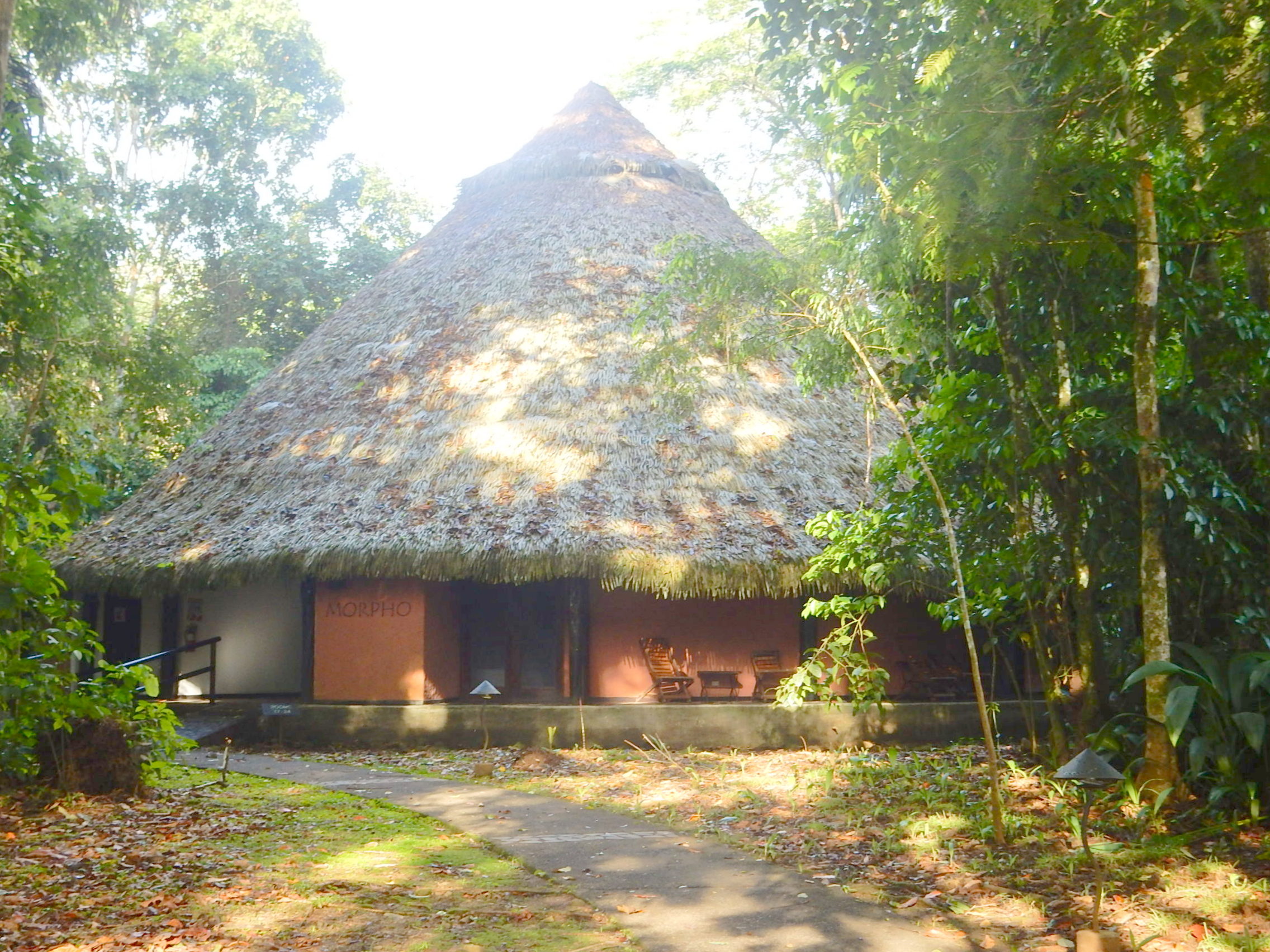 For the next
few nights we'll be at the Sarapiquí Rainforest Lodge.
We drove through cloud forest and transitional forest to get there -
there was, indeed, pretty much fog and clouds the whole way. The
Lodge
is fairly rustic, arranged in round palenques (picture at left - as we
saw in the model village in the Gold Museum) with a thatched roof of
palm leaves. I think there are 8 rooms in each residential
building (we were in the Morpho, shown here), and then other buildings
are used for
administration, dining, small museum, etc. Each room has an entrance
from the center interior and also a sliding door onto the circular
"porch" with outdoor seating. For the next
few nights we'll be at the Sarapiquí Rainforest Lodge.
We drove through cloud forest and transitional forest to get there -
there was, indeed, pretty much fog and clouds the whole way. The
Lodge
is fairly rustic, arranged in round palenques (picture at left - as we
saw in the model village in the Gold Museum) with a thatched roof of
palm leaves. I think there are 8 rooms in each residential
building (we were in the Morpho, shown here), and then other buildings
are used for
administration, dining, small museum, etc. Each room has an entrance
from the center interior and also a sliding door onto the circular
"porch" with outdoor seating.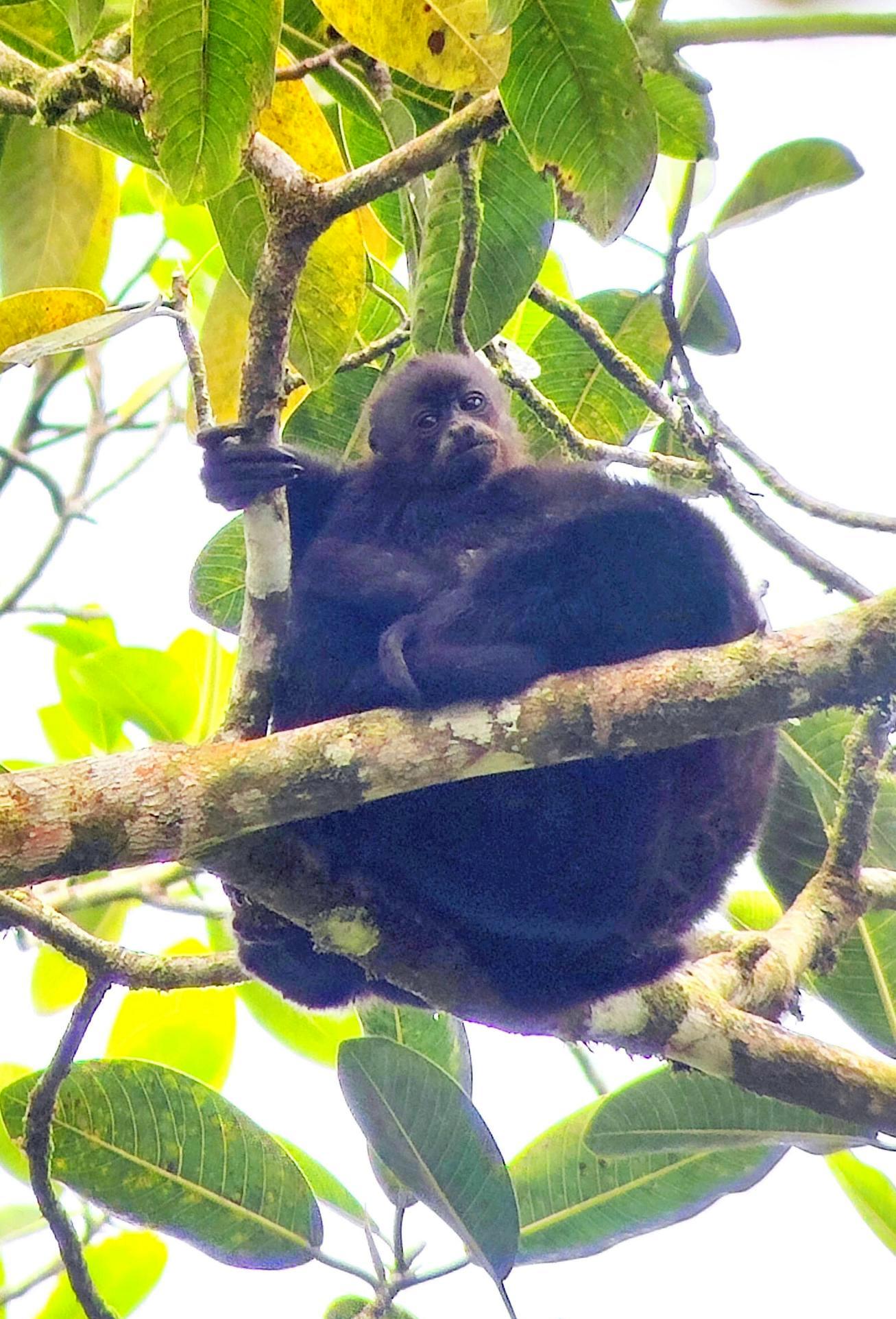 Monday, Jan 20 - Monday, Jan 20 - Before breakfast Liz (Lizeth Alfaro) and Rebeca (Rebeca Paniagua) offered an early nature walk for anyone who was interested. We actually didn't get too far because we saw a family of howler monkeys right outside of the lobby where we met and spent quite a bit of time watching and photographing them! (Mom and baby at the right.) Eventually we moved on and saw some birds - the clay colored thrush is the National bird of Costa Rica, allegedly because it's "everywhere" so it can belong to the whole country. We also saw a rufous tailed hummingbird, and a flycatcher but they were all too active to get pictures. (I did get some later this afternoon!) We saw and learned about the walking palm (picture at the left below, it uses its vertical "stilt roots" to avoid flooded areas, fungus or other diseases - very gradually it can actually change its location in very small increments) and the strangler fig. After breakfast, in the rain, we walked down to the archeological site where we learned more about the culture of the indigenous people: their lifestyles, burial customs (burial plots at the center below) and construction methods; we also saw more monkeys, several sloths (mother and child at the right below) and a cacao (aka chocolate) tree - we saw ripening pods as well as the seeds inside a pod that had opened). 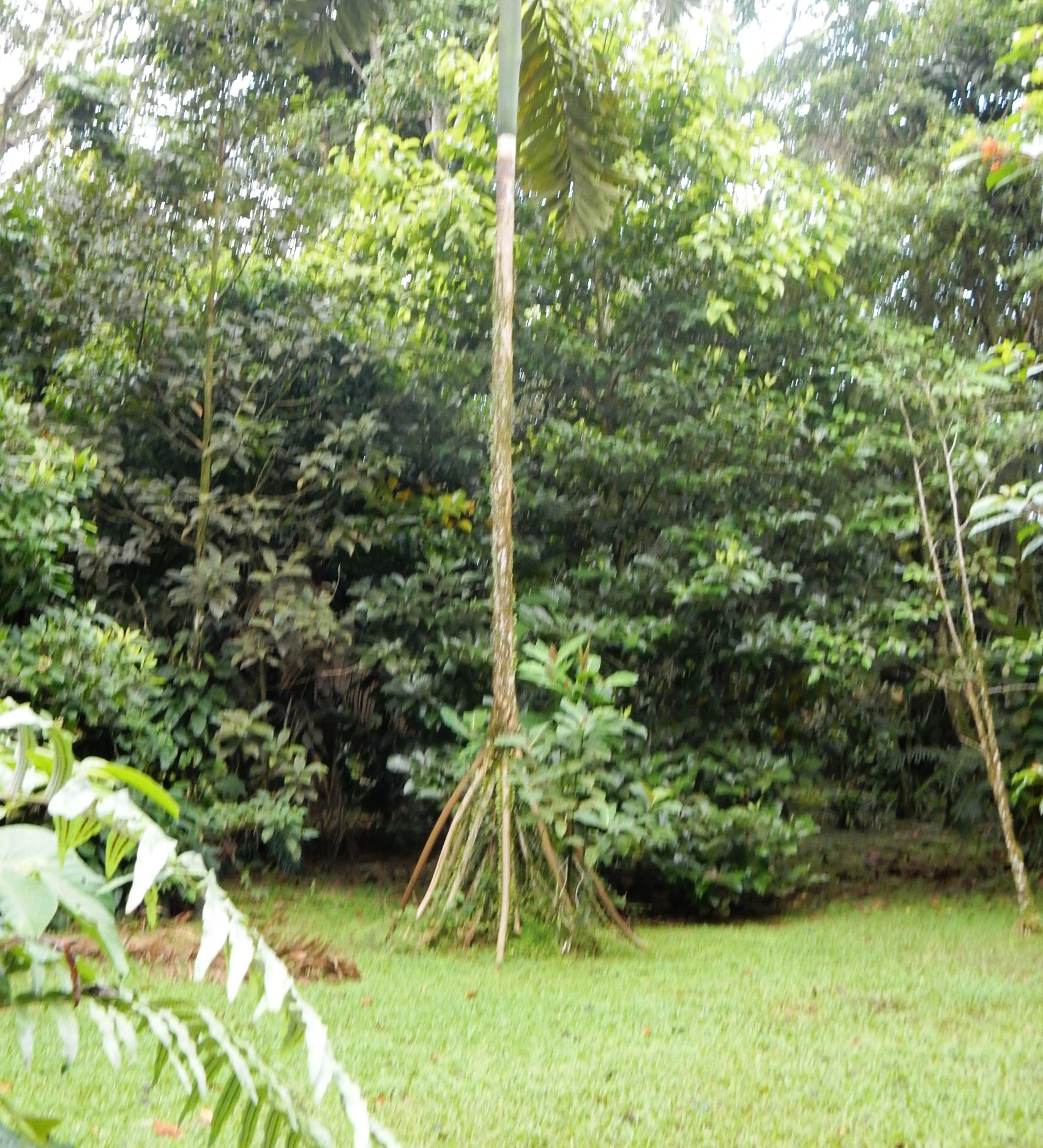 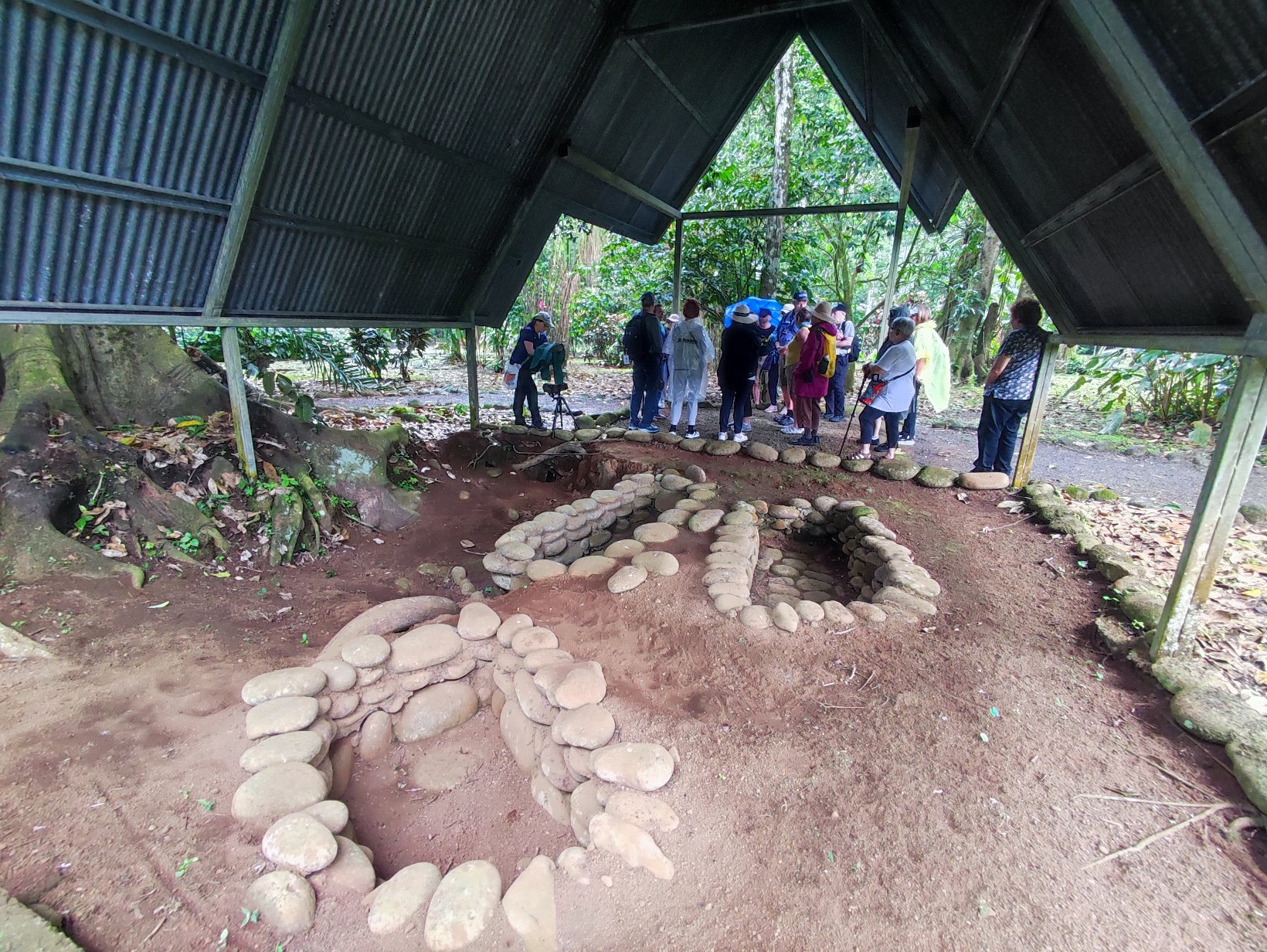 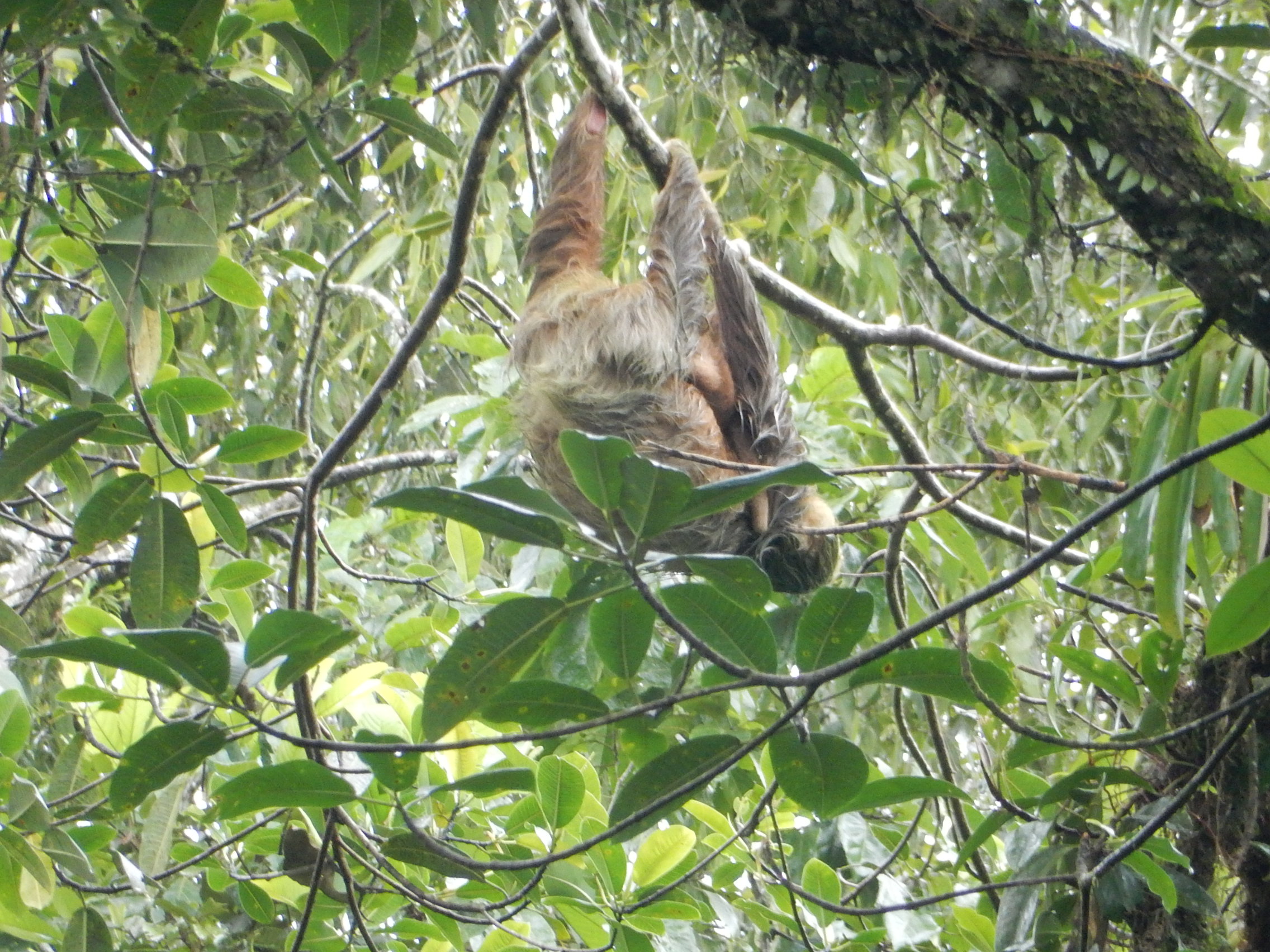 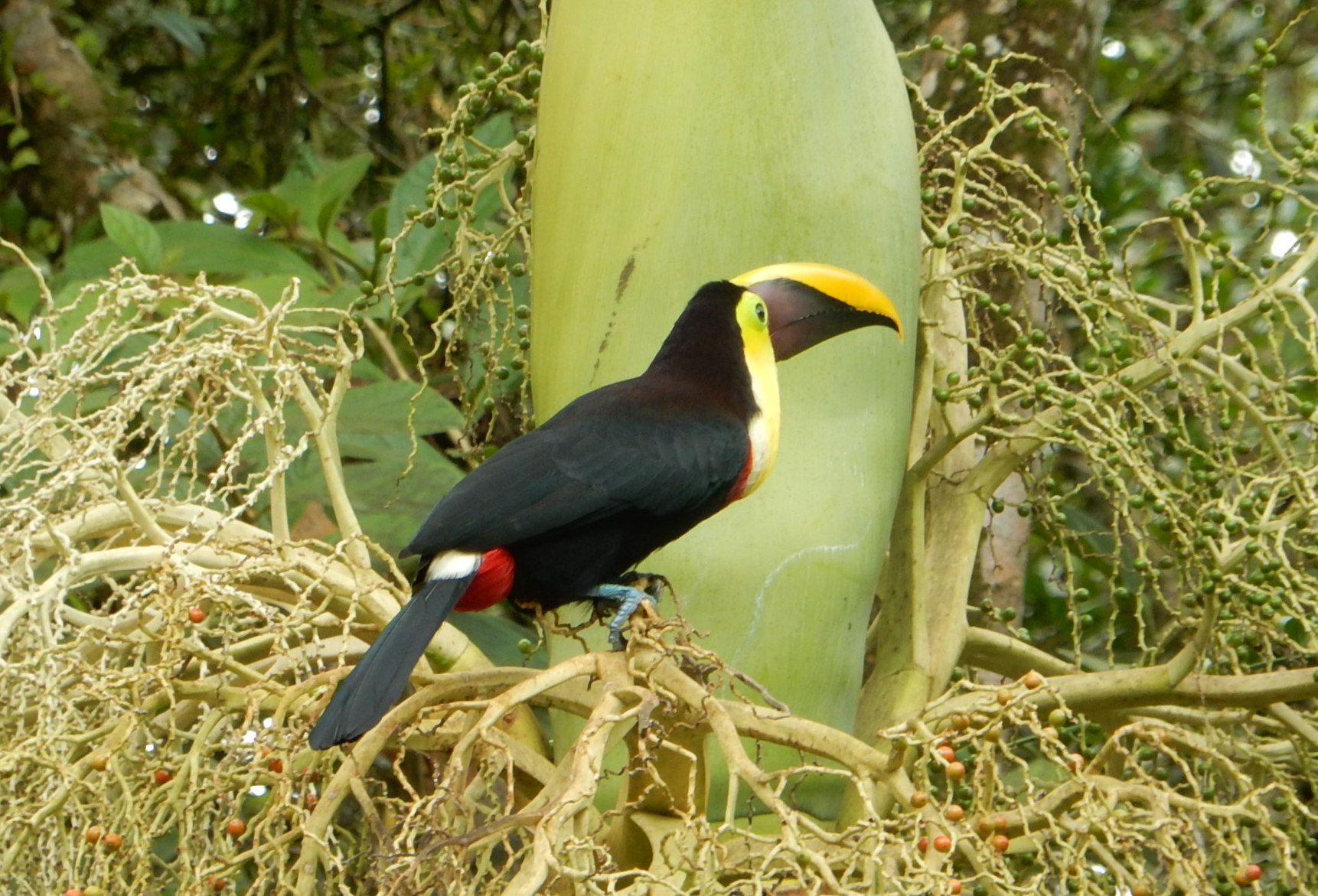 On
the way back to our room, I walked through the small botanical garden -
it was very well-kept and full of tropical plants, of course!
When we went up to the dining hall for lunch, a chestnut mandibled
toucan was having his lunch on a berry tree right in front of the
drive. On
the way back to our room, I walked through the small botanical garden -
it was very well-kept and full of tropical plants, of course!
When we went up to the dining hall for lunch, a chestnut mandibled
toucan was having his lunch on a berry tree right in front of the
drive. In the afternoon we took a field trip to a family-run organic farm. Their main crop is pepper - we learned that black pepper and white pepper come from the same plant - the 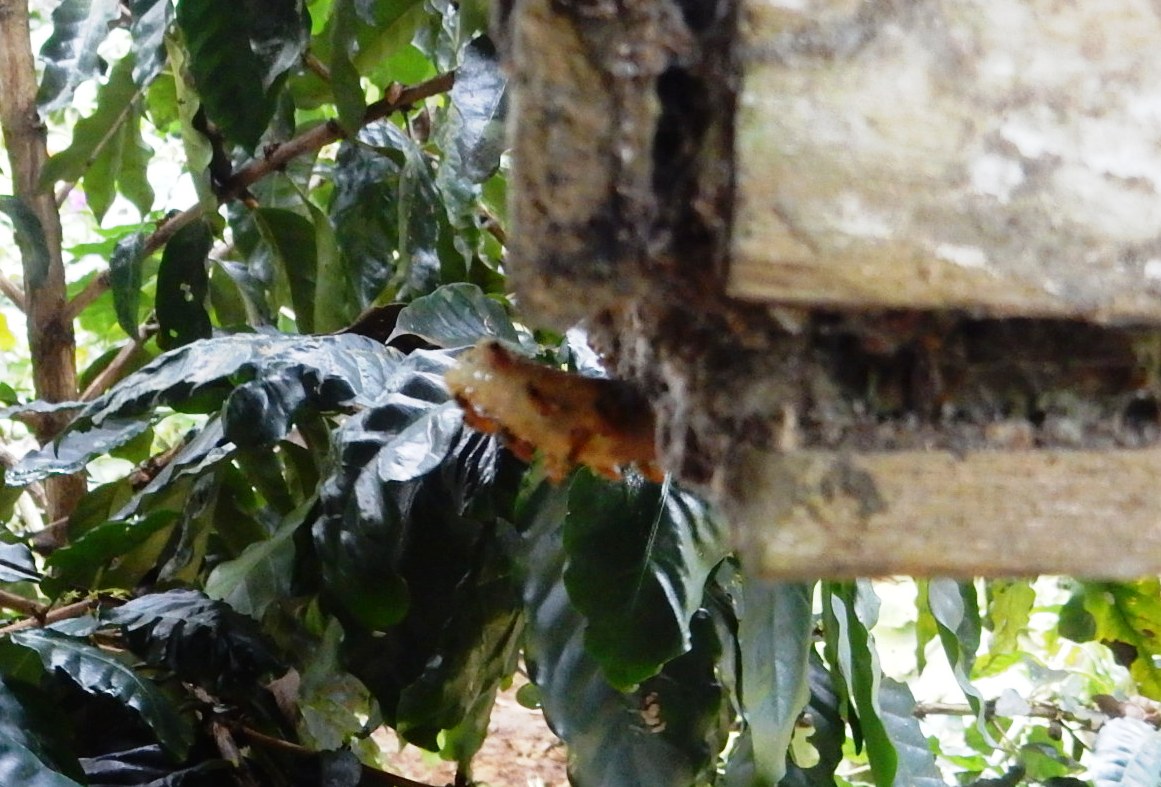 difference
is in the preparation. The berries are soaked for about a week to
create white pepper - the black covering is removed and what is left is
a white peppercorn. If that soaking stage is omitted, the
peppercorn stays black and produces the more familiar black
pepper. They also make fresh marmelade from their orchard and
treated us to some delightful sauces and snacks. Their son, who
is in his early teens, did a science fair project on "stingless bees" a
few years ago and it so enthralled them all that producing that special
honey from those teeny tiny bees (meliponines) became another regular
part of their farm. The picture to the left is a close up of the hive -
you probably have to enlarge it to see the bees! The tube they
use to go in and out of the box is narrower than a straw; the bees
themselves are around a quarter of an inch long. difference
is in the preparation. The berries are soaked for about a week to
create white pepper - the black covering is removed and what is left is
a white peppercorn. If that soaking stage is omitted, the
peppercorn stays black and produces the more familiar black
pepper. They also make fresh marmelade from their orchard and
treated us to some delightful sauces and snacks. Their son, who
is in his early teens, did a science fair project on "stingless bees" a
few years ago and it so enthralled them all that producing that special
honey from those teeny tiny bees (meliponines) became another regular
part of their farm. The picture to the left is a close up of the hive -
you probably have to enlarge it to see the bees! The tube they
use to go in and out of the box is narrower than a straw; the bees
themselves are around a quarter of an inch long.They have an open-air covered building with chairs that they use for their demonstrations and, perhaps unfortunately, they have a long bird feeder on one side. The unfortunate part is that the birds were so distracting I spent more time taking their pictures and missed some of the educational topics! But it certainly added to the afternoon - a few are shown below: clay colored thrush, blue grey tanager and a rufous tailed hummingbird. 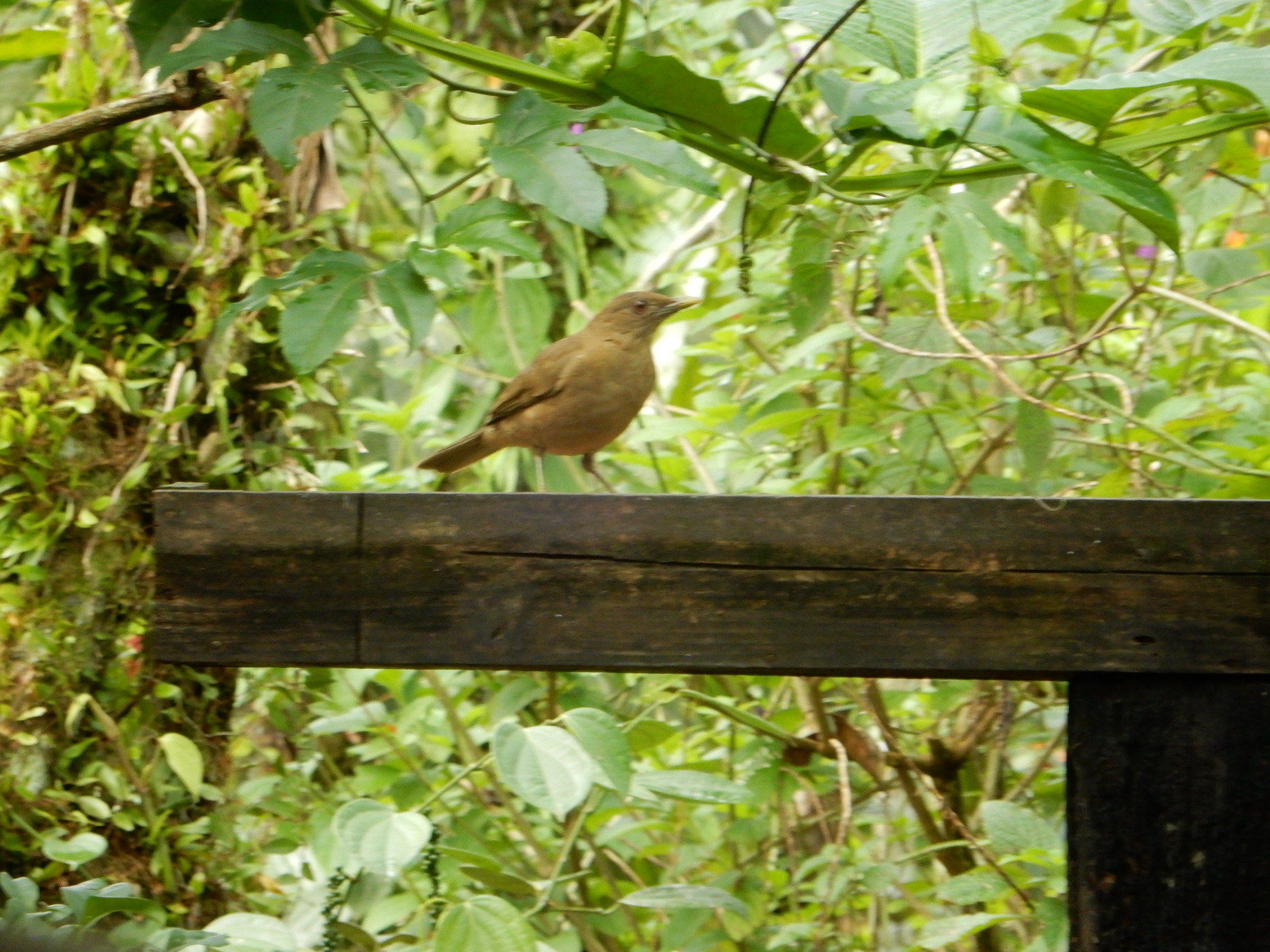 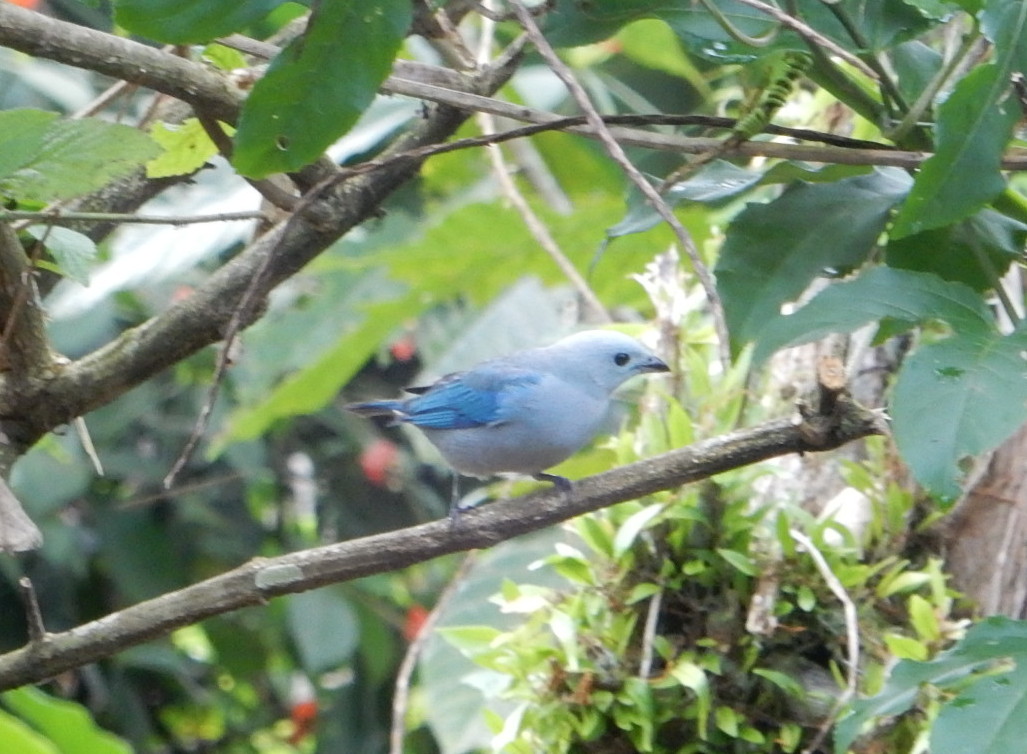 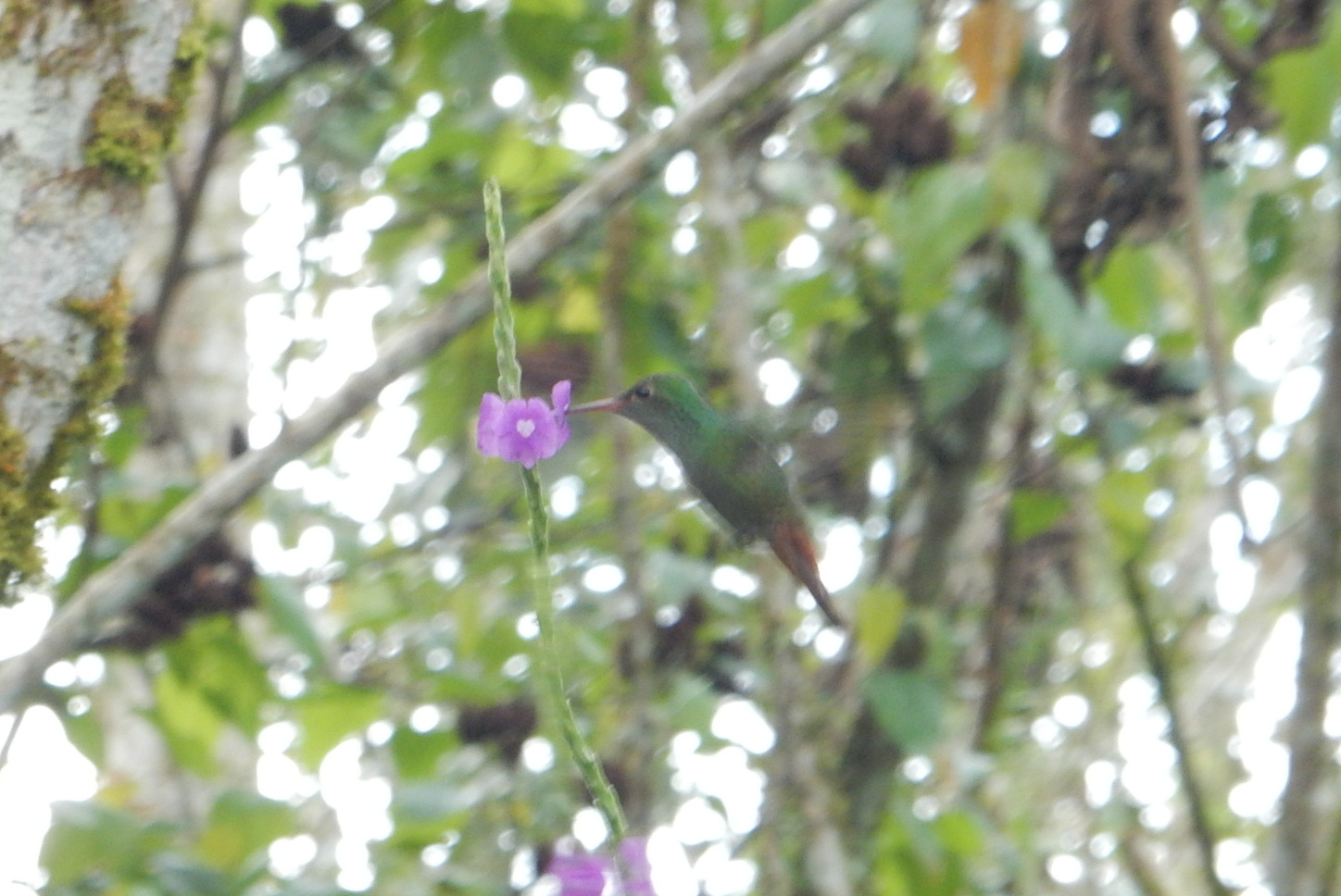 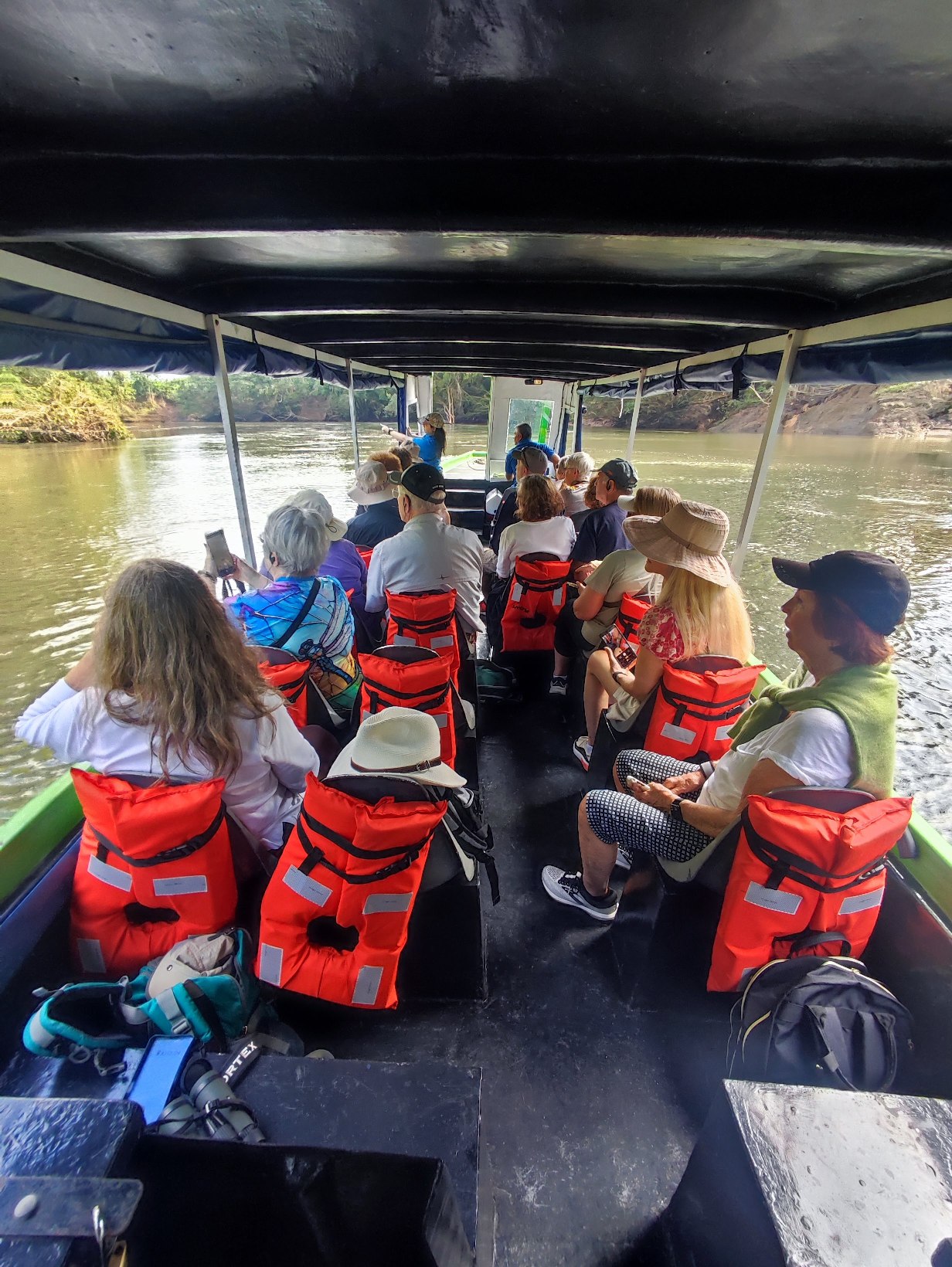 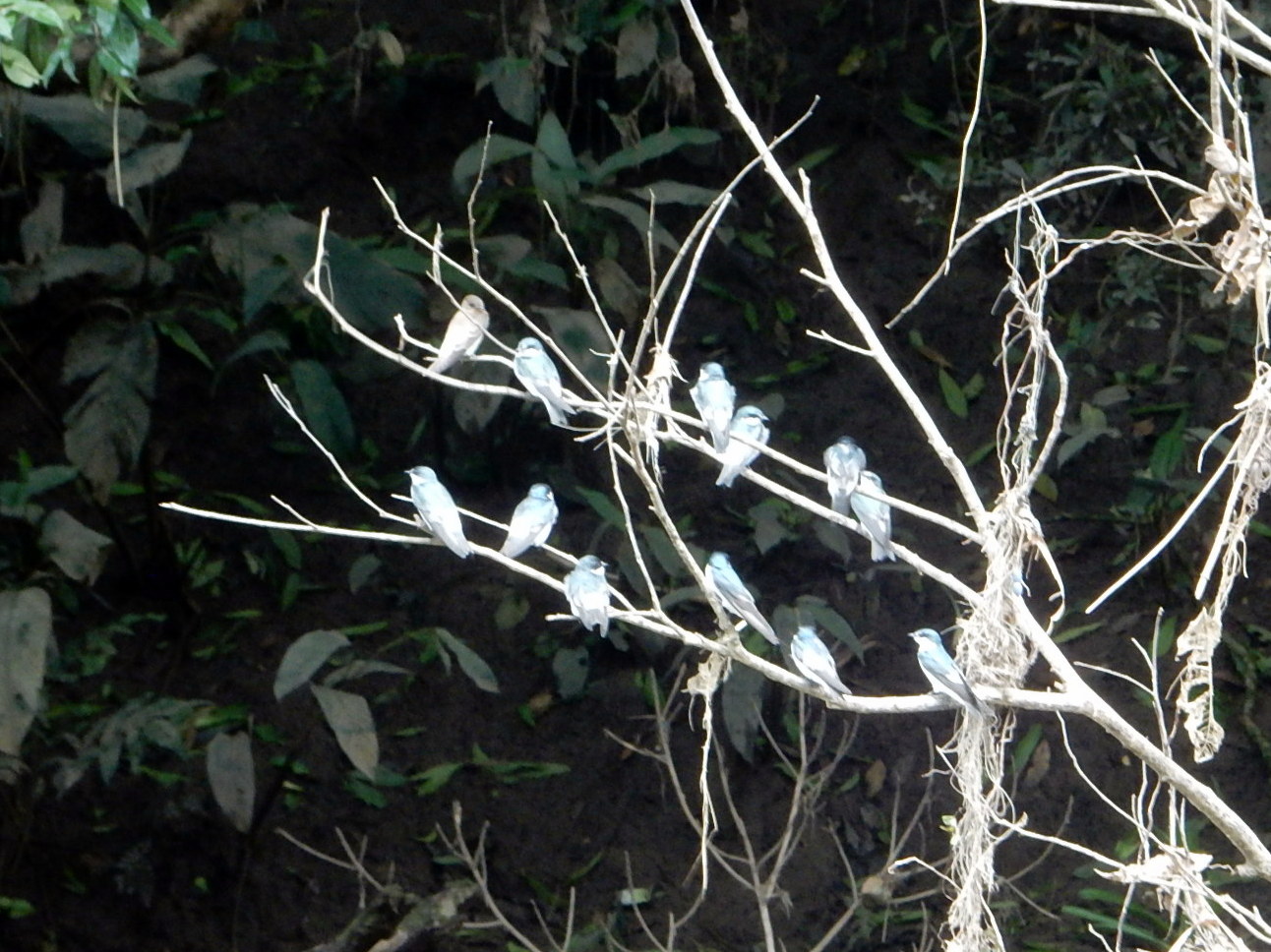 The next morning we started with a river
boat trip along the Sarapiquí River to see the various kinds of
wildlife supported in that area. Mostly we saw water birds but
some iguanas and lizards were briefly visible along the banks.
One small lizard I didn't get a picture of is a basilisk lizard, known
as the "Jesus lizard," because he has "fringes" on his toes and is so
light and quick, he can run across water! Numerically the most
common birds we saw were the mangrove swallows - they swooped all over
gobbling up insects but they did take a little break and I was able to
get a picture of them (at the right) resting between "meals!" The next morning we started with a river
boat trip along the Sarapiquí River to see the various kinds of
wildlife supported in that area. Mostly we saw water birds but
some iguanas and lizards were briefly visible along the banks.
One small lizard I didn't get a picture of is a basilisk lizard, known
as the "Jesus lizard," because he has "fringes" on his toes and is so
light and quick, he can run across water! Numerically the most
common birds we saw were the mangrove swallows - they swooped all over
gobbling up insects but they did take a little break and I was able to
get a picture of them (at the right) resting between "meals!" Pictured below is an anhinga, drying out its wings; a green ibis (we've seen plenty of white ones but never a green one before) and a green heron. We saw many other birds that are not pictured here - snowy egrets, great egrets, blue and tricolored herons for instance. 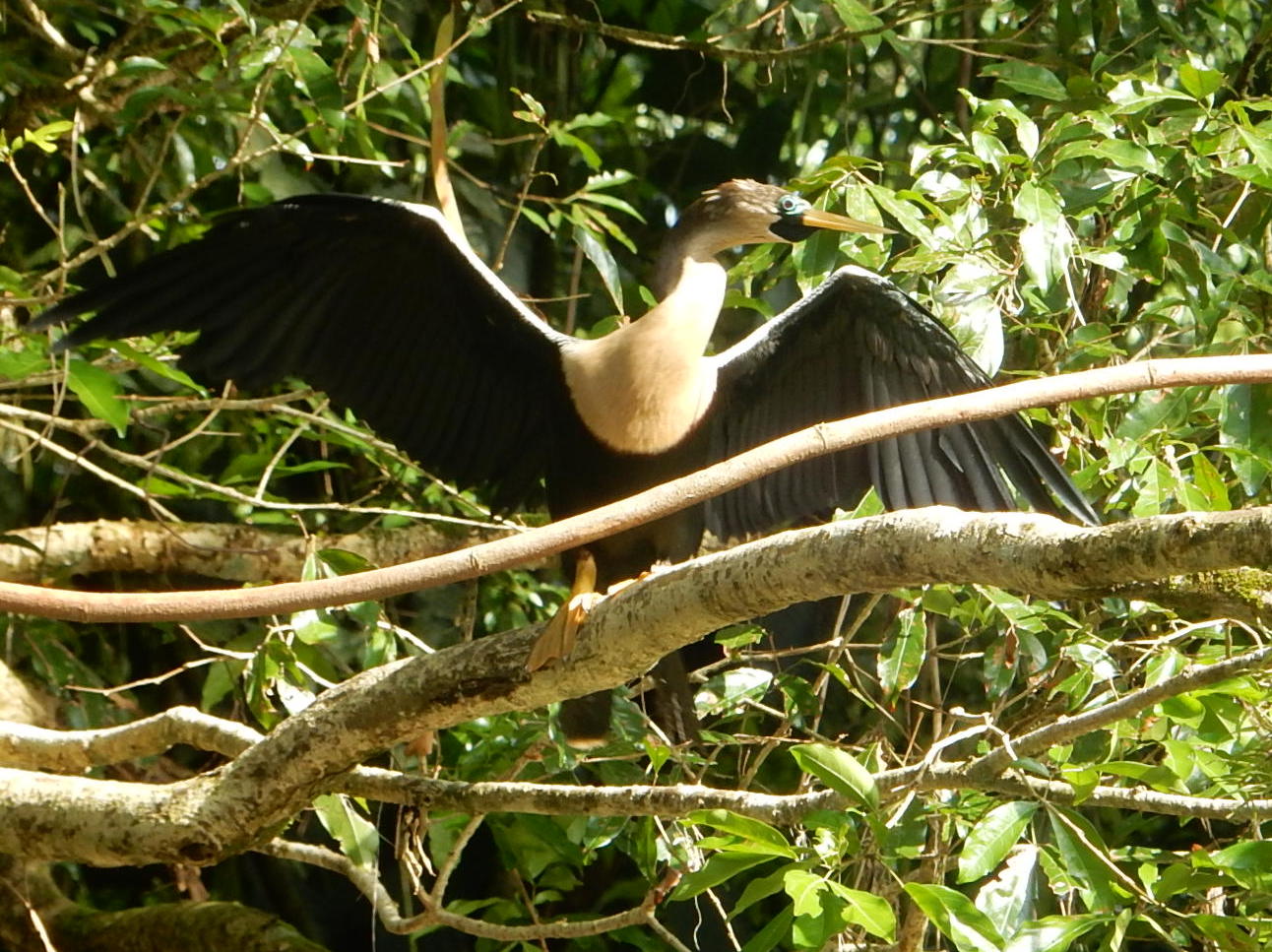 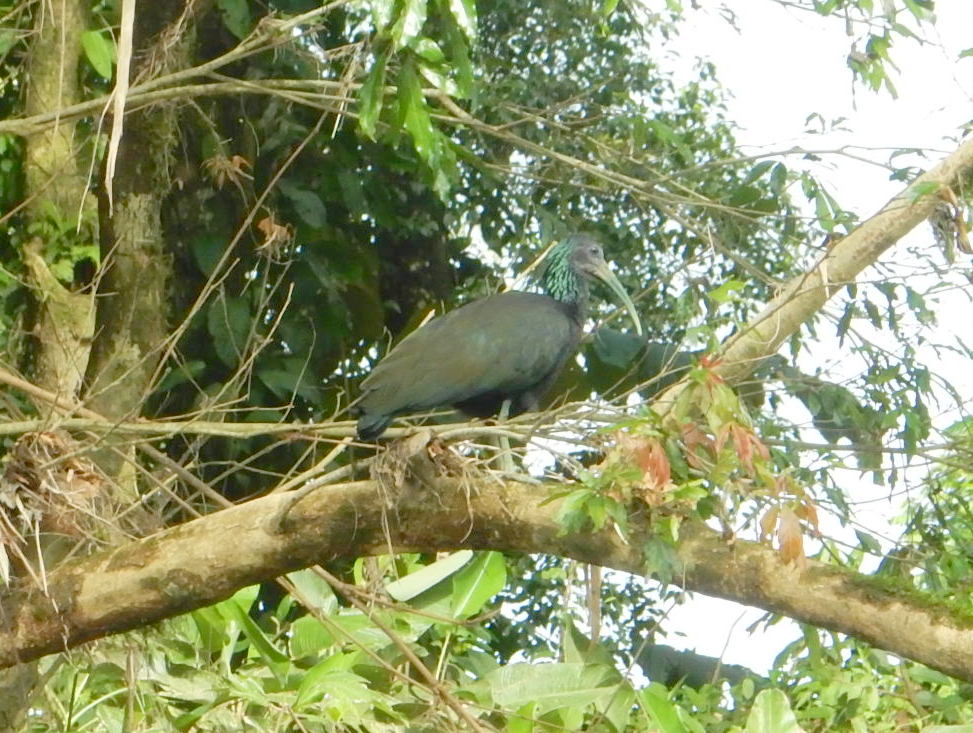 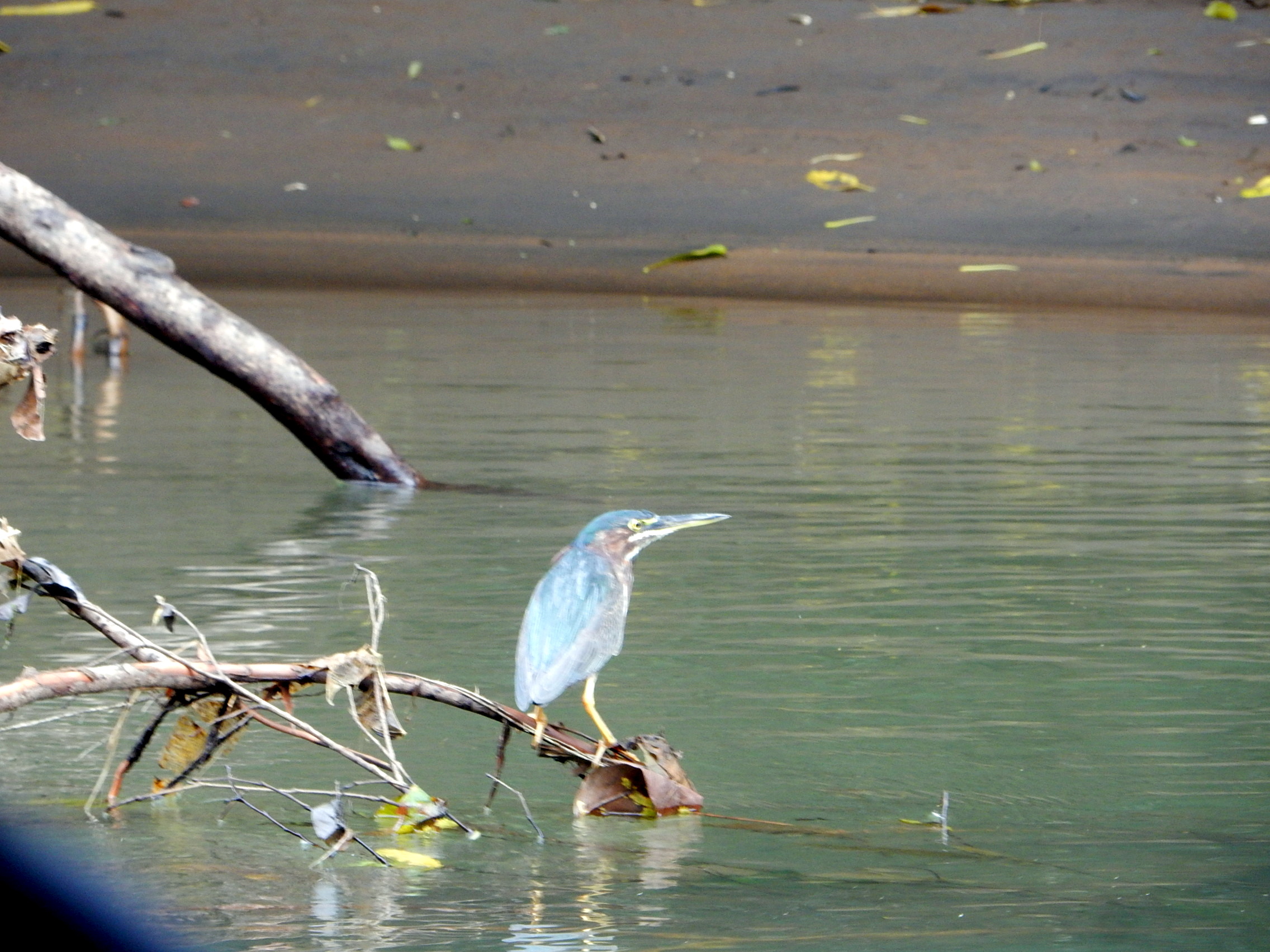 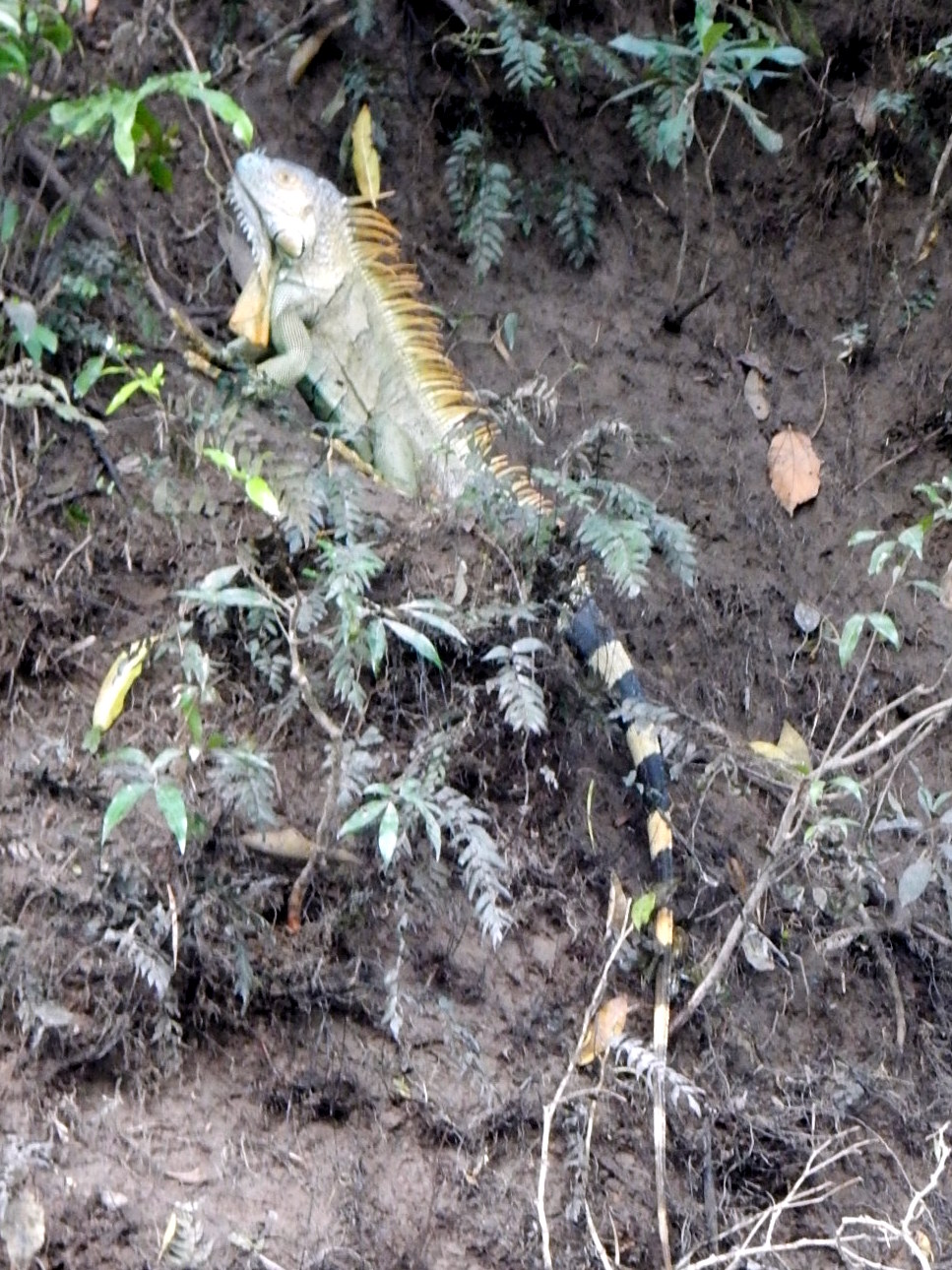 (At
the left is a green iguana we also spotted on the river tour. ) (At
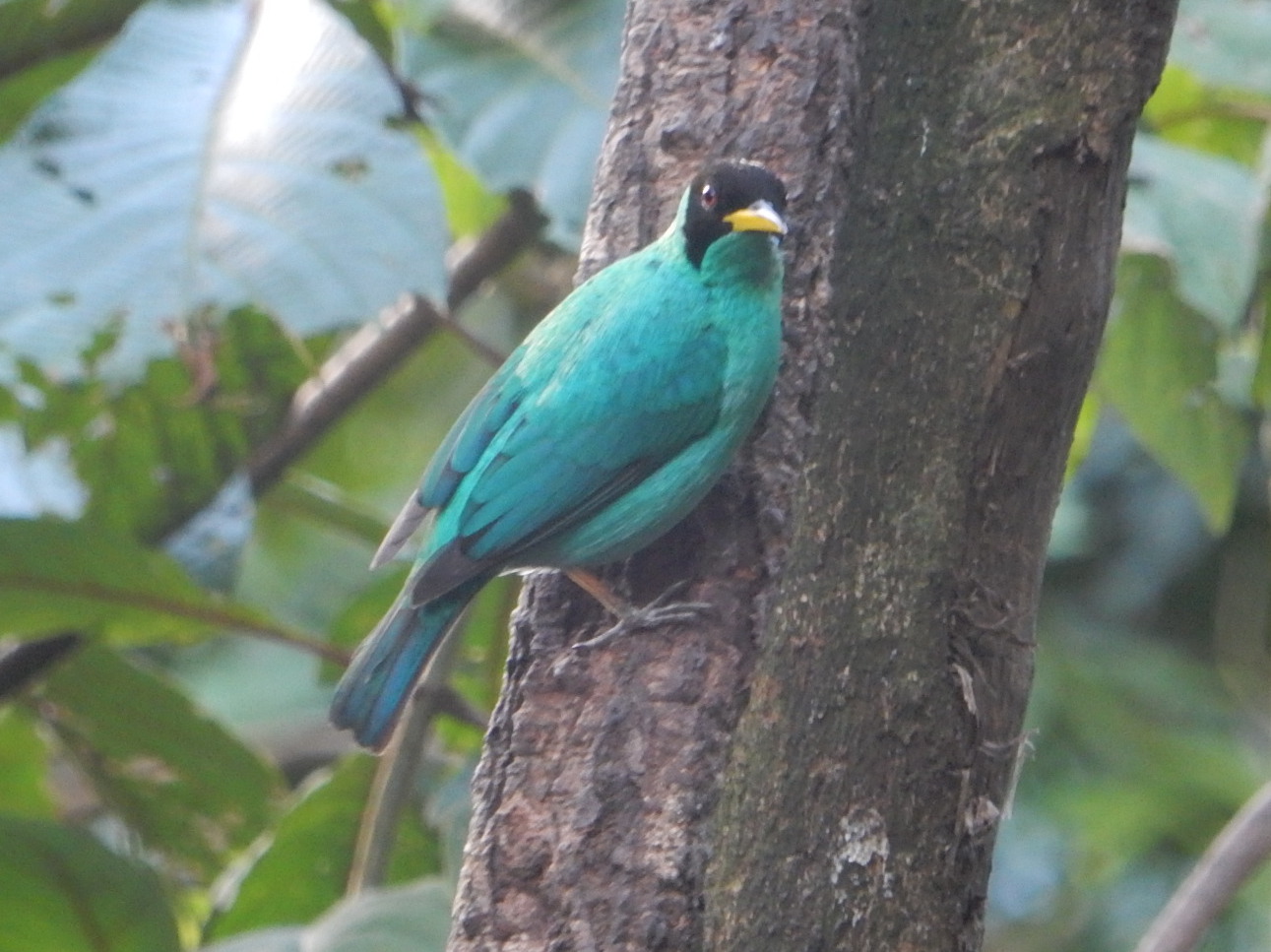
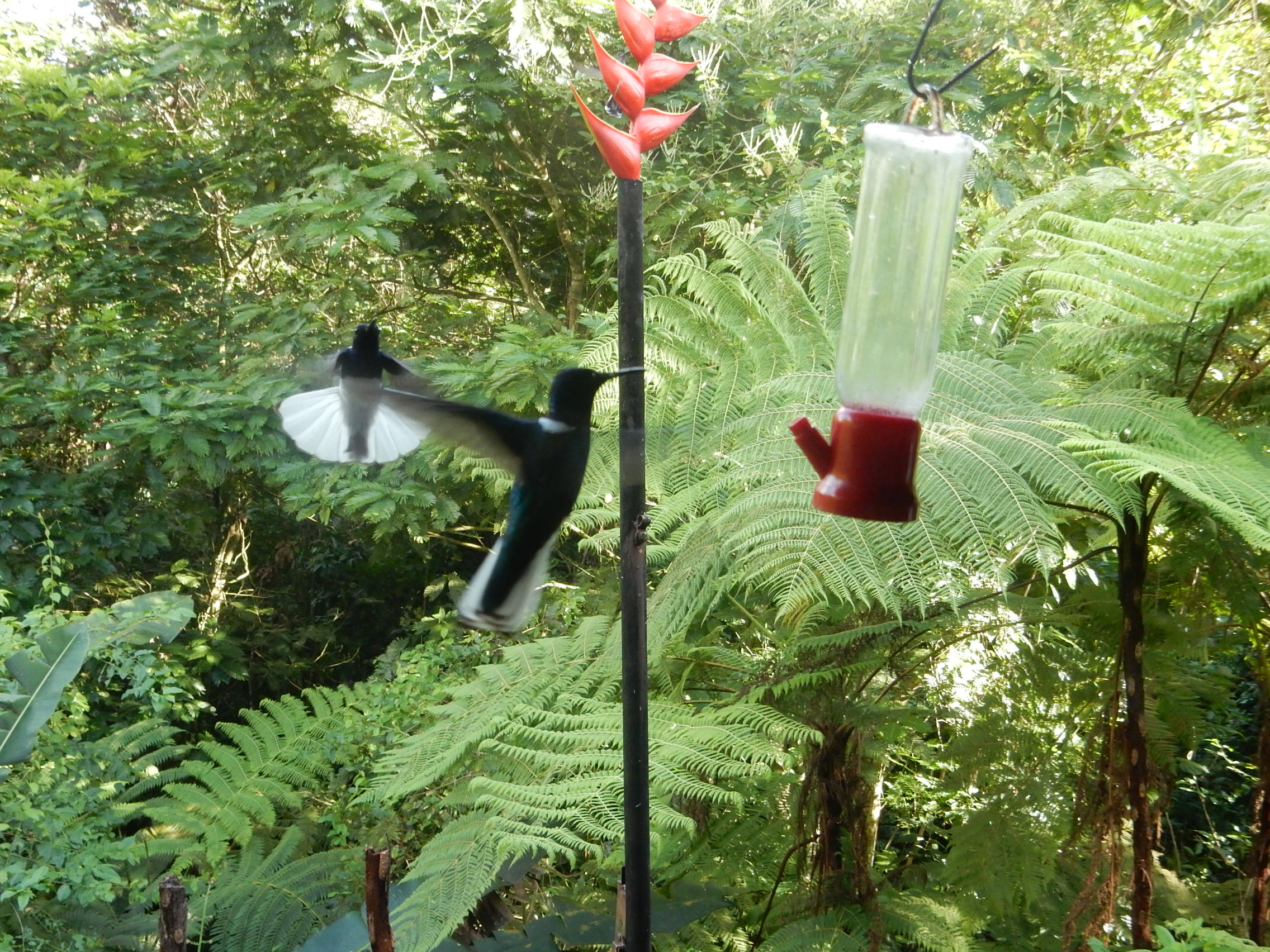
the left is a green iguana we also spotted on the river tour. ) Next we headed to the restaurant Palmitour near Puerto Viejo which is part of another family-run business that raises heart of palm - a vegetable harvested from the interior of various kinds of palm trees. One of the owners met with us and explained how it was harvested and processed. And then we got to sample it in various dishes for lunch! Our final stop of the day was at a "Nature Park" also known as Dave & Dave's! The two Daves are father and son who have developed a large area (I forget how many hectares) to be a totally natural bird sanctuary. They also host weddings and take visitors on long nature walks in their woods and along the river. We just hung out on the patio and watched the incredible birds. I have literally dozens of pictures at the general photo link but here are a few of my favorites. The top row, from left to right: a male/female pair of scarlet-rumped tanagers, a green honeycreeper and crimson- collared tanagers. The bottom row includes a keel-billed toucan, scaly-breasted hummingbirds and white-necked jacobin hummingbirds. 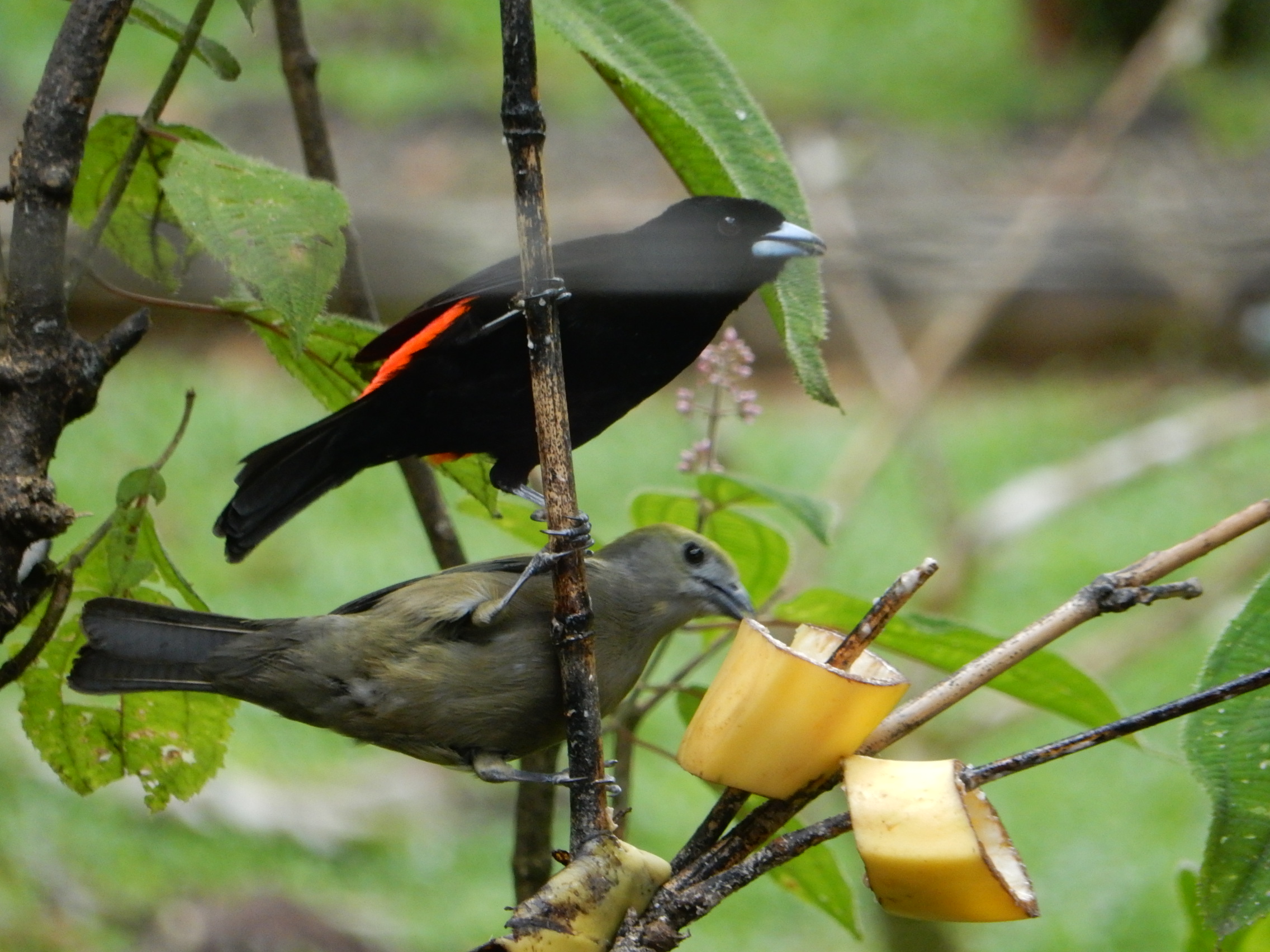
  
 Wednesday, Jan 22 We had a relaxed morning so Rebeca offered to take another walk around the area for those who were interested. We went in a different direction and had a nice walk. The only thing of note that I saw was a white-collared manakin - you can find its picture in the photo album, but it was taken through a fence and I didn't think it worth posting here!  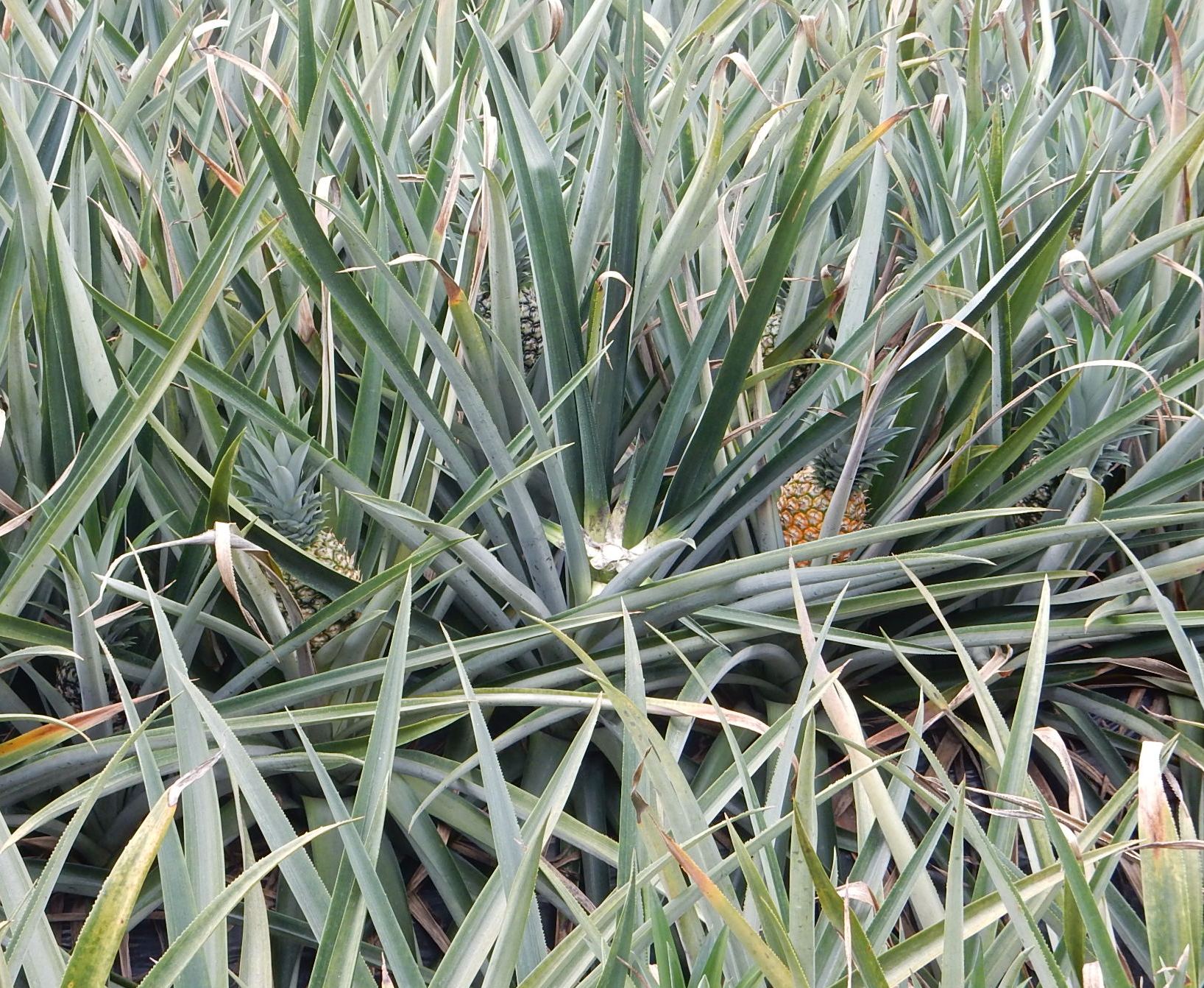 Around
10:30 we left for our "pineapple" tour. That was fun - they
greeted us with pineapple smoothies and then we went out on a
tractor/trailer to see the farm and learn about pineapple
harvesting. I didn't even realize they grew right on the
ground! (left) You only get one pineapple per plant and it takes about 6
months to be ready to pick. For the large growers they must also
be sorted as they are harvested. In the picture at right you'll see a line of workers - the first one picks the
pineapple and tosses it to the next one and so on down the row.
The last person sorts by size/weight and puts them in the correct
piles. I also learned that when the pineapple smells fully ripe,
it is probably over-ripe and what we're smelling is fermentation!
They demonstrated the "right" way to cut up and section a pineapple
(with a machete!) and we had snacks before we moved on to lunch and
then to our next destination: Hotel Arena Manoa Resort at the foot of
the Arenal Volcano! That will be in Part 2. Around
10:30 we left for our "pineapple" tour. That was fun - they
greeted us with pineapple smoothies and then we went out on a
tractor/trailer to see the farm and learn about pineapple
harvesting. I didn't even realize they grew right on the
ground! (left) You only get one pineapple per plant and it takes about 6
months to be ready to pick. For the large growers they must also
be sorted as they are harvested. In the picture at right you'll see a line of workers - the first one picks the
pineapple and tosses it to the next one and so on down the row.
The last person sorts by size/weight and puts them in the correct
piles. I also learned that when the pineapple smells fully ripe,
it is probably over-ripe and what we're smelling is fermentation!
They demonstrated the "right" way to cut up and section a pineapple
(with a machete!) and we had snacks before we moved on to lunch and
then to our next destination: Hotel Arena Manoa Resort at the foot of
the Arenal Volcano! That will be in Part 2.Click here to see the second part of our Trip: Arenal and the central Pacific area Click here to see the final part of our Trip: Playa Hermosa Click here to
return to
Barb's Index |